

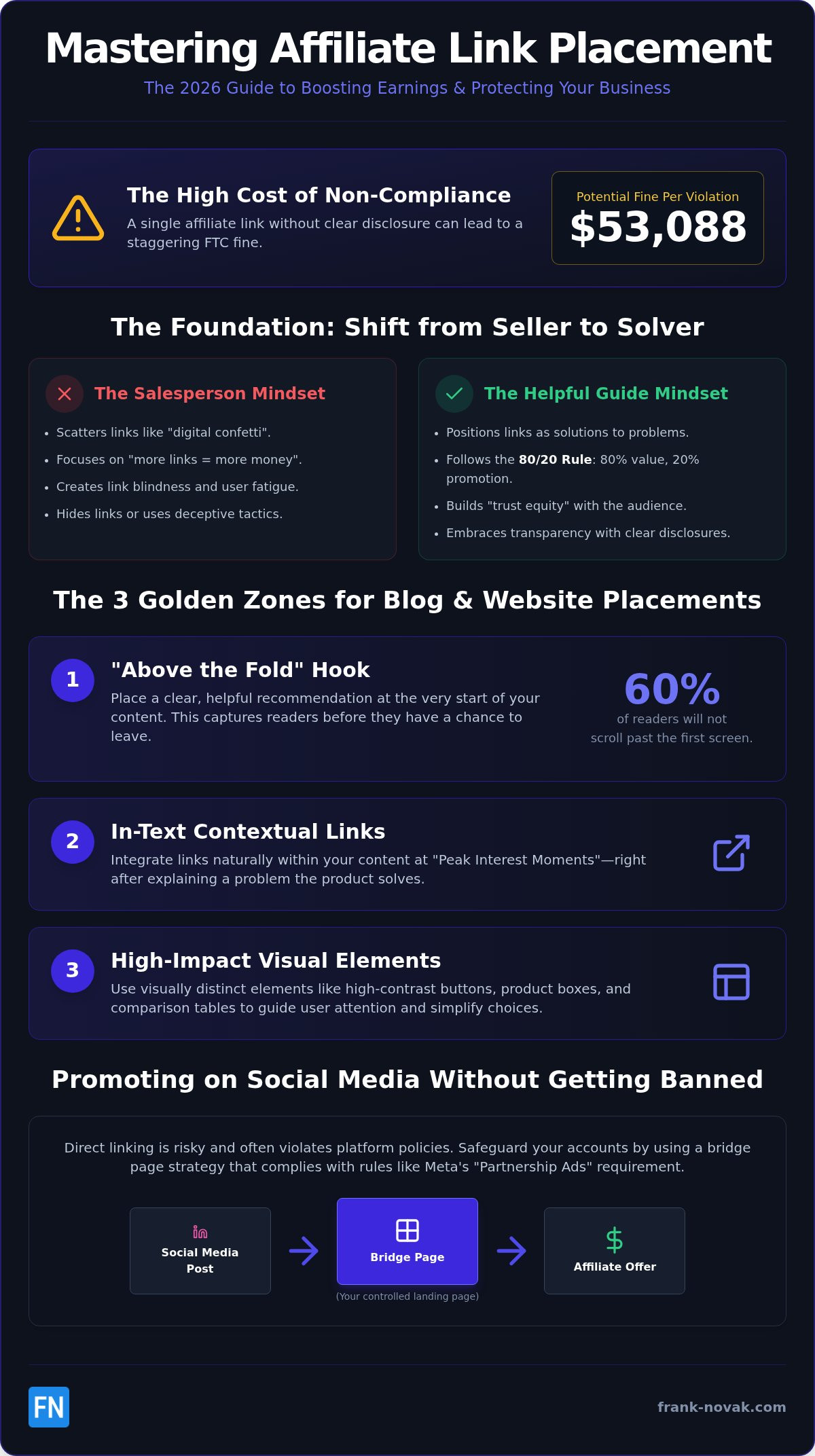
Did you know that a single affiliate link without a clear disclosure could now cost you up to $53,088 in FTC fines per violation? It’s a staggering figure that highlights why mastering affiliate link placement best practices is no longer just about sales, but about protecting your hard-earned digital business. You’ve likely felt the frustration of seeing high traffic numbers that don’t translate into commission checks, or perhaps you’re worried that adding too many links will make your site look like a cluttered billboard. It’s natural to feel a bit overwhelmed by the fine line between being helpful and appearing spammy, especially with platforms like Meta and Google constantly updating their rules.
If you’re looking for a way to increase your earnings without risking your account health, we’re here to provide a steady and reliable guide for your journey. In this 2026 guide, we’ll provide a clear roadmap for where to place your links to capture interest at the exact moment your reader is ready to act. We’ll walk through the psychology of user behavior, the mandatory “Partnership Ads” requirements for social media, and the specific steps you can take to build a professional profile that turns visitors into loyal customers.
Key Takeaways
- If you want to build lasting trust with your audience, shift your mindset from selling to solving by positioning your links as helpful recommendations that address immediate needs.
- To capture the most traffic, master affiliate link placement best practices by targeting the “Golden Zones” that catch the attention of the 60% of readers who don’t scroll.
- Since direct linking is often risky on social platforms, safeguard your accounts with bridge page strategies that comply with Meta’s latest partnership requirements.
- If you’re looking for higher click-through rates, use psychological triggers like high-contrast buttons and comparison tables to guide your audience toward the best choice.
- To save time and scale your growth, see how the ClickBank Super Funnel can automate your link placements in high-converting areas for maximum efficiency.
The Foundation of Strategic Affiliate Link Placement
Strategic placement is the art of appearing exactly when your reader needs you most. It’s not about scattering URLs across a page like digital confetti; it’s about positioning a solution at the precise moment a problem arises. If you understand the core of what affiliate marketing is, you know that your role is to act as a trusted connector between a consumer’s need and a brand’s solution. When you approach affiliate link placement best practices with this mindset, you stop being a salesperson and start becoming a resource.
Adopting a “Helpful Guide” mindset changes everything about how you work. If you were recommending a kitchen gadget to a close friend, you’d explain how it saved you time during a busy weeknight. Your links should feel the same way. A helpful recommendation is welcomed; an intrusive ad is ignored. To maintain this balance, follow the 80/20 rule of content. Devote 80% of your energy to providing deep, actionable value that requires nothing from the reader. The remaining 20% can then focus on promotional opportunities that naturally complement that value. This ratio ensures you build enough “trust equity” to make your recommendations carry weight.
Transparency is your secret weapon for building long-term authority. While the 2026 FTC guidelines mandate clear disclosures, being upfront about your partnerships actually increases your click-through rates. Readers in 2026 are savvy. They appreciate honesty and are often happy to support creators who provide them with free, high-quality information. If you hide your links or use deceptive tactics, you risk losing that fragile bond of trust that takes months to build and only seconds to break.
Why ‘More Links’ Rarely Means ‘More Money’
It’s tempting to think that doubling your link count will double your commissions, but the opposite is often true. The paradox of choice suggests that when people are presented with too many options, they often feel paralyzed and choose nothing at all. You’ve likely experienced “link blindness” yourself while browsing the web. This happens when a page is so cluttered with underlined text that your brain starts to filter it out as noise. Link fatigue occurs when a reader becomes emotionally and visually exhausted by an over-saturation of promotional calls to action within a single piece of content. If you want to scale effectively without overwhelming your audience, using a structured system like the ClickBank Super Funnel can help you automate these placements in a way that feels natural and organized.
Identifying the ‘Peak Interest’ Moments in Your Content
Successful affiliate link placement best practices rely on mapping your reader’s journey from initial curiosity to the moment they realize they need a specific tool. If you’re writing a tutorial, the best place for a link is often right after you’ve explained a difficult step that the tool makes easier. This is the “Peak Interest” moment. Using empathy is essential here. Ask yourself what your reader is feeling at every stage of your article. If they’re feeling frustrated by a complex process, that’s your cue to offer a helpful shortcut. By positioning your link as the logical next step, you provide a service rather than a distraction.
The 3 Golden Zones for Blog and Website Placements
If you want your content to work as hard as you do, you need to understand where your readers actually look. While some suggest that a single link in a description is enough, a high-converting website relies on a specific architectural layout. Mastering affiliate link placement best practices involves identifying the ‘Golden Zones’ where your audience is most likely to engage. By focusing your efforts on these high-traffic areas, you ensure that your recommendations are seen by the right people at the right time.
Zone 1 is the ‘Above the Fold’ Hook. Research in user behavior consistently shows that roughly 60% of readers will not scroll past the initial screen. If you don’t offer a path forward immediately, you’re losing more than half your potential commissions before the reader even gets to your best points. To maximize this area, you should learn how to drive traffic to affiliate links by placing a clear, helpful recommendation right at the start of your page.
Zone 2 is the In-Text Contextual Link. This is often the highest-converting placement because it appears when the reader is deeply engaged with your story or tutorial. It feels less like an ad and more like a necessary tool for the task at hand. Finally, Zone 3 is the ‘Final Verdict’ CTA. When a reader reaches the end of your article, they’ve been educated and are looking for a definitive next step. This is where you close the deal by providing a clear instruction on what to do next.
Conversely, sidebar and footer links are generally the least effective for direct sales. By 2026, most users have developed a strong sense of ‘banner blindness’ for anything outside the main content column. These areas are better suited for navigation or social proof rather than direct conversion. If you follow affiliate link placement best practices, you’ll prioritize the center of the page where the reader’s attention is naturally focused.
Mastering the ‘Above the Fold’ Placement
If you want to capture those early clicks, try inserting a link within the first 200 words of your post. This doesn’t mean you should force it. Instead, use a ‘Quick Summary’ box that highlights your top recommendation. This provides immediate value for those in a hurry who just want the answer. If you’re looking for a way to streamline this process, the ClickBank Super Funnel can help you structure these high-priority zones automatically so you can focus on creating content.
The Power of Contextual Anchor Text
The days of using ‘Click Here’ are long gone. Modern audiences respond to descriptive, benefit-driven anchor text that tells them exactly what they’ll find on the other side. When you match the link’s destination with the surrounding sentence’s promise, you build credibility. It’s also vital to remain compliant with the FTC’s Endorsement Guides by ensuring your disclosures are clear and conspicuous near these links. Using bolding or subtle color shifts can make your links pop naturally without looking like spam.
Promoting Links on Social Media Without Getting Banned
While your blog is a space you control, social media platforms operate on borrowed ground with rules that change without warning. If you’ve ever felt the sting of a shadowban or had a post reach zero people, you know that these platforms are increasingly sensitive to promotional content. By 2026, the Facebook Compliance Challenge has become a major hurdle for creators. Direct linking to affiliate offers is now frequently flagged as a deceptive practice, which can result in immediate account penalties or permanent bans. To navigate this safely, you must shift your focus from direct selling to building a journey that the platform respects.
The ‘Bridge Page’ strategy is your most effective tool for protecting your social accounts. Instead of sending a user directly to a sales page, you guide them to a simple landing page that you own. This page provides a moment for the reader to catch their breath and see the value you’re offering. It also ensures you comply with affiliate link placement best practices by allowing you to place your mandatory FTC disclosures clearly and conspicuously before the reader ever sees an affiliate link. If you use this buffer, you appear as a helpful curator rather than a bot-like spammer.
Strategic placement in Facebook Groups requires a similar level of care. If you want to grow your presence, you must provide value first and links second. Most group moderators will remove you instantly if you drop a link without context. Instead, answer a question thoroughly and mention that you have a resource that might help. If they ask for it, that’s your cue to share your bridge page. This approach builds trust and ensures your link is welcomed rather than reported.
Facebook Ad Placement Best Practices
If you’re running paid traffic, you must navigate the strict Facebook ads for affiliate marketing guide to ensure your account remains in good standing. As of 2026, Meta mandates the use of the “Partnership Ads” format for any content promoting a brand. Your ad creative should never link directly to a sales page; doing so is one of the fastest ways to get your ad rejected. Instead, use your ad to drive traffic to an educational blog post or a lead magnet that then introduces the affiliate offer naturally.
Leveraging the ‘First Comment’ for Organic Reach
There’s a well-known algorithm secret that many successful marketers use: Facebook often prefers posts that don’t contain outbound links in the main caption. To maximize your reach, write a ‘teaser’ post that generates curiosity and tells people the link is waiting for them in the first comment. This keeps the user on the platform longer, which the algorithm rewards with more visibility. You should also manage your comment threads actively. By replying to questions and keeping the conversation going, you ensure your link stays visible and relevant to everyone who joins the discussion.
Visual and Psychological Triggers for Higher CTR
While knowing the physical locations of your links is a great start, understanding why a reader decides to click is what separates a hobbyist from a professional. If you want to master affiliate link placement best practices, you must look at your page through the lens of human psychology. It’s not enough to simply have a link available; it must be presented in a way that aligns with how our brains process information and make decisions. By using visual cues, you can guide a reader’s eye toward your recommendation without ever feeling pushy or intrusive.
Heatmap insights from standard marketing pages show that users don’t read every word on a screen. Instead, they scan in an “F-pattern,” focusing on headings, the first few sentences of paragraphs, and visual breaks. This means your links need to stand out from the surrounding “noise” of the text. Scarcity and urgency are also powerful psychological triggers that can be used ethically to encourage action. If a reader sees a link placed near a countdown timer or a mention of a limited-time offer, their brain prioritizes that information as more urgent, which naturally increases the likelihood of a click.
Designing High-Converting CTA Buttons
The debate between using buttons or plain text links often comes down to the intended action. Text links are excellent for deep-dive contextual information, but high-contrast buttons are the champions of the final decision. Color psychology plays a significant role here. In 2026, shades like “Amazon Orange” or “Action Green” still perform well because they signal a clear path forward. Your micro-copy also matters. If you use “Get Instant Access” instead of a generic “Buy Now,” you focus on the immediate benefit rather than the cost. Just be careful not to overdo it. If you place too many buttons on a single page, you risk creating visual fatigue that causes readers to tune out entirely.
Discover how to automate your high-converting funnels here
The ‘Comparison Framework’ for Link Placement
One of the most effective ways to use affiliate link placement best practices is through a structured comparison framework. This approach respects the reader’s intelligence by giving them options while still guiding them toward the best result. You can implement this in three simple steps:
- Step 1: Identify the top three features your audience cares about most, such as price, ease of use, or speed.
- Step 2: Create a clean comparison table that pits your top recommendations against each other with clear “Check Price” buttons.
- Step 3: Highlight one option as the “Best Value” or “Editor’s Choice” to simplify the final decision for the reader.
Comparison tables reduce buyer’s remorse by providing the necessary context for the reader to feel confident that they’ve explored their options before making a purchase. This structured layout makes the “Check Price” link feel like a helpful tool rather than a sales pitch. When you provide this level of clarity, you build a sense of trust that often leads to higher commission checks and more loyal followers.
Automating Your Placements with the ClickBank Super Funnel
If you’ve followed the strategies in the previous sections, you’ve already seen how much care goes into every single link. While these affiliate link placement best practices are essential for building trust, doing everything manually can eventually become the biggest bottleneck in your business. Scaling entrepreneurs often reach a point where they spend more time auditing old posts than they do creating new ones. Moving from a manual approach to an automated system is the logical next step for your professional growth.
Building a “Set and Forget” asset means creating a system that works 24/7 without requiring your constant attention. Instead of manually inserting links into every new paragraph, you can use pre-built structures that handle the heavy lifting for you. These systems are designed to position your offers in the ‘Golden Zones’ we discussed earlier, ensuring that your high-contrast buttons and contextual recommendations are always exactly where they need to be to capture interest. By automating these affiliate link placement best practices, you free up your time to focus on high-level strategy rather than technical chores.
Email follow-up sequences provide another layer of automation that many beginners overlook. If a reader visits your bridge page but doesn’t buy immediately, an automated series of emails can continue the conversation. Each email in that sequence serves as a new opportunity for strategic link placement, guiding the reader back to the solution when they’re most ready to commit. This creates a cohesive journey that feels supportive rather than salesy, allowing you to build a professional-looking presence that earns commissions while you sleep.
Scaling with the ClickBank Super Funnel
The ClickBank Super Funnel is specifically built to optimize link placement for high-ticket offers. These templates remove the uncertainty of where to place a button or how to frame a recommendation by using layouts that have already been tested for conversion. Removing the guesswork allows you to scale faster than manual blogging ever could. If you’d like more personalized guidance on how to tailor these systems to your specific niche, you can visit Frank Novak’s homepage to explore coaching options that fit your unique goals.
Your Next Steps for Affiliate Growth
To put these insights into practice, you can follow this simple roadmap to refine your current assets and boost your conversion rates:
- Audit your top five most popular content pieces to ensure you’ve captured the 60% of readers who stay ‘Above the Fold’.
- Implement a bridge page for all social media link placements to protect your account health and comply with platform rules.
- Consider Online Success Coaching to refine your overall digital strategy and build a business that scales with ease.
Build Your Path to Sustainable Affiliate Growth
Mastering affiliate link placement best practices is a journey of shifting from a salesperson to a trusted guide. By focusing on high-impact “Golden Zones” and respecting platform regulations with bridge pages, you’ve built a foundation of trust that many competitors overlook. It’s about meeting your audience exactly where they are with the right solution at the right time. You now have the roadmap to turn your digital presence into a professional asset that provides genuine value.
If you’re ready to move beyond manual bottlenecks, this system is built by Frank Novak, a seasoned affiliate professional. It’s fully optimized for 2026 Facebook compliance and is a core component featured in our Online Success Coaching to ensure your growth is both steady and compliant.
Scale your commissions today with the ClickBank Super Funnel
You have the tools to create a business that works for you. With a steady approach and the right systems in place, your potential for growth is limited only by your willingness to take that next step. We’re here to support your progress every step of the way as you navigate this new professional landscape.
Frequently Asked Questions
How many affiliate links should I put in a 1,000-word blog post?
You should aim for three to five strategic placements rather than saturating every paragraph. While there’s no hard limit, over-linking often triggers link fatigue and can make your content feel like a cluttered advertisement. If you focus on affiliate link placement best practices, you’ll find that placing one link in the introduction, one in a contextual middle section, and one in the conclusion usually yields the highest engagement.
Is it better to use text links or image banners for affiliate products?
Text links generally outperform image banners because they appear as a natural part of your helpful advice. Most readers in 2026 have developed a strong sense of banner blindness and instinctively ignore graphical ads in sidebars. If you use a descriptive text link that explains the specific benefit of the product, you build much more trust than a generic banner ever could.
Can I put affiliate links directly in my Facebook posts in 2026?
You can technically post direct links, but doing so frequently results in reduced reach or potential account flags. Meta’s algorithms prioritize content that keeps users on their platform, so a direct outbound link to a sales page is rarely the best path. It’s much safer to use a bridge page or a “link in first comment” strategy to maintain your account health while still driving conversions.
Does affiliate link placement affect my website’s SEO ranking?
Placement itself isn’t a direct ranking factor, but how it impacts user experience definitely matters for your search visibility. If your links are intrusive or slow down your page, your bounce rate might increase, which signals to search engines that your content isn’t useful. Always use the rel=”sponsored” attribute on your links to help search engines understand the nature of your outbound connections.
What is the best way to disclose affiliate links to stay compliant?
The best method is to place a clear disclosure at the very top of your page or immediately before the first link appears. Vague terms like “partner” are no longer sufficient under 2026 guidelines. You should use plain language to explain that you may earn a commission if the reader makes a purchase, which helps you stay compliant with the latest legal requirements.
Should I use a link cloaker for my affiliate URLs?
Yes, using a link cloaker is a standard practice for creating professional-looking, branded URLs that are much easier to track. It helps you manage all your links from a central dashboard, which is vital if a merchant changes their platform. Just remember that cloaking should never be used to hide the fact that a link is an affiliate recommendation; transparency remains your most important asset for building trust.
Why are my affiliate links getting clicks but no sales?
This usually happens when there’s a congruency gap between your content and the product’s landing page. If you’ve promised a specific solution but the sales page focuses on something else, the reader will feel confused and leave. It’s also possible that the offer itself isn’t the right fit for your specific audience’s current needs or their budget at that moment.
Where should I place links in a YouTube video description?
You must place your most important links in the first two lines of your description, before the “Show More” fold. This ensures that mobile viewers and desktop users see the link immediately without having to click extra buttons. If you follow affiliate link placement best practices for video, you’ll also mention the link verbally and use a pinned comment to keep the URL visible during the discussion.

Article by
Frank Novak
Frank Novak is an online marketing professional and coach who focuses on affiliate marketing and business automation. Through his website, frank-novak.com, he shares insights and strategies for leveraging social media platforms like Facebook to generate traffic and commissions.
Affiliate / Sponsored Content Disclaimer
This [website/post] contains affiliate links. If you click through and make a purchase, we may receive a commission at no additional cost to you. We only recommend products or services we believe will add value to our readers.