

Facebook shouldn’t be your only source of affiliate traffic. Strong alternatives to Facebook ads for affiliate traffic include search, video, email, creator partnerships, display ads, and retargeting. Start by testing one or two channels for 60 to 90 days, then compare the quality and cost of the traffic they bring.
If Facebook has been a reliable source of clicks, it’s understandable to hesitate before shifting your budget. But relying on one channel leaves your affiliate business exposed when performance changes. Diversification means building options, not replacing everything at once.
This guide explains how the main alternatives work, which may suit different affiliate offers, and how to compare them using practical measures such as conversions and customer acquisition cost. You’ll also find a phased transition plan showing how display ads and retargeting can complement your traffic mix without requiring you to abandon paid social overnight.
Key Takeaways
- Test one or two alternative channels for 60 to 90 days, comparing performance before shifting more of your traffic strategy.
- Use a phased transition to build new traffic sources, assess what works, and scale the channels that fit your affiliate offer.
- Consider display and retargeting as ways to reconnect with people who have already shown interest, rather than relying only on new prospecting.
- Review each platform’s link rules and campaign requirements before choosing between a direct affiliate link and a landing page.
- Match your channel choice to how your audience discovers and evaluates offers, then track results consistently across sources.
1. Testing alternative ad channels over 90 days
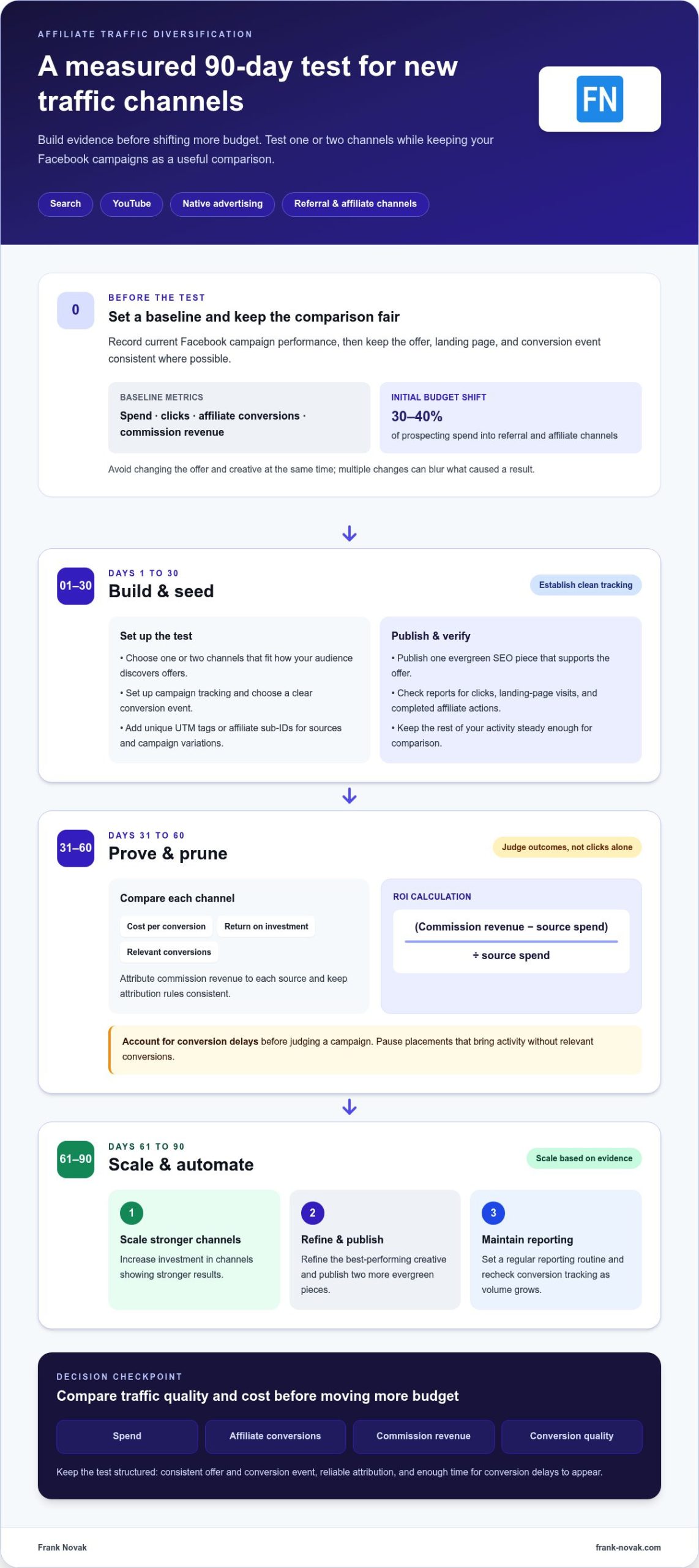
Use a 90-day test to compare new traffic sources without shutting off Facebook campaigns prematurely. Choose one or two channels, such as YouTube, search, or native advertising, that fit how your audience discovers affiliate offers. Keep the offer, landing page, and conversion event consistent where possible. That makes it easier to tell whether a channel can generate useful visitors, rather than merely clicks.
To see how affiliates approach paid and free traffic sources, watch this video:
Begin with a baseline from your current Facebook campaigns: record spend, clicks, affiliate conversions, and commission revenue. Then move 30 to 40 percent of prospecting spend into referral and affiliate channels as an initial test. Keep the rest of your activity steady enough to provide a useful comparison. Avoid changing the offer and creative at the same time, because that can blur what caused a result.
During days 1 to 30, build and seed the test. Set up campaign tracking, choose a clear conversion event, and publish one evergreen SEO piece that supports the offer. Add unique UTM tags or affiliate sub-IDs to identify traffic sources and campaign variations. Check that clicks, landing-page visits, and completed affiliate actions appear in the right reports before increasing spend.
Use days 31 to 60 to prove and prune. Compare each channel’s cost per conversion and return on investment, not just click volume. To compare ROI, attribute commission revenue to each source, subtract that source’s spend, then divide by its spend. Keep attribution rules consistent, and account for conversion delays before judging a campaign. Pause placements that bring activity without relevant conversions.
During days 61 to 90, scale and automate the channels that show stronger results. Publish two more evergreen pieces, refine the best-performing creative, and set a regular reporting routine. Recheck that tracking still records affiliate conversions accurately as volume grows. This 30-60-90-day structure gives each channel time to generate evidence while helping you make measured budget decisions.
This 30-60-90 plan supports reducing reliance on paid social through three phases: build-and-seed, prove-and-prune, and scale-and-automate as evidence accumulates over time.
2. Why affiliate marketers should diversify beyond Facebook Ads
A Facebook campaign can reach people quickly, but a business that relies on one platform depends heavily on its delivery. Adding a source such as email, search, or creator partnerships gives you another way to reach potential buyers. It also lets you compare how audiences respond to the same offer across channels and landing pages.
Influencer and creator partnerships can build ongoing engagement through useful demonstrations, while paid ads offer more direct control over targeting and delivery. A creator who regularly discusses your niche can introduce an affiliate offer in context; a paid campaign can test creative and audience segments more directly.
Email can generate affiliate traffic by sending relevant offers to subscribers who chose to hear from you, then directing interested readers to a focused landing page. Email marketing was reported to return $42 for every $1 spent, but results depend on audience relevance and campaign execution. In the United States, CAN-SPAM governs commercial email, so plan for truthful message details and a working unsubscribe process.
Diversification also helps reduce reliance on a single source of audience access. According to Gartner’s 2025 survey, 61% of B2B buyers said they prefer a rep-free buying experience, which supports providing clear information across channels. Email, search content, and creator posts can help people evaluate an offer in the way that suits their buying process.
Low-quality traffic can consume your budget without producing meaningful affiliate actions, and ad account bans can interrupt delivery. Violating an affiliate program’s terms can also put commissions or account access at risk. Keep traffic relevant, make honest claims, and review each ad platform’s policies and the affiliate program’s promotion terms before launching.
Use a simple source-by-source report to see whether diversification is working. Track visits, affiliate clicks, conversions, commissions, and spend; compare conversion quality as well as volume. Michaels reported a 25% increase in email campaign click-through rate after increasing the share of personalized campaigns from 20% to 95%, illustrating why relevance can matter. Meanwhile, 89% of companies with the strongest omnichannel customer engagement strategies retain their customers.
If you’re building a more resilient affiliate approach, explore these affiliate marketing guidance resources as one way to structure your next steps.
4. Display and retargeting
Display ads place visual promotions across websites and apps, helping affiliate marketers reach people beyond social feeds. Retargeting focuses on people who have already interacted with a page or campaign. For example, someone who read a comparison of email tools might later see an ad for a related offer. Display can introduce an offer, while retargeting can bring an interested visitor back.
Start by defining the action that signals useful interest. Visiting an affiliate review page may indicate curiosity; clicking an offer button shows stronger intent. Build audience segments around these actions rather than treating every visitor alike. Someone who viewed a product explanation could receive a reminder about its benefits, while a person who clicked through to a merchant page may need different messaging.
Build the campaign around a relevant landing page. If a display ad promotes a budgeting app, send visitors to a page that explains who the app suits, outlines its key features, and includes an affiliate disclosure. The page should deliver on the ad’s promise, not switch to an unrelated offer. This connection helps visitors understand why they arrived and what to do next.
Target carefully. Exclude people who have completed the tracked action if another promotion would add little value, and segment visitors by the pages they viewed. Someone who read a beginner’s guide may need introductory information, while a visitor who examined a comparison page may be closer to choosing. Relevant segments help make creative more useful and reduce repetitive ads.
Display creative should communicate one clear benefit and include a direct call to action. A banner for a meal-planning service, for example, could highlight easier weekly planning and lead to a detailed review. Retargeting creative can answer a question raised on the landing page, such as how the service works. Keep the message consistent between the ad and page so the offer feels like a natural next step.
Measure the full path, not impressions alone. Compare ad spend with affiliate clicks, tracked conversions, and commission revenue for each audience segment. If a segment brings many visits but few affiliate actions, review its audience definition, creative, and landing page before increasing the budget. If visitors engage but convert later, account for the merchant’s buying cycle and use consistent attribution settings.
Review each ad platform’s and affiliate program’s policies before launching display or retargeting campaigns. Programs may set rules for brand terms, claims, or traffic sources, and ignoring them can put commissions at risk. Keep a record of approved creative, destination pages, and campaign changes. This makes it easier to see which targeting choices bring relevant, trackable affiliate traffic.
4. Can TikTok ads be used to promote affiliate offers, and what are the rules?
TikTok can be a paid traffic option for affiliate offers when the offer, ad, and destination comply with the platform’s current advertising policies. Approval isn’t automatic for every product or landing page. Before creating a campaign, review TikTok’s ad requirements and the affiliate program’s promotion terms. Make sure both allow your planned creative, claims, and destination.
Audience fit matters. TikTok is most popular with people aged 18 to 34, so consider whether your offer serves that audience. A financial product for experienced investors, for example, may need a different audience strategy than a beginner-friendly fitness program. Match the offer to the people you can reach, rather than choosing TikTok simply because it has broad reach.
Creative needs to earn attention quickly. Advertisers have only a couple of seconds to capture viewers’ attention, so open with a clear problem, demonstration, or useful result. For a kitchen gadget, show it solving a practical task before explaining its features. Keep the ad focused and make the next step obvious.
TikTok users may respond to product discovery: 55% of users had bought something after seeing a brand on the app. That figure doesn’t predict affiliate conversions, but it shows why a relevant demonstration can introduce an offer. Build a test around a specific audience need, then track clicks and completed affiliate actions instead of judging performance by views alone.
Use this practical review before launching:
- Check the offer: Confirm the affiliate program permits paid social traffic and the intended promotion method.
- Review the destination: Make sure the landing page explains the offer clearly and matches the ad’s message.
- Check each claim: Use accurate product details and avoid promises the merchant cannot support.
- Plan tracking: Use campaign identifiers to distinguish TikTok visits and affiliate conversions from other sources.
A landing page can add context between a short TikTok ad and a detailed affiliate offer. For example, a tutorial-style ad about meal planning could lead to a page comparing the features of a relevant planning tool. Clearly disclose the affiliate relationship, and avoid claims beyond the merchant’s information. Confirm that the program permits this route.
Keep creative testing separate from offer changes. Start with one offer and a small set of distinct video concepts, such as a demonstration and a problem-solution format. Compare each version using the same conversion event and attribution approach. If TikTok brings views but few relevant clicks, revise the hook or audience fit before expanding the campaign.
5. Which ad platforms allow direct affiliate links, and which require a landing page?
There’s no single rule for every advertising platform. Whether a link is accepted can depend on the platform, campaign type, destination, and affiliate program terms. Pinterest affiliates can place an affiliate link in an image description. That doesn’t mean every Pinterest ad format accepts the same destination or every affiliate program permits that approach.
Before launching, separate two questions: can the platform technically accept the link, and do its policies allow the promotion? A clickable link can still trigger an ad review issue if the destination or offer conflicts with platform rules. Your affiliate agreement may also restrict direct linking, brand terms, or paid traffic. Review both sets of requirements for each campaign.
A direct affiliate link sends visitors straight to the merchant or offer page. With fewer steps, it can suit a simple promotion when the ad clearly explains the offer. But you have less room to add context, answer questions, or explain why the offer fits. If the merchant page doesn’t match the ad’s promise, visitors may leave before taking action.
A landing page gives you room to introduce the offer, explain its relevance, and disclose your affiliate relationship before sending visitors onward. For example, an ad for a recipe service could lead to a page describing its meal-planning features, followed by a link to the merchant. Make the page useful and closely aligned with the promotion rather than using it as a thin redirect.
Use this decision process for each platform:
- Identify the format: Check whether the ad placement supports a clickable destination or a link in its description.
- Review the destination: Confirm the ad and landing page describe the same offer and make the next step clear.
- Read program terms: Look for limits on paid traffic, direct linking, trademarks, or promotional claims.
- Test tracking: Use a unique campaign identifier and confirm clicks reach the intended page.
Keep a simple record for Pinterest, TikTok, and every other platform you test. Note the link format, landing page, campaign identifier, and relevant program terms. If an ad is rejected, use the stated reason to determine whether the issue concerns the creative, destination, or promotion method. Change one element at a time to get clearer feedback from the next review.
Choose the shortest route that still gives visitors enough context. A direct link may suit a clear, simple offer when platform and program terms permit it. A landing page is more useful when visitors need a comparison, explanation, or disclosure before deciding. Measure affiliate clicks and conversions for each route, not just ad engagement, and keep the option that brings relevant visitors.
Frank Novak: Online Success Coaching
Online Success Coaching can help you bring more structure to your affiliate marketing plans. If you’re weighing channels, tracking results, or deciding how to build beyond paid social, coaching gives you a way to work through those choices and connect them to your wider online business goals.
It may be a useful next step if you understand the options but want support turning them into a practical direction. Frank Novak also offers ClickBank Super Funnel and Never Succeed Online, resources for readers exploring affiliate marketing and business automation.
Visit frank-novak.com to explore Frank Novak’s online marketing resources.
Build your next traffic experiment with purpose
Choosing alternatives to Facebook ads for affiliate traffic is only the beginning. Next, decide what you want each channel to teach you: which audience responds, what message earns attention, and where interested visitors go next. Treat each test as a way to make a more informed decision, not a reason to replace every campaign at once.
If you’d like support shaping decisions around your affiliate business, explore Online Success Coaching. Frank Novak also offers ClickBank Super Funnel and Never Succeed Online for people developing their online marketing approach. Choose the support that matches the question you’re working through, whether you’re planning a direction or exploring affiliate resources.
Keep learning from each test, and let the evidence guide your next move. Steady, intentional steps can help you build a traffic strategy that has more room to adapt.
Frequently Asked Questions
Alternatives to Facebook Ads: What Are Your Options?
Options include search-focused content, YouTube videos, email, creator partnerships, Pinterest, display advertising, and retargeting. The best fit depends on how people discover and evaluate your offer. A product that benefits from visual demonstrations may suit video, while a detailed comparison can attract people actively researching a purchase. Choose a channel that fits both the offer and the content you can produce consistently.
Is Facebook Ads Still a Reliable Traffic Source?
Facebook Ads can remain useful if your campaigns bring relevant visitors and trackable affiliate conversions. Their value to your business depends on factors such as audience fit, creative performance, landing-page relevance, and the affiliate program’s terms. Review your campaign data over time rather than assuming past results will continue. If traffic quality changes, compare Facebook with another channel before making a major budget shift.
Push Notifications: Can They Replace Facebook Ads?
Push notification ads can provide another traffic source, but they won’t automatically replace Facebook’s reach or targeting. The format is compact, with two lines of text and a small icon, so a specific message matters. A pre-landing page can provide context before visitors reach an affiliate offer. For example, a short notification about a product comparison could lead to a page explaining the options.
What are the best alternatives to Facebook ads for affiliate traffic?
There isn’t one best channel for every affiliate offer. Search content can reach people looking for answers, while YouTube can support demonstrations and reviews. Email can bring relevant offers to existing subscribers, and creator partnerships can introduce products through niche content. Match these options to your audience and resources, then judge them by relevant affiliate actions rather than clicks alone.
What are the best ad platforms for different affiliate niches and offer types?
Match the platform to how people learn about the offer. A visual product may suit TikTok or YouTube demonstrations; a home, style, or planning offer may fit Pinterest content. For a complex service, use a landing page that explains key details before the merchant link. A comparison article, for example, can help readers assess software features, while a short video can show a product in use.
How do affiliate marketers use SEO and content marketing to get traffic?
Affiliate marketers can publish evergreen SEO content that supports an offer and helps people assess it, then guide interested readers to a relevant landing page. Track traffic sources and affiliate actions to evaluate performance.

Article by
Frank Novak
Frank Novak is an online marketing professional and coach who focuses on affiliate marketing and business automation. Through his website, frank-novak.com, he shares insights and strategies for leveraging social media platforms like Facebook to generate traffic and commissions.
Affiliate / Sponsored Content Disclaimer
This [website/post] contains affiliate links. If you click through and make a purchase, we may receive a commission at no additional cost to you. We only recommend products or services we believe will add value to our readers.