
What if the reason your promotional posts are met with silence isn’t a lack of interest, but a simple misunderstanding of how the platform actually works? If you’ve ever dealt with the frustration of a shadowban or seen your reach plummet after posting a direct link, you’re certainly not alone. Many creators feel that the best way to promote affiliate links on Facebook is a moving target that’s impossible to hit. However, with Meta’s launch of the Facebook Affiliate Partnerships program on March 24, 2026, the rules have changed in a way that actually favors those who prioritize clear communication and value.
In this guide, you’ll discover how to move past the fear of account bans by adopting a compliant “Bridge Strategy” that protects your reputation and scales your earnings. We’ll walk through why traditional posting fails and how to utilize shoppable product tags and Reels to create a system that works on autopilot. If you’re ready to build a reliable roadmap for your digital growth, then understanding these new direct integration tools is your first step toward higher click-through rates and a more professional presence.
Key Takeaways
- Understand why direct linking often triggers Facebook’s security filters and how to pivot toward a strategy that prioritizes on-platform engagement.
- Learn how to navigate the 2026 algorithm by focusing on high-quality destination pages and genuine conversation rather than engagement bait.
- Implement a compliant “Bridge Strategy” as the best way to promote affiliate links on Facebook to ensure your account remains safe while you scale your commissions.
- Use the “Trojan Horse” method in Groups and Reels to provide significant value, which builds the trust necessary for successful soft-promotions.
- Transition from exhausting manual tasks to a more efficient system that uses automation and professional coaching to keep your affiliate business growing.
Myth vs. Reality: Why Direct Linking is the Fastest Way to Fail
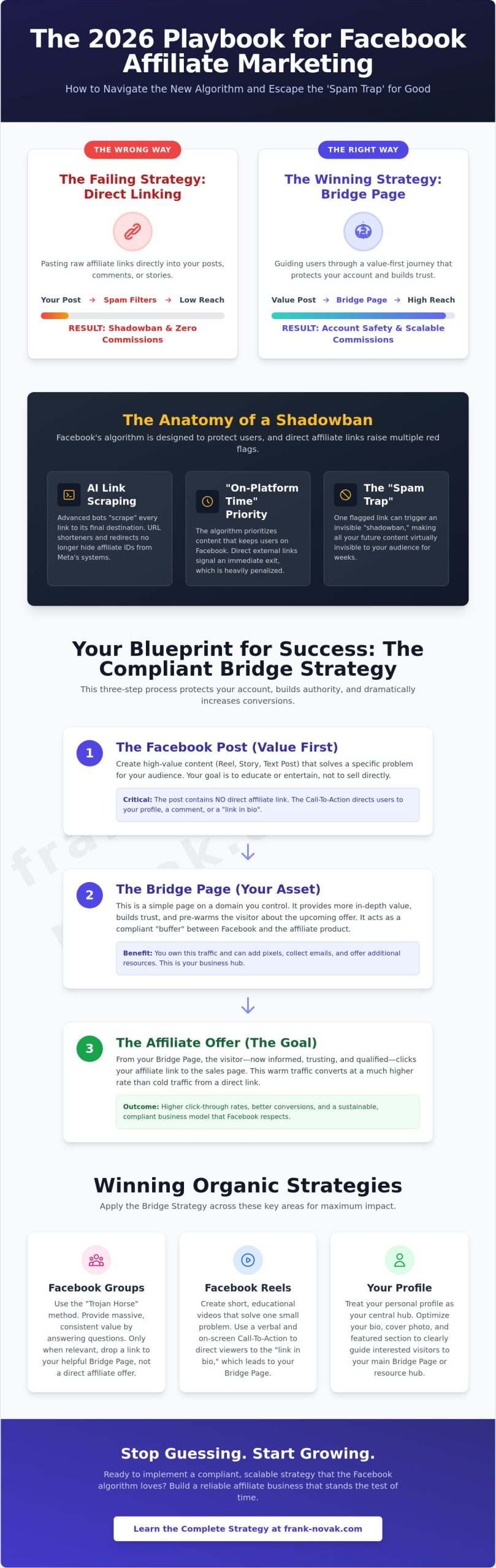
Direct linking is the practice of taking a raw affiliate URL and pasting it directly into a post, story, or comment. It’s simple. It’s fast. It’s also the quickest way to see your reach disappear. While this might have worked years ago, Facebook’s security systems now use advanced “Link Scraping” to analyze exactly where a user goes after they click. To understand what affiliate marketing is at its core, you have to recognize it as a performance-based system, but Facebook’s security treats these raw, external links as intrusive threats. If you’re looking for the best way to promote affiliate links on Facebook, you have to move past the idea that a simple copy-paste job will bring in commissions.
The 2026 algorithm updates have made this even more clear. Since the major policy shift on March 24, 2026, when Meta launched its own Affiliate Partnerships program, the platform has become much stricter about how users leave the site. The algorithm heavily prioritizes “On-Platform” time. If your post encourages an immediate exit to an external sales page, the system naturally deprioritizes it. This creates a “Spam Trap” where one bad link can shadowban your entire profile, making your future content invisible to your followers. Transitioning from a link-first mentality to a value-first mindset is no longer optional; it’s a requirement for survival.
The ‘Invisible’ Ban: What Shadowbanning Actually Looks Like
If you notice your posts suddenly receive zero engagement or your view counts on Reels flatline, you’re likely experiencing a shadowban. This isn’t a formal notification, but an invisible restriction on your reach. Facebook’s AI categorizes posts with direct affiliate links as low-quality promotional content because it recognizes the sales-heavy language that usually accompanies them. Additionally, user reports play a massive role. If a few people mark your link as spam, your visibility can vanish for weeks. It’s a steep price to pay for a single promotional attempt.
Why URL Shorteners Aren’t a Magic Bullet Anymore
Many creators try to bypass these filters by using URL shorteners. While this hides the affiliate ID from a human reader, it doesn’t fool Meta’s crawlers. These bots follow every redirect to identify the final destination. If that final URL belongs to a blacklisted domain from a major affiliate network, your post is flagged instantly. Redirects are a signal, not a cloak, for modern AI filters. Using these tools without a proper strategy often does more harm than good, as it signals to the algorithm that you’re intentionally trying to hide your destination.
The reality of the current digital landscape is that the algorithm rewards genuine connection and helpfulness. If you’re struggling to see results with your current methods, it might be time to look at resources like the Never Succeed Online program, which helps clarify why these common technical hurdles exist. Shifting your focus toward providing solutions rather than just pushing products is the only way to build a sustainable business on the platform today.
The 2026 Facebook Algorithm: How to Stay Compliant and Visible
Understanding the technical side of the algorithm is essential if you want your content to reach beyond a handful of people. In 2026, Meta doesn’t just evaluate your post’s text or image; it assigns a “Quality Score” to the destination page behind your link. If the site you’re linking to is slow, cluttered with intrusive pop-up ads, or lacks a clear privacy policy, the algorithm will drastically reduce your post’s reach. Finding the best way to promote affiliate links on Facebook requires a deep understanding of how the algorithm evaluates the user’s journey after the click. It’s no longer enough to have a great post if the destination fails to meet Meta’s standards for a positive user experience.
Another critical factor is the shift toward Meaningful Social Interaction (MSI). The algorithm now distinguishes between “engagement bait” and genuine conversation. If you’re simply asking people to “like if you agree” or “type YES below,” you’re likely to face a reach penalty. Instead, the system rewards posts that spark multi-sentence replies and back-and-forth discussions between users. To check your link’s reputation, you can use the Sharing Debugger tool within the Meta for Developers dashboard, which shows you exactly how the platform scrapes and perceives your domain before you even hit publish.
Mastering Meta’s Community Standards for Affiliates
Staying compliant means clearly separating commercial content from spam. Since the policy updates on March 24, 2026, all posts containing affiliate links are officially classified as branded content. This means you must use the “paid partnership” label to remain in good standing. Following the FTC’s Endorsement Guides is also a legal necessity, as clear disclosures build the trust that prevents users from reporting your content as unsolicited spam. Avoiding “click-gap” penalties involves building a history of sharing high-quality, non-promotional content that establishes your profile as a helpful resource rather than a dedicated sales feed.
The Power of Native Content: Keeping Users on Facebook
Facebook Reels and Stories have become the primary “Safe Zones” for affiliate promotion because they prioritize entertainment and education over direct selling. By using “Link in Bio” or “Comment for Link” strategies, you keep the initial interaction within the app, which the algorithm prefers. Native lead generation is the practice of capturing interest and providing value entirely within the Facebook ecosystem before ever asking a user to click away to an external offer. If you’re looking for a structured approach to this, the ClickBank Super Funnel provides a clear framework for building these compliant, high-conversion pathways without risking your account’s health.
The Bridge Page Blueprint: Your Insurance Against Account Bans
If you want to build a business that lasts, you need a strategy that protects your primary assets. A bridge page is not just an extra step in the process; it’s the foundation of a sustainable affiliate presence. By placing a simple, high-value page between your Facebook post and the final offer, you create a compliance buffer. This buffer allows Facebook’s crawlers to see a clean, informative page that adheres to their standards, even if the eventual vendor page is more aggressive in its sales tactics. Learning how to build a high-converting funnel is often the difference between a banned account and a flourishing business.
Beyond compliance, the bridge page serves a psychological purpose known as the “pre-frame.” When a user clicks your link, they are in a social mindset rather than a buying mindset. If you send them directly to a checkout page, the sudden shift in tone can cause them to bounce immediately. A bridge page allows you to transition the user gently by acknowledging their current problem and introducing the affiliate product as a logical solution. This approach is widely considered the best way to promote affiliate links on Facebook because it respects the user’s journey while increasing the likelihood of a sale.
Direct Link vs. Bridge Page: The ROI Reality
While direct linking might provide a quick, short-term hit of traffic, it fails to build long-term value. If you capture an email address on your bridge page, you gain the ability to market to that individual off-Facebook through automated sequences. This shift from a one-time visitor to a long-term lead significantly increases your return on investment over time. Trust is the currency of the internet, and a bridge page provides the space needed to establish your authority before asking for a purchase.
Essential Elements of a Compliant Bridge Page
To ensure your bridge page remains in Facebook’s good graces, you must include three essential legal links: a Privacy Policy, Terms of Service, and a Clear Disclaimer. These elements signal to the algorithm that your site is a legitimate business entity. You should also maintain ad-to-page scent, which means the imagery and messaging on your bridge page should closely match your original Facebook post to reduce bounce rates. Using a proven framework like the ClickBank Super Funnel can provide instant credibility and ensure you don’t miss these critical technical details.
Organic Promotion Strategies: Groups, Reels, and Profiles
If you’ve built your bridge page as we discussed, your next step is filling it with the right traffic. Many people assume they need a massive ad budget to see results, but the best way to promote affiliate links on Facebook in 2026 is actually through a “Trojan Horse” organic strategy. This method involves providing 90% pure value and only 10% soft promotion. By positioning yourself as a helpful resource rather than a salesperson, you build the social capital required to make people actually want to click your links. You can explore more about strategic traffic generation for affiliate links to see how this fits into a larger business model.
The goal is to stop “selling” and start “solving.” When you share a tip, a transformation story, or a helpful tutorial, you’re not just creating content; you’re building a reputation. If you’re consistent, your profile becomes a destination for people in your niche. This organic approach works because it aligns with how the algorithm functions today, rewarding creators who keep users engaged and satisfied within the ecosystem.
The ‘Value-Loop’ Group Strategy
To succeed in Facebook Groups, you must avoid the “Affiliate Spam” hubs where everyone is posting links and nobody is buying. Instead, identify high-intent groups where your ideal customers are asking questions. Focus on creating engagement posts that spark discussion, as this forces the algorithm to show your content to more members. In 2026, the “DM Close” often converts much better than a public link. By moving the conversation to Messenger, you can provide personalized advice and share your bridge page link in a way that feels like a helpful suggestion rather than a cold pitch.
Facebook Reels: The 2026 Viral Engine for Affiliates
Facebook Reels are the most powerful tool for reaching new audiences today. Since the March 24, 2026 update, Meta has made it easier to integrate shoppable tags, but driving traffic to your bridge page remains the most stable long-term strategy. Use a “Visual Hook” to stop the scroll in under two seconds. This could be a surprising result, a common mistake, or a quick “how-to” tip. Once you have their attention, use your caption to direct them to your bio link. Optimizing these captions with relevant keywords ensures your Reels are discoverable through Facebook’s internal search engine.
If you’re feeling overwhelmed by the technical setup or the pace of these algorithm changes, our Online Success Coaching provides the one-on-one mentorship you need to move forward with confidence. We can help you refine your organic strategy so you spend less time guessing and more time growing your commissions.
Scaling Your Success: Automation and Professional Coaching
Many affiliates find themselves stuck in a cycle of manual posting, which is the primary cause of burnout in this industry. If you’re spending every waking hour in Facebook Groups or replying to hundreds of comments, you haven’t built a business; you’ve created a demanding job for yourself. Shifting toward automated lead engines allows your affiliate funnel to work 24/7 without your constant supervision. This transition is essential for anyone who wants to move beyond small, inconsistent commissions toward a more predictable income stream. If you are looking for the best way to promote affiliate links on Facebook while maintaining your freedom, automation is the only logical answer.
While the technical steps of setting up a funnel are clear, the path is often filled with small hurdles that can stall your progress. This is where mentorship plays a vital role in your journey. By working with a seasoned practitioner who has already navigated these algorithm shifts, you can bypass the exhausting “trial and error” phase that stops most beginners. Understanding why Online Success Coaching is your shortcut helps you focus on high-level strategy rather than getting lost in the weeds of daily execution. A guide can help you identify exactly where your funnel is leaking, saving you months of frustration and lost revenue. Once your organic strategy is proven and your bridge page is converting, the natural next step is to amplify your results by learning how to use Facebook ads for affiliate marketing to drive a consistent, scalable flow of paid traffic to your offers.
Building Your ‘Webinar Profit Engine’
Selling high-ticket affiliate offers requires more than a short post or a simple Reel. Automated webinars allow you to deliver deep value and build significant trust before presenting a high-value solution to your audience. Once your organic traffic from Groups and Reels has proven that your bridge page and offer convert, you can confidently scale using paid traffic to increase your volume. Integrating the Webinar Profit Engines system into your Facebook strategy ensures that your presentation is professional and persuasive, even when you’re not physically at your computer. This system acts as a silent salesperson, greeting new leads and warming them up for the affiliate offer around the clock.
The Path to Financial Freedom: From Hobbyist to Business Owner
The final piece of the puzzle isn’t a tool or a tactic, but your own perspective. Developing the Success Mindset required for long-term growth means treating your affiliate efforts as a legitimate business rather than a side hobby. Transitioning from simple link sharing to strategic business building is what separates those who struggle from those who succeed. If you’re ready to take that next step and move into professional scaling, you can join the Ambassador JV program for professional scaling. This provides access to the frameworks and support needed to turn your Facebook presence into a sustainable digital career that supports your lifestyle for years to come.
Building Your Sustainable Future on Facebook
Shifting your approach from high-pressure direct linking to a value-first bridge strategy is the most significant change you can make for your longevity on Meta’s platforms. By respecting the user journey and aligning with the 2026 algorithm, you transform your profile from a temporary sales feed into a reliable business asset. It’s clear that the best way to promote affiliate links on Facebook today is to focus on building trust through compliance and providing genuine solutions before asking for a click. This methodical approach ensures that your account remains safe while your reach continues to expand.
If you’re ready to put these insights into action, you don’t have to navigate the technical setup alone. You can access 2026-ready compliance strategies and proven bridge page templates that take the guesswork out of your daily operations. With expert mentorship from Frank Novak, you’ll have a steady guide to help you transition from manual grinding to a streamlined, automated system that works for you.
Ready to automate your affiliate commissions? Discover the ClickBank Super Funnel here.
The roadmap is now clear, and with the right tools in place, your potential for growth is limited only by your willingness to take that first step. You have the knowledge to succeed; now it’s time to build your future.
Frequently Asked Questions
Is it legal to post affiliate links on Facebook in 2026?
Yes, it’s entirely legal and officially supported through the Facebook Affiliate Partnerships program launched on March 24, 2026. You must follow the FTC’s Endorsement Guides by clearly disclosing your relationship with the brand. Since all affiliate content is now classified as branded content, using the “paid partnership” label is a standard requirement to stay within the platform’s community standards and maintain your professional reputation.
How do I promote affiliate links on Facebook without a website?
You can promote products effectively by using native features like Facebook Reels and Stories. The 2026 updates allow creators to embed shoppable tags directly into their content, which removes the need for an external website for many partners. If you’re looking for more control over your leads, using a simple bridge page builder is a great way to warm up your audience before they see the final offer.
Will Facebook ban me for posting Amazon Associate links?
Facebook won’t ban you for using Amazon links, especially since Amazon is a primary launch partner for Meta’s 2026 affiliate program. However, you might face restrictions if you post links repeatedly without adding original value or helpful context. To stay safe, ensure you’re using the “paid partnership” tag and focusing on helpful reviews or tutorials rather than just dropping a raw URL into every post.
What is the best frequency for posting affiliate content on a Facebook Page?
A balanced approach is usually the most successful, following a rule of 90% value and 10% promotion. If you post promotional links too often, the algorithm might categorize your content as low-quality, which reduces your overall reach. By focusing on creating meaningful social interactions first, you ensure that when you do share a recommendation, the system is more likely to show it to a larger portion of your audience.
How do I disclose my affiliate relationship on Facebook to stay compliant?
To stay compliant, you should use the built-in branded content tools to apply the “paid partnership” label to your post. It’s also a good practice to include a clear, written statement like “I may earn a commission” at the beginning of your caption. This dual approach satisfies both Meta’s internal policies and legal requirements, ensuring your content remains visible and your account stays in good standing with the community.
Can I use Facebook Ads to promote affiliate links directly?
Direct affiliate links are generally not allowed in the ad creative itself, as this often leads to immediate rejection of your campaign. Using a compliant bridge page is the best way to promote affiliate links on Facebook through paid advertising. This method provides a “compliance buffer” that Meta’s crawlers prefer, as it offers a better user experience than sending someone directly to a third-party sales page that you don’t own. For a deeper look at how to structure compliant and profitable campaigns, the 2026 guide to using Facebook ads for affiliate marketing sustainably walks you through the exact setup needed to protect your ad account while maximizing your return.
What should I do if my Facebook account gets restricted for spam?
If your account is restricted, the first step is to pause all promotional posts and remove any links that might have triggered the flag. You can then focus on sharing high-quality, organic content that encourages genuine conversation to help rebuild your profile’s reputation. It’s helpful to use the Sharing Debugger tool in the Meta for Developers dashboard to see if a specific domain you’ve shared has been blacklisted by the system.
How do I track which Facebook posts are actually generating affiliate sales?
You can track your performance by using unique tracking IDs provided by your affiliate network for different posts or campaigns. In 2026, the Professional Dashboard also includes a “Monetization” section where you can see detailed analytics for your Affiliate Partnerships. This data helps you understand which formats, like Reels or Stories, are driving the most engagement and sales, allowing you to refine your strategy for better results. If you’re ready to take your paid campaigns to the next level, learning how to run Facebook ads for ClickBank with a compliance-first approach will help you build ban-proof campaigns that scale your commissions consistently.

Article by
Frank Novak
Frank Novak is an online marketing professional and coach who focuses on affiliate marketing and business automation. Through his website, frank-novak.com, he shares insights and strategies for leveraging social media platforms like Facebook to generate traffic and commissions.
Affiliate / Sponsored Content Disclaimer
This [website/post] contains affiliate links. If you click through and make a purchase, we may receive a commission at no additional cost to you. We only recommend products or services we believe will add value to our readers.