
What if the constant fear of seeing “Account Disabled” was actually the result of following an outdated playbook? It’s frustrating to watch your hard-earned budget disappear into high ad costs or, worse, lose your entire platform because of a confusing policy change. If you’ve felt like you’re walking on eggshells every time you launch a campaign, you’re certainly not alone. Many marketers find that mastering Facebook ads for affiliate marketing feels like a moving target, especially with the 2026 shift toward mandatory Partnership Ads and verified identities.
The good news is that these new Meta Advertising Standards actually provide a clearer path to stability than we’ve seen in years. This guide will show you how to build a compliant foundation that protects your account while driving a steady flow of traffic to your offers. We’ll explore the mechanics of the bridge page strategy, how to leverage AI-generated creatives that are currently outperforming human designs by 18 percent, and the steps to automate your commission generation. This journey starts with the core principles of compliance and moves steadily toward the specific technical setups you need for a professional, scalable business.
Key Takeaways
- Understand why the shift to “Value-First” advertising in 2026 makes Meta the most powerful engine for growth when you prioritize the reader’s experience.
- Master the technical setup of Facebook ads for affiliate marketing by using a bridge page strategy that satisfies strict compliance standards while protecting your account.
- Discover how to use “Intent-Based” targeting to find high-quality leads without accidentally corrupting your pixel data with low-value traffic.
- Identify the “Big Three” policy traps that lead to account bans and learn how to vet affiliate offers before you spend a single cent on ads.
- Learn the professional mindset needed to transition from a manual ad manager to a digital business owner who can scale through automation and coaching.
The State of Facebook Ads for Affiliate Marketing in 2026
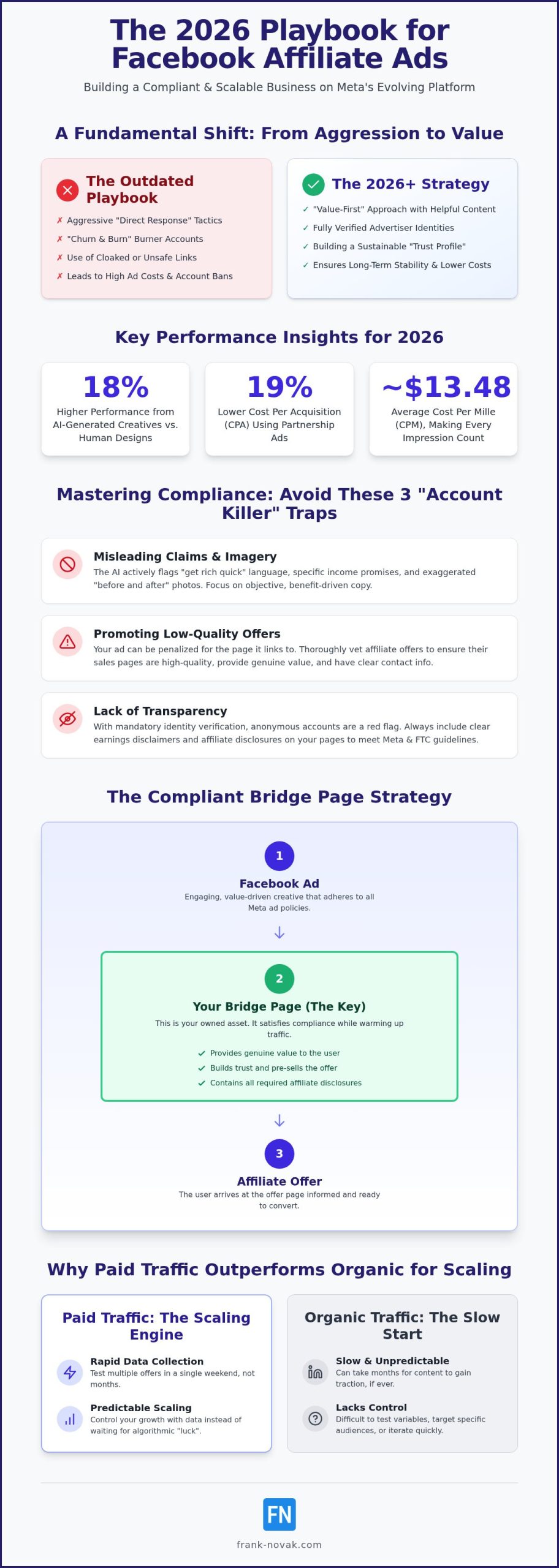
Meta remains the dominant force for scaling because of its sheer volume and sophisticated machine learning. While other platforms offer flashes of viral growth, Meta’s infrastructure provides the stability needed for long-term business. Successfully using Affiliate marketing strategies on this platform now requires a move away from aggressive “Direct Response” tactics. Instead, the 2026 ecosystem prioritizes a “Value-First” approach where ads feel like helpful content rather than intrusive sales pitches. This shift ensures that users stay engaged, which is exactly what the platform wants.
The 2026 algorithm uses advanced AI to identify patterns typical of low-quality affiliate campaigns. It looks for specific landing page structures and “bait-and-switch” creative styles that used to work in previous years. If you’re still using “churn and burn” methods like cloaked links or burner accounts, you’ll find the platform increasingly hostile. Because all ads are now tied to verified identities, building a sustainable reputation with the Meta Advertising Standards is the only way to ensure your traffic doesn’t vanish overnight. It’s about playing the long game.
Why Paid Traffic Still Outperforms Organic for Scaling
Many beginners start with organic reach, but they soon realize it lacks the predictability required to build a real business. Paid traffic allows for rapid data collection. You can test three different offers in a weekend rather than waiting months for an algorithm to pick up a video. It’s about control. If you have a proven system like the ClickBank Super Funnel, you can buy your way into profitable niches like telehealth or DIY by simply out-bidding competitors who don’t have a backend strategy. You don’t have to wait for “luck” when you can analyze real-time data.
Defining Success in the 2026 Meta Ecosystem
Success is no longer just about the cheapest click. Meta now rewards advertisers who focus on engagement quality and keeping users within their ecosystem through formats like Reels or Instant Experience. Partnership ads are particularly effective here, often delivering a 19 percent lower Cost Per Acquisition than standard ads. If your ad leads to high bounce rates or negative feedback, your costs will skyrocket. The average CPM has reached approximately $13.48 in 2026, meaning every impression must count. Affiliate Compliance is the alignment of offer value with platform safety. By focusing on this alignment, you create a win-win scenario where Meta keeps its users happy and you keep your commissions flowing. When you prioritize the platform’s health, your Facebook ads for affiliate marketing become a stable asset rather than a risky gamble.
Mastering Compliance: Promoting Offers Without Getting Banned
Compliance is often viewed as a hurdle, but in the current Meta ecosystem, it’s actually your greatest competitive advantage. When you align your campaigns with the Meta Advertising Standards, you aren’t just avoiding a ban; you’re building a “Trust Profile” that rewards you with lower costs and more stable reach. This starts with advertiser identity verification. Because all ads in 2026 are tied to a verified entity, the days of using anonymous burner accounts are over. If your Business Manager is fully verified and transparent, the algorithm is much more likely to give your campaigns the benefit of the doubt during routine reviews.
Before you spend a cent on Facebook ads for affiliate marketing, you must vet the offer itself. If an affiliate sales page makes unrealistic claims or lacks clear contact information, Meta’s AI will likely flag your ad by association. You should look for offers that provide genuine value and maintain high-quality landing pages. Transparency is a non-negotiable requirement now. This means your bridge pages must include visible earnings disclaimers and clear affiliate disclosures to meet both Meta’s rules and FTC guidelines. If you’re feeling uncertain about these technical requirements, seeking Online Success Coaching can provide the personalized mentorship needed to navigate these complex policies safely.
Avoiding the ‘Low Quality’ and ‘Misleading’ Triggers
The algorithm is specifically trained to spot “misleading” triggers that were common in the past. You must avoid “before and after” imagery or copy that promises specific financial results, such as “get rich” language. Instead, focus on objective, benefit-driven copy. For example, rather than promising a specific income, describe the skills or tools the user will gain. It’s also vital that your landing page matches your ad creative perfectly. If your ad promises a guide on gardening but your landing page immediately pivots to a high-ticket software sale, the “low quality” signal will trigger an immediate review. Consistency creates a positive user experience, which is exactly what the platform rewards.
The Meta Ad Compliance Checklist for 2026
To keep your account in good standing, ensure every campaign checks these boxes:
- Partnership Labels: If you’re running creator-style content, you must use the mandatory “Partnership Ads” format to disclose the compensated relationship.
- AI Disclosure: You are now required to disclose if your ad creatives were generated or significantly altered by AI tools.
- Legal Essentials: Your bridge page must have a functional Privacy Policy, Terms of Service, and “Contact Us” link in the footer.
For a more detailed breakdown of these requirements, you can explore the Facebook Ad Compliance for Affiliates guide. Following these steps ensures your traffic remains sustainable and your commissions keep growing without the constant fear of an account shutdown.
The Bridge Page Strategy: The Key to Sustainable Conversions
Direct linking to affiliate offers is a guaranteed ban in 2026. Meta’s automated systems are now designed to protect the user experience by blocking “blind” redirects that hide the final destination from the user. Using a bridge page is the only viable way to run Facebook ads for affiliate marketing with long-term security. It provides a transparent layer where you can display your Privacy Policy and affiliate disclosures, showing the platform that you’re a professional business owner rather than a fly-by-night operator. This middle step isn’t a hurdle; it’s the foundation of your business’s reputation.
A successful bridge page acts as a strategic asset that pre-sells the offer. You should include a compelling headline that mirrors your ad copy, a relatable story or problem-solving video, and clear social proof to build trust. Integrating the ClickBank Super Funnel makes this process seamless. It allows you to move traffic through a proven architecture that balances strict compliance with high conversion rates, ensuring that your automation handles the heavy lifting while you focus on scaling.
Building an ‘Advertorial’ Style Landing Page
Using an advertorial style helps bridge the gap between the social atmosphere of a Facebook feed and the commercial nature of an affiliate sales page. By providing educational content first, you establish yourself as a helpful guide rather than a pushy salesperson. This approach significantly reduces the friction that often leads to high bounce rates and negative feedback. Bridge pages act as a buffer for compliance by ensuring that the user’s first interaction with your brand is rooted in value and transparency.
Automation and List Building with Funnels
With the average cost per lead rising to approximately $27.66 in 2026, you can’t afford to waste traffic on one-off clicks. The “Money is in the List” mantra is truer than ever. When running Facebook ads for affiliate marketing, your goal should be to own the data. By collecting an email address on your bridge page, you turn your ad spend into an appreciative asset that you can market to for years. Setting up automated follow-ups ensures that you’re maximizing your ROAS even if the user doesn’t buy on the first visit. Linking your ad strategy to an Automated Marketing Funnel allows you to build a business that generates commissions while you sleep.
Precision Targeting and Creative Execution in 2026
Targeting in 2026 has shifted from manual demographic selection to “Intent-Based” modeling. While basic age and gender settings still exist, Meta’s algorithm now relies heavily on how users interact with your creative to define who sees your ad next. This means your creative is actually your primary targeting tool. When setting up Facebook ads for affiliate marketing, you must ensure you aren’t “poisoning” your pixel with low-quality data. If you feed the algorithm data from accidental clicks or non-buyers, your Lookalike Audiences will become increasingly ineffective. Instead, focus on high-intent events, such as lead form completions or bridge page engagement, to train the AI on what a profitable user looks like.
Leveraging Meta’s AI for Affiliate Targeting
The debate between “Broad” and “Niche” targeting has a clear winner in 2026: a hybrid approach. Starting with broad targeting allows the algorithm to explore, but using specific “Interest” guardrails helps maintain profitability in high-competition niches. It’s equally important to use “Exclusions” to prevent your budget from being wasted on people who have already opted into your list. To bridge the data gap caused by privacy changes, implementing the Conversion API (CAPI) is now mandatory. It ensures your affiliate tracking remains accurate, even when browser-based cookies fail.
Crafting Ad Copy That Passes the ‘Bot’ Test
Your ad copy must satisfy both the human reader and the automated compliance bots. Using the “Question-Lead” technique is a safe way to spark engagement without making prohibited claims. For example, asking “Are you looking for a more efficient way to manage your garden?” is far safer than promising a “100 percent success rate.” Video content continues to dominate, with Instagram Reels offering a 26 percent lower CPC, at roughly $1.28, compared to the $1.72 average for the Facebook Feed. This cost difference makes Reels an ideal placement for testing new affiliate offers.
User-generated content (UGC) remains a high-converting format because it feels authentic. Interestingly, AI-generated creatives are now outperforming human-designed ads by 18 percent in terms of click-through rates. The key is to maintain a testing framework where you rotate these formats regularly. By testing three to five creative variations against a single audience, you can identify the “winner” before scaling your budget. This methodical approach ensures your Facebook ads for affiliate marketing remain profitable even as global affiliate spend reaches its projected $15.7 billion high.
Scaling Your Affiliate Business with Professional Coaching
Transitioning from a manual practitioner to a strategic leader is the final step in your journey toward a sustainable income. If you want to scale your Facebook ads for affiliate marketing beyond a few hundred dollars a day, you must stop thinking like an ad manager and start acting like a digital business owner. An ad manager reacts to daily fluctuations in CPM or CPC; a business owner focuses on the long-term systems that convert traffic into revenue. Statistics suggest that roughly 90 percent of affiliates fail when trying to scale alone because they lack the resilience and the data-driven perspective required to handle the inevitable volatility of paid traffic.
Personalized mentorship through Online Success Coaching allows you to bypass the expensive trial-and-error phase that drains most beginner budgets. By working with a steady guide who has navigated policy shifts since 2018, you can identify which metrics actually matter and which are just noise. This level of support helps you develop the professional mindset needed to treat your campaigns as a real business. It’s about building an infrastructure that can withstand platform changes rather than one that relies on a single, fragile tactic.
The Value of a Steady Guide in 2026
One of the biggest obstacles to growth is “shiny object syndrome,” where marketers jump between different traffic sources the moment they face a challenge. If you have a professional coach, you’re much more likely to stay focused on the strategies that are already yielding results. You’ll learn how to interpret your dashboard like a seasoned practitioner, identifying whether a drop in performance is due to your creative or a broader shift in Meta’s algorithm. You can find more details on why Online Success Coaching is your shortcut to growth and how it helps you avoid the common pitfalls that stall most affiliate businesses.
Your Next Steps: From Zero to Profitable
Your journey toward a stable affiliate business should be measured in months, not days. Setting a realistic 90-day scaling plan allows you to test your funnels and creatives methodically before you commit heavy capital. Community and networking are also vital; being surrounded by others who are navigating the same 2026 compliance standards provides a layer of emotional and technical support that’s hard to find alone. If you encounter an ad account setback, having a community and a coach means you have a plan for a pivot rather than an ending. By following this structured path, you transform Facebook ads for affiliate marketing from a source of stress into a predictable engine for growth.
Your Path to Sustainable Affiliate Growth
Building a business with Facebook ads for affiliate marketing in 2026 is no longer about finding a temporary loophole. It’s about establishing a professional foundation through verified identities, compliant bridge pages, and high-quality creatives that the Meta algorithm rewards. By prioritizing the user experience and using automated systems like the ClickBank Super Funnel, you can turn unpredictable ad spend into a stable, appreciative asset.
Frank Novak has been an active practitioner in this space since 2018, navigating every major policy shift to help entrepreneurs find their footing. With personalized mentorship and access to proven automation tools, you don’t have to face the complexities of digital scaling alone. You have the map and the tools; now it’s time to take the first step toward your professional future.
Frequently Asked Questions
Is affiliate marketing on Facebook still allowed in 2026?
Yes, affiliate marketing remains a core part of the Meta ecosystem, provided you follow the updated Meta Advertising Standards. In 2026, you must use the Partnership Ads format for any creator-led promotions and ensure all your business details are verified. The platform prioritizes high-quality content that adds value to the user’s feed. If you focus on transparency and follow the disclosure rules, you can build a very successful business here.
Can I promote ClickBank links directly on Facebook?
You cannot promote ClickBank links directly as this often leads to immediate account flags or permanent bans. Meta’s AI identifies direct affiliate redirects as low-quality user experiences because they bypass the transparency that a bridge page provides. By using an intermediary page, you can include your own Privacy Policy and affiliate disclosures. This extra step protects your account while allowing you to pre-sell the offer to your audience effectively.
How much should I spend on Facebook ads as a beginner affiliate?
Beginners should start with a budget of $5 to $20 per day to test different creatives and audiences without overextending. Once you find a combination that works, a minimum of $50 per day is recommended for more predictable and stable results. The average CPM in 2026 is approximately $13.48, so starting with a focused budget allows you to gather data without wasting capital on unproven ad sets or landing pages.
What is a bridge page and do I really need one?
A bridge page is a simple landing page that sits between your ad and the affiliate offer. You absolutely need one in 2026 to stay compliant with Meta’s policies and to protect your ad account from being disabled. It also serves as a critical asset for building your email list. By capturing lead information before sending traffic to the sales page, you ensure that you own the data for long-term marketing.
How do I get my Facebook ad account back if it gets disabled?
If your account is disabled, you must use the official Meta Business Support appeal process while providing your verified identity documents. Success rates for appeals in 2026 are higher for those who have already completed the advertiser identity verification process. It is much harder to recover an account if you’ve been using “burner” profiles or cloaked links. Being honest and showing that you’ve corrected any policy misunderstandings is usually the best path forward.
Which affiliate niches work best with Facebook ads in 2026?
While traditional niches like weight loss are still active, newer opportunities in telehealth, DIY, survival, and manifestation are currently yielding excellent results. These niches often allow for more creative storytelling and education-based ads, which align perfectly with Meta’s “Value-First” approach. Success in these areas depends on your ability to create engaging video content, particularly Reels, which often have a 26 percent lower CPC than standard feed placements.
Do I need a website to run Facebook ads for affiliate marketing?
Yes, you need a professional domain and a basic website structure to run Facebook ads for affiliate marketing effectively. Meta requires your landing pages to have a functional Privacy Policy and contact information to pass their compliance checks. Having your own site also allows you to implement the Conversion API (CAPI), which is essential for accurate tracking in 2026. Without your own domain, you lose control over the user experience and the data.
How do I track my affiliate sales in the Facebook Ad Manager?
You should track your sales by using the Conversion API (CAPI) and specific UTM parameters on your bridge page. This setup allows you to send conversion data back to Meta’s servers even when browser cookies are blocked. By matching your affiliate network’s data with your Ad Manager reports, you can see exactly which creative is driving the most revenue for your campaigns. This data-driven approach is the only way to scale profitably over time.

Article by
Frank Novak
Frank Novak is an online marketing professional and coach who focuses on affiliate marketing and business automation. Through his website, frank-novak.com, he shares insights and strategies for leveraging social media platforms like Facebook to generate traffic and commissions.
Affiliate / Sponsored Content Disclaimer
This [website/post] contains affiliate links. If you click through and make a purchase, we may receive a commission at no additional cost to you. We only recommend products or services we believe will add value to our readers.