

With US advertisers projected to spend $13.81 billion on affiliate marketing in 2026, it’s clearly a powerhouse of the modern economy, yet explaining that to your parents often feels like defending a pyramid scheme. It’s exhausting to deal with the “scam” accusations or the blank stares when you mention your latest campaign. You want your loved ones to see the hard work and strategy behind your success, not just a mysterious laptop screen. Mastering how to explain affiliate marketing to family and friends is the first step toward building a supportive environment for your business.
If you’ve ever struggled to simplify your digital systems, you’re in the right place. We’ll help you strip away the jargon and address those “get-rich-quick” stigmas head-on, turning skeptical silence into genuine respect. This guide provides the exact framework you need to define your value proposition clearly. We’ll explore simple metaphors, such as viewing the ClickBank Super Funnel as a digital storefront, and provide scripts to help you establish professional boundaries. By the end of this article, you’ll have the tools to transform your family’s confusion into a foundation of lasting support.
Key Takeaways
- Use relatable analogies like real estate to describe your work as a digital commission-based service rather than a technical mystery.
- Discover how to explain affiliate marketing to family and friends by framing your automated funnel as a professional digital storefront.
- Gain the confidence to distinguish your business from multi-level marketing by highlighting the focus on product sales over recruitment.
- Master a two-step communication framework that validates family concerns while pivoting the conversation toward your business growth.
- Learn how to share small wins and consistent results to turn initial skepticism into long-term support for your entrepreneurial path.
The Simple Definition: Affiliate Marketing for Non-Techies
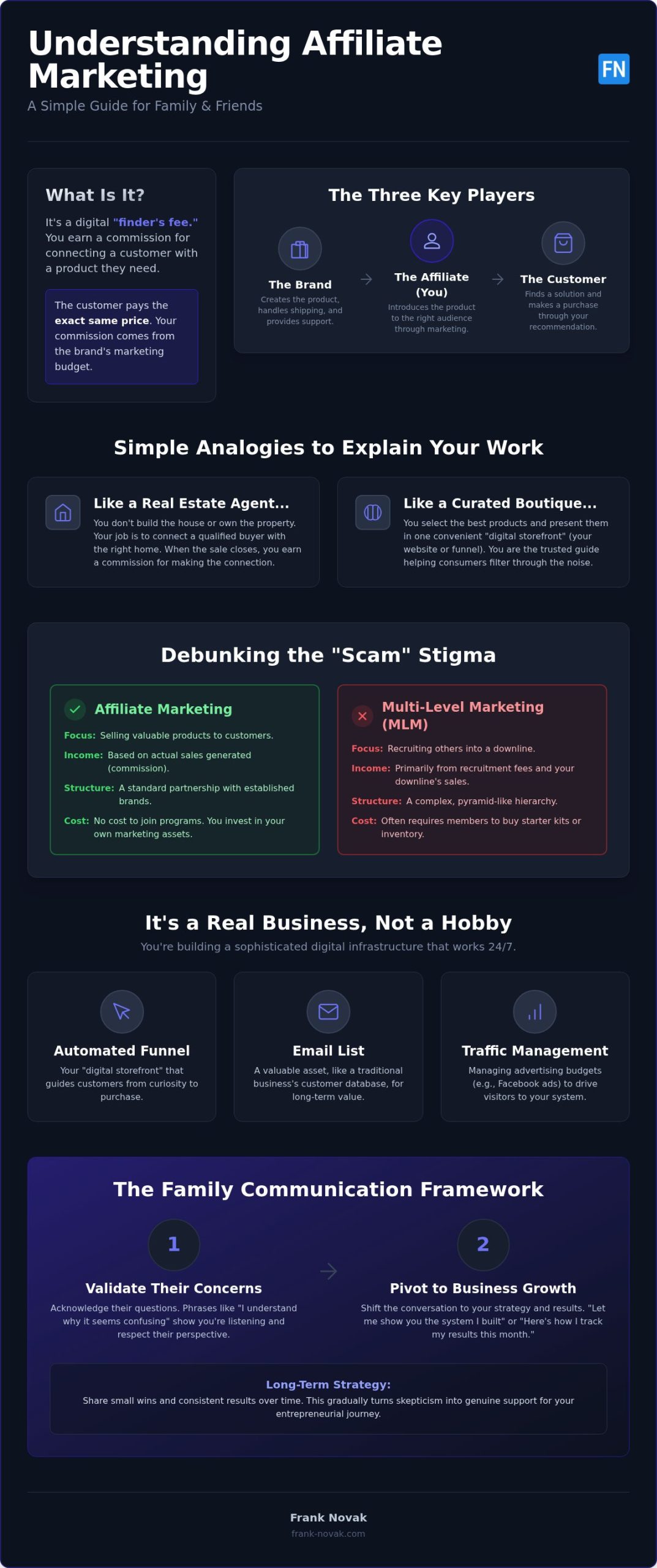
If you are wondering how to explain affiliate marketing to family and friends, start by stripping away the technical layers. Tell them it’s simply a digital version of a “finders fee.” Just as a salesperson earns a commission for a successful referral in the physical world, you earn a small percentage when you help a customer find a product they actually need. It’s a standard business practice that has existed for decades, just moved into the online space.
Think of it like a real estate agent. An agent doesn’t build the house, and they don’t own the property. Their entire job is to connect a qualified buyer with the right home. Once the sale closes, the developer pays the agent for making that connection. In your business, you’re the agent connecting people to high-quality products they are already searching for. You don’t have to worry about manufacturing or shipping; your value lies in the introduction.
Understanding the structure helps clarify the process for those who aren’t familiar with digital growth. According to this Affiliate Marketing Definition, there are three primary players involved in every transaction:
- The Brand: The company that creates the product, handles the logistics, and provides customer support.
- The Affiliate (You): The marketing partner who introduces the product to a specific audience.
- The Customer: The person who makes a purchase through your recommendation to solve a problem.
It’s vital to explain that the customer pays exactly the same price they would if they went directly to the brand. There is no “middleman tax” added to their receipt. The commission you earn comes out of the brand’s existing marketing budget, not the customer’s wallet. This is a crucial point to make when learning how to explain affiliate marketing to family and friends, as it removes the fear that you’re somehow taking advantage of people.
The Retail Store Analogy
You can also compare your work to a curated boutique shop. Imagine a store owner who picks the best local crafts and places them in one convenient location for shoppers. Your website or automated funnel acts as that curated storefront. Brands prefer paying you a commission for a guaranteed sale rather than spending millions on TV ads that might never reach the right person. You’re effectively the “digital bridge” in the modern economy, helping consumers filter through the noise.
Why Brands Love Affiliates
Large companies like Amazon and Target rely heavily on “performance marketing.” This means they only pay for results. If you don’t make a sale, they don’t pay a cent. This model is incredibly efficient for businesses because it eliminates the risk of traditional advertising. This creates a perfect win-win-win scenario where the brand gains a sale, the customer finds a helpful solution, and the affiliate earns a reward for their marketing expertise.
Beyond the Links: Explaining the Business Infrastructure
One of the biggest hurdles when considering how to explain affiliate marketing to family and friends is the misconception that you simply post links on social media and hope for the best. In reality, you’re building a sophisticated infrastructure. Think of your automated marketing funnel as a digital storefront. It’s a structured journey that guides a potential customer from initial curiosity to a final purchase. This isn’t a hobby; it’s a piece of digital real estate that works even when you’re sleeping.
Instead of chasing one-time sales, you’re focused on building an asset. For most professionals, this asset is an email list. This is similar to a traditional business maintaining a customer database. By providing value and staying in touch with your audience, you create a sustainable business model rather than a series of random transactions. You manage traffic sources, such as Facebook ads, to drive visitors to your system. This involves managing advertising budgets and ensuring all content follows FTC Disclosure Guidelines. You are essentially a Digital Architect, designing systems that run 24/7.
The ClickBank Super Funnel Example
To make this concrete, you might describe the ClickBank Super Funnel as a pre-built business system. It provides the technical foundation, including the landing pages and email sequences, that allow a business to scale. This isn’t a “post and pray” social media strategy. It’s a sophisticated tech stack that enables you to grow without trading every hour for a dollar. If you want to see how these systems integrate, exploring Online Success Coaching can provide the necessary clarity.
The Data-Driven Side of the Job
Your day-to-day work is often less about “marketing” and more about data analysis. You spend time reviewing metrics like conversion rates and ROI (Return on Investment). This requires a mix of copywriting, strategy, and technical troubleshooting. Instead of “posting links,” you are managing a digital portfolio. If a specific campaign isn’t performing, you analyze the data to find the bottleneck and fix it. This analytical approach is what separates a professional business from a casual side hustle. When you’re learning how to explain affiliate marketing to family and friends, focusing on these professional metrics helps establish your credibility as a business owner.
Affiliate Marketing vs. MLMs: Debunking the Scam Stigma
When you sit down to discuss your new career, the first question from a concerned relative is often, “Is this one of those pyramid schemes?” It’s a valid concern given the noise online. However, the most important part of how to explain affiliate marketing to family and friends is highlighting the total absence of “recruiting” or “downlines.” In a legitimate business, you don’t make a single cent by signing up other people to do what you do. Your income is tied strictly to the sale of a product to a customer who actually wants it.
This distinction is what separates you from Multi-Level Marketing (MLM) structures. In those models, the focus is often on building a team to earn a percentage of their sales. In affiliate marketing, you are a solo entrepreneur or a small business owner. There are no “startup kits” to buy, no mandatory monthly inventory to store in your garage, and no pressure to “rank up” by bothering your social circle. You are a marketing partner for brands, providing a service that companies are willing to pay for. Because you operate on professional platforms like Facebook, you must also adhere to strict compliance standards. These platforms don’t tolerate scams; they require transparency and honest advertising.
Why the Confusion Exists
Much of the skepticism comes from “Get Rich Quick” advertisements that flood social media feeds. These ads promise overnight wealth with zero effort, which is the opposite of reality. These bad actors give the entire industry a poor reputation. Real affiliate marketing is a slow-build professional career that requires technical skill and strategy. Building an Affiliate Marketing Success Mindset is the actual foundation of your business. It’s about developing mental resilience and treating your work like a long-term investment rather than a lottery ticket.
The Legitimacy Check
If your loved ones need more proof, point them toward the major corporations that use this model every day. Household names like Amazon, Apple, and Walmart all run massive affiliate programs. They use this system because it’s an efficient way to find new customers. On the financial side, your business is as official as it gets. Your income is reported to the IRS, and you’ll receive a 1099-NEC form once you earn $600 or more in a year. You are essentially a “Freelance Marketer.” When you frame your work as professional freelance consulting for global brands, you’ll find that how to explain affiliate marketing to family and friends becomes a much simpler task.
The Family Communication Framework: Scripts for Success
Understanding how to explain affiliate marketing to family and friends requires more than just facts; it requires a strategic approach to conversation. When you’re met with raised eyebrows at the dinner table, your first instinct might be to get defensive. Instead, try a more effective four-step framework. Start by validating their concern. Usually, their skepticism comes from a place of love and a desire for your financial safety. If you acknowledge that they want the best for you, the tension often evaporates instantly.
The next step is the “Professional Pivot.” This means changing your language from “making money online” to “digital customer acquisition” or “performance marketing.” If they can’t visualize what you do, show them. Don’t show them a bank statement or a screenshot of commissions, as this can look like a “get-rich-quick” scheme. Instead, show them a high-quality landing page you’ve built or a professional partnership with a major brand. Finally, set clear boundaries. You don’t need to justify your career every time you see them. It’s okay to say that you’d rather focus on family time than work talk.
The “Elevator Pitch” Script
Having a rehearsed response prevents you from stumbling over technical terms. For casual acquaintances, keep it brief: “I help established brands find new customers through digital systems.” This positions you as a service provider rather than a mysterious internet user. When you’re speaking with parents, you can go deeper: “I build automated funnels that connect people to products they already need, and the brands pay me a commission for that connection.”
You should strictly avoid phrases like “passive income” or “laptop lifestyle” during these initial stages. While these are parts of the business, they carry a heavy “scam” stigma for people outside the industry. Focus on the mechanics of the work, such as data analysis and copywriting, to ground the conversation in reality.
Handling the “Skeptical Uncle” Scenario
We’ve all faced the relative who asks, “Isn’t that just a scam?” or “Why don’t you just get a real job?” Instead of arguing, pivot back to your professional growth. You might say, “I understand why you’re cautious, but I’m working with the same systems companies like Amazon use to grow.” If the pressure continues, explain that you are investing in your professional development through structured programs like Online Success Coaching. This shows them that you have a roadmap and are learning from established practitioners in the field.
Turning Skepticism into Support: Your Long-Term Strategy
While scripts provide a starting point, your consistent behavior over time acts as the most powerful evidence for your business. When you are figuring out how to explain affiliate marketing to family and friends, remember that results eventually replace the need for long definitions. However, you shouldn’t wait for a high-revenue month to start changing the narrative. You can shift their perception by sharing small, professional milestones. Instead of saying you “made money,” explain that your latest campaign achieved a positive return on investment. This frames you as a Business Owner rather than just an “Internet User” who happened to get lucky.
Inviting your family into your daily workflow can demystify the process. Instead of talking about vague sales, mention a specific problem you solved during the day. You might explain how you adjusted a headline to better help a specific audience or how you optimized a technical sequence in your funnel. This makes the work feel tangible. It transforms the image of you “playing on the computer” into the reality of you managing a complex digital operation. When they see you troubleshooting and strategizing, their respect for your professional discipline grows.
Professionalism as a Proof Point
Professionalism is your strongest proof point. If you treat your work like a hobby, your family will likely do the same. This means respecting your business hours and maintaining a dedicated workspace. Investing in your growth through Online Success Coaching signals to your inner circle that you are serious about your career path. Professional development validates your choice. It shows you are following a structured curriculum and learning from experts rather than guessing in the dark. When you value your time, others will follow suit.
When to Stop Explaining
There will be moments when you need to stop explaining. Some people are simply committed to misunderstanding your path, regardless of how clearly you present the facts. In these cases, it’s more productive to focus your energy on your traffic generation strategies rather than winning every dinner table argument. Focus on the work. Let your progress be the answer to their doubts.
Success in this industry is a quiet, steady build. Once you’ve provided a basic, honest explanation, maintain your relationships by focusing on non-work topics. You don’t need everyone to understand the mechanics of a tracking pixel to love and support you. By establishing professional boundaries and focusing on your growth, you create a space where your business can thrive while your personal connections remain strong. Your success will eventually become a quiet, undeniable fact that no longer requires a defense.
Building a Legacy of Support and Success
Mastering the art of communication is just as vital as mastering your technical funnels. By using clear analogies and maintaining professional boundaries, you transform skeptical relatives into your biggest cheerleaders. Learning how to explain affiliate marketing to family and friends allows you to focus on growth without the weight of outside judgment. You’ve seen that your results and your commitment to ethical standards provide the ultimate proof of your professional legitimacy. You are no longer just an internet user; you are a digital entrepreneur building a sustainable future.
With expert guidance from Frank Novak, you can scale your digital business with total confidence. Accessing professional systems like the ClickBank Super Funnel and ensuring Facebook ad compliance will solidify your standing as a serious entrepreneur. You’ve built something remarkable, and you’re ready to take the next step in your professional development.
Ready to turn your affiliate “hobby” into a respected professional business?
Your journey is just beginning. Keep moving forward with clarity, and let your success speak for itself.
Frequently Asked Questions
Is affiliate marketing a real job or just a side hustle?
Affiliate marketing is a legitimate business model that can function as a full-time career or a scalable side hustle. Many people start part-time, but they treat it with the same professional rigor as a 9-to-5. If you treat it like a hobby, it will pay like a hobby. Through Online Success Coaching, entrepreneurs learn to build systems that replace traditional income. It’s a professional career choice in the digital economy, requiring skill in data analysis.
How do I explain that I am not scamming people?
You aren’t scamming because you are providing a valuable bridge between a customer and a product they need. The customer pays the exact same price as if they bought directly from the brand. Your commission is paid by the company out of their marketing budget. When you focus on high-quality products and honest reviews, you’re performing a professional service. This transparency is a core part of how to explain affiliate marketing to family and friends.
What is the difference between affiliate marketing and a pyramid scheme?
The primary difference is the lack of recruitment. In a pyramid scheme or MLM, income is often based on the number of people you sign up under you. In affiliate marketing, you earn zero dollars for recruiting others. You only get paid when a customer makes a purchase through your link. There are no downlines or complex team structures; it’s a direct, performance-based relationship between you and a brand that sells real products.
How do I handle parents who want me to get a “traditional” 9-to-5?
Acknowledge that their concern comes from a desire for your stability. Explain that you are building an asset, such as an email list, which provides long-term security. You might show them that you’re registered as a business and pay self-employment taxes. Framing your work as digital consulting or automated customer acquisition often helps them see it as a professional path rather than a risky gamble. Stability comes from owning your systems, not just a paycheck.
Should I show my family how much money I am making?
It’s usually better to wait until you have consistent, long-term results before showing bank statements. Raw commission screenshots can sometimes look like get-rich-quick schemes to the uninitiated. Instead, share professional milestones like successfully launching a ClickBank Super Funnel or hitting a target conversion rate. This shifts the focus from luck to your technical expertise and business growth. Showing them the storefront you built is more impressive than showing them a single receipt.
How do I explain my “work from home” schedule to friends who think I am always free?
You must treat your business hours with the same respect you would a traditional office job. If friends call during the day, explain that you are in deep-work sessions managing campaigns. Setting these boundaries early prevents people from assuming you’re always available for errands. Once they see you sticking to a disciplined routine, they’ll stop viewing your home office as a place where you’re just hanging out online. Professionalism starts with your own schedule.
What if my family wants to join my “business”?
Be cautious about mixing family and business directly. If a relative is genuinely interested, it’s best to point them toward professional resources rather than trying to mentor them yourself. You might suggest they look into Online Success Coaching so they can build their own independent foundation. This keeps your personal relationships healthy while ensuring they get the structured training they need to succeed without relying solely on you for every technical step or strategy adjustment.
How can I explain the technical side of funnels to older relatives?
Use the “Automated Salesman” analogy. Explain that instead of you standing in a store talking to people, your funnel is a series of digital pages that does the talking for you around the clock. It greets the customer, shows them the benefits of a product, and helps them make a purchase. They understand the concept of a salesman; you’re just using technology to make that process happen automatically for thousands of people at once.

Article by
Frank Novak
Frank Novak is an online marketing professional and coach who focuses on affiliate marketing and business automation. Through his website, frank-novak.com, he shares insights and strategies for leveraging social media platforms like Facebook to generate traffic and commissions.
Affiliate / Sponsored Content Disclaimer
This [website/post] contains affiliate links. If you click through and make a purchase, we may receive a commission at no additional cost to you. We only recommend products or services we believe will add value to our readers.

