
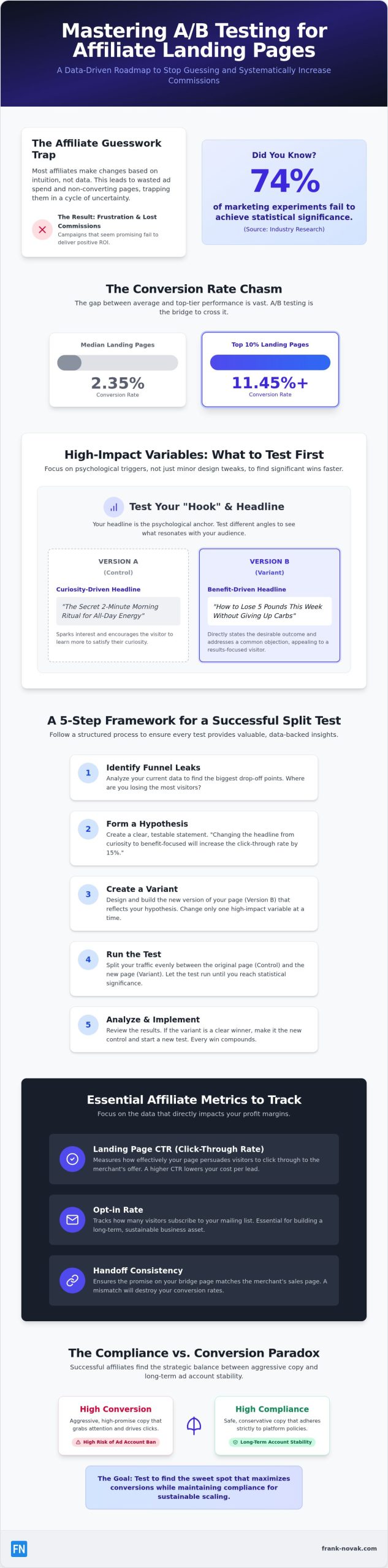
Did you know that 74% of marketing experiments fail to achieve statistical significance? This means most affiliates are essentially guessing while their hard-earned ad spend disappears into a void of non-converting pages. You’ve likely felt that specific frustration when a campaign you were certain would win ends up costing more in leads than it generates in commissions. It’s completely natural to feel uncertain about which landing page elements actually drive sales, especially when you’re trying to balance persuasive copy with the constant fear of getting your ad accounts banned for being too aggressive.
If you’ve ever felt stuck in this cycle, you’re not alone, and there is a methodical way forward. This guide will show you how to master A/B testing affiliate landing pages so you can stop the guesswork and start building a sustainable, automated commission machine. You’ll learn how to move beyond simple design changes and focus on the psychological triggers that can push your conversions toward that top-tier 11.45% benchmark. We’ll provide a clear roadmap for testing your bridge pages systematically, ensuring every tweak helps to maximize your commissions and lower your lead acquisition costs while maintaining the latest 2026 compliance standards.
Key Takeaways
- Discover how A/B testing affiliate landing pages allows you to identify small conversion lifts that compound into significant profit margins over time.
- Learn to isolate high-impact variables like headlines and lead magnets to determine exactly which psychological triggers resonate most with your target audience.
- Understand how to navigate the balance between aggressive, high-converting copy and long-term ad account stability through strategic compliance testing.
- Follow a structured 5-step framework to identify leaks in your funnel and create data-backed hypotheses for your next split test.
- Explore how to integrate winning results into automated systems like the ClickBank Super Funnel to scale your affiliate business with confidence.
Why A/B Testing is the Secret to Scaling Affiliate Commissions
Success in affiliate marketing isn’t about having a “magic touch” or a sudden burst of creative inspiration. It’s about being a diligent scientist with your data. In the context of a bridge or squeeze page, A/B testing is the process of showing two different versions of your page to your visitors to see which one performs better. One version might focus on a curiosity-based headline, while the other highlights a direct benefit. By splitting your traffic, you let your audience tell you exactly what they want through their actions.
Many affiliates stay in the red because they fall into the “guesswork trap.” They make changes based on what looks visually appealing or what they saw a competitor doing. However, research suggests that the median landing page conversion rate is around 2.35%, while the top 10% of pages convert at over 11.45%. Moving from the median to the top tier isn’t a result of luck. It’s the result of a patient, methodical approach where you trust data over your own intuition. When you commit to A/B testing affiliate landing pages, you stop gambling with your ad spend and start investing in a proven system.
To better understand the mechanics of setting up these experiments, watch this helpful video:
The Financial Anatomy of a Split Test
If you manage to achieve a 10% lift in your landing page click-through rate, you aren’t just getting a few more clicks. You’re effectively lowering your Cost Per Lead (CPL) and increasing your Earnings Per Click (EPC) simultaneously. If your ad costs remain the same but your page converts better, your profit margins can expand rapidly. This is why testing should be viewed as a core investment for your digital business. If you’re using a structured framework like the ClickBank Super Funnel, you already have a pre-optimized starting point, making it much easier to find those compounding wins.
Affiliate-Specific Metrics You Must Track
To scale effectively, you need to look beyond simple “vanity” metrics and focus on what actually moves the needle. First, monitor your Landing Page CTR, which measures how well your bridge page moves people from the ad to the merchant’s offer. Second, track your Opt-in Rate to ensure you’re building a sustainable mailing list. Finally, pay attention to handoff consistency. If your bridge page makes a promise that the merchant’s sales page doesn’t immediately reflect, your conversion rates will plummet. A successful test ensures that the transition feels like a logical, helpful next step for the visitor.
High-Impact Variables: What to Test on Your Affiliate Page
When you start A/B testing affiliate landing pages, it’s easy to get lost in minor details like font sizes or background colors. While these elements matter, your scaling success depends on testing variables that fundamentally shift a visitor’s decision-making process. By focusing on high-leverage components first, you can find winning variants faster and avoid wasting your daily ad budget on tweaks that don’t actually move the needle.
The Power of the ‘Hook’ and Headline
The hook is the psychological anchor of your page that captures immediate attention and frames the reader’s problem. If your headline doesn’t resonate within the first few seconds, you’ve likely lost the visitor. Google data indicates that the probability of a bounce increases by 32% as page load time goes from 1 to 3 seconds, and the same principle applies to the mental load of your copy. You should test a Big Promise headline, which focuses on the ultimate result, against a Unique Mechanism headline, which explains the specific way your solution works. For example, testing a curiosity-based headline like “The Secret 2-Minute Morning Ritual” against a benefit-driven one like “How to Lose 5 Pounds This Week” will reveal exactly what motivates your specific traffic source.
Your choice of lead magnet also serves as a critical bridge to your mailing list. You might find that a short, actionable checklist attracts higher quality subscribers than a long ebook because it offers immediate gratification. Similarly, your Call to Action (CTA) phrasing can change your click-through rate significantly. Testing “Watch the Video” against “Get Instant Access” often reveals whether your audience is in a learning or a buying mindset. While social proof like testimonials can build trust, be careful not to overdo it. Sometimes, a clean page with a single, powerful testimonial performs better than a cluttered layout that distracts the user from the main offer.
Visual Hierarchy and Layout Tests
Since the vast majority of web traffic in the US is now consumed on mobile devices, your layout must be thumb-friendly and responsive. Testing a simple single-column layout against a more complex design can often lead to surprising results in mobile conversion rates. The hero image you choose also plays a massive role in establishing immediate credibility for your brand. Instead of searching for the perfect button color, focus on testing contrast. A button that stands out clearly from the rest of the page will almost always outperform one that blends into the brand’s color palette. If you want a shortcut to these optimized layouts, the ClickBank Super Funnel provides a pre-tested structure that you can use as your baseline.
The Compliance vs. Conversion Paradox in Split Testing
Affiliates often face a difficult choice: write copy that converts like crazy or write copy that keeps their ad accounts alive. In 2026, ad platforms like Facebook have become incredibly sophisticated at detecting “hypey” or aggressive claims. If you lean too far into aggressive copy, your account might be flagged before your test even reaches statistical significance. This is why A/B testing affiliate landing pages must include a compliance-focused variant. By testing a ‘Safe’ version against a slightly more ‘Aggressive’ one, you can find the sweet spot where you maximize profit without risking a permanent ban.
It’s crucial to include standard legal elements in every variant you test. With FTC fines for non-compliance now exceeding $50,000 per violation, and total GDPR fines surpassing €4.5 billion since 2018, you can’t afford to overlook your Privacy Policy or Earnings Disclaimer. These elements don’t just protect you legally; they also signal to ad bots and users alike that your business is legitimate and trustworthy. If you display these clearly, you’re much more likely to pass automated reviews during the testing phase.
Testing for Ad Platform Bots
When you set up your experiments, remember that automated reviewers are scanning your pages just as often as humans are. You should structure your tests so they don’t resemble “cloaking,” which is the practice of showing different content to bots than to users. Instead, try testing neutral imagery against niche-specific imagery. While a niche-specific image might convert better, a more neutral image could lead to lower ad costs and higher account longevity. In 2026, a “Compliance First” mindset is the only way to build a business that lasts. If you want to dive deeper into this, I’ve put together a guide on Facebook ads for affiliate marketing that covers these nuances in detail.
The Role of the Bridge Page
The bridge page acts as a buffer between your ad and the merchant’s offer. One of the most effective tests you can run is on the length of this page. You might find that a short, punchy bridge page works best for low-ticket items, while a long-form educational page is necessary for high-ticket coaching programs. The goal is to maintain a consistent “scent” so the user doesn’t feel tricked when they finally reach the merchant. If your ad promises a solution for back pain, your bridge page and the eventual affiliate offer must align perfectly with that promise. Understanding how to drive traffic to affiliate links effectively requires you to respect this journey. If you break the scent, your conversion rates will drop, regardless of how good the merchant’s page is.
Setting Up Your First Affiliate Split Test: A 5-Step Framework
If you’re ready to move from guessing to knowing, a structured framework is your best friend. Success in A/B testing affiliate landing pages doesn’t come from massive, sweeping changes, but from small, calculated experiments. By following a logical “if-then” progression, you can isolate exactly what makes your audience click. This systematic approach ensures that every dollar you spend on traffic is working toward a clearer understanding of your customer’s psychology.
- Step 1: Identify your ‘Leaking Hole’. Use your funnel analytics to find the biggest drop-off point. If your ad gets clicks but your landing page doesn’t, that’s where you start.
- Step 2: Create a single hypothesis. Based on lead psychology, decide on one change. For example: “If I change the headline to a curiosity-based hook, then the opt-in rate will increase.”
- Step 3: Set up the variants. Your ‘Control’ (A) is your current page. Your ‘Challenger’ (B) is the version with the single change you’ve identified.
- Step 4: Drive equal traffic. Send high-quality traffic to both variants simultaneously. It’s vital to run them at the same time to account for external factors like day of the week or news cycles.
- Step 5: Analyze and implement. Once you have enough data, crown a winner. Implement the successful change as your new baseline before starting your next test.
Establishing Statistical Significance on a Budget
You don’t need millions of visitors to get reliable results, but you do need enough data to avoid making decisions based on random chance. A good baseline is the ‘Rule of 100’, where you aim for at least 100 conversions per variant before calling a winner. It’s crucial to run your tests until they reach a statistical significance level of at least 95%. To gather this data faster, many practitioners use an automated marketing funnel that handles the distribution and tracking for them. You can use built-in tools in your page builder or free options like GrowthBook or Statsig to manage these experiments without a massive monthly overhead.
Avoiding Common Testing Pitfalls
The most common mistake is testing too many things at once. If you change the headline, the button color, and the image all at the same time, you won’t know which one actually caused the lift. Stick to one variable to keep your data clean. Also, be wary of the “lucky spike.” It’s tempting to end a test early because one version looks like a clear winner after two days, but traffic quality can fluctuate. Stay patient and let the numbers reach the required threshold. As you finish each test, document your findings in a proprietary conversion library. This record becomes a valuable asset for your business, showing you exactly what works for your specific niche.
Join the ClickBank Super Funnel today
Beyond the Test: Scaling Your Automated Business
Once you’ve identified a clear winner through A/B testing affiliate landing pages, you’ve moved past the hardest part of the journey. The transition from manual experimentation to automated optimization is where your business starts to feel truly sustainable. Instead of guessing which copy might work, you now have a validated baseline that allows you to scale your ad spend with confidence. When the data proves that a specific variant consistently converts, increasing your daily budget becomes a logical business decision rather than a high-risk gamble.
As you move toward scaling, remember that the data your tests provide is a proprietary asset. This information allows you to justify higher lead acquisition costs because you know exactly what your backend return will be. However, interpreting complex data sets can sometimes be a challenge for those just starting out. This is why Online Success Coaching is often the fastest shortcut to success. Having an experienced practitioner help you analyze your results ensures you don’t misinterpret a temporary trend or miss a hidden opportunity for further optimization.
Integrating Results into the ClickBank Super Funnel
A winning test shouldn’t be confined to just your landing page. If a specific curiosity-based hook outperformed a benefit-driven one, you should immediately apply that insight to your email follow-up sequences within the ClickBank Super Funnel. Consistency across your entire funnel reinforces the “scent” we discussed earlier, leading to higher trust and better long-term conversions. When you’re ready to scale your winners on Facebook, do so gradually. Making small, incremental budget increases of 15 to 20 percent every few days helps you avoid resetting the platform’s “Learning Phase,” which keeps your optimized variants performing at their peak without sudden fluctuations in cost.
Building Mental Resilience for the Testing Process
It’s vital to treat “failed” tests as paid data rather than personal failures. In the world of affiliate marketing, a test that doesn’t result in a lift still provides immense value by telling you exactly what your audience does not respond to. This mindset shift is what separates the top 10 percent of affiliates from those who give up too early. The long-term value of an optimized, automated lead generation system far outweighs the temporary cost of a few losing variants. Developing a strong affiliate marketing success mindset will help you stay patient and methodical. If you remain focused on the logic of the numbers, you’ll eventually build a commission machine that runs with minimal daily intervention.
Your Roadmap to Sustainable Affiliate Growth
By now, you understand that scaling is a result of methodical testing rather than luck. You’ve learned how to isolate high-impact variables like headlines and lead magnets while navigating the complexities of modern ad compliance. This data-driven approach ensures that your bridge pages remain profitable and your ad accounts stay secure. When you treat every experiment as a learning opportunity, you’re building a foundation that most affiliates completely overlook.
Mastering A/B testing affiliate landing pages is the bridge between being a hobbyist and a professional practitioner. With personalized mentorship through Online Success Coaching and expert guidance on Facebook ad compliance, you can interpret your results with total clarity. Utilizing proprietary automated lead generation systems takes the pressure off your daily routine, allowing you to focus on the high-level strategy that drives your business forward.
Ready to skip the guesswork? Discover how the ClickBank Super Funnel automates your testing and scaling today.
You have the tools and the framework to build something lasting. Stay focused on the numbers, remain patient with your experiments, and watch as your automated commission machine begins to grow. Your future in affiliate marketing is bright if you trust the process and keep moving forward.
Frequently Asked Questions
How much traffic do I need to start A/B testing my affiliate page?
You need enough traffic to reach statistical significance, typically a few hundred visitors per variant. Aim for at least 100 conversions, such as opt-ins or clicks, for each version to ensure the results aren’t random. If your page gets 100 visitors a day, you can often get reliable results in about a week. If traffic is lower, it might take a month to gather the data you need for a confident decision.
What is the most important thing to test first on a landing page?
The headline is almost always the most important element to test first because it’s the first thing visitors see. A strong headline determines if the visitor stays or leaves in the first three seconds. Test a curiosity-based hook against a direct benefit promise to see what resonates. Since a large portion of your page’s success depends on the initial hook, getting this right provides the biggest potential conversion lift.
Can I A/B test without expensive software?
Yes, you can start A/B testing affiliate landing pages using free or low-cost tools like GrowthBook or Statsig. Many page builders also have built-in split testing features included in their basic plans. You don’t need to spend hundreds of dollars on enterprise software when you’re just starting out. Focus on tools that offer a free tier with unlimited experiments, allowing you to optimize your bridge pages without increasing your monthly overhead.
How long should I run a split test before picking a winner?
You should run a split test until you reach at least 95% statistical significance, which usually takes seven to fourteen days. Running a test for at least a full week accounts for variations in traffic quality between weekdays and weekends. Don’t end a test early just because one version looks like a winner after 48 hours. Traffic spikes can be misleading, and waiting for the data to stabilize ensures your winner is a sustainable improvement.
Will A/B testing my landing page get my Facebook ad account banned?
Split testing itself won’t get you banned, but testing aggressive, non-compliant copy definitely will. Facebook’s automated bots scan every variant you create. If one version uses prohibited claims or “get rich quick” language, your entire account is at risk. It’s safer to test different hooks that stay within compliance guidelines. Using a pre-optimized system like the ClickBank Super Funnel helps ensure your variants meet the latest 2026 standards for bridge page compliance.
What is a good conversion rate for an affiliate bridge page in 2026?
A median conversion rate is around 2.35%, but top-performing affiliate pages often convert at over 11.45%. Your specific rate will depend on your niche and the quality of your traffic source. If you’re seeing anything above 5%, you’re performing better than the industry average. Use these benchmarks as a guide rather than a strict rule. Focus on consistent improvement through testing rather than hitting a specific number immediately to grow your profit margins.
Should I test my landing page or my ad creative first?
You should generally test your ad creative first to lower your initial cost per click. If your ads aren’t getting clicks at an affordable price, it doesn’t matter how well your landing page converts. Once you have a winning ad that brings in steady traffic, you can shift your focus to A/B testing affiliate landing pages. This sequence ensures you have enough data flowing through your funnel to make your experiments statistically significant.
How do I track affiliate sales back to a specific landing page variant?
Use unique tracking IDs, often called SIDs or TIDs, for each variant’s affiliate links to see which version generates the most sales. Most affiliate networks, including ClickBank, allow you to append a tracking parameter to your hoplink. By using “VariantA” for one link and “VariantB” for the other, your sales reports will show exactly which page produced the commission. This allows you to track beyond just the initial click-through rate.

Article by
Frank Novak
Frank Novak is an online marketing professional and coach who focuses on affiliate marketing and business automation. Through his website, frank-novak.com, he shares insights and strategies for leveraging social media platforms like Facebook to generate traffic and commissions.
Affiliate / Sponsored Content Disclaimer
This [website/post] contains affiliate links. If you click through and make a purchase, we may receive a commission at no additional cost to you. We only recommend products or services we believe will add value to our readers.