
With 631 million monthly active users and a staggering 97% of searches being unbranded, Pinterest has evolved into a powerhouse for discovery rather than just another social platform. If you’ve been looking for a way to start Pinterest affiliate marketing without a blog, you might feel overwhelmed by the technical hurdles of setting up a website or the fear of getting banned for spamming links. It’s natural to feel hesitant when you’re exploring new professional landscapes. Many people want the benefits of passive commissions but find the traditional blogging route to be a significant barrier to entry.
The good news is that you can leverage Pinterest as a high-traffic search engine to generate sales without the technical headache of maintaining a site. This article will show you exactly how to build a sustainable workflow for pinning products from platforms like ClickBank or Amazon. We’ll walk through the mechanics of creating compliant, high-performing pins and how to satisfy both the algorithm and the user. By the end of this guide, you’ll have a clear roadmap to start earning commissions through a strategy built for the 2026 digital growth environment.
Key Takeaways
- Understand why the 2026 Pinterest algorithm favors high-quality visuals over traditional domain authority, opening doors for creators who don’t own a website.
- Master the “Bridge System” to successfully navigate Pinterest affiliate marketing without a blog while keeping your account safe from automated spam filters.
- Learn how to use the Pinterest search bar’s auto-suggest feature to find the exact keywords your target audience is using to shop.
- Follow a clear, step-by-step process for selecting profitable visual niches and setting up a business account that provides the data you need to grow.
- Explore how professional coaching can help you transition from a simple side hustle to a reliable, long-term digital business.
What is Pinterest Affiliate Marketing Without a Blog?
If you want to start earning online without the burden of technical maintenance, understanding how to execute Pinterest affiliate marketing without a blog is a game changer. This approach involves using high-quality visual pins to guide interested shoppers toward specific products or transition pages. To grasp the foundation, it helps to know What is Affiliate Marketing; it’s a performance-based system where you earn a commission for every sale made through your unique link. In the past, many thought you needed a complex website to succeed, but the digital landscape has shifted toward simplicity.
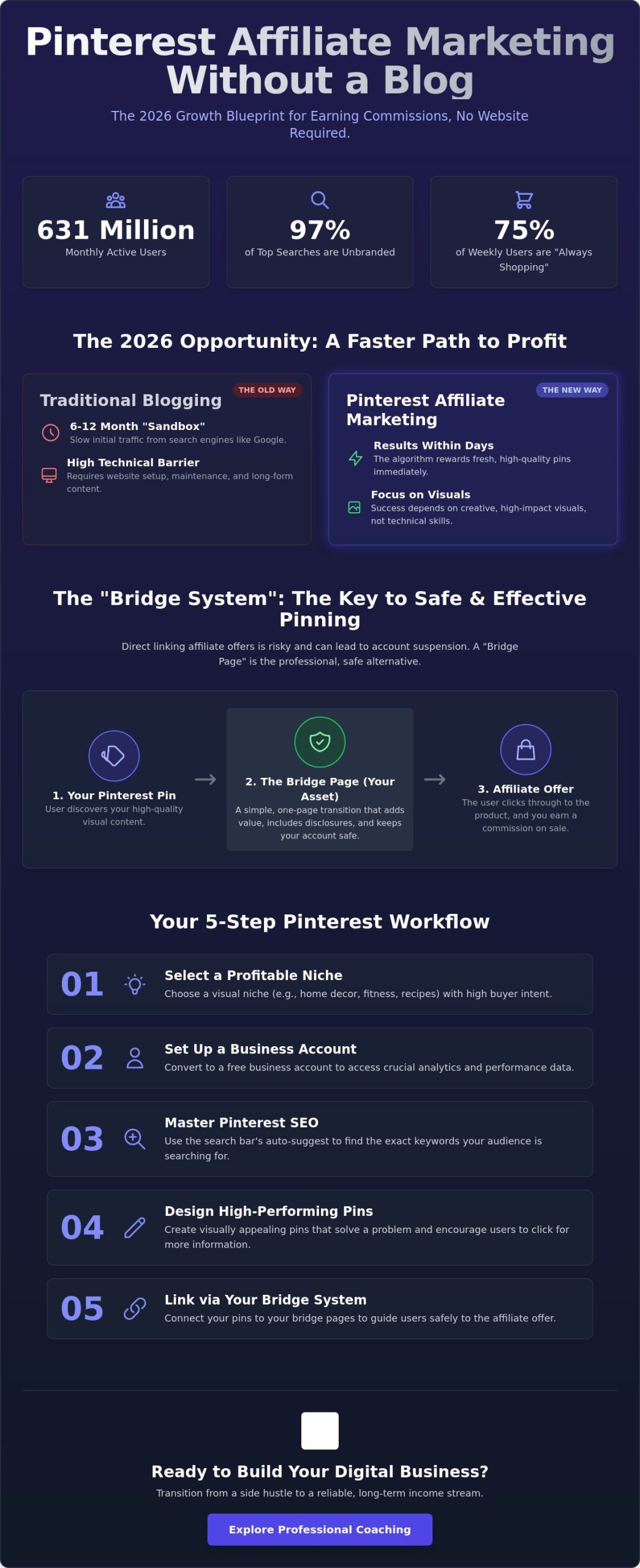
Starting in 2026 is particularly advantageous because Pinterest’s current algorithm prioritizes fresh, original content over the age or “authority” of a domain. If you launch a traditional blog today, you might wait six to twelve months in a “sandbox” before search engines like Google even notice you. Pinterest works differently. Because it rewards new pins immediately, you can see traffic and potential commissions within days rather than months. This removes the primary barrier for most beginners and allows you to focus entirely on the creative side of your business.
To better understand how this concept works in practice, watch this helpful video:
Distinguishing between “social pinning” and “affiliate pinning” is vital for your progress. While social pinning is about sharing inspiration or personal interests, affiliate pinning is a strategic, results-oriented process. You aren’t just posting pretty pictures. You’re creating visual solutions for people who are actively looking to buy. By positioning your pins as helpful resources, you build a bridge between a user’s problem and a product that solves it.
The Shift from Social Media to Visual Search
Most people treat Pinterest like Facebook or TikTok, but it functions more like a visual version of Google. Users on other platforms are usually there to be entertained or to chat with friends. On Pinterest, people are often in a “planning” or “buying” mindset. According to Pinterest’s 2026 data, 75% of weekly users say they are “always shopping.” This high buyer intent means your pins reach people who are looking for a reason to spend money. If your content provides that reason, the algorithm will continue to surface your pins in search results for months.
Why You Do Not Need a Blog in 2026
The rise of micro-landing pages and bridge systems has made traditional blogging optional. Instead of writing a 2,000-word article, you can use a simple bridge page to provide context and satisfy Pinterest’s safety filters. This strategy is much more time-efficient. If you only have five hours a week to dedicate to your business, spending that time on high-impact visuals is far more effective than trying to manage a WordPress site. Pinterest currently allows direct links in many categories, but using a bridge system ensures your account remains in good standing while building trust with your audience.
The Bridge System: Why Direct Linking is a Risk
Many people starting out with Pinterest affiliate marketing without a blog assume they can grab a link from an affiliate network and paste it directly into their Pin’s destination URL. While this might seem like the fastest path to a commission, it’s a high-risk strategy that often leads to account suspension. Pinterest uses sophisticated spam filters to protect its users, and direct affiliate links are frequently flagged as low-quality or untrustworthy content. A bridge page is a one-page transition between a Pin and an offer. This simple middle step acts as a safety net, ensuring your account remains in good standing while you build a professional presence.
Beyond account safety, there’s a significant legal component to consider. The FTC disclosure requirements mandate that you clearly communicate your relationship with the brands you promote. When you use a bridge page, you have a dedicated space to include these necessary disclosures, which builds trust with both the regulators and your audience. It’s a small step that protects your business from potential penalties that can reach over $50,000 per violation in 2026.
The Problem with Direct Linking
Direct linking creates a “bait and switch” experience for the user. If someone clicks a beautiful image of a home office setup and is immediately redirected to a cluttered sales page, they’ll likely hit the back button. This friction kills your potential for earnings. You also lose the ability to track data. If you don’t know which Pins are actually driving sales, you can’t optimize your strategy for better results. Without this middle step, you’re essentially flying blind in your marketing efforts.
Building Your First Automated Funnel
If you want to increase your conversion rate by as much as 300% compared to direct linking, a simple automated funnel is the answer. This is the most effective way to manage Pinterest affiliate marketing without a blog while scaling your results. By using a bridge page, you can capture email addresses and turn a one-time visitor into a long-term asset. This allows you to follow up with users who didn’t buy immediately, which is where the majority of profits are often found. If you’re looking for a structured way to set this up, the ClickBank Super Funnel provides a ready-made solution that handles the heavy lifting for you.
Transitioning to a funnel-based approach allows you to control the narrative. You can introduce the product, explain its benefits, and then guide the user to the final offer in a way that feels helpful rather than salesy. This methodical approach builds trust, which is why many successful marketers choose to work with Online Success Coaching to refine their strategy and ensure long-term growth.
Mastering Pinterest SEO and Pin Design
If you treat Pinterest like a search engine instead of a social network, you’ll unlock the true potential of your campaigns. Success depends on three core pillars: keywords, board relevance, and image metadata. Because the platform uses visual recognition technology, it can actually identify the objects and text within your images to decide who should see them. When you’re executing Pinterest affiliate marketing without a blog, your pin’s metadata becomes your primary tool for discovery. This means you need to be intentional about every word and pixel you upload.
The first pillar is keyword placement. You should include your primary terms in the pin title, the description, and even the “alt-text” field. This helps the algorithm categorize your content accurately. Board relevance is the second pillar; if you’re pinning a kitchen gadget, it must live on a board specifically about kitchen organization or home cooking. Finally, the third pillar is the image itself. Pinterest’s AI reads the text on your image, so using clear, bold fonts helps the system understand your offer before a human even reads the description.
Finding Profitable Keywords
You don’t need expensive software to find what people are searching for. The Pinterest search bar “auto-suggest” feature is your best friend. If you type a broad term like “home office” and then the letter “a”, Pinterest will show you exactly what users are looking for. This “ABC method” allows you to discover long-tail keywords that have less competition. As you learn how to make money as an affiliate marketer, you’ll see that keyword precision is your most valuable asset. Using the “Trends” tool also helps you anticipate seasonal spikes, such as fitness equipment in January or gardening tools in April, allowing you to prepare your pins weeks in advance.
High-Converting Pin Anatomy
A scroll-stopping pin usually follows a standard 2:3 aspect ratio, which is about 1000 by 1500 pixels. This vertical format dominates mobile feeds, where 80% of Pinterest users spend their time. To trigger clicks, use text overlays with “Power Words” like “Essential,” “Hidden,” or “Transform.” These words create curiosity and encourage users to stop scrolling. I recommend the “Three Pin Rule”: create three distinct designs for every single affiliate offer you promote. One might be a lifestyle shot, one a product closeup, and one a text-heavy tutorial. For example, if you are promoting high-end Karndean flooring, referencing the professional imagery at franklyflooring.co.uk can help you create these varied pins effectively. This strategy helps you identify which visual style resonates most with your audience without needing to write a single blog post.
Visual consistency is another key factor. Even if you don’t have a central blog, using a consistent color palette and font selection builds a sense of familiarity. When users see your pins repeatedly, they begin to recognize your brand as a reliable source of information. This trust is what ultimately leads to the clicks that generate your passive commissions.
Step-by-Step: Promoting Affiliate Products on Pinterest
Moving from theory to execution requires a methodical approach to ensure your efforts result in actual commissions. When you’re building a business around Pinterest affiliate marketing without a blog, your first task is selecting a niche that translates well into imagery. Visual categories like home decor, DIY projects, technology gadgets, and personal finance consistently perform well. These niches work because users are often looking for specific solutions or inspiration, making them more likely to click through to an offer that solves their immediate problem.
Once you’ve identified your niche, you must vet your affiliate programs carefully. While platforms like ClickBank and Impact are excellent choices, you should always check their terms of service to ensure they allow traffic from Pinterest. Accuracy in your setup is vital for long-term health. For instance, Pinterest prohibits the use of link shorteners like Bitly because they can trigger spam filters. You also need to remain compliant with the law. The FTC can issue penalties of up to $51,744 per violation for inadequate disclosures. Always include clear tags like #ad or #affiliate in your pin descriptions to maintain transparency with your audience and the platform.
Setting Up for Success
If you want Pinterest to trust your content, you should verify the domain of your bridge page or funnel. This verification tells the algorithm that you’re a legitimate creator rather than a temporary bot. After your account is verified, create five to ten niche-specific boards. Each board should have a keyword-rich description that explains exactly what a user will find there. Your professional bio should also reflect this focus, positioning you as a helpful curator who provides value rather than just a marketer looking for a click.
The Execution Phase
In 2026, the daily pinning workflow is more about quality than sheer volume. It’s better to post three high-quality, original pins than thirty low-effort ones. If you use scheduling tools, you can maintain a consistent presence without being tied to your computer 24/7. This consistency allows the algorithm to learn your posting patterns and show your content to the right people. As your traffic grows, use your analytics to identify your top-performing pins. If a specific design or topic is getting more traction, double down on that style to maximize your results. For those who want to skip the trial and error, getting professional Online Success Coaching can provide the personalized guidance needed to scale your efforts quickly.
If you’re using a single-page funnel, you can also utilize a “Link in Bio” strategy on your profile. This provides a central hub for your most popular offers, making it easy for returning followers to find what they need. By combining these steps, you create a professional, automated system that works for you around the clock.
Scaling Your Pinterest Business with Professional Coaching
Starting with Pinterest affiliate marketing without a blog is an excellent way to dip your toes into digital entrepreneurship, but moving from a casual side hustle to a sustainable business requires a shift in mindset. This DIY plateau often happens because without a structured plan, it’s easy to get lost in the minor details of pin design while missing the bigger picture of business growth. Many beginners find themselves excited during the first week, only to quit after thirty days when they don’t see immediate, life-changing results. If you’re serious about creating a reliable income stream, transitioning toward a professional framework is the next logical step.
Mentorship acts as a bridge between struggling with complex systems and achieving a predictable outcome. When you have a seasoned practitioner sharing insights in a one-on-one setting, the uncertainties that typically lead to burnout begin to fade. Instead of guessing which strategies might work, you follow a clear roadmap that has already been tested and refined. This steady encouragement helps build the confidence necessary to navigate the ever-changing digital landscape with ease.
Moving Beyond the Basics
Once you’ve mastered the mechanics of pinning and basic SEO, your focus should shift toward advanced automation. Linking your Pinterest traffic to automated email sequences allows you to build a relationship with your audience on autopilot, ensuring that a single click can lead to multiple touchpoints. Strategic scaling involves moving from low-ticket items to high-ticket affiliate offers, as the same amount of traffic can lead to significantly higher commissions when the offer is right. To refine your approach to audience acquisition, you can learn more about Strategic Traffic Generation to ensure you’re attracting the right buyers. By automating these processes, you free up your time to focus on high-level strategy rather than repetitive manual tasks.
The Value of Mentorship
The digital world is full of distractions, often referred to as “shiny object syndrome,” where marketers jump from one strategy to the next without ever seeing one through. Having a steady, reliable guide can shave months off your learning curve by providing a clear roadmap based on proven results. Frank Novak’s Online Success Coaching is designed to help you navigate these complexities with confidence, ensuring that every pin you create contributes to your long-term financial freedom. If you’re ready to stop guessing and start building a professional system, you can Apply for Online Success Coaching to automate your path to commissions. This personalized mentorship turns the potential of Pinterest affiliate marketing without a blog into a structured reality for your future.
Building Your Passive Future on Pinterest
By shifting your perspective from simple social sharing to strategic visual search, you’ve already taken the most important step toward a more efficient income stream. We’ve explored how the bridge system protects your account from filters while significantly boosting your conversion rates. You now understand that success in Pinterest affiliate marketing without a blog isn’t about the sheer volume of pins, but rather the quality of your keyword metadata and the intentional design of your visuals. This methodology allows you to bypass the traditional blogging sandbox and reach an audience with high buyer intent almost immediately.
If you’re ready to move beyond the learning phase and implement a fully automated system, professional mentorship is the most reliable path forward. Frank Novak’s coaching provides a clear roadmap that includes the proprietary ClickBank Super Funnel and a focus on 2026-compliant automation. You don’t have to navigate these technical landscapes alone when you can have a seasoned practitioner guiding your progress every step of the way. Start your journey with Frank Novak’s Online Success Coaching today to transform these insights into a sustainable digital business. Your path to professional growth is clear, and with the right support, your potential is limitless.
Frequently Asked Questions
Do I need a Pinterest Business account for affiliate marketing?
Yes, you definitely need a Pinterest Business account. This type of account gives you access to vital analytics, such as which pins are driving the most clicks and saves. It also allows you to verify your domain, which builds trust with the Pinterest algorithm. Transitioning to a business profile is free and ensures you’re using the platform in a way that aligns with their professional guidelines.
Can I link directly to ClickBank from a Pinterest Pin?
You can link directly, but it isn’t recommended for long-term success. Pinterest’s spam filters are increasingly sensitive to raw affiliate links from networks like ClickBank. If you want to build a sustainable business, sending traffic to a bridge page first is a much safer approach. This middle step protects your account from being flagged and allows you to provide more context to the shopper before they see the sales page.
How many pins should I post per day to see results?
Consistency is more important than posting a high volume of content. In the current year, aiming for three to five fresh, high-quality pins per day is a solid strategy. This pace allows you to maintain a presence without overwhelming the algorithm or sacrificing design quality. If you focus on creating pins that solve specific problems, you’ll likely see better engagement than if you were pinning dozens of generic images.
Is Pinterest affiliate marketing still profitable in 2026?
Yes, the platform is more profitable than ever. With 631 million monthly active users as of Q1 2026, the reach is massive. Since 75% of weekly users are actively shopping, the buyer intent is far higher than on other social networks. If you use a methodical approach to Pinterest affiliate marketing without a blog, you can tap into a growing demographic of users looking to discover and buy new products.
What happens if Pinterest marks my affiliate link as spam?
If your link is flagged, your pin will lose visibility, and your account could face suspension. To avoid this, stop using direct links immediately and switch to a bridge page or a funnel system. This acts as a safety net that keeps your account in good standing. If you’ve already been flagged, reach out to Pinterest support politely to explain your situation, but prevention through a bridge system is always the best strategy.
Do I need to show my face on Pinterest to make money?
You don’t need to show your face to be successful. Because Pinterest is a visual search engine, users are looking for ideas, products, and solutions rather than personal updates. You can build a very profitable business using high-quality product photography, helpful infographics, and clear text overlays. This allows you to maintain your privacy while still providing the visual inspiration that Pinterest users crave during their search.
How much does it cost to start Pinterest affiliate marketing without a blog?
Starting is very affordable since you aren’t paying for a traditional website or hosting. You can set up your Pinterest Business account for free. Your primary investment will be a small monthly fee for a landing page builder or a bridge page tool. This setup is significantly cheaper than the costs associated with custom web development, making it an accessible entry point for those just starting their digital growth journey.
How do I properly disclose affiliate links on Pinterest?
You must disclose your relationship clearly by adding #ad or #affiliate to your pin description. The FTC takes this seriously, with potential penalties reaching up to $51,744 per violation for missing disclosures. Ensure the tag is easy to see before the user clicks the link. Being transparent builds trust with your audience and ensures you stay compliant with both Pinterest’s policies and federal regulations regarding Pinterest affiliate marketing without a blog.

Article by
Frank Novak
Frank Novak is an online marketing professional and coach who focuses on affiliate marketing and business automation. Through his website, frank-novak.com, he shares insights and strategies for leveraging social media platforms like Facebook to generate traffic and commissions.
Affiliate / Sponsored Content Disclaimer
This [website/post] contains affiliate links. If you click through and make a purchase, we may receive a commission at no additional cost to you. We only recommend products or services we believe will add value to our readers.