

What if better email conversions came from sending fewer, more relevant messages rather than building dozens of complicated segments? If you’re wondering how to segment your email list for better conversions, it’s understandable to feel unsure where to start. A one-size-fits-all campaign can miss what subscribers care about, but collecting too much data or creating endless groups can make email harder to manage.
The most useful segments are built around what people need and what they do, such as the topic that brought them to your list or the links they choose to click. That gives you a practical way to make messages and calls to action more relevant without guessing or overcomplicating your setup.
In this guide, you’ll learn how to choose useful subscriber data, create a few manageable segments, and shape email journeys around each group’s intent and behavior. You’ll also see how to measure results and refine your segments over time, so your approach can improve as you learn more about your audience.
Key Takeaways
- Learn how to segment your email list for better conversions by choosing signals that help you send more relevant messages, not by collecting data without a clear purpose.
- Follow a simple workflow: set a goal, select a reliable signal, create a segment, tailor the message, and review the results.
- Compare behavior-based, interest-based, lifecycle-based, and source-based segments to find an approach that fits your audience and campaigns.
- Give each segment a clear reader need, message, and next action, then measure engagement and conversions to see what may need refining.
- Keep segmentation manageable by documenting how groups work and merging, pausing, or revising segments that no longer change what you send.
What Email List Segmentation Means and Why It Can Improve Conversions
If your list includes people with different interests, questions, and levels of readiness, one campaign may not fit everyone. Email segmentation is grouping subscribers so you can match messages to their interests, actions, or stage. Learning how to segment your email list for better conversions starts with that simple idea: send each group something more relevant than a message designed for the whole list.
A closer fit can make the subscriber experience more useful and give readers a clearer next step, whether that’s clicking a resource, replying, signing up, or making a purchase. Segmentation doesn’t guarantee those outcomes, but it can help you shape a focused strategy. As a foundational overview, Marketing automation describes segmentation as dividing an audience using criteria such as demographic, psychographic, and behavioral information.
For a practical introduction to the process, watch this beginner tutorial:
What Does Email List Segmentation Actually Do?
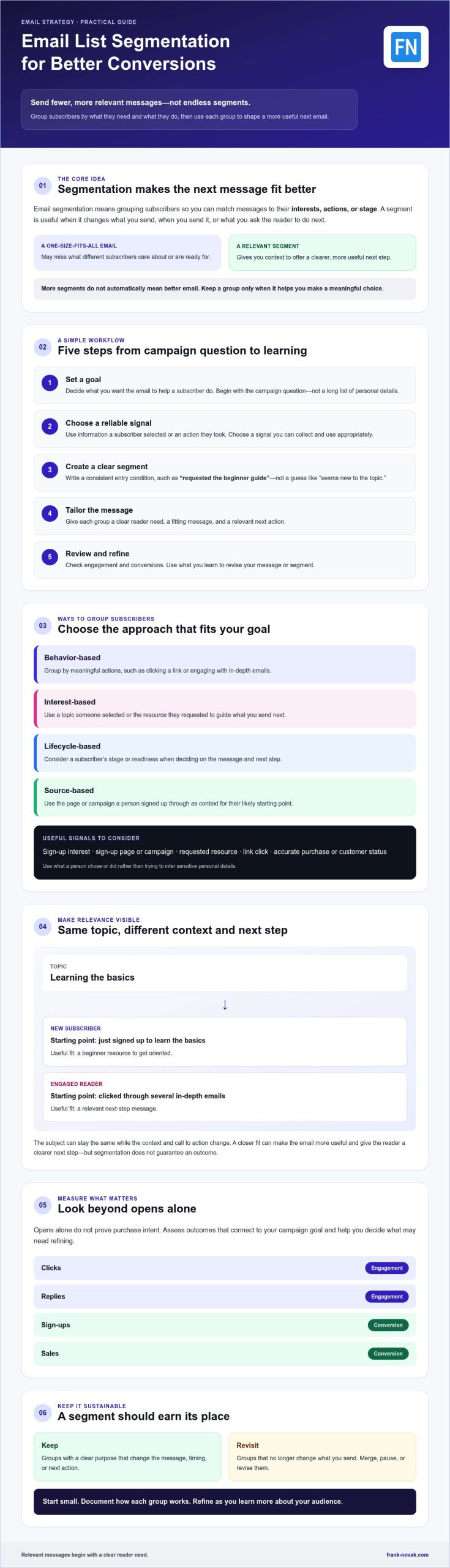
A single subscriber list can include someone who has just signed up to learn the basics and someone who has already clicked through several in-depth emails. A beginner resource may help the new subscriber get oriented, while an engaged reader may be ready for a useful next-step message. The topic can be the same, but the context and call to action can differ.
A segment is useful when it changes what you send, when you send it, or what you ask the reader to do next. If splitting a group doesn’t meaningfully affect any of those choices, the extra segment may add work without making the campaign more relevant.
Why Relevance Matters More Than Making More Segments
More segments don’t automatically mean better email. Opens alone don’t prove purchase intent, and demographic labels may not explain what a subscriber wants right now. Look for signals that connect to a useful message, then assess outcomes such as clicks, replies, sign-ups, or sales.
Start with a small number of groups that each serve a clear purpose. You don’t need a large list or an elaborate data system to begin. A relevant sign-up interest or meaningful action may be enough. Keep the focus on whether the segment helps you make the next email more useful.
How to Segment Your Email List for Better Conversions: A Step-by-Step Framework
A manageable segmentation workflow begins with a campaign question, not a long list of personal details. Before you collect another data point, decide what you want the email to help a subscriber do. Then identify the signal that can guide a more relevant message.
In short, define the goal, use a reliable signal to create a group, tailor the next message, and review what happens. This framework gives you a practical way to learn how to segment your email list for better conversions without building a complicated system before you need one.
Choose the Subscriber Signals That Matter to Your Goal
Start with signals you can collect and use appropriately. These might include an interest someone selects on a sign-up form, the page or campaign they signed up through, the resource they requested, or a meaningful action such as clicking a link. Purchase or customer status can also help, but only if you already collect that information accurately and have a suitable reason to use it.
For an affiliate marketer, a subscriber’s interest in a particular topic and their stage in a funnel may help shape the next email. Keep the distinction practical: use what a person chose or did, rather than trying to infer sensitive personal details. Klaviyo’s overview of email segmentation strategies offers additional examples of signals marketers can consider.
Build a First Segment Without Overcomplicating Your List
Choose one audience problem or campaign outcome, then write a clear entry condition. For example, “requested the beginner guide” is easier to apply consistently than “seems new to the topic.” Give the segment a name that explains its purpose, such as “Beginner guide requested,” so its meaning is clear when you review it later.
Before planning a campaign around a signal, check that your email platform can capture and apply it reliably. What’s available depends on your sign-up form, platform, consent, and tracking quality. If you’re mapping groups into a broader customer journey, see this overview of online business resources as a starting point for thinking about how a funnel fits together.
Use a Five-Step Workflow
- 1. Define the goal. Choose a reader action to support, such as clicking a relevant resource or signing up.
- 2. Choose a useful signal. Select a declared interest, source, requested content, or tracked action that relates to the goal.
- 3. Create the segment. Set a clear entry condition and confirm your platform can apply it.
- 4. Tailor the message. Adjust the example, context, or next step to suit the group.
- 5. Review results. Check the outcome tied to your goal, then keep, revise, or remove the segment based on whether it helps guide a different message.
That final review keeps segmentation useful rather than ornamental. If a group doesn’t change the message or next action, combine it with a broader segment and keep your workflow simpler.
Which Email Segmentation Strategy Fits Your Audience and Goals?
The right approach depends on the distinction that would actually change your email. A small list can still benefit from segmentation. You might simply separate people who requested different resources or chose different topics. Avoid creating groups just to make the list look organized. If two groups would receive the same message and next step, they may not need separate treatment.
Use the comparison below to match a signal to a campaign. These approaches can work together, but combine them only when each adds a useful distinction. For more ideas, explore these email segmentation strategies.
| Approach | Signal needed | Useful campaign | Maintenance effort | Potential limitation |
|---|---|---|---|---|
| Behavior-based | A tracked click, download, or other relevant action | Follow-up related to a resource someone requested or clicked | Requires checking that tracking and segment rules work | An action shows what happened, not necessarily what someone intends to buy |
| Interest-based | A topic preference the subscriber clearly stated | Content or examples focused on a selected subject | Low if preferences are simple and kept current | Stated interest may change or may not indicate readiness to purchase |
| Lifecycle-based | A relevant status, such as new subscriber, active prospect, or customer | Welcome, consideration, or customer follow-up messages | Depends on how reliably status is updated | Not every business has meaningful lifecycle stages or accurate status data |
| Source-based | The form, page, or campaign a subscriber came from | Contextual follow-up connected to the sign-up experience | Usually manageable if sources are recorded consistently | Source alone doesn’t prove ongoing interest |
Behavioral Segmentation: Respond to What Subscribers Do
A click on an affiliate marketing topic, a download of a beginner resource, or completion of a relevant action can help determine what follow-up to send. Treat the event as an observed signal, not a conclusion about purchase intent. Tracking features and accuracy vary by platform and setup, so verify how actions are recorded and how segment rules are applied before relying on them.
Interest, Lifecycle, and Signup-Source Segmentation
If subscribers choose a topic on your form, use that preference to guide examples and content. Lifecycle groups can help distinguish a new subscriber from an active prospect or customer, but only if those categories fit your business and you can identify them accurately. A sign-up source can provide useful context, such as which resource prompted registration, but it shouldn’t define someone’s long-term interests by itself.
To decide how to segment your email list for better conversions, start with the signal that best supports the campaign goal. Then check whether it gives you a genuinely different message or next step. Keep the rest of the list together until another meaningful distinction emerges.
How to Turn Segments into Relevant Emails and Measure Results
A segment becomes useful when it guides the email itself. For each group, write a brief plan: who receives the message, why it fits their needs, and what action you want them to take. This keeps the campaign focused and helps you apply how to segment your email list for better conversions in a practical way, without creating an entirely separate email for every subscriber.
Match the Email and Call to Action to the Segment
Use the segment’s needs to adjust the subject line, examples, offer context, and call to action. A new subscriber might receive an educational resource or an invitation to explore a topic further. Someone who has shown relevant interest may be ready for a more direct offer, provided the message fits their actions and the offer is appropriate.
For example, an affiliate marketer could send readers who requested introductory content a helpful explanation before introducing a next step. A broader affiliate funnel resource, such as the ClickBank Super Funnel, can serve as an example of how email communication may relate to a larger funnel. The aim is to make the transition understandable, not to assume every subscriber is ready for the same offer.
Keep the core campaign where it works for multiple groups, then change only the parts that matter: a subject line that reflects the reader’s interest, an example that fits their context, or a call to action suited to their stage.
Measure, Test, and Refine Without Misreading the Data
Choose a measure that matches the goal. If the email asks readers to review a resource, track clicks. If it invites a conversation, track replies. For a sign-up or sale, review that outcome where your tracking allows. Opens can offer context, but Apple Mail Privacy Protection may inflate reported open rates, so don’t treat opens alone as proof that a message resonated.
For a fair comparison, look at campaigns with similar audiences and goals, and note differences such as timing, subject line, or offer. Test one meaningful change at a time when possible, and keep a simple record of the segment, message, change, and result. If the audience or campaign conditions differ, describe the comparison cautiously rather than assigning the result to segmentation alone.
Before drawing a conclusion, confirm the rules still include the intended subscribers, exclude those who don’t fit, and handle any overlap as expected. Review whether the signal is current. A small or inconsistent sample may not point to a reliable winner, so keep the result provisional and test again as more data becomes available.
For related ideas, see Frank Novak’s online business resources.
How to Maintain Email Segments and Make Them Part of a Sustainable Funnel
A segment is only helpful if you can keep its rules accurate and understand why it exists. Document the basics in one place so you or a teammate can review the setup without guessing:
- Purpose: the reader need or campaign goal the segment supports.
- Entry rule: the signal that qualifies a subscriber.
- Message: the email or journey the group receives.
- Owner: the person responsible for checking the segment and its content.
- Review trigger: a change in the offer, data source, campaign, or results that should prompt a check.
This simple record helps make how to segment your email list for better conversions a repeatable process rather than a collection of forgotten tags and rules.
Keep Segment Rules Useful as Your List Changes
Review whether the information behind each segment is still accurate and whether subscriber behavior still supports its purpose. Check the segment’s inclusion and exclusion rules, look for unexpected overlap, and confirm that old or outdated conditions aren’t shaping a journey that no longer fits.
Before building or refreshing automation, check consent, preference, and suppression settings in your email platform. Honor unsubscribe requests, and verify the email requirements that apply to your audience and locations before sending. Keep the setup simple enough to review consistently as your list and business evolve.
If two segments now receive essentially the same message, consider merging them. If a segment no longer supports a useful campaign, pause it. Revise it when the audience need still matters but the entry rule or message has changed. Automation can apply these decisions consistently, but it can’t replace the judgment needed to decide whether a segment remains relevant.
Connect Email Segmentation to a Wider Business System
A well-planned journey can connect the source of a subscriber’s interest to a useful resource and then to an appropriate next step. For instance, an affiliate marketer might use an email to explain a topic before pointing interested readers toward a relevant funnel resource. The ClickBank Super Funnel is one example to explore when considering how email may fit into a broader affiliate funnel. It isn’t required for segmentation, and any next step should suit the reader’s needs.
As your approach develops, revisit the segment’s purpose and results rather than adding more rules by default. A clear, maintained structure is easier to improve and more likely to keep messages aligned with what subscribers have shown they need.
Learn more about Frank Novak’s online success coaching.
Start with One Segment and Build from What You Learn
Effective segmentation doesn’t depend on a large list or a complicated setup. It starts with a clear subscriber need, a signal you can use reliably, and a message with one relevant next step. From there, track meaningful outcomes such as clicks, replies, sign-ups, or sales, and adjust groups that no longer guide a different message.
If you’re considering how to segment your email list for better conversions, keep the first version simple. Choose one audience distinction, document why it matters, and review whether it helps you communicate more clearly. Useful automation can make that approach easier to apply, but understanding your audience remains the foundation.
Frank Novak focuses on online marketing, affiliate marketing, and business automation. His resources include Online Success Coaching and the ClickBank Super Funnel, which may be relevant as you think about connecting email journeys to a broader online business.
Start with one thoughtful change, learn from your subscribers’ responses, and let each improvement guide the next. Explore Online Success Coaching with Frank Novak.
Frequently Asked Questions
What is the best way to segment an email list?
The best starting point is to define your campaign goal, then choose one reliable subscriber signal that changes the email you send. Depending on your platform and the permissions you have, that signal might be a stated interest, sign-up source, or relevant action. Begin with a few clear segments, not a complex system. Review outcomes such as clicks or sign-ups before adding more groups, since no single approach fits every audience.
How many segments should an email list have?
There’s no ideal number of segments for every list. A useful segment has a clear purpose and leads to a meaningfully different message or next step. Start with a few manageable groups rather than dividing subscribers into many overlapping categories. If a segment becomes difficult to maintain, or no longer changes what you send, consider combining it with another group or removing it from your active campaign setup.
Can you segment an email list with a small number of subscribers?
Yes, a smaller list can still benefit from segmentation if subscribers have distinct needs or interests. Begin with a simple distinction that affects your message, such as a topic preference someone selected or the resource they requested. Don’t split the list just to create more categories. Since each group may have limited activity, treat early results cautiously and look for useful patterns over time rather than drawing firm conclusions from a few responses.
What data should you use to segment email subscribers?
Use information that’s relevant to your campaign and collected appropriately. Depending on your business and email platform, useful signals may include stated interests, sign-up source, customer status, or actions such as clicking a topic link. Before using a data point, clarify why it’s needed and check that it’s accurate. Avoid inferring sensitive traits or assuming that one click proves purchase intent. Keep the segment tied to a message that serves the subscriber.
Does email segmentation increase conversions?
Segmentation can make emails more relevant, which may support actions such as clicks, sign-ups, or purchases, but it doesn’t guarantee higher conversions. Results depend on factors including the audience, offer, message, timing, and measurement. Choose an outcome that matches your campaign goal, then compare similar audiences and campaigns where possible. Test one meaningful change at a time, and avoid drawing a firm conclusion if the results are limited or inconsistent.
How do I segment an email list for affiliate marketing?
For affiliate marketing, start with a subscriber’s stated topic interest, the resource they requested, or a relevant action that helps guide what content may be useful next. Match the email to an appropriate educational step, and clearly disclose affiliate relationships where required. A click can show interest in a topic, but it doesn’t prove someone is ready to buy. Keep recommendations relevant to the subscriber’s expressed interests and needs.
How often should you review email list segments?
Review segments when campaign performance, subscriber preferences, offers, or automation rules change, and set a regular check-in your team can maintain. Look for outdated information, overlapping groups, and rules that no longer lead to a distinct message. There’s no universal review schedule; the right cadence depends on how quickly your audience and campaigns change. If a segment stops serving a clear purpose, revise it, combine it, or pause it.

Article by
Frank Novak
Frank Novak is an online marketing professional and coach who focuses on affiliate marketing and business automation. Through his website, frank-novak.com, he shares insights and strategies for leveraging social media platforms like Facebook to generate traffic and commissions.
Affiliate / Sponsored Content Disclaimer
This [website/post] contains affiliate links. If you click through and make a purchase, we may receive a commission at no additional cost to you. We only recommend products or services we believe will add value to our readers.