

Did you know that a well-told story can make your message up to 22 times more memorable than a list of facts? If you’ve ever felt like your affiliate links are invisible, you aren’t alone. In a digital world where consumers encounter thousands of ads daily, “ad blindness” has become a survival mechanism for most people. Learning how to use storytelling in affiliate marketing is no longer just a creative choice; it’s a strategic necessity if you want to stand out in a crowded niche.
You likely recognize the frustration of seeing low click-through rates despite your best efforts to share quality products. It’s easy to feel discouraged when your audience seems skeptical, but this is exactly where narrative-driven content changes the game. This guide will show you how to transform cold traffic into a community of loyal customers who value your insight. By mastering this art, you can bypass skepticism and build genuine trust with every post.
If you’re ready to stop sounding like a salesperson and start connecting as a mentor, we’ll provide a repeatable framework for creating engaging content. We’ll explore how to use stories as the fuel for your automated funnels, ensuring better engagement on social media and a steady path toward higher conversion rates.
Key Takeaways
- Understand why the human brain prioritizes narratives over data and how to shift your content from listing product features to sharing authentic, shared experiences.
- Discover a repeatable 5-step framework that explains how to use storytelling in affiliate marketing to address audience pain points and build immediate rapport.
- Learn platform-specific strategies for Facebook and email that allow you to stop the scroll while maintaining compliance with advertising regulations.
- Explore how to weave these stories into automated systems like the ClickBank Super Funnel to nurture trust and pre-sell offers while you sleep.
- Identify the importance of professional mentorship in finding your unique voice, helping you stand out in even the most crowded digital landscapes.
The Psychology of Storytelling in Affiliate Marketing
To understand how to use storytelling in affiliate marketing, we first have to redefine what a story actually is. It isn’t just a creative flourish; it’s the strategic shift from listing product features to sharing a lived, human experience. While a technical spec sheet might provide data, a story provides the context that makes that data matter. In 2026, consumers are increasingly skeptical of “polished” corporate marketing. They crave authenticity because they’ve been conditioned to ignore traditional sales pitches. For those seeking a comprehensive overview of affiliate marketing, it’s clear that the industry has evolved from simple link-sharing to deep relationship-building.
This evolution is driven by the fact that the human brain is hardwired for narrative. When we hear a story, we don’t just process information; we simulate the experience. This creates a “Bridge” between where your reader is now—likely feeling stuck or frustrated—and the solution you’re offering. Instead of telling them why a product is good, you show them how it changed a life. This approach humanizes the process, making you feel like a helpful mentor rather than a distant salesperson. For example, Frank Casey uses this strategy by focusing on the confidence their formal wear provides for life’s biggest milestones, rather than just the suits themselves.
To better understand this concept, watch this helpful video:
Why Facts Tell but Stories Sell
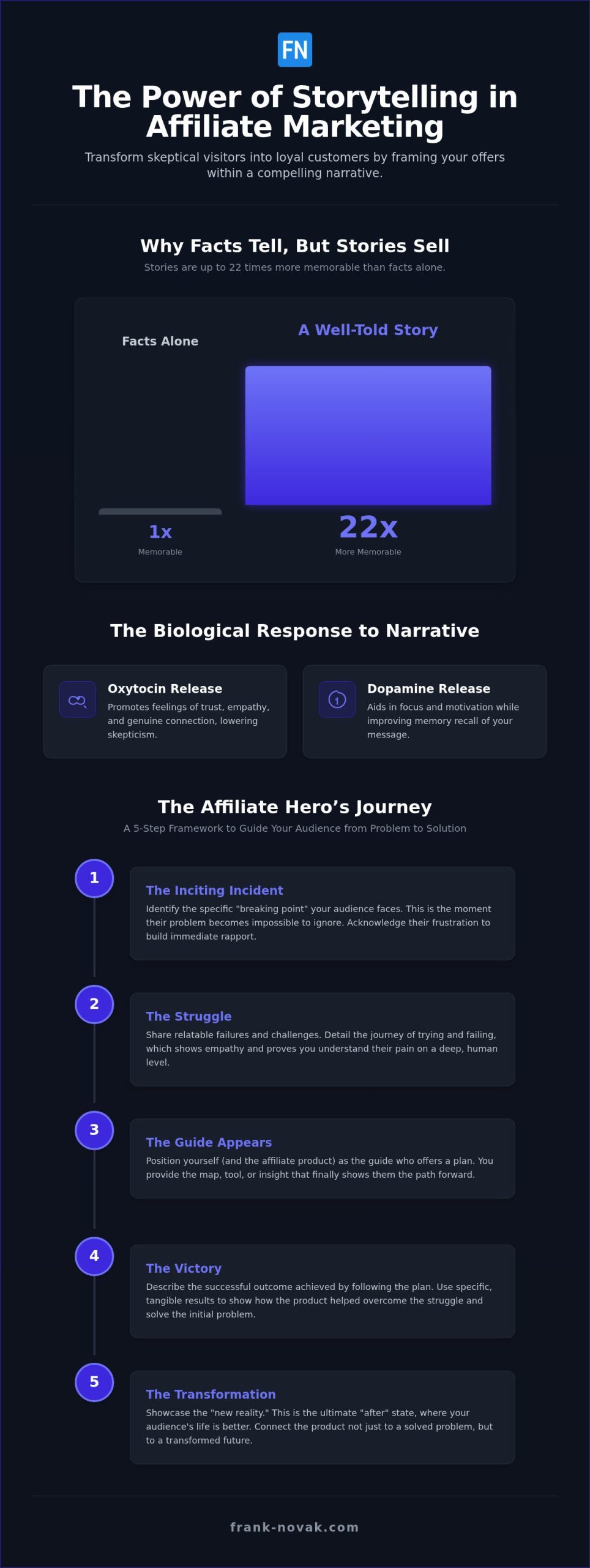
When you share a narrative, your audience’s brain chemistry actually changes. Research in neurobiology shows that stories trigger the release of oxytocin, which promotes trust, and dopamine, which aids in focus and memory. This biological response allows you to bypass the “logical” brain that is constantly looking for reasons to say “no” or close the tab. If you present only bullet points, the reader stays in a critical mindset. If you present a journey, they join you on it. Storytelling is the emotional infrastructure of a sale.
By focusing on shared experiences, you lower the barrier to entry. Consider these benefits of a narrative-first approach:
- It builds immediate rapport by acknowledging the reader’s specific pains.
- It simplifies complex concepts by placing them in a real-world scenario.
- It creates a sense of “if they can do it, I can too” in the reader’s mind.
The 22x Rule: Memorability in a Crowded Market
Data from marketing psychology suggests that stories are up to 22 times more memorable than facts alone. This is a vital statistic for an affiliate because your audience rarely buys the first time they see a link. If you use a narrative, you stay “top of mind” for when they are finally ready to make a purchase. This memorability builds long-term brand authority. When you use a system like the ClickBank Super Funnel, these stories become the fuel that powers your automation. They ensure that every automated email feels like a personal check-in from a trusted friend, which is the key to scaling your growth without losing your soul.
The Affiliate Hero’s Journey: A 5-Step Narrative Framework
While understanding the psychology of narrative is a great start, the real magic happens when you apply a structured framework to your content. Many creators struggle because they treat a story like a random anecdote rather than a strategic path. If you want to master how to use storytelling in affiliate marketing, you should view your audience as the hero of the story and yourself as the guide. This perspective shift is supported by the neuroscience of storytelling, which highlights how certain narrative structures trigger trust and emotional investment in the reader.
A successful affiliate narrative typically follows these five essential steps:
- The Inciting Incident: This is the moment the problem becomes impossible to ignore. You must identify the specific “breaking point” your audience is facing right now.
- The Struggle: Here, you share the relatable failures you or others encountered while trying to fix the problem. This builds immense rapport because it shows you’ve walked in their shoes.
- The Discovery: You introduce the affiliate product not as the hero, but as the “Secret Weapon” that finally worked after everything else failed.
- The Transformation: This is where you paint a vivid picture of life after the solution. It’s about the peace of mind or the time saved, not just the technical features.
- The Call to Adventure: You provide a clear, narrative-driven invitation for the reader to start their own journey by clicking your link.
To see how professional storytellers manage these narrative frameworks to keep readers engaged, you can discover Mike Kingston and explore his political thriller series. Studying how a novelist handles the ‘Hero’s Journey’ provides excellent inspiration for your own marketing narratives.
Identifying the Villain: What’s Stopping Your Audience?
Every great story needs a villain. In affiliate marketing, the villain is rarely a person; it’s usually a systemic problem like “The Algorithm,” “Information Overload,” or “Hidden Fees.” When you personify these obstacles, you give your audience something to root against. By acknowledging the “Villain” in your own past journey, you create instant empathy. You aren’t just selling a tool; you’re offering a way to defeat a common enemy that has been holding them back. This connection transforms a simple recommendation into a shared mission.
The Transformation: Selling the Result, Not the Tool
When you reach the transformation stage, focus on sensory details to describe the “After” state. Instead of saying a software is “fast,” describe the feeling of closing your laptop at 3:00 PM because your work is already done. People don’t buy products; they buy better versions of themselves. Using social proof as a mini-success story within your larger narrative reinforces that this transformation is possible for them too. If you find it difficult to pin down your unique narrative voice, Online Success Coaching can help you refine your message to ensure it resonates deeply with your target market. By focusing on the result, you make the purchase feel like a natural next step in the reader’s personal growth.
Platform-Specific Storytelling: Facebook, Email, and Social Media
Once you understand the narrative framework, you must adapt your delivery to the specific environment where your audience lives. A story that works in a long-form blog post might fail on a social feed if it doesn’t account for user behavior. Knowing how to use storytelling in affiliate marketing requires a deep understanding of platform psychology. For instance, a Facebook user is looking for connection and entertainment, while an email subscriber is often looking for deeper value and continuity. If you treat every platform the same, you risk losing the attention you worked so hard to capture.
The Facebook Narrative: Engagement First, Links Second
On Facebook, your primary goal is to stop the scroll within the first three seconds. This is where “The Hook” becomes your most valuable tool. Instead of starting with a product name, start with a high-stakes moment or a surprising realization from your own life. Industry observations suggest that story-based posts often achieve three times more organic reach than direct promotional links. This happens because the platform’s algorithm prioritizes content that generates meaningful conversation and keeps users on the site longer.
To stay compliant and avoid common ad bans, you should focus on your own journey or a specific case study rather than making bold claims about the reader’s potential results. Use a first-person perspective to share what you discovered. This shift in tone makes your content feel like a personal recommendation from a friend rather than a cold advertisement. If you want to dive deeper into sustainable traffic strategies, you can explore our resources on Facebook Ads for Affiliate Marketing to see how narrative fits into a broader strategy.
Email Sequences: The Art of the Soap Opera
Email is the perfect medium for “Soap Opera Sequences,” which are stories broken into several parts to build anticipation over five or more days. By using open loops, which involve mentioning a secret or a solution you’ll reveal in the next message, you give subscribers a reason to look for your name in their inbox every morning. This method builds a level of trust that a single broadcast email simply cannot match because it allows the reader to follow your progress step-by-step.
Don’t forget the power of the “P.S.” line. Many readers scan to the bottom of an email first, so use that space to deliver a secondary narrative punch or a soft invitation to learn more. Integrating these stories into your automated marketing funnel ensures that your brand remains helpful even when you aren’t manually sending updates. This consistent narrative flow keeps your brand top-of-mind and prepares your audience for the eventual affiliate offer in a way that feels natural and helpful.
Automating the Narrative: Weaving Stories into Your Funnel
Scaling your affiliate business requires moving beyond manual content creation. While many marketers focus on the latest trends, the most successful practitioners focus on building systems that work around the clock. Learning how to use storytelling in affiliate marketing is most effective when you realize that your narrative can be automated. By weaving your personal journey into your email autoresponders and sales pages, you create a consistent brand presence that builds trust while you sleep. This approach ensures that every new lead receives the same high-quality mentorship and guidance, regardless of when they join your list.
The Bridge Page: Where Story Meets Sale
The bridge page serves as the essential handshake between your content and the product you’re promoting. It’s not just a page with a button; it’s the place where you validate the reader’s struggle and offer a path forward. A high-performing bridge page typically follows a clear anatomy: a hook-driven headline, a personal story, a testimonial, and a direct call to action. Research into conversion optimization shows that a short, authentic anecdote on this page can significantly increase click-through rates. You should avoid the “hype” trap. In 2026, people are quick to spot a fake story, so keep your automated narratives grounded in real-world experiences and believable outcomes.
Scaling with Story-Driven Automation
To build a business that lasts, you should focus on creating “evergreen” stories. These are narratives that address core human desires or persistent niche problems that don’t change with the seasons. When you use a structured system like the ClickBank Super Funnel, you can deploy these story-driven assets across your entire marketing engine. This allows you to maintain a personal touch even as your audience grows into the thousands. You can also use dynamic content tags to tailor your stories to different segments, ensuring the message feels relevant to each individual’s journey. Leveraging professional delivery systems like Webinar Profit Engines helps ensure your narrative reaches your audience with maximum impact. By testing which stories drive the most commissions, you can constantly refine your automation for better results.
Mastering Storytelling with Professional Coaching
Mastering how to use storytelling in affiliate marketing is a journey that often requires an outside perspective. While you now understand the mechanics of the hero’s journey and the importance of bridge pages, it can be difficult to see the unique value in your own life experiences when you’re too close to them. A coach acts as a mirror, helping you identify the specific moments in your past that will resonate most with your future customers. This guidance helps you transition from being a “link spammer” who simply pushes offers to becoming a “narrative marketer” who builds a community through shared values and mentorship.
When you work with a professional, you aren’t just learning a skill; you’re developing a unique voice that makes you stand out in a crowded niche. By auditing your current funnel for story opportunities, you can begin to replace cold, clinical descriptions with warm, human experiences. This shift is what allows you to scale your business while maintaining the authenticity that 2026 consumers demand.
Finding Your Unique Founder Story
Your personal “Why” is the most powerful marketing asset you possess. It is the reason your audience will choose to follow your recommendations rather than those of a faceless corporation. Many new marketers fear being “too vulnerable” in their content, yet that vulnerability is precisely what builds the trust necessary for a sale. Through Online Success Coaching, we provide the objective feedback needed to sharpen your narrative. We help you overcome the hesitation of sharing your struggles, showing you how those failures are actually the foundation of your authority. If you can show your audience that you’ve overcome the same “villains” they face, they will naturally look to you for the solution.
Implementation: From Theory to Commissions
Moving from theory to actual commissions requires a structured approach to implementation. If you’re ready to start, consider a simple 30-day plan to integrate one new story into your affiliate business. You might start by rewriting your welcome email or adding a personal anecdote to your highest-traffic bridge page. As you implement these changes, it’s vital to measure your success by tracking engagement, clicks, and sales specifically for your story-based content. You’ll likely find that the more human your content becomes, the more your conversions improve.
- Week 1: Identify your core “Founder Story” and the primary problem it solves.
- Week 2: Audit your automated funnel and find the best place to insert this narrative.
- Week 3: Deploy your story-driven assets and monitor initial audience engagement.
- Week 4: Refine your message based on clicks and feedback to optimize for commissions.
Join the ClickBank Super Funnel today and start telling stories that pay.
Start Your Narrative Transformation Today
The digital landscape of 2026 demands more than just technical proficiency; it requires a return to genuine human connection. You’ve seen how stories can bypass consumer skepticism and how a structured framework can turn a simple recommendation into a shared mission. Mastering how to use storytelling in affiliate marketing is the most sustainable way to build a brand that thrives even as algorithms change. By moving from manual efforts to automated systems, you ensure that your unique voice reaches your audience consistently and effectively.
If you’re ready to bridge the gap between complex systems and your end-user, professional support can make all the difference. You can leverage proven strategies for Facebook traffic and ready-to-use automated digital assets to accelerate your growth. With personalized mentorship from Frank Novak, you’ll have a steady guide to help you identify the stories that truly resonate with your niche.
Scale your affiliate business with the ClickBank Super Funnel
Your journey toward becoming a narrative marketer starts with a single step. We’re here to help you turn your passion into a structured, profitable roadmap. Believe in the power of your own story, and watch as your audience transforms into a loyal community.
Frequently Asked Questions
Do I need to be a good writer to use storytelling in affiliate marketing?
You don’t need to be a literary expert to succeed with these methods. Most high-converting content relies on a clear, conversational structure rather than sophisticated vocabulary. If you follow a repeatable framework, you can produce effective narratives by simply being authentic about your experiences. Effective communication is about clarity and empathy, which is why mentors often focus on your unique voice rather than your grammar skills.
What is the best type of story for a beginner affiliate marketer?
The “Struggle to Discovery” narrative is usually the best starting point for those learning how to use storytelling in affiliate marketing. This involves sharing a specific problem you faced and the frustrations you felt before finding the affiliate product. Because this story is rooted in a real-world scenario, it builds immediate rapport with readers who are currently stuck in that same struggle.
How long should my marketing stories be on platforms like Facebook?
On platforms like Facebook, you should aim for stories between 150 and 400 words. Since you only have about three seconds to stop someone from scrolling, your hook needs to be immediate and punchy. While long-form posts can work well for building deep trust, keeping your narrative concise ensures that you don’t lose the reader’s attention before they reach your call to action.
Can I use other people’s stories if I don’t have my own results yet?
You can absolutely share the success stories of others if you haven’t achieved your own specific results yet. This is often called “The Reporter” method, where you highlight case studies or testimonials from the product’s community. As long as you’re transparent about whose results you’re sharing, these stories provide the social proof needed to validate the affiliate offer’s effectiveness.
How do I make a story about a product I didn’t create myself?
To create a story for a product you didn’t invent, you should focus entirely on the transformation it provides to the end-user. You’re acting as a guide who has discovered a secret weapon. Describe the specific “before and after” moments that the product enables. This shift in perspective helps you understand how to use storytelling in affiliate marketing to position the product as the hero of the solution.
Will storytelling work for technical or ‘boring’ affiliate niches?
Storytelling is actually most effective in technical or “boring” niches because it humanizes dry data. If you’re promoting a technical tool, you can use analogies to compare complex processes to everyday frustrations. By focusing on the time saved or the stress reduced, you make the technical benefits feel tangible and desirable to a non-technical audience.
How do I balance storytelling with the actual sales pitch?
You should generally aim for a ratio of 80% story and 20% sales pitch. The narrative should do the heavy lifting by building trust and demonstrating value, making the final recommendation feel like a natural next step. If your story is compelling enough, the reader will be looking for a way to achieve the same results before you even present the link.

Article by
Frank Novak
Frank Novak is an online marketing professional and coach who focuses on affiliate marketing and business automation. Through his website, frank-novak.com, he shares insights and strategies for leveraging social media platforms like Facebook to generate traffic and commissions.
Affiliate / Sponsored Content Disclaimer
This [website/post] contains affiliate links. If you click through and make a purchase, we may receive a commission at no additional cost to you. We only recommend products or services we believe will add value to our readers.