

What if you discovered that a significant portion of your traffic was actually converting, but those commissions were vanishing into a technical “black hole” before they ever reached your account? It is an incredibly frustrating reality for many marketers who want to know how to track affiliate sales accurately but find themselves struggling with network “shaving” or broken funnel links. If you have ever felt that sinking feeling when your click count rises while your revenue stays flat, you know that relying solely on a network’s default tracking is no longer enough in 2026.
This guide will show you how to implement a fail-safe technical framework designed for a privacy-first environment. We want to help you move past the uncertainty of broken attribution and into a space where your data is reliable and your ROI is clear. We will walk through the essential shift to server-side tracking, how to navigate Apple’s Advanced Fingerprinting Protection, and the exact steps to ensure every click is attributed to you, providing the peace of mind you need to grow your business with confidence.
Key Takeaways
- Identify the “leaky bucket” syndrome where minor technical errors can lead to a significant loss in your total commission revenue.
- Learn the essential technical frameworks for how to track affiliate sales accurately by transitioning from fragile client-side pixels to more reliable attribution models.
- Navigate the complex 2026 privacy landscape, including the latest browser-level tracking prevention, to keep your funnel links fully operational.
- Implement granular Sub-IDs and UTM parameters to gain precise visibility into which traffic sources are delivering your best ROI.
- Discover how automated funnel systems and expert mentorship can provide a fail-safe foundation for scaling your affiliate business with confidence.
Why Accurate Affiliate Tracking is the Foundation of Your Digital Business
Many marketers treat tracking as a secondary technical task, but it’s actually the heartbeat of your entire operation. Learning how to track affiliate sales accurately is what separates a hobbyist from a professional entrepreneur. If you don’t own your data, you don’t truly own your business. Your tracking data is the primary asset you possess, providing the insights needed to scale what works and discard what doesn’t. Without it, you are essentially flying blind.
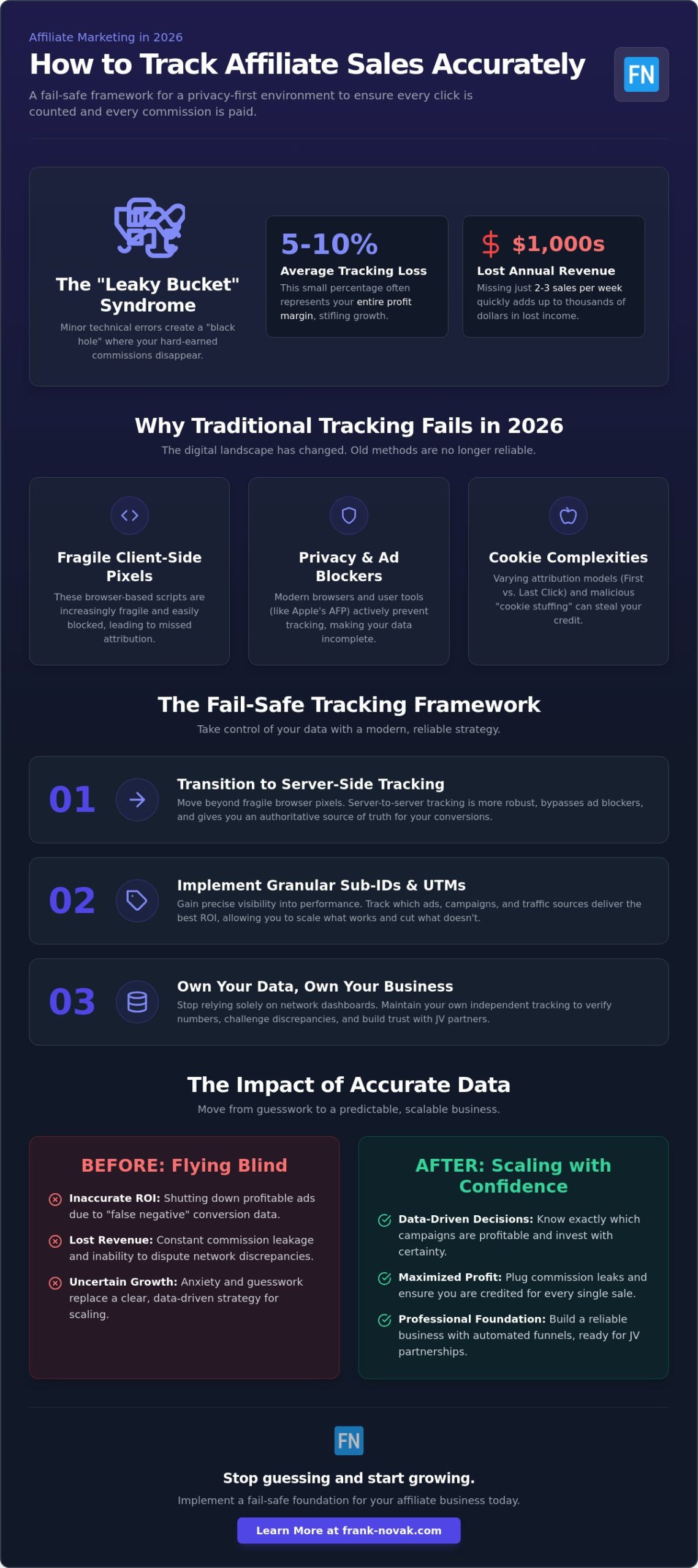
Think of your sales funnel as a bucket. If that bucket has small holes, you can keep pouring in traffic, but a portion of your effort will always go to waste. This “Leaky Bucket” syndrome often results in a 5% to 10% tracking loss, which might sound small initially. However, in the competitive world of affiliate marketing, that small percentage often represents your entire profit margin. If you lose 10% of your credited sales to technical errors, you aren’t just losing pocket change; you’re losing the capital required to reinvest and grow.
To better understand this concept, watch this helpful video:
The Financial Impact of Commission Leakage
Commission leakage is the gap between a customer’s intent and the affiliate’s credited reward. When you look at your stats over a 12-month period, missing just two or three sales a week can add up to thousands of dollars in lost revenue. This doesn’t just affect your bank balance; it warps your decision-making. If your tracking fails to record a conversion from a specific ad, you might conclude that the ad is a “false negative” and shut it down. In reality, that ad might have been your most profitable campaign. Mastering how to track affiliate sales accurately ensures that every dollar you spend on ads is judged by its true performance.
Building Trust with Your Audience and Partners
Reliable data is the bedrock of any professional relationship, especially when you begin exploring Joint Venture (JV) opportunities. If you can’t verify your own numbers, you have no leverage when a network’s dashboard shows a discrepancy. By maintaining your own independent tracking, you can challenge these differences with confidence and clarity. This professional mindset shifts tracking from a boring chore into a vital investment. There is a profound psychological benefit to knowing your numbers inside and out. It replaces the anxiety of guesswork with the steady confidence of a practitioner who understands exactly how their machine operates.
Understanding the Primary Methods of Tracking Affiliate Sales
To master the technical side of your business, you need to understand that not all tracking methods are created equal. Most beginners start with basic links, but as you scale, you’ll find that the mechanics of how affiliate tracking works can vary significantly between networks. In 2026, relying on just one method is risky. Most networks still use client-side pixels, which are small snippets of code that fire in a user’s browser. While these are easy to set up, they’re increasingly fragile because they depend on the browser’s willingness to allow tracking scripts to run without interference.
Cookies and Attribution Windows
Cookies remain a fundamental part of the industry. These small data files live on a visitor’s device to identify you as the referring affiliate. However, you must pay close attention to attribution models. In a “Last Click” model, the very last affiliate link a customer clicks gets the credit. Conversely, a “First Click” model rewards the person who introduced the customer to the brand. For high-ticket offers, such as premium coaching programs, a 30-day or 90-day cookie window is vital. It gives your audience enough time to move through their decision-making process. You should also stay alert to “cookie stuffing,” where malicious scripts overwrite your tracking data. Using a dedicated redirect domain is a great way to protect your links from these issues.
Server-to-Server (S2S) and Postback Tracking
If you’re serious about learning how to track affiliate sales accurately, you need to move toward Server-to-Server (S2S) tracking. This method is often called the “Gold Standard” because it bypasses the user’s browser entirely. Instead of a pixel firing on a web page, the merchant’s server sends a direct signal to the affiliate network’s server using a unique transaction ID. It’s a much more robust system because it’s immune to ad-blockers and privacy settings that usually break standard cookies. This is especially important for tracking sales within mobile apps. When you join a new network, always ask your manager if they support postback URLs. It’s a simple question that marks you as a professional who understands data integrity.
Another reliable method is coupon code attribution. This allows you to track conversions without a direct click, which is perfect for social media or offline promotions. The system simply links a specific discount code to your affiliate ID. If you’re feeling overwhelmed by these technical choices, exploring a pre-configured system like the ClickBank Super Funnel can help you implement these strategies without the technical headache. By combining these methods, you create a safety net that ensures you’re credited for every sale you generate.
Overcoming 2026 Tracking Hurdles: Privacy, Ad-Blockers, and ITP
If you feel like the rules of the game are changing every week, you aren’t alone. The shift towards user privacy has fundamentally altered how we gather data. Apple’s Intelligent Tracking Prevention (ITP) and the legacy of iOS 14+ updates have created an environment where traditional cookies are often blocked or deleted within hours. For anyone trying to figure out how to track affiliate sales accurately, these hurdles can feel like a brick wall. Ad-blockers add another layer of complexity, often preventing standard tracking pixels from firing at all. This means your dashboard might show zero sales even when your customers are buying, simply because the tracking script was suppressed by the visitor’s browser.
As third-party cookies continue to disappear, “First-Party” data has become the only reliable way to maintain visibility. This means you need to collect information directly from your audience rather than relying on a network to do it for you. If you understand the limitations of different tracking methods, you can build a more resilient system. Relying on a third-party script to fire correctly in a modern browser is a gamble that most professional marketers are no longer willing to take.
Navigating the Cookie-less Future
To survive this transition, you must focus on building an email list. By capturing a lead’s email address before sending them to an offer, you “own” the tracking journey from the start. This allows you to use your own first-party data to attribute sales, even if the final conversion happens on a different device later. Many marketers find that their old strategies are simply no longer effective, which is a key theme explored in Never Succeed Online. While some networks use “fingerprinting” as a backup, which uses device settings to identify users, it has significant limitations and is often blocked by privacy-focused browsers like Safari and Brave.
Surviving ITP and Browser Restrictions
Modern versions of ITP, such as ITP 2.3, can shorten the lifespan of your affiliate cookies to as little as 24 hours if the user arrives from a “tracking-capable” domain. If your lead takes two days to decide, you lose the commission. To counter this, focus on these strategies:
- Lead Warming: Provide enough value on your front-end so that users are ready to buy immediately upon reaching the sales page.
- Bridge Pages: Use an intermediate page you control to set your own first-party cookies before the user hits the affiliate link.
- Direct Attribution: Use coupon codes or unique landing pages that don’t rely on a cookie to fire.
Mastering how to track affiliate sales accurately in this climate requires a shift from passive link-sharing to active data management. If you adapt now, you’ll be ahead of the majority of marketers who are still wondering why their numbers don’t match. It’s about building a system that respects privacy while securing your rewards.
How to Implement a Reliable Tracking Strategy for Your Campaigns
If you’re ready to stop guessing which of your efforts are paying off, you need a systematic approach to your technical setup. Learning how to track affiliate sales accurately is about building a chain of evidence that follows a lead from the first click to the final purchase. It’s not enough to hope the network’s links work; you have to verify the journey yourself. To build this foundation, follow these five essential steps:
- Step 1: Use a dedicated link tracker. Instead of raw links, use a redirect domain you own to mask and monitor every click, giving you a backup set of data if the network’s stats fail.
- Step 2: Implement granular Sub-IDs. Use UTM parameters for every traffic source to identify exactly where your buyers are coming from, whether it’s a specific email or a Facebook ad.
- Step 3: Set up custom pages. Use your own bridge pages to fire conversion pixels before the user reaches the merchant, allowing you to track intent even if the final sale isn’t captured.
- Step 4: Audit regularly. Use “Incognito” mode and VPNs to test your links as if you were a customer in a different country, ensuring your redirects aren’t broken for international traffic.
- Step 5: Consolidate data. Bring all your metrics into a single dashboard to create a “Single Source of Truth” for your ROI, rather than jumping between different network accounts.
Mastering Sub-IDs and UTM Parameters
When you start running multiple ads, you’ll quickly realize that knowing you made a sale isn’t enough. You need to know which specific headline, image, or email subject line triggered that sale. By structuring your Sub-IDs to track the Campaign, Ad Set, and specific Creative, you gain the clarity needed to optimize your budget. Sub-IDs act as digital breadcrumbs, allowing you to trace a commission back to its exact origin. This level of detail ensures you don’t waste money on underperforming traffic sources while scaling the ones that convert.
The Power of Redirect Domains
If you’re still using raw affiliate links in your marketing, you’re leaving your business vulnerable to link hijacking and browser-level blocking. A redirect domain acts as a protective shield, keeping your affiliate ID hidden while providing you with independent click data. This is especially important for maintaining a professional appearance in your emails and social media posts. Integrating your redirect strategy with the ClickBank Super Funnel ensures you maintain maximum control over your traffic flow while protecting your hard-earned commissions. If you’re looking for a mentor to help you navigate these technical hurdles, you can find expert guidance through Online Success Coaching.
Scaling with Confidence: How Automation and Coaching Ensure Accuracy
If you’ve already implemented the technical steps discussed in the previous sections, you’re ahead of the vast majority of your competition. However, as your traffic grows from a few dozen clicks to thousands of visitors a day, managing every individual link and Sub-ID manually becomes a recipe for error. This is where automation becomes your greatest ally. Moving from a basic affiliate to a strategic partner means you no longer just hope for a sale; you own the data that proves it happened. By using automated systems, you create a consistent environment where every visitor is logged, tagged, and tracked without you having to lift a finger for every individual click.
This transition from a basic affiliate to a strategic partner is a hallmark of professional growth in any technical field. In the broader financial technology landscape, firms such as Mark Loucas Ltd facilitate this kind of strategic excellence by connecting fintech and digital banking organizations with the specialized talent required to manage complex technical operations at scale.
Automation is the key to longevity. Without it, you’re just guessing. By establishing a system that handles the heavy lifting of data collection, you free up your time to focus on the creative aspects of your marketing campaigns. When you understand how to track affiliate sales accurately through automated workflows, you eliminate the technical friction that often leads to commission leakage. It allows you to scale your budget with the confidence that every dollar spent is being monitored by a system that doesn’t get tired or make manual entry mistakes.
Integrating the ClickBank Super Funnel
Integrating a structured architecture like the ClickBank Super Funnel is the most effective way to maintain this consistency. When you use a pre-built funnel, you aren’t just sending people directly to a merchant’s sales page. Instead, you’re capturing the lead first, which creates a closed-loop tracking environment. This ensures that even if a merchant’s pixel fails to fire, you still have the lead’s contact information and a record of their entry into your system. This architecture is the recommended choice for serious marketers who want to ensure their tracking remains robust across all platforms and devices.
The Role of Professional Coaching
While tools are essential, the human element is often what bridges the gap between a broken setup and a six-figure business. A mentor can often spot tracking leaks that are invisible to the untrained eye, such as subtle redirects that strip away your cookies or misconfigured UTM parameters that lead to “dark traffic.” If you want to scale with total confidence, making decisions based on accurate data rather than guesses is non-negotiable. If you feel like your current setup might still have gaps, you can book a session or explore coaching to audit your tracking. Having a seasoned practitioner look over your shoulder ensures your business is built on a foundation of truth, allowing you to focus entirely on your progress. Mastery of how to track affiliate sales accurately is a journey, and having a guide makes that path much clearer.
Securing Your Future with Data Integrity
We’ve explored how transitioning to server-to-server tracking and using redirect domains can effectively plug the holes in your “leaky bucket.” By mastering Sub-IDs and UTM parameters, you gain the visibility needed to scale your most profitable campaigns without the fear of commission theft. Understanding how to track affiliate sales accurately is the definitive step that transforms a struggling side project into a resilient, professional digital asset.
If you’re ready to stop guessing and start growing, it’s time to implement a system built on decades of experience in business automation. You can build your high-conversion tracking engine with the ClickBank Super Funnel and leverage proven strategies for ClickBank success. We provide personalized coaching for digital scaling to ensure your technical framework is fail-safe and future-proof. You now have the roadmap to protect your hard-earned commissions; it’s simply a matter of putting those building blocks in place. Your journey toward a more stable and profitable business starts today.
Frequently Asked Questions
Why do my affiliate clicks not match my network sales?
Discrepancies usually occur because of commission leakage caused by ad-blockers, browser privacy settings, or technical failures in the network’s tracking script. If a user clicks but their browser blocks the cookie or the pixel fails to fire, the click is recorded while the sale is lost. If you want to know how to track affiliate sales accurately, you must account for these browser-level interruptions by using server-side tracking methods.
Can I track affiliate sales without using cookies?
Yes, you can track sales using server-to-server (S2S) postback URLs or unique coupon codes. These methods don’t rely on the user’s browser storage, making them much more resilient to modern privacy updates like Apple’s Intelligent Tracking Prevention. Learning how to track affiliate sales accurately in 2026 almost always involves moving toward these cookieless options to ensure your data remains reliable across all devices.
How much does it cost to set up accurate affiliate tracking?
While basic tracking is often free through your network, professional tracking software usually involves a monthly subscription. Prices for specialized tools vary depending on your click volume and the specific features you need. If you’re just starting out, using a structured system like the ClickBank Super Funnel provides a cost-effective way to manage your data without the high overhead of custom developed tracking solutions.
Is it possible for someone to “steal” my affiliate commission?
Commission theft can happen through malicious browser extensions or “cookie stuffing,” where another affiliate’s script overwrites your tracking data. To protect yourself, you should always use a redirect domain and mask your links. This prevents bad actors from easily identifying and hijacking your affiliate ID during the redirection process, ensuring your hard-earned rewards reach your account instead of someone else’s.
What is the best way to track sales from Facebook Ads?
The most effective method is using the Facebook Conversions API combined with granular UTM parameters for every campaign. Since iOS updates have limited the effectiveness of the standard Facebook Pixel, sending data directly from your server to Facebook ensures better attribution. This setup allows you to see exactly which ad creative is driving your revenue, even when browser-level tracking is restricted.
How do I know if a network is “shaving” my sales?
You can identify potential shaving by comparing your independent click and lead data against the network’s reported sales. If you consistently see a high volume of qualified leads but zero conversions over a long period, it may indicate a discrepancy. Maintaining your own “Single Source of Truth” dashboard is the only way to verify these numbers and challenge a network with confidence.
What happens if a customer clears their cookies before buying?
If a customer clears their cookies and you’re using standard cookie-based tracking, you’ll likely lose the commission. This is why professional marketers prioritize capturing email leads before sending traffic to an offer. If you have the customer’s email, you can use your own first-party data to maintain the connection and attribute the sale even if their browser storage is wiped clean.
Does Google Analytics 4 track affiliate sales accurately?
Google Analytics 4 is excellent for tracking user behavior on your own site, but it often struggles to track the final conversion on a merchant’s page. Because you don’t control the merchant’s checkout process, GA4 can’t “see” the actual sale. To get a complete picture, you need a dedicated tracker that can receive postback signals directly from the affiliate network’s server.

Article by
Frank Novak
Frank Novak is an online marketing professional and coach who focuses on affiliate marketing and business automation. Through his website, frank-novak.com, he shares insights and strategies for leveraging social media platforms like Facebook to generate traffic and commissions.
Affiliate / Sponsored Content Disclaimer
This [website/post] contains affiliate links. If you click through and make a purchase, we may receive a commission at no additional cost to you. We only recommend products or services we believe will add value to our readers.