
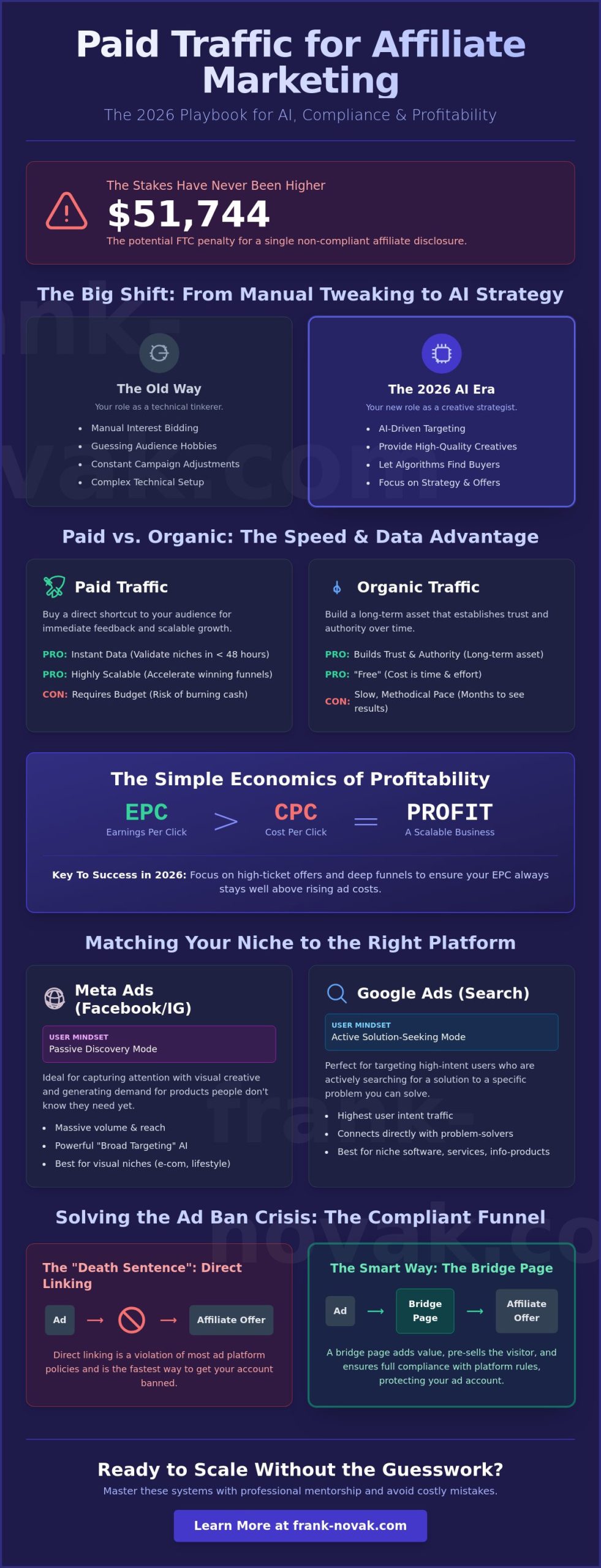
Did you know the FTC can now issue penalties of up to $51,744 for a single non-compliant affiliate disclosure? In 2026, the stakes for using paid traffic for affiliate marketing have never been higher, but the rewards for those who get it right are equally significant. You might feel a bit overwhelmed by the complexity of modern ad platforms or worry about burning through your budget without seeing a return. It’s a common concern, especially when platform rules seem to change every week and the fear of an account ban looms over every campaign.
If you want to move beyond the uncertainty of organic reach and build a business that scales predictably, then mastering these paid systems is your next logical step. This guide will show you how to strategically navigate these challenges to create a steady stream of leads and sales while protecting your professional reputation. We are going to compare the costs and compliance requirements of major platforms like Google and Meta; we will also explore the essential bridge page strategies that keep your accounts safe and your commissions growing in this new landscape.
Key Takeaways
- Understand how AI-driven targeting has transformed the landscape, moving beyond manual bidding to focus on providing platforms with high-quality creative assets.
- Identify the most profitable platforms for your specific niche, whether you’re leveraging the visual appeal of Meta or the high-intent search traffic of Google.
- Learn why direct linking is often a “death sentence” for your accounts and how to use bridge pages to maintain compliance when using paid traffic for affiliate marketing.
- Discover a scalable business model that generates a predictable stream of leads without the constant pressure of 24/7 content creation.
- Explore how professional mentorship through Online Success Coaching can help you navigate complex platform rules and avoid the high costs of wasted ad spend.
What is Paid Traffic for Affiliate Marketing in 2026?
Using Affiliate marketing through paid channels means you are buying a direct shortcut to your target audience. Rather than waiting months for organic search rankings to develop, you pay for immediate visibility on platforms where your customers already spend their time. By 2026, the environment has evolved into a space where AI-driven targeting does the majority of the heavy lifting. We have moved past the days of manual interest-based bidding where you had to guess which hobbies your audience enjoyed. Now, sophisticated algorithms analyze millions of data points to find the right person at the exact moment they are ready to engage. Your role is no longer that of a technical tinkerer; you are now a strategist who provides the high-quality creative assets these AI systems need to perform.
To better understand how these mechanics work in 2026, watch this helpful video:
Think of paid traffic for affiliate marketing as the high-octane fuel for your business automation. If you have a funnel that converts, this traffic acts as an accelerator that can turn a modest stream of income into a significant revenue source very quickly. However, there is a vital distinction between buying clicks and buying customers. Buying clicks is often a vanity exercise that leads to a drained bank account. Buying customers involves understanding the entire journey from the first ad impression to the final checkout. When you treat your ad spend as an investment in a customer relationship rather than just a hit of traffic, your long-term profitability changes for the better.
Paid vs. Organic: Why Speed Matters
While organic Facebook marketing is a vital long-term asset for building trust, it moves at a methodical pace. In contrast, paid traffic for affiliate marketing provides instant data feedback. If you aren’t sure if a new affiliate niche is viable, you can spend a small budget and know within 48 hours if the audience actually responds to the offer. This speed allows you to fail fast and pivot toward profitable campaigns without wasting months on content that nobody wants to read.
The Economics of Paid Affiliate Marketing
Success in this space comes down to two primary numbers: Earnings Per Click (EPC) and Cost Per Click (CPC). If your EPC is higher than your CPC, you have a healthy, scalable business. The Break-Even Point for a 2026 affiliate campaign occurs when your total ad spend exactly matches the total commissions generated from your front-end and back-end offers. Because ad costs have stabilized at a higher level, staying profitable often requires moving away from low-commission retail items. Instead, focus on high-ticket offers or deep funnels that maximize the value of every visitor you purchase, ensuring your margins remain robust even as competition grows.
Comparing the Top Paid Traffic Sources for Affiliates
Choosing the right platform for paid traffic for affiliate marketing is less about finding a “perfect” source and more about matching the user’s mindset to your specific offer. In 2026, different platforms carry distinct levels of user intent that dictate how you should approach your funnel. For example, a person scrolling through Instagram is in a passive discovery mode, while someone searching on Google is in an active solution-seeking mode. Developing a successful affiliate strategy requires you to understand these psychological nuances before you commit your budget. If you ignore the intent behind the click, you risk paying for high volumes of traffic that simply won’t convert into commissions.
Meta Ads: Still the King of Volume
Meta remains a powerhouse for affiliates because of its sheer volume and sophisticated AI. In 2026, the focus has shifted away from granular interest targeting toward “Broad Targeting.” This means you let the algorithm find your audience based on the quality and message of your ad creative rather than manual settings. This approach makes the platform more accessible for beginners, but it puts significant pressure on your ability to tell a compelling visual story. If you’re ready to dive deeper into this specific channel, our guide on Facebook Ads for affiliate marketing provides a step-by-step roadmap for maintaining long-term account safety while scaling.
Google and YouTube: Tapping into Search Intent
Google Search is often considered the gold standard for high-ticket affiliate offers because the intent is incredibly clear. When someone types in “best project management software review” or searches for a specific product bonus, they are very close to a final purchase decision. YouTube Ads offer a unique middle ground by combining the visual storytelling of social media with the intent-based targeting of search. While the technical barrier to entry is higher on Google due to strict compliance rules and the complexity of keyword management, the high quality of the traffic often justifies the extra effort. If you can master search intent, you can capture leads at the exact moment they are ready to buy.
Native Advertising: Scaling Under the Radar
Native advertising platforms like Taboola or Outbrain allow you to scale your campaigns by placing your content on major news sites. This traffic is often “cold,” meaning the reader wasn’t looking for your offer, but the volume is massive and the costs can be lower than search. Success with native traffic usually requires an “advertorial” landing page. This is a bridge page that looks and feels like a news article, helping to warm up the audience and build trust before they see the affiliate offer. If you’re feeling unsure about which platform fits your current business goals, exploring Online Success Coaching can provide the clarity needed to avoid costly trial and error in your early campaigns.
While the “Big Three” dominate the landscape, secondary players like Pinterest and X can be highly effective for specific niches. Pinterest is excellent for visual categories like home decor or DIY, while X remains a strong contender for real-time financial or tech news. Each source has its own learning curve, but the goal remains the same: finding the most efficient way to turn a paid click into a loyal customer.
Solving the Ad Ban Crisis: Compliance and Funnels
Many affiliates jump into paid traffic for affiliate marketing by sending clicks straight to an offer, only to find their accounts disabled within hours. In 2026, direct linking is effectively a death sentence for your ad accounts because platforms prioritize the user experience and safety above all else. They want to see that you are providing genuine value rather than just acting as a middleman who passes traffic along. When an ad platform sees a direct affiliate link, it often flags the account for “low-quality landing page experience,” which can lead to permanent bans that are nearly impossible to appeal.
This is where the “Bridge Page” becomes your most important asset. A bridge page is an intermediate step that warms up the visitor and provides the context the ad platform requires. It allows you to introduce yourself, offer a lead magnet, or share a helpful review before the visitor ever sees the affiliate product. If you want a pre-built solution that handles these complexities, the ClickBank Super Funnel acts as a vital safety buffer between the ad platform and the offer. It ensures that your traffic lands on a high-quality, compliant page that builds trust with both the platform and the customer.
Adopting a compliance-first mindset means treating the advertising platform’s rules as a framework for long-term growth rather than a series of hurdles to bypass. By building a layer of separation between your ads and your offers, you protect your business from sudden platform shifts and ensure your income stream remains stable.
2026 Ad Compliance Protocols
Platforms like Google and Meta now use sophisticated AI bots that scan your landing pages in milliseconds. To stay safe, your pages must include clear links to a Privacy Policy, Terms of Service, and Earnings Disclaimers. You can find more specific details in our guide on Facebook ad compliance for affiliates. It’s also critical to avoid “Aggressive Claims” or unrealistic promises that might trigger an automatic flag. AI moderation is unforgiving, so staying within the lines is the only way to protect your digital assets.
The Power of the Automated Marketing Funnel
Moving from a single-sale mindset to building a long-term lead asset is the secret to scaling. When you use automated marketing funnels, you aren’t just paying for a one-time click; you are building an email list. This lowers your effective lead cost over time because you can market to that same person for months without paying for another ad. Email follow-ups allow you to turn a campaign that might only break even on the first day into a genuine profit machine by the end of the week.
Matching Your Niche to the Right Paid Channel
If you are promoting a health supplement, your strategy will differ significantly from someone selling a high-ticket business course. Success with paid traffic for affiliate marketing requires you to meet your audience where they are most receptive to your specific message. For those in the health and wellness space, the visual nature of Meta allows you to showcase lifestyle transformations, while native advertising provides the perfect platform for long-form storytelling. These “advertorial” styles work exceptionally well for wellness products because they build a narrative before the reader ever sees the product offer.
If your focus is on wealth or business opportunities, you will likely find better results by tapping into the high-intent search traffic on Google or the professional demographics on LinkedIn. While the average CPC on LinkedIn is higher at $5.26, the quality of the lead often justifies the cost for high-ticket B2B offers. Similarly, software and SaaS affiliates often dominate the search results by targeting “comparison” keywords. By positioning your offer as the better alternative to a well-known competitor, you capture users who are already at the bottom of the sales funnel and ready to switch services.
If you’re ready to master these niche-specific strategies and build a sustainable business, Online Success Coaching can provide the personalized guidance you need to avoid common entry-level mistakes.
Budget Allocation Strategies
When you are launching your first campaign, you should set aside a testing budget that allows for at least 100 to 200 clicks per ad variation. Based on 2026 data, with Google Search averaging $2.69 per click and Meta ranging from $0.50 to $2.00, a starting test of $200 to $500 is often necessary to gather meaningful data. Many successful affiliates follow the 70/20/10 rule for scaling their traffic:
- 70% of your budget goes to proven campaigns that are already generating a positive ROI.
- 20% is allocated to testing new audiences or creative variations within those successful niches.
- 10% is reserved for experimental “moonshot” ideas on new platforms like X or Pinterest.
Knowing when to “kill” an ad is just as important as knowing when to scale. If an ad has reached twice your target lead cost without a conversion, it’s usually time to stop the spend and analyze your creative assets.
Tracking and Attribution in a Post-Cookie World
In 2026, you cannot rely on the ad platform dashboard alone to manage your affiliate data. Because third-party cookies have been phased out, server-side tracking has become a necessity for accurate ROI reporting. This technology allows your funnel to communicate directly with the ad platform, ensuring that every sale is attributed to the correct ad. Without this setup, you are essentially flying blind, as you won’t know which specific creative or keyword actually drove the commission. By integrating your funnel with dedicated tracking software, you gain a clear view of the full customer journey from the first click to the final sale.
Scaling to Success: Why Mentorship is the Ultimate Multiplier
If you decide to venture into the world of digital advertising alone, you might find that the hidden costs are much higher than just your ad spend. The 2026 landscape is unforgiving to those who treat paid traffic for affiliate marketing as a simple game of trial and error. Without a steady hand to guide you, it’s easy to fall into the trap of “burning” ad accounts or spending thousands on campaigns that never had a chance of converting. Mentorship acts as a vital safeguard, helping you identify the subtle red flags in your data before they become expensive mistakes. By learning from someone who has already navigated these complex systems, you move from a place of uncertainty to a position of professional authority.
When you choose to work with Online Success Coaching, you aren’t just getting a set of instructions; you are gaining a roadmap for high-spend campaigns. This transition is what separates a casual affiliate marketer from a true digital business owner. Instead of chasing the next “hack,” you focus on building a scalable, automated business model that thrives on predictable systems. Expert feedback on your ad creatives and funnel structure ensures that your budget is always working toward your long-term growth rather than being lost to inefficient testing.
From First Click to Sustainable Growth
If you are ready to move beyond small commissions, using tools like Webinar Profit Engines can help you scale high-ticket offers with precision. These systems allow you to provide deep value to your audience, building the trust necessary for larger sales while keeping your traffic costs manageable. A key part of this sustainability is building a mailing list that serves as your own private traffic source. When you focus on monetizing an email list, you create an asset that you can reach out to repeatedly without having to pay for a new ad every time you have a recommendation.
Your 90-Day Paid Traffic Roadmap
Building a successful business with paid traffic for affiliate marketing is a methodical process. If you follow a structured plan, the journey becomes much more manageable. Most successful students follow this 90-day progression:
- Phase 1: Compliance and Funnel Setup. Focus on building your bridge pages and ensuring every disclaimer is in place to protect your ad accounts.
- Phase 2: The Testing Phase. Run low-spend campaigns to gather high-quality data on your creative assets and audience response.
- Phase 3: Scaling the Winners. Once you identify a profitable combination, you gradually increase your budget while maintaining a strict eye on your ROI.
If you’re ready to skip the months of trial and error and start building your scalable business with a proven guide, Apply for Online Success Coaching today and let’s build your roadmap together.
Build Your Scalable Affiliate Future
Navigating the world of paid traffic for affiliate marketing in 2026 requires more than just a budget; it demands a strategic commitment to compliance and automation. If you focus on providing AI-driven platforms with high-quality creative assets and use bridge pages to protect your accounts, you can build a predictable stream of income that does not rely on constant content creation. By matching your specific niche to the right traffic source and implementing server-side tracking, you ensure that every dollar spent is an investment in a long-term business asset rather than a temporary spike in views.
If you find the technical complexities of ad compliance or funnel setup a bit daunting, you don’t have to face those challenges alone. Our proprietary ClickBank Super Funnel system is designed to provide the safety buffer you need while our mentorship focuses on sustainable business automation. If you are ready to move from trial and error to a proven roadmap, join the Online Success Coaching program to scale your affiliate business with expert guidance. Your journey toward a scalable and secure digital business starts with a single, well-informed step. We are here to help you take it with confidence and clarity.
Frequently Asked Questions
Is paid traffic for affiliate marketing profitable for beginners in 2026?
Yes, paid traffic for affiliate marketing remains profitable for beginners if you prioritize a structured funnel over direct linking. While entry costs have risen, the AI-driven targeting on modern platforms reduces the technical guesswork of finding an audience. You’ll see the best results by focusing on high-ticket offers that provide enough margin to cover your ad spend while you optimize your creative assets.
How much money do I need to start with paid traffic?
You should generally set aside between $200 and $500 for your initial testing phase. This budget allows you to purchase enough clicks to gather statistically significant data on your ads and landing pages. Since the average CPC on Google Ads is $2.69 and Meta ranges from $0.50 to $2.00, this starting amount ensures you can test multiple variations to see what resonates with your audience.
Can I run Facebook ads directly to my affiliate link?
No, running ads directly to an affiliate link is a quick way to get your account permanently disabled. Meta’s 2026 policies require a high-quality user experience, which means you must use a bridge page or a compliant landing page. Direct linking is often flagged as spam or low-quality content; it’s much safer to build a buffer that provides value before the final offer.
What is the best traffic source for ClickBank products right now?
The best source for ClickBank products depends on your specific niche and the audience’s mindset. If you’re in the health and wellness space, Meta and Native ads offer the visual storytelling you need to convert cold traffic. For business or wealth-related offers, Google Search and YouTube are often superior because they tap into high-intent users who are actively searching for a solution to their problems.
How do I avoid getting my ad account banned as an affiliate?
Avoiding account bans requires a compliance-first strategy that includes clear disclosures and a high-quality landing page. You must include a Privacy Policy, Terms of Service, and Earnings Disclaimers on every page your ads point to. If you avoid making aggressive or unrealistic claims in your ad copy, you’ll stay on the right side of the AI moderation bots that scan your content.
Do I need a website for paid affiliate marketing?
Yes, you absolutely need a website or at least a dedicated domain for your landing pages. Ad platforms require you to have control over the destination URL so you can host the necessary legal disclaimers and compliance information. Beyond safety, having your own site allows you to build an email list, which is the most effective way to monetize your traffic over the long term.
What is the difference between PPC and Native advertising for affiliates?
PPC is intent-based traffic where users see your ads after searching for specific keywords on Google or Bing. Native advertising appears as recommended content on news sites and requires an advertorial style to warm up a colder audience. While PPC often converts faster for high-ticket items, Native allows for massive scaling once you’ve dialed in a story that captures the reader’s attention.
How long does it take to see a return on investment with paid ads?
You can see data feedback within 48 hours, but achieving a consistent return on investment usually takes two to four weeks of optimization. This period allows the platform’s AI to learn which users are most likely to convert based on your creative assets. If you’re patient during the initial testing phase, you can identify the winning combinations that will eventually allow you to scale your budget.

Article by
Frank Novak
Frank Novak is an online marketing professional and coach who focuses on affiliate marketing and business automation. Through his website, frank-novak.com, he shares insights and strategies for leveraging social media platforms like Facebook to generate traffic and commissions.
Affiliate / Sponsored Content Disclaimer
This [website/post] contains affiliate links. If you click through and make a purchase, we may receive a commission at no additional cost to you. We only recommend products or services we believe will add value to our readers.