
A single “Rejected” notification in your Ads Manager isn’t a sign to panic; it’s actually a valuable data point Meta provides about your account’s health. We’ve all felt that sinking feeling when a campaign you spent hours perfecting gets flagged by a bot before it even spends a cent. If you’re tired of seeing “Circumventing Systems” warnings or dealing with the inconsistent behavior of the new MARS review system, you aren’t alone. Mastering the art of troubleshooting common Facebook ad rejections for affiliates is no longer just about fixing a typo. It’s about understanding how Meta’s 2026 AI risk scoring evaluates your entire digital footprint from your creative to your landing page.
You can build a stable, long-term ad account even in this strict compliance landscape by shifting your approach from reactive to proactive. This guide will show you exactly why your affiliate ads are hitting walls and provide the precise technical and creative fixes you need to stay online. We’ll walk through the latest 2026 policy shifts, including the April 7th AI disclosure requirements and the tightening of personal attribute rules. By the time you finish reading, you’ll have a clear roadmap to turn those red rejection bars into green “Active” statuses.
Key Takeaways
- Understand Meta’s 2026 “User Experience First” mandate and how AI-driven moderation scans your entire funnel for specific affiliate signatures.
- Learn how to audit your copy for “Personal Attribute” traps and replace high-risk visual red flags with compliant, high-converting imagery.
- Master the architecture of a high-quality bridge page; it’s essential for troubleshooting common Facebook ad rejections for affiliates and protecting your account’s health.
- Identify the technical steps, such as domain verification and Pixel configuration, required to resolve persistent rejections and improve your trust score.
- Discover how to transition from tactical fixes to a sustainable system that uses automation to reduce your dependency on any single platform.
Why Facebook Rejects Affiliate Ads: The 2026 Meta Philosophy
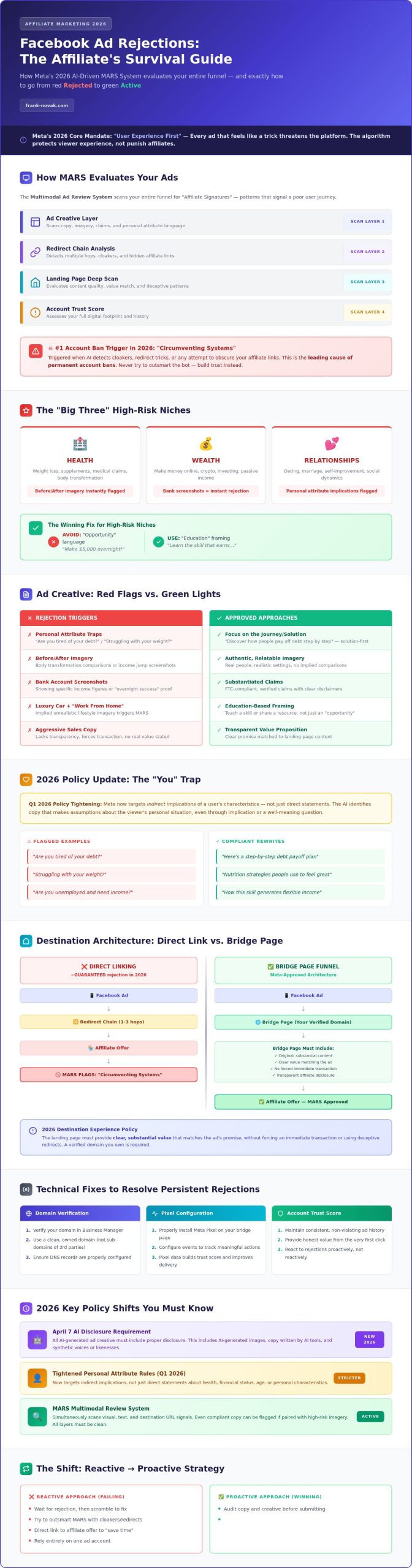
Meta’s primary goal in 2026 is simple: they want users to keep scrolling. Every ad that feels like a “trick” or a “get rich quick” scheme threatens the platform’s long-term health. If you’re currently troubleshooting common Facebook ad rejections for affiliates, you have to understand that the algorithm isn’t out to get you. It’s designed to protect the viewer experience by filtering out anything that looks like low-quality promotional content. When you look at an Affiliate marketing overview, you’ll see a performance-based industry, but Meta’s AI-driven Multimodal Ad Review System (MARS) scans for “Affiliate Signatures” that often signal a poor user journey. These signatures include specific patterns in your funnel, such as bridge pages with no original content or aggressive sales copy that lacks transparency.
If your ad gets rejected, it’s usually a signal that your strategy needs a pivot, not that your account is doomed. The most dangerous flag you can receive is “Circumventing Systems.” This happens when the AI thinks you’re trying to hide your affiliate links or bypass their review process using cloakers or redirects. It’s the leading cause of account bans in 2026. Instead of trying to outsmart the bot, your focus should be on building a “trust score” by providing clear, honest value from the very first click.
To better understand why these rejections happen and how to handle them, watch this helpful video:
The Problem with Direct Linking
In 2026, direct linking to an affiliate offer is almost a guaranteed way to trigger a rejection. When you use a redirect chain, Meta’s bots see multiple hops between the ad and the final page. This looks suspicious to an automated system because it obscures the final destination. You need a clean, verified domain that you own to serve as the destination for your traffic. The 2026 Destination Experience policy requires that the landing page must provide clear, substantial value that matches the ad’s promise without forcing an immediate transaction or using deceptive redirects.
Identifying “High-Risk” Affiliate Niches
While you can succeed in any niche, the “Big Three” consisting of health, wealth, and relationships remain high-risk zones. Meta’s 2026 algorithm is incredibly efficient at detecting “Get Rich Quick” patterns, such as screenshots of bank accounts or promises of overnight success. To stay safe while troubleshooting common Facebook ad rejections for affiliates in these spaces, you must shift your copy from “Opportunity” to “Education.” Instead of promising a specific monetary result, focus on teaching a skill or sharing a helpful resource. This approach builds credibility with both the algorithm and your potential customers.
Troubleshooting Ad Creative: A Visual and Copy Checklist
If your ad creative is failing the review process, the cause often lies in a specific nuance that the AI has flagged. Troubleshooting common Facebook ad rejections for affiliates frequently involves identifying the “You” trap. Meta tightened enforcement of its Personal Attributes policy in Q1 2026, which now targets indirect implications of a user’s characteristics. If you find yourself using phrases like “Are you tired of your debt?” or “Struggling with your weight?”, the bot will likely flag the ad for making assumptions about the viewer. Instead, focus on the journey or the solution. Aligning your copy with FTC advertising guidelines by ensuring your claims are substantiated and not misleading is a great first step toward long-term approval.
Visual elements are just as sensitive as your copy. The Multimodal Ad Review System (MARS) is specifically trained to spot “Before and After” shots or unrealistic body and income imagery. Even if you don’t show a direct comparison, a photo of a luxury car paired with a “work from home” headline can trigger a rejection for deceptive claims. Additionally, avoid using symbols like “$$$” or writing “F.R.E.E” in your text. These are classic “bot-bait” patterns that signal low-quality content to the algorithm.
- Replace “Before and After” images with lifestyle shots showing the end result.
- Remove symbols like “$$$” or unconventional spacing that act as bot-bait.
- Swap direct “You” questions for first-person storytelling or third-person testimonials.
- Eliminate zoomed-in body parts or unrealistic income screenshots.
- Add the mandatory AI disclosure label if your visual is synthetic or altered.
As of April 7, 2026, it is mandatory to disclose the use of AI-generated content in ads, especially for those featuring fully synthetic faces or photorealistic products. If you use AI to create your visuals, you must check the “Altered Content” box in Ads Manager. Failing to do so can lead to a “Circumventing Systems” flag, which we previously discussed as a primary risk to your account’s health.
Fixing Compliance in Your Ad Copy
If you’re promoting a wealth-based offer, move away from income guarantees. Use conditional phrasing like “if you apply these steps” or “for those who master the skill.” This shift from “Opportunity” to “Education” helps pass the 2026 review process. Our ClickBank Super Funnel training often emphasizes this educational approach to ensure your ads remain both effective and compliant. By acting as a steady guide rather than a high-pressure salesperson, you build trust with both the algorithm and your audience.
AI-Generated Imagery and Video Fixes
When using AI visuals, avoid the “Uncanny Valley” effect where faces look slightly unnatural or “too perfect.” Meta’s classifiers often reject ads that appear deceptive or overly synthetic without proper labeling. For video, troubleshoot rejections by removing non-functional buttons in the creative that mimic real interface elements. Ensure your audio is clear and doesn’t contain sudden volume spikes that might trigger negative user feedback scores.
Fixing the Destination: Landing Page and Bridge Page Architecture
If your ad creative passes the initial scan but your campaign is quickly paused after a few impressions, the issue is almost certainly your landing page. A bridge page acts as your essential buffer between the Facebook platform and the final affiliate offer. Without this intermediate step, you’re sending users directly into a high-pressure sales environment that Meta’s review bots often flag as aggressive. When you’re troubleshooting common Facebook ad rejections for affiliates, you’ll frequently encounter the “Low Quality or Disruptive Content” warning. This flag usually indicates that your site lacks substantial original text or that the layout is too cluttered for a positive user journey. You can see how a professional system stays ahead of these issues by observing how the ClickBank Super Funnel handles compliance naturally through a value-first architecture.
Consistency is the foundation of a high trust score with Meta’s 2026 review system. If your ad headline promises a “Step-by-Step Guide” but your landing page H1 immediately pushes a “Limited Time Offer,” the bot detects a bait-and-switch. Your H1 must mirror the ad’s core message to ensure the user feels they’ve arrived at the right place. This alignment reduces bounce rates and signals to Meta that your destination is reliable and transparent.
Essential Legal Elements for Affiliates
Meta’s bots in 2026 are highly sensitive to legal transparency and professional site architecture. You must include a clear disclaimer stating your site is not affiliated with Meta or Facebook, which is typically placed in the footer of every page in your funnel. Your Privacy Policy and Terms of Service are also non-negotiable requirements; if these pages are missing or lead to 404 errors, your ad account is at high risk of a permanent ban. Additionally, being honest about your commissions by following the FTC’s Endorsement Guides actually helps your approval status. When the automated review system sees a clear affiliate disclosure, it registers your site as a legitimate business rather than a deceptive redirect.
User Experience (UX) and Page Speed
Slow load times are a fast track to “Destination Experience” rejections. If your page takes more than three seconds to load, Meta views it as a poor user experience and will likely stop serving your ads to protect their audience. You also need to strictly follow the “No Exit Pop-up” rule. Intrusive elements that prevent a user from leaving the page or obscure the content are seen as disruptive and often lead to account restrictions. Page clarity is the direct link between a user’s intent and their ability to easily find the information promised in your ad creative without facing technical hurdles.
Managing Technical Rejections and Account Health
Technical foundations are often the most overlooked part of a successful campaign, yet they’re the primary reason many affiliates find themselves stuck in a rejection loop. If you’re currently troubleshooting common Facebook ad rejections for affiliates, your first step should be domain verification within your Business Manager. In 2026, Meta’s review system treats unverified domains with high suspicion, especially those using shared sub-domains from affiliate networks. When multiple users run traffic through the same sub-domain, any policy violation by one person can negatively impact the “AI risk score” for everyone else. By verifying a top-level domain that you own, you establish a clear, professional identity that significantly boosts your account’s credibility.
Your Meta Pixel setup also plays a critical role in account health. While it’s tempting to track every possible data point, you must ensure your tracking doesn’t violate evolving privacy rules. Troubleshooting data tracking issues often reveals that rejections stem from the Pixel firing on pages that don’t match the destination URL in your ad. Consistency across your technical assets signals to Meta that you’re running a legitimate operation, which helps maintain a high “Account Quality” score and prevents the dreaded shadow-banning that leads to skyrocketing CPMs.
Handling Rejections the Right Way
When an ad is rejected, your reaction determines the long-term safety of your Business Manager. If you’re certain your ad follows the rules, use the “Request Review” protocol to ask for a manual check. In your appeal, calmly state which specific policy you believe was misinterpreted by the automated MARS review system. Avoid the common mistake of deleting a rejected ad and immediately re-uploading the exact same creative. This behavior is a major red flag for the “Circumventing Systems” policy and can lead to an instant ban. For a deeper look at maintaining a compliant presence, refer to our guide on Facebook Ads for Affiliate Marketing to ensure your traffic strategy remains sustainable.
Warming Up and Scaling Safely
New affiliate accounts require a “slow and steady” approach to spending to build trust with the algorithm. Instead of jumping straight into high-budget conversion campaigns, consider using “Engagement Ads” to generate likes and comments first. This social proof shows Meta that users find your content valuable, which lowers your risk profile. Security is equally vital in 2026; ensure that two-factor authentication (2FA) is active for every administrator in your Business Manager to protect your assets from unauthorized access. If you’re looking for personalized guidance on building a resilient affiliate business, our Online Success Coaching can help you navigate these technical hurdles with confidence.
From Troubleshooting to Scaling: Building a Sustainable System
Mastering the technical side of your campaigns is a major milestone, but moving from panic-fixing to long-term growth requires a shift in perspective. While you’re troubleshooting common Facebook ad rejections for affiliates, it’s easy to get caught in a cycle of tactical repairs. You fix a landing page, swap a creative, and wait for the green light. However, the most successful practitioners in 2026 treat these rejections as signals to build a more resilient business model. Scaling isn’t just about increasing your daily spend. It’s about creating a framework where your business can survive a temporary ad pause because you’ve built an asset that exists outside of Meta’s servers.
One of the most effective ways to reduce your dependency on any single platform is through email list automation. By using your Facebook traffic to build a subscriber base, you create a direct line to your audience that no algorithm can take away. This approach turns a single ad click into a multi-touch relationship, allowing you to promote relevant offers over weeks or months rather than relying on a single conversion. If an ad account faces a temporary restriction, your revenue doesn’t drop to zero because your automated funnels continue to work in the background. Discover how Online Success Coaching helps you navigate these policy shifts while building these vital business assets.
The Role of Business Automation
Success in the modern compliance landscape requires a “value-first” philosophy. The core ideas found in Never Succeed Online remind us that shortcuts often lead to long-term failure. In 2026, this applies directly to ad compliance. Using automated funnels to filter and educate your traffic before it ever reaches an affiliate offer is the gold standard for safety. This bridge between the ad and the offer ensures that the user is fully informed and engaged, which drastically reduces negative feedback scores. For a deeper look at this strategy, you can explore The Best Way to Promote Affiliate Links on Facebook to see how high-level marketers are structuring their funnels this year.
Leveraging Professional Mentorship
Navigating the 47 policy updates Meta has already implemented in 2026 can be overwhelming if you’re doing it alone. This is why Online Success Coaching is vital for 2026 affiliates who want to stay ahead of the curve. Having a seasoned practitioner perform a “Compliance Audit” before you launch can save you thousands in wasted ad spend and prevent the anxiety of an account ban. Troubleshooting common Facebook ad rejections for affiliates becomes much simpler when you have a roadmap designed by someone who has already seen the patterns Meta’s AI is looking for. Stay optimistic; 2026 is the year of the “Clean Affiliate,” where transparency and professional standards are rewarded with lower costs and higher stability.
Secure Your Affiliate Business for the 2026 Landscape
Managing the complexity of Meta’s 2026 advertising standards doesn’t have to be a solo journey filled with anxiety. By focusing on high-quality bridge pages, verifying your domains, and shifting your creative toward an educational tone, you’ve already taken the most important steps toward a stable account. Troubleshooting common Facebook ad rejections for affiliates is ultimately about building a foundation of trust with the automated review systems. When you align your technical setup with clear, transparent user experiences, you move from merely surviving rejections to scaling a professional business.
If you’re ready to move beyond trial and error, expert guidance can be the ultimate insurance for your ad account. As the founder of the ClickBank Super Funnel and a specialist in automated affiliate systems, Frank Novak provides the mentorship needed to master 2026 Facebook compliance. Stop the rejection cycle and scale with confidence; join Frank Novak’s Online Success Coaching today.
The future of affiliate marketing belongs to those who embrace these professional standards. With the right systems in place, you can focus on what matters most: growing your revenue and reaching new audiences with complete peace of mind.
Frequently Asked Questions
Why is my Facebook ad rejected for “Circumventing Systems” even if I followed the rules?
This rejection usually happens when Meta’s bots detect redirect chains or hidden destinations, even if they aren’t intentional. If you use a standard affiliate link that hops through several servers before reaching the offer, the MARS review system flags it as an attempt to bypass the review process. If you’re troubleshooting common Facebook ad rejections for affiliates, ensure your domain is verified and your destination URL is clean and direct. Meta’s 2026 AI risk scoring treats unverified domains as a major security threat.
Can I promote ClickBank products on Facebook without getting banned in 2026?
You can promote ClickBank products successfully as long as you prioritize transparency and education over aggressive sales tactics. The key is to avoid “get rich quick” claims and instead focus on sharing a helpful resource or teaching a specific skill. By using a bridge page to pre-sell the viewer, you satisfy Meta’s “User Experience First” mandate. This approach builds a professional reputation with the algorithm and keeps your account safe from permanent restrictions.
What is a bridge page and how does it fix affiliate ad rejections?
A bridge page is a website you own that serves as an intermediate step between your Facebook ad and the final affiliate offer. It fixes rejections by providing the original content and legal disclaimers that Meta’s 2026 bots require for approval. Instead of a direct link that can look suspicious, a bridge page allows you to establish a high-quality “Destination Experience.” This setup ensures that you aren’t flagged for “Low Quality or Disruptive Content” during the automated review process.
How do I appeal a rejected Facebook ad without risking my whole account?
You should only request a review after you’ve carefully audited your ad against the latest Meta Advertising Standards. Use the “Request Review” protocol in your Account Quality dashboard and provide a calm, professional explanation of why you believe the ad is compliant. Don’t delete the rejected ad and immediately re-upload the same creative. This behavior is a red flag for the “Circumventing Systems” policy and can lead to an instant, permanent account ban.
Does Facebook allow AI-generated images in affiliate ads?
Meta allows AI-generated imagery, provided you follow the mandatory disclosure rules implemented on April 7, 2026. If your ad features photorealistic synthetic people, voices, or products, you must check the “Altered Content” box in Ads Manager. Troubleshooting common Facebook ad rejections for affiliates often reveals that a lack of proper labeling is the cause of the flag. Failing to disclose AI use is seen as a deceptive practice and can quickly damage your account’s trust score.
What are “Personal Attributes” and how do I fix copy that triggers this rejection?
Personal attributes refer to copy that implies you know specific details about a user’s characteristics, such as their financial status or physical health. Asking “Are you tired of being broke?” triggers an automatic rejection because it targets a personal trait. You can fix this by shifting your copy to the first or third person. Instead of targeting the user directly, share a testimonial or describe the benefits of the solution to stay within Meta’s 2026 enforcement guidelines.
Is direct linking to an affiliate offer still allowed on Facebook?
Direct linking is technically allowed but is highly discouraged due to the high risk of account bans. Meta’s automated systems frequently flag direct affiliate links as “Circumventing Systems” because the redirect chains obscure the final landing page. Using a verified domain and a bridge page is a much safer alternative. This method ensures that the destination URL matches what the bots expect, which is a fundamental requirement for maintaining long-term account health.
How many ad rejections will cause a Facebook account to be permanently disabled?
Meta doesn’t use a fixed number of rejections; instead, they rely on a weighted AI risk score to evaluate your account. A single severe violation, like attempting to hide a landing page, is much more damaging than several minor rejections for simple copy errors. If your rejection rate starts to climb, it’s a signal to pause your ads and perform a thorough compliance audit. Building a consistent history of approved ads is the best way to protect your Business Manager from being disabled.

Article by
Frank Novak
Frank Novak is an online marketing professional and coach who focuses on affiliate marketing and business automation. Through his website, frank-novak.com, he shares insights and strategies for leveraging social media platforms like Facebook to generate traffic and commissions.
Affiliate / Sponsored Content Disclaimer
This [website/post] contains affiliate links. If you click through and make a purchase, we may receive a commission at no additional cost to you. We only recommend products or services we believe will add value to our readers.