

A working affiliate link can still lose the buyer before they reach checkout. If you’re wondering why my affiliate links are not converting, the cause is often a mismatch between what readers need, where they encounter the recommendation, and how much they trust the path to purchase. You don’t necessarily need to abandon affiliate links: conversion rate is the number of conversions divided by unique clicks, multiplied by 100.
It’s frustrating to see clicks without sales, especially when you’ve chosen an offer that seems like a good fit. But a click is only one step in the buying journey. A low result doesn’t automatically mean affiliate marketing is the wrong approach.
This article explains how buyer intent, checkout trust, overlooked banners, and conversion benchmarks can help you find where people drop off. You’ll also learn how to use blog posts, email, and social media in ways that fit each audience’s mindset, so your recommendations feel relevant rather than simply more frequent.
Key Takeaways
- Match each recommendation to what readers are trying to do, whether they’re learning, comparing options, or ready to buy.
- Look for breaks in trust between your content and the checkout experience, and make recommendations clear, relevant, and transparent.
- Reconsider where links and banners appear; placements that look like ads can be easy for readers to overlook.
- Calculate conversions against unique clicks, then interpret the result in context rather than relying on one benchmark alone.
- Adapt promotions to each channel: use helpful blog content, relevant email recommendations, and social posts that demonstrate the product.
1. Guiding audiences through the buying journey
Affiliate links convert when the offer fits what a reader needs next. Someone searching for beginner baking lessons may want a how-to guide, while a person comparing mixers needs product information. If your article teaches a skill but links to an unrelated purchase, readers may not click. This mismatch can help explain why my affiliate links are not converting, even when my audience is active.
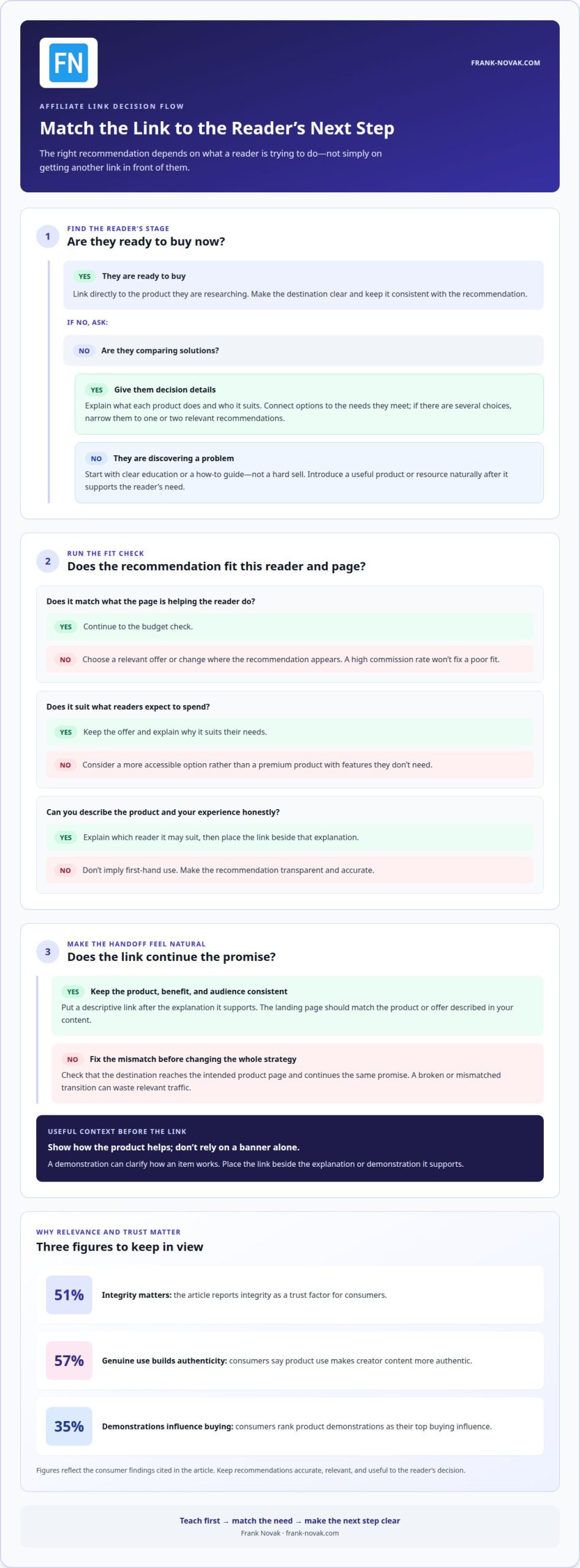
Start by identifying the reader’s stage in the buying journey. Someone discovering a problem needs clear education, not a hard sell. A reader comparing solutions needs relevant details, such as what a product does and who it suits. Someone ready to buy may benefit from a direct link to the product they’re researching. Shape the content and link format around that intent.
Match the recommendation to the page’s purpose. In a beginner’s guide, explain a useful product or resource before adding a contextual link. In a comparison article, connect each option to the needs it meets. If readers face several choices, narrow them to one or two relevant recommendations. Too many affiliate options can make the decision harder, not easier.
Budget matters, too. A product can be relevant but still feel out of reach for your audience. Consider what readers expect to spend before choosing an offer. A high commission rate won’t fix a poor fit. For example, readers seeking an affordable starting point may prefer an accessible tool to a premium option with features they don’t need.
Trust develops through useful, honest recommendations. If you’ve personally used a product, describe the experience accurately and explain which reader it may suit. If you haven’t, avoid implying first-hand use. Integrity is a trust factor for 51 percent of consumers, while 57 percent say genuine product use makes creator content more authentic. Clear explanations give readers a reason to consider your recommendation.
Show the product in context before asking readers to click. A demonstration can clarify how an item works, and 35 percent of consumers rank product demonstrations as their top buying influence. A tutorial showing a kitchen tool in use, for example, gives more decision support than a banner alone. Then place the link beside the explanation it supports.
Finally, don’t rely on a single mention. Readers may need to encounter a recommendation at the right point in their journey, so introduce it naturally in relevant content more than once. Teach first, answer likely questions, and then offer a clear next step. That sequence helps the link serve the reader’s decision instead of interrupting it.
2. Trust continuity between creator content and checkout
A click starts a handoff: your recommendation sets expectations, and the affiliate program’s landing page must meet them. If a post promises a beginner-friendly tool but the link opens a technical product page, the context breaks down. Readers may leave because the destination doesn’t match the reason they clicked. Keep the product, benefit, and audience consistent from the first mention through checkout.
Trust also depends on how often your content sells. A suggested content calendar mix is 80 percent value-driven material and 20 percent promotional content. Treat that as a planning guide, not a rigid formula: a useful tutorial can include a relevant recommendation, while an email that only pushes offers may feel out of step with earlier messages. Transparency and consistency matter to consumers as trust factors, at 57 percent and 44 percent, respectively.
Match each message to intent. Someone reading a product comparison needs a clear explanation of differences; a subscriber asking how to solve a specific problem may need a focused recommendation. Twenty-four percent of consumers say they’re more likely to buy when a creator presents a product as a solution to their needs. Explain the connection in your own words before adding a call to action.
To check whether links and tracking work, click each link as a reader would, confirm it reaches the intended product page, and compare tracked clicks with your site analytics. Check the affiliate dashboard’s link identifier and reporting period. If clicks appear in one system but not the other, inspect the redirect and tracking details before changing the content.
Improve placement by adding a descriptive link after the paragraph that answers a common objection. Use a specific call to action such as “Compare the features” rather than “Click here.” The landing page should continue the same promise and present the product or offer described in your content. A broken or mismatched transition can waste otherwise relevant traffic.
Price, competition, and checkout experience shape the final decision. If a product is above your audience’s expected budget, another option may be a better fit. If checkout adds unexpected steps or weakens confidence, even a ready buyer may abandon the purchase. Describe the product’s value honestly, avoid claims the landing page doesn’t support, and make the destination clear before the click.
If you’re building a more consistent online business approach, explore online business guidance as you refine how your content leads readers from advice to action.
3. Affiliate banners and ad blindness
A banner can be visible on a page yet still go unnoticed. Readers often scan past familiar ad-shaped blocks, especially in a sidebar filled with promotions. If an affiliate link sits beside several unrelated banners, it may blend into the page instead of helping someone choose. A useful link within the article may attract more attention than a sidebar placement.
Consider a home organization post with a sidebar banner for storage containers. A reader focused on the article’s steps may ignore the banner, even if the product fits. The issue may be placement, not product quality. Put the recommendation near the section that explains the storage problem, so readers see its purpose while considering a solution.
Repeated design patterns can encourage ad blindness. If every affiliate offer uses the same bright button, stock image, and short slogan, returning readers may treat each as background advertising. Instead, explain the offer in the surrounding text. For example, describe how a labeled container could help separate seasonal clothes, then place the relevant link beside that explanation.
Review each page as a reader would. Start at the headline, scan the introduction, and notice where your eyes naturally pause. If the affiliate banner appears among navigation, unrelated promotions, or a long sidebar, test a contextual link in the section that answers the reader’s question. Keep the banner only if it gives readers a clear, distinct way to find the offer.
Placement should follow the reader’s task. A recipe article might introduce a useful kitchen tool near the step where it matters, while a software tutorial could link to a tool after explaining the feature it supports. The link label should say what readers will find, such as “view the storage set,” rather than relying on a generic “learn more.”
Use a simple comparison to diagnose weak banner engagement. Keep the article and offer consistent, then compare a sidebar banner with a text link beside relevant advice. Change one placement at a time and give each version enough traffic to reveal a useful pattern. If clicks rise after moving the link, its location may have mattered more than its design.
Check the affiliate program’s available reporting for link-level results, if provided. A banner with few clicks may be overlooked; one with clicks but no purchases points to a different stage of the journey. Keep these signals separate. For instance, a reader may notice a banner and click, then leave because the destination doesn’t meet their expectations.
Choose formats that support the content rather than interrupt it. A banner can work when it fits the page and clearly identifies the offer, while an in-context text link may be more useful within a detailed explanation. Revisit placements as the article changes, and remove promotions that distract from the reader’s goal.
4. Affiliate conversion rate benchmarks
Start with a consistent calculation: divide conversions by unique clicks, then multiply by 100. For example, 20 purchases from 500 unique clicks produce a 4 percent conversion rate. Use unique clicks rather than page views, since views don’t show how many people reached the affiliate offer. Apply the same measure across pages and reporting periods to make comparisons meaningful.
A strong affiliate conversion rate typically falls between 1 and 5 percent, although audience, niche, and product type affect the result. Affiliate marketers regularly above 2 percent are generally performing well. These benchmarks offer context, not a pass-or-fail score. A rate below 1 percent can still reflect a page attracting early-stage readers, while purchase-focused traffic may behave differently.
Compare like with like before changing a campaign. A tutorial page and a product comparison serve different needs, so their results may differ even when they promote the same offer. Compare similar content, traffic sources, and products. Then look at trends across a consistent period, rather than drawing conclusions from a small number of clicks or purchases.
Affiliate program terms also shape which sales receive credit. Commission rules determine the reward for an eligible purchase, while cookie duration and attribution rules determine whether a referred visit receives credit after later activity. Read the program’s stated terms before interpreting missing commissions. A purchase may not qualify under its attribution conditions.
Use analytics to find where results weaken. Compare unique clicks with recorded conversions for each link, page, or traffic source. If clicks are low, revisit the content and link placement; if clicks are steady but purchases lag, examine the product fit and landing-page continuity. For an A/B test, change one element, such as the call to action, and compare the same metric under similar conditions.
Common mistakes can muddy results or put commissions at risk. A broken link, mismatched destination, or unsupported product claim can undermine a reader’s decision. A program’s policies may also restrict promotional methods or claims, so follow its current terms. Keep a record of each link or placement you change, then connect that change to the relevant click and conversion data.
Benchmarks become useful when they guide a specific next step. If 500 unique clicks produce 20 purchases, the 4 percent result sits within the typical range. If a similar page produces a lower rate, investigate its audience, offer, and buyer path before replacing the affiliate link entirely.
5. Promoting through blog posts, email, and social media
The same person may use Google, email, and social media for different reasons. A blog visitor often arrives with a problem to solve or a product to compare. Social media may be a place for discovery, while email can reach subscribers who have agreed to hear from you. Copying one promotion across all three channels can miss the moment.
Give each channel a distinct role. A blog post can answer a focused search, then introduce an affiliate link where it supports the explanation. For example, a comparison post can identify who each option suits and discuss the main differences. Recommend one or two products so readers can decide without sorting through an overwhelming list.
Email gives you room to build a recommendation into a useful conversation. A personal update can explain why a particular tool became relevant, while a subscriber question can guide a product-focused answer. If every message promotes an offer, readers may stop expecting useful information. A suggested calendar mix is 80 percent value-driven content and 20 percent promotion.
Social media often starts the relationship rather than completing a purchase. Use a product demonstration, a follow-up answer, or an everyday example to help people understand the recommendation. Consumers follow creators for inspiration at a rate of 46 percent, and 56 percent follow for entertainment. Educational posts also fit: 53 percent enjoy tips, tricks, and how-to tutorials.
This difference matters if you’re trying to convert social traffic with a single purchase link. A short post can introduce a product, but readers may need more context before deciding. Show how it fits a real task, answer a common question in a follow-up, and direct interested viewers to a fuller explanation. Keep the path from social post to destination clear.
Make the content format fit the channel. A blog can carry details and comparisons; an email can respond to a subscriber’s question; a social post can demonstrate one use. If the same recommendation appears in each, adapt the message rather than repeating identical copy. Keep the product benefit consistent while adjusting the detail to suit the reader’s attention and intent.
Review results by channel, not only by product. Compare link clicks and attributed purchases from blog posts, email, and social updates separately. If a social post attracts interest but few purchases, use it to educate and guide readers to a detailed page. If email receives clicks, examine whether the recommendation answers the subscriber’s stated need.
Keep promotions relevant and measured. Twenty-nine percent of consumers respond strongly to exclusive offers when buying through an influencer, but an offer alone cannot replace a useful explanation. Match each promotion to the content around it, then use channel-specific results to decide where to refine your next message.
Frank Novak
Frank Novak can help connect affiliate marketing decisions with a broader online business strategy. If you’ve reviewed your audience, content, and traffic but still aren’t sure what to adjust, Online Success Coaching offers personal coaching for affiliate marketers. The ClickBank Super Funnel, Never Succeed Online, and Clickbank Profit Club are also resources for building your online business.
Consider turning to Frank Novak when you want guidance on shaping your approach, rather than simply adding more affiliate links. A clearer plan can help you decide which channels and recommendations suit your goals.
Choose a Clear Next Step
Your next move doesn’t need to be a complete overhaul. Choose the page or channel where you most want to help readers act, then define what a useful outcome looks like for that audience. This keeps improvements connected to the people you serve, rather than turning every quiet sales period into a reason to change everything.
If you’re still asking why my affiliate links are not converting, consider what kind of online business you want those recommendations to support. A focused direction can guide decisions about what to publish, where to promote it, and which opportunities deserve your attention. Your next step should fit both your goals and your audience’s needs.
Keep learning from your audience, make thoughtful choices, and build the next stage at a pace that works for you.
Frequently Asked Questions
Do I need to switch away from affiliate links entirely?
No, not automatically. If your audience visits mainly for community or entertainment, product recommendations may fit only some of their needs. Keep those pages useful without forcing a promotion, and test affiliate offers on content where readers are actively considering solutions. Track whether the change brings qualified purchases, not just clicks. If commercial intent stays low across relevant pages, reconsider how much affiliate content you publish rather than abandoning every link.
Why Are Your Affiliate Promotions Not Converting?
If you’re asking why your affiliate links are not converting, look for a break between the promise and the purchase. For example, a post about beginner-friendly accounting tools may send readers to a product page full of advanced features. Also distinguish a tracking problem from a sales problem: confirm the referral appears in program reports before deciding visitors chose not to buy.
What are the most common reasons affiliate links get clicks but no sales?
Clicks without purchases can mean readers were curious but not ready to buy, or the destination didn’t answer their remaining questions. A link might also lead to a changed offer, an unexpected product, or a checkout that asks for more than the visitor expected. Review the destination and referring content together. If the page still matches, investigate whether the affiliate program attributes the purchase correctly.
How do traffic quality and audience intent affect affiliate conversion rates?
Traffic quality depends on whether visitors arrive with a need the recommended offer can address. Someone searching for a specific product comparison is closer to a purchase decision than someone browsing a general topic for inspiration. Segment results by source and page purpose before judging performance. For example, compare visitors from a product review with visitors from a broad social post, rather than treating their clicks as equivalent.
What affiliate conversion rates are typical by industry and traffic source?
There isn’t one dependable conversion rate for every industry or traffic source. A product review, an educational guide, and a social discovery post attract visitors with different levels of purchase intent. Compare similar pages and sources, and use the same definition of a click and conversion each time. This gives you a more useful benchmark for your own audience than an industry label alone.
How can I build trust and disclose affiliate relationships properly in the United States?
Use a clear, plain-language disclosure near your recommendation, so readers understand the relationship before acting on a link. For example, say that you may earn a commission if someone buys through it. Make the notice easy to see in each format, including a blog post, email, or social caption. Keep product descriptions honest, and distinguish personal experience from features you haven’t personally tested.

Article by
Frank Novak
Frank Novak is an online marketing professional and coach who focuses on affiliate marketing and business automation. Through his website, frank-novak.com, he shares insights and strategies for leveraging social media platforms like Facebook to generate traffic and commissions.
Affiliate / Sponsored Content Disclaimer
This [website/post] contains affiliate links. If you click through and make a purchase, we may receive a commission at no additional cost to you. We only recommend products or services we believe will add value to our readers.