

A quiz should earn the recommendation, not disguise a sales pitch. If you’re using quizzes to generate affiliate leads, the difference matters: a generic quiz can collect email addresses, but a useful one helps people understand their needs and gives you a clear reason to follow up.
It’s understandable to feel unsure where to begin. Choosing a topic and writing questions can be challenging, and sign-ups don’t mean much if subscribers ignore your emails or find your offers irrelevant. Start by understanding what people need, then recommend something only when it fits. Be clear about how you’ll use their answers and contact details.
This guide explains how to choose a quiz concept around a specific audience need, write questions that reveal useful preferences, and turn responses into meaningful email segments. You’ll also learn how to connect each result to a relevant affiliate recommendation, disclose your relationship transparently, and use performance data to improve the experience. The goal is a practical quiz that serves your audience while supporting a focused affiliate funnel.
Key Takeaways
- Choose a quiz topic around a specific audience need, and make the promised result useful on its own.
- Ask questions that reveal preferences or goals and meaningfully shape the respondent’s result or next step.
- When using quizzes to generate affiliate leads, collect contact details with clear permission and use answers to create relevant email segments.
- Decide between a quiz and a static form based on whether your lead magnet needs personalized guidance or a simple sign-up.
- Build trust with educational follow-up, clear affiliate disclosures, and a small test that helps you improve the quiz over time.
Why use quizzes to generate affiliate leads instead of collecting emails blindly?
A sign-up form can tell you someone wants a download. It usually can’t tell you whether they’re new to a topic, what they’re trying to achieve, or which kind of guidance would help next. Using quizzes to generate affiliate leads gives you a way to learn that context through useful questions, rather than treating every new subscriber as if they had the same needs.
An affiliate lead quiz is an interactive lead magnet that gives someone a relevant insight in exchange for permission to receive follow-up by email. Unlike a static form, which mainly collects contact details, a quiz can also gather answers about a person’s goals, preferences, or experience. Those answers can help you create more relevant follow-up within affiliate marketing, where recommendations should fit the audience and the offer.
A completed quiz and a qualified lead aren’t the same thing. Someone may finish out of curiosity without wanting further emails or being a good fit for a particular recommendation. Treat completion as a sign of engagement, not proof of buying intent. Lead quality depends on whether the answers point to a real need and the person has knowingly opted in to hear from you.
Which affiliate audiences benefit most from a quiz?
A quiz is most useful when it serves one defined audience and a closely related need, rather than trying to connect unrelated offers under one broad topic. For example, an affiliate site focused on beginner investing education could ask about a reader’s familiarity with basic investing concepts and what they want to learn next. The result could point to suitable educational resources, rather than pushing the same product to every respondent.
This is an educational example, not personalized financial advice. I’m not giving personalized financial advice, and a quiz shouldn’t suggest that one answer is enough to determine what someone should do with their money. The aim is to understand context, then offer relevant general information or clearly presented options. For an audience learning affiliate marketing, questions about experience and current funnel challenges can similarly help tailor educational follow-up.
What makes a quiz useful rather than a disguised sales pitch?
Give respondents something worthwhile before asking them to consider an affiliate offer. A result might identify a learning stage, clarify a preference, or suggest a sensible next area to explore. Explain the quiz’s purpose in plain language, and state before collecting an email address what follow-up the person is agreeing to receive. Make the email field and permission clear, rather than implying that contact details are needed just to see a result.
Keep the outcome connected to the answers. If someone says they’re a beginner, a result built around advanced tools will feel careless, even if the offer pays a commission. Avoid guaranteed-success claims, countdown pressure, or language that turns a general result into a personal directive. Explain any affiliate relationship clearly when recommending an offer, and let the reader decide whether it fits. Trust grows when the quiz helps first and promotes an offer only where there’s a genuine match.
How an affiliate quiz turns answers into relevant leads
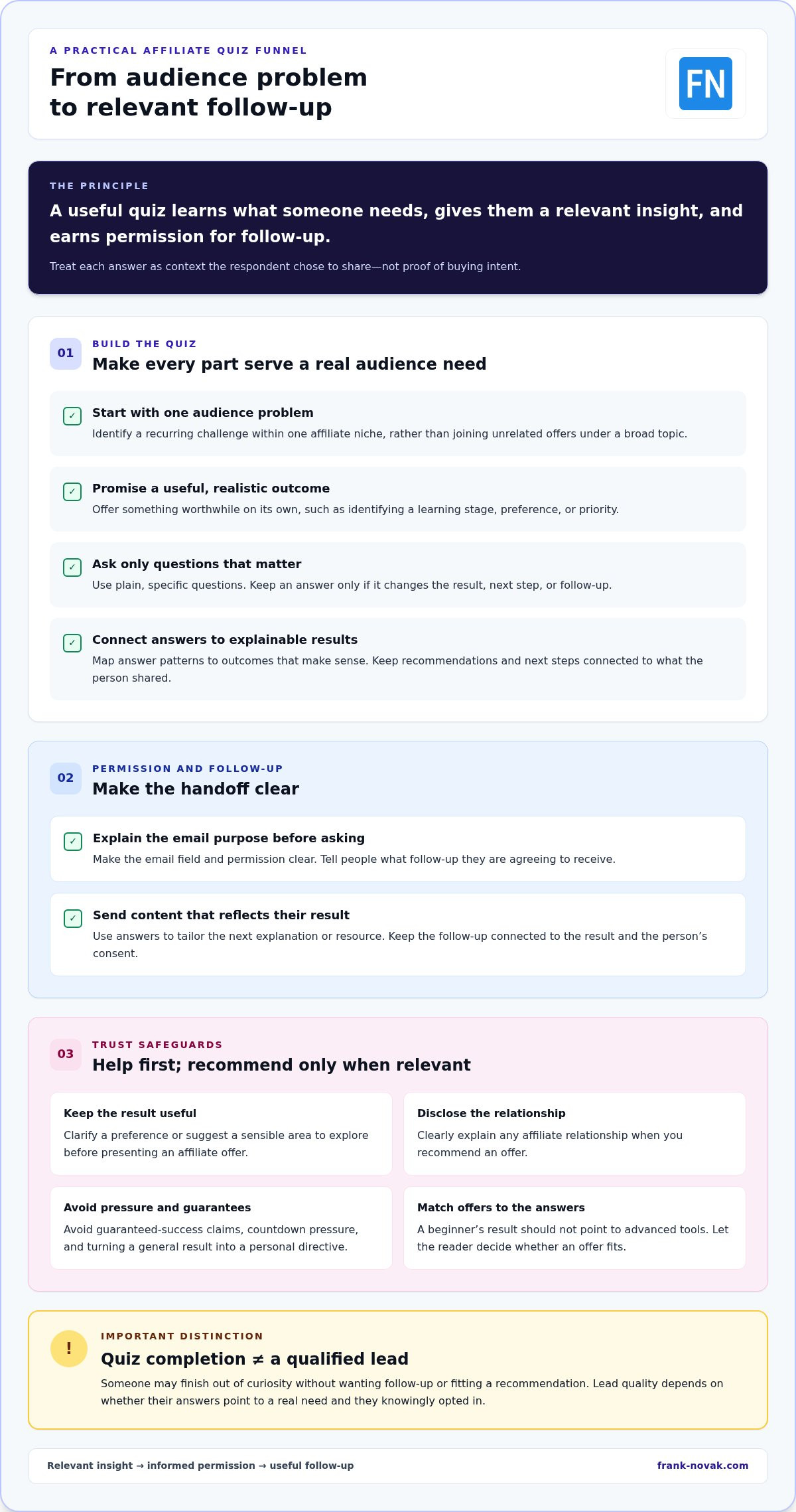
A useful quiz funnel follows a clear path: start with an audience problem, promise a helpful outcome, ask questions that clarify the person’s situation, apply result logic, invite an informed email opt-in, then follow up in a way that reflects what they shared. Each step should connect to the next. If the quiz promises to help someone find their next step in affiliate marketing, for example, its questions should reveal what the respondent already understands and where they’re stuck.
Quiz responses become useful when they guide relevant follow-up. They aren’t a license to guess what a subscriber wants. Treat each answer as information the respondent chose to share, then use it to tailor the next explanation or resource. This is the practical value of using quizzes to generate affiliate leads: you can make follow-up more specific without assuming everyone has the same needs.
- Audience problem: Identify a recurring challenge within one affiliate niche.
- Quiz promise: Offer a clear, realistic outcome, such as identifying a learning stage or priority.
- Questions: Ask only what helps distinguish between useful results.
- Result logic: Map answer patterns to outcomes that make sense and can be explained.
- Opt-in and follow-up: Explain the email purpose, collect permission, and send content connected to the result and the person’s consent.
How should you choose a quiz topic and questions?
Begin with a question your audience regularly asks or a decision they find difficult. For an affiliate marketing audience, that could be whether to focus first on choosing a niche, creating content, or building an email list. For financial-services content, a quiz could help readers identify which general educational topic to explore, such as mortgage refinancing for self-employed people or improving credit before applying for a home loan. Keep the result educational, not a personal product recommendation.
Write questions in plain, specific language. “Have you started an email list?” gives clearer context than “How advanced are you?” Each answer should affect the result, the next step, or the kind of follow-up sent. If it changes none of those, remove it. Unnecessary questions add effort without improving the guidance.
How do results connect to email follow-up?
Give each result a short explanation of what the answers suggest and one practical learning step. A respondent who is still shaping a niche might receive introductory guidance, while someone already publishing content could receive material about building a focused funnel. Segmentation means organizing subscribers by expressed interests or experience, not assigning motives they didn’t state. Keep follow-up aligned with the opt-in they agreed to. A quiz answer is not permission to send unrelated messages.
For example, if someone indicates that their main challenge is connecting content to email follow-up, the first message can explain that connection before presenting a relevant resource. This sequence fits into a broader automated marketing funnel, where each message has a purpose and builds on the previous step. If you’re developing your affiliate approach, Frank Novak’s practical affiliate marketing guides offer another perspective as you shape that process.
Quiz lead magnet vs. static form: what should affiliate marketers choose?
A quiz adds value when people’s answers lead to meaningfully different guidance. A form is often more direct, with fewer steps between a reader and a resource. The right choice depends on what the audience needs and what you’ll do with the information afterward. Using quizzes to generate affiliate leads can support relevant segmentation, but the added interaction makes sense only if it improves the experience or follow-up.
Use this comparison to weigh the trade-offs before building:
| Criteria | Quiz | Static form |
|---|---|---|
| Audience intent | Explore a need, preference, or next step | Get one specific resource or update |
| Information gained | Answers that can guide relevant segments | Usually contact details and basic sign-up context |
| Setup effort | Requires questions, result logic, and testing | Typically simpler when the offer is straightforward |
| Follow-up needs | Best when messages can reflect different results | Works when the same follow-up suits everyone |
When is a quiz a better fit than a simple opt-in?
Favor a quiz if distinct answers lead to different educational paths. For instance, readers who are choosing an affiliate niche may need different guidance from those already building an email list. A quiz can direct each group to a fitting next lesson. If one checklist or download serves the audience equally well, a simple form is likely enough. Ask whether the extra interaction earns its place: does it improve the guidance, or just add steps before sign-up?
How can affiliate marketers evaluate quiz tools?
Start with the funnel you actually need, then assess whether a tool can support your question logic, result pages, and email workflow. Consider how easily you can create and revise the quiz, review responses, and organize follow-up. A long feature list isn’t useful if the setup is confusing or the tool doesn’t fit your process.
Be careful with performance claims, too. A vendor may promote case studies or headline figures such as “more leads” or “more qualified leads,” but those are examples from that vendor’s marketing, not independent benchmarks or a promise of what your quiz will achieve. Results can depend on the audience, traffic source, quiz design, and opt-in experience. Instead of choosing a platform solely for impressive claims, identify the functions you need and test whether the workflow helps you serve respondents clearly.
Use a form for a single, broadly useful resource. Choose a quiz when answers genuinely change the next educational step. Either way, make the experience useful enough to justify the information you’re asking people to share.
How to build, launch, and improve an affiliate lead quiz
A strong quiz doesn’t need to be complicated at launch. Focus on one audience, one useful promise, and a clear connection between the answers and the guidance that follows. Using quizzes to generate affiliate leads works best as an ongoing process: build a focused first version, see where respondents get stuck, and improve the experience based on what they do next.
- Set the promise. Describe who the quiz helps and what respondents will learn or identify. Keep the outcome realistic and specific.
- Draft the questions and results. Use only questions that affect the result or next step. Write result explanations that offer a practical action, not just a label.
- Set up the opt-in and delivery. Explain why you’re requesting an email address, what follow-up the person can expect, and how they’ll receive their result. Ask for clear permission before sending marketing emails.
- Test the experience. Complete every answer path yourself, check that each result displays correctly, and confirm that the right follow-up reaches each segment.
- Review and refine. Start with a small launch, then examine completion, opt-in behavior, email engagement, and relevant affiliate actions before changing the quiz.
What should the quiz landing page and result include?
On the landing page, state who the quiz is for, what respondents will receive, and why an email is requested. Keep the result useful even if the person doesn’t click an offer. For a finance-related topic, frame results as general educational guidance, not personalized financial advice. If you include an affiliate recommendation or link, disclose the relationship plainly: “I earn a commission if you apply through my link, but this doesn’t cost you anything extra.”
Which metrics help you improve lead quality?
Look at the full path, not just the number of sign-ups. Completion can reveal whether people finish the questions; opt-in behavior shows whether the result and email exchange feel worthwhile. Then check whether subscribers engage with the follow-up and whether clicks or applications align with the result they received. A high number of sign-ups isn’t useful if the messages don’t match their needs.
- Low completion: Review question clarity, length, and any point where the quiz feels repetitive.
- Opt-ins without engagement: Check that the landing-page promise matches the result and emails delivered.
- Clicks that don’t fit the result: Revisit the recommendation and the answer-to-result logic.
Change one meaningful element at a time, then allow enough activity to gather a useful comparison. Short-term movement alone doesn’t prove that a change caused the result. If you’re relying on SEO to help people discover the quiz, ranking for target keywords generally takes 2-4 months of consistent effort. Review discovery separately from the quiz’s performance once visitors arrive.
Turn quiz insights into a trustworthy affiliate funnel
A quiz result can start a helpful conversation, not trigger an immediate sales pitch. Use the result to shape an educational email sequence: first explain what the result means, then share a practical next step, and introduce an affiliate offer only if it genuinely fits the need the respondent expressed. This gives people context to evaluate the recommendation rather than asking them to act on a bare link.
For example, if someone’s answers suggest they’re new to building an affiliate funnel, an early message could explain how an audience moves from discovering content to receiving follow-up. A later email might describe a relevant resource and why it could be useful at that stage. Keep the recommendation optional. Readers should be able to learn from the sequence without buying anything.
How do you recommend an affiliate offer without losing trust?
Connect the offer to a specific answer or result, and explain the connection in plain language. Describe what the resource is intended to help with, who may find it relevant, and any limits that matter. Don’t imply that one quiz result proves an offer is suitable for someone’s personal circumstances, particularly with financial products. A quiz can guide general education, but it can’t replace individualized financial advice.
Be transparent near the recommendation and link. Use this disclosure: “I earn a commission if you apply through my link, but this doesn’t cost you anything extra.” Clear disclosure gives readers useful context about your relationship with the offer while leaving the choice with them. Avoid pressure tactics or promises of income and results. Relevance and honest explanation do more to support a lasting relationship than urgency ever could.
What is a practical next step after the quiz goes live?
Review the actual responses and the messages people receive. Look for questions that cause confusion, results that don’t reflect the answers, or emails that feel disconnected from the quiz outcome. If subscribers engage with the educational content but ignore an offer, check whether the recommendation fits the result before changing the wording to make it more persuasive. Improve the path, not just the sign-up count.
If quiz respondents are ready for more structured funnel guidance, the ClickBank Super Funnel is a resource to explore. It’s an optional next step, not a guarantee of leads or income. Readers who want broader practical support can also explore Online Success Coaching as they develop their affiliate approach.
Using quizzes to generate affiliate leads is most valuable when the quiz, emails, and offer work as one coherent experience. Let the answers inform the education, make the commercial relationship clear, and give subscribers room to decide what makes sense for them. That steady approach helps keep the funnel useful after the quiz is finished.
Build a quiz that grows with your audience
Your first quiz doesn’t have to be the final version. Treat it as a starting point for a more attentive affiliate business: keep learning from the questions people ask, notice when their priorities shift, and refine your approach so the experience stays useful over time. That process makes using quizzes to generate affiliate leads a long-term skill, not just a way to collect email addresses.
If you’re ready to strengthen the wider system around your quiz, Frank Novak’s practical affiliate marketing guides and tutorials can help you consider your next steps. Online Success Coaching and the ClickBank Super Funnel are resources for readers developing affiliate funnels, without promising a particular outcome.
Start with one thoughtful improvement, then build from what you learn. You can make the funnel more useful to your audience with each step.
Frequently Asked Questions
Is using quizzes to generate affiliate leads effective?
It can be effective if the quiz attracts people with a genuine interest and the follow-up matches what they came to learn. Judge it by more than completed quizzes: review whether subscribers read your emails, explore relevant resources, or take an action that fits their stated interest. If people finish but don’t engage, check whether the quiz promise attracted the right audience or whether the next messages deliver on it.
Can I use a quiz to generate affiliate leads without a large audience?
Yes. A large audience isn’t required to test whether a quiz makes sense for your niche. You can share it with the visitors and subscribers you already have, then review responses for patterns, such as a repeated question or an unclear result. With a smaller pool, avoid drawing firm conclusions from a handful of responses. Use early feedback to spot obvious friction, then keep learning as more people take the quiz.
What questions should I ask in an affiliate marketing quiz?
Ask about information that helps you understand a reader’s current situation or what they want to learn next. For an affiliate marketing quiz, useful prompts might ask whether someone has chosen a niche, published content, or started an email list. Offer answer choices in familiar language, and include an option such as “I’m not sure” when it fits. Avoid asking for sensitive details unless they’re genuinely necessary.
How many questions should an affiliate lead quiz have?
There isn’t one ideal question count for every quiz. Use the smallest set that can sort respondents into results you can explain and follow up on. Read each question aloud and ask whether its answer changes the outcome, the educational next step, or the message someone receives. If it only makes the quiz feel more detailed, remove it. A short draft is a practical starting point for testing the flow.
Do I need to disclose affiliate links in quiz results and follow-up emails?
Make the commission relationship clear wherever you recommend an affiliate offer, including a result page or follow-up email that contains a link. Place the disclosure close enough that readers can understand it before deciding whether to click. For example: “I earn a commission if you apply through my link, but this doesn’t cost you anything extra.” Clear wording helps readers assess the recommendation with full context.
Can a quiz recommend financial products as personalized financial advice?
No. A quiz can direct someone to general educational information, but answers alone can’t establish what financial product is suitable for an individual’s circumstances. Keep results descriptive, such as pointing to beginner resources about investment terms, rather than telling a respondent which investment to choose. The writer is not giving personalized financial advice and should not present as a licensed financial advisor. Encourage readers to consider their own situation before making financial decisions.

Article by
Frank Novak
Frank Novak is an online marketing professional and coach who focuses on affiliate marketing and business automation. Through his website, frank-novak.com, he shares insights and strategies for leveraging social media platforms like Facebook to generate traffic and commissions.
Affiliate / Sponsored Content Disclaimer
This [website/post] contains affiliate links. If you click through and make a purchase, we may receive a commission at no additional cost to you. We only recommend products or services we believe will add value to our readers.