

Your country should shape your affiliate strategy before your first application, not after your first commission. If you’re exploring affiliate marketing for non-US residents, you may be wondering whether programs accept applicants where you live and how you’ll receive earnings. The answer depends on each program’s eligibility rules and payment options. Living outside the United States doesn’t automatically rule you out, but it does make the groundwork important.
This guide explains how to assess program eligibility, payout methods, currencies, account requirements, and possible conversion costs before promoting an offer. You’ll also learn what to consider when reviewing disclosure rules and tax responsibilities across jurisdictions. Requirements can vary based on where you live and how a program classifies payments, so build these checks into your plan early.
A country-aware approach helps you choose offers that fit both your circumstances and your audience. The steps below cover program eligibility, payments, compliance, and how to build a sustainable affiliate business. Frank Novak’s Online Success Coaching focuses on digital business growth, affiliate marketing, and automation, with resources to help you develop a more structured plan.
Key Takeaways
- Affiliate marketing for non-US residents can be possible from many locations, but eligibility depends on each program’s current rules.
- Compare offers by country access, audience fit, payout method, payment terms, and promotion restrictions, not commission structure alone.
- Before applying, map your country, target audience, preferred language, and accessible ways to receive payments.
- Understand how referral tracking, qualifying actions, and commission approval work before promoting an offer.
- Build long-term trust with useful content, a permission-based email list, and clear disclosures that reflect applicable requirements.
Affiliate marketing for non-US residents: what it is and what changes by country
Definition: Affiliate marketing is a way to earn a commission when someone follows your tracked referral and completes an action defined by a program, such as making a purchase. Your location is where you live and operate; your audience’s location is where potential customers live. Those locations can differ, and each can affect which offers make sense.
The basic model involves a merchant offering a product or service, an affiliate sharing a referral link, and a consumer taking an action through that link. The affiliate marketing overview explains these roles and common tracking and payment approaches. In practice, the program’s terms determine which referrals qualify, how commissions are calculated, and when approved earnings are paid.
For affiliate marketing for non-US residents, living outside the United States doesn’t automatically prevent participation. But internet access is only one part of getting started. Programs may set country-specific application criteria, require particular account or tax information, and support only certain payment methods or currencies. Check these details before building a campaign around an offer, since they affect both whether you can join and how you can receive commissions.
Can you do affiliate marketing from any country?
There isn’t one eligibility rule for every affiliate program. One may accept applicants in your country, while another may limit applications or payments based on location. Before investing time in content, review the program’s current eligibility requirements, payment options, payout threshold, and promotion rules. If you can’t access a required payment method, the offer may not be practical even if its products suit your audience.
Why audience location matters alongside your own
Your residence and your customers’ residence are separate considerations. For example, a creator living outside the United States might publish in English for readers in the United States. The creator’s location may affect application and payment eligibility, while the readers’ location can influence product availability, language fit, and which version of an offer they can use. Define both locations before choosing programs.
Keep the distinction clear when reviewing requirements. A program’s acceptance of your country doesn’t guarantee that its offer serves every audience you want to reach. Likewise, an offer that suits your readers may not be available to you as an affiliate. Compare both sides: where you can apply and receive funds, and where customers can access the product or service.
Disclosure and tax responsibilities also depend on the relevant jurisdictions and circumstances. Don’t assume that a rule described for the United States automatically applies worldwide, or that your country’s rules cover every audience market. Check the applicable official authorities and each program’s terms, then include those requirements in your content process from the start.
How affiliate programs, tracking, and international payouts work
An affiliate commission passes through several steps, each governed by the program’s terms. You apply with your location and account details. If approved, you receive a unique tracking link. When a customer follows that link and completes an eligible action, the program records the referral. It then reviews the action under its rules before approving and paying the commission.
A tracked click isn’t automatically an approved commission. Attribution rules determine whether a referral is credited to you, which may depend on the program’s tracking window and how it handles other interactions. Approval rules determine whether the customer’s action qualifies. Returns, cancellations, or other conditions may affect the result if the program’s terms say so. Read these details before estimating what a campaign could earn.
- Application: Submit the required information and check that applicants in your country are eligible.
- Approval: Review the program’s decision and any instructions for using its links.
- Referral: Share your tracked link through promotion methods the program allows.
- Qualifying action: A referred customer completes an action that meets the program’s requirements.
- Payment: The program approves commissions and pays them according to its schedule and payout terms.
What to check before joining an affiliate program
Before building content around an offer, review applicant-country eligibility, identity checks, and any required tax documentation. Then read the commission structure, attribution window, qualifying actions, prohibited promotion methods, payment schedule, and minimum payout threshold. Confirm that the product suits your audience and that your planned channels, such as a website or email, are permitted. These checks help you spot practical barriers before investing in promotion.
ClickBank is one example of an affiliate platform, but its requirements and options don’t necessarily apply to every resident or market. Check ClickBank’s current country-specific terms, including eligibility and payment details, before relying on it for a campaign. Apply the same approach to any program: use its latest terms rather than advice that may describe a different country or an older policy.
How international affiliate payouts reach you
Compare each program’s payment methods with accounts and services you can use in your country. Check the payout currency, minimum threshold, payment frequency, and whether the program sends funds directly to a bank or through another supported method. A payment option may seem convenient but still involve conversion or transfer fees. Find out how currency exchange is handled and estimate the net amount you may receive.
Keep a simple record of approved commissions, payment dates, currencies, and any deductions shown in your account. Confirm that the name and details on your payout account meet the program’s requirements, and understand the payment route before relying on it. Frank Novak’s Online Success Coaching focuses on digital business growth, affiliate marketing, and automation, and can help you develop a more structured business plan.
How to compare affiliate programs as a non-US resident
A useful comparison starts with more than the commission rate. In affiliate marketing for non-US residents, an offer is practical only if you can apply from your location, reach the intended customers, use an available payout method, and promote it through permitted channels. Put these details side by side before investing time in content. Treat anything you haven’t verified in the program’s official information as an open question, not a confirmed benefit.
| Factor | What to compare | Why it matters |
|---|---|---|
| Eligibility | Applicant countries, identity requirements, and required account or tax details | A relevant offer won’t help if you can’t join or complete registration. |
| Audience fit | Product access, language, delivery, and customer support for your target market | Customers need to be able to understand, access, and use the offer. |
| Payout method | Available payment routes, payout threshold, timing, and currency handling | Check that you can receive funds and understand possible conversion or transfer costs. |
| Program terms | Qualifying actions, commission conditions, and attribution rules | The headline rate alone doesn’t show when a referral earns an approved commission. |
| Promotion restrictions | Rules for websites, email, social platforms, and paid advertising | Your intended marketing channels must fit the program’s requirements. |
Choose offers your audience can actually use
Start with your readers, not the largest advertised commission. Check whether the product can be purchased or accessed in their market, whether the information and checkout suit their language, and whether delivery or customer support makes sense for their location. If your audience is in one country and you live in another, assess the customer experience separately from your own eligibility and payment access.
Compare program terms, payments, and promotion rules
Review each candidate using the same criteria, then mark every item as verified, unclear, or unsuitable. For instance, if you live in one country and write for readers elsewhere, confirm both your ability to apply and your audience’s ability to use the offer. Check the official program terms for permitted channels, payout options, thresholds, timing, and currency handling. Don’t treat a detail from an old post or another affiliate’s experience as current confirmation.
Weigh practical access and product relevance before comparing commission structures. A higher rate may be less useful if the offer doesn’t serve your audience or its payout route doesn’t work for you. A lower rate may be a better fit if customers can use the product and the program’s terms support your content approach. Keep notes on where each detail came from, so assumptions don’t quietly become part of your plan.
Program terms and payment availability can change. Recheck the official terms before applying and before expanding a campaign, especially if your audience or location changes. This comparison helps you choose deliberately instead of building around an offer that proves inaccessible or poorly matched.
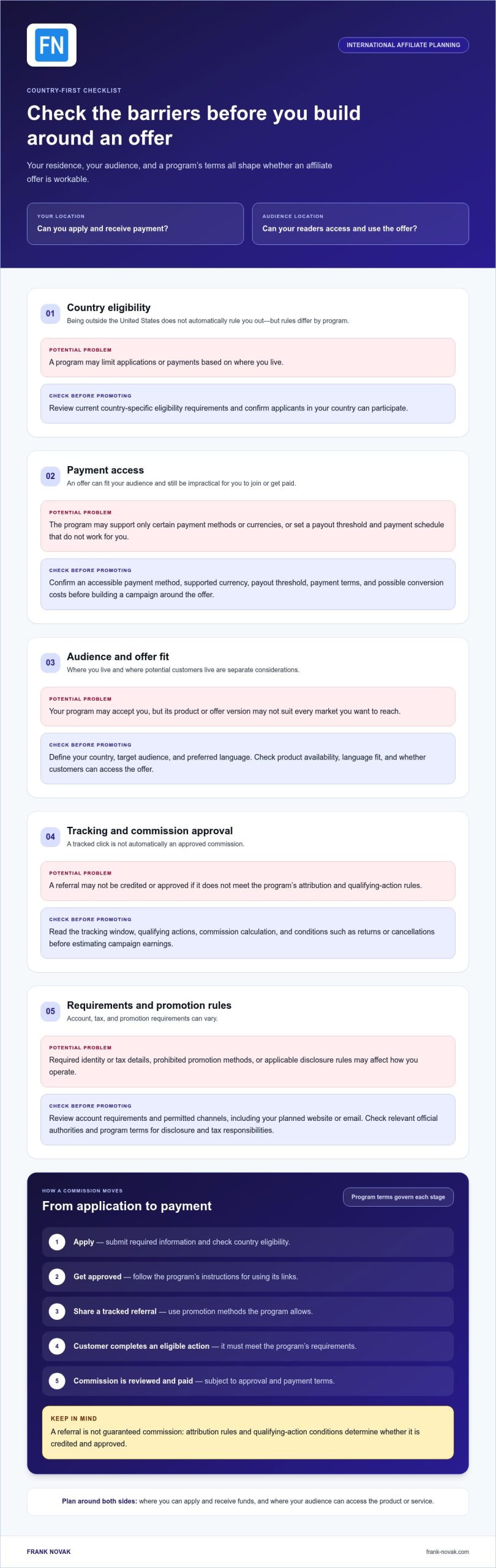
How to start affiliate marketing outside the US: a country-first checklist
Before choosing an offer, write down four details: your country of residence, the markets you want to reach, the language you’ll use, and the payment methods you can access. These give you a practical starting point for affiliate marketing for non-US residents. They help you assess whether a program fits both your circumstances and the audience you plan to serve.
Use this sequence to move from an idea to a careful first campaign:
- Define your audience. Identify who you want to help, where they live, what language they use, and a problem they’re actively trying to solve.
- Shortlist relevant offers. Look for products or services that address that problem and can be accessed in your audience’s market.
- Check eligibility and payment access. Review each program’s current rules for applicants in your country, required account information, payment methods, currencies, and terms.
- Prepare useful content. Choose a channel you can maintain and that the program permits. Create helpful material that explains the offer in context, and make affiliate disclosures clear.
- Track and review results. Keep records of links, content, clicks, approved commissions, and payments. Use those records to decide what to improve before expanding.
Prepare your audience, platform, and first offer
Start with a focused audience rather than trying to serve several markets at once. Choose a real need you understand, then assess whether a proposed offer genuinely helps address it. Check that customers in your target location can access or purchase it, and that its language, delivery, and support are suitable for them. The program’s rules should also permit your chosen channel, whether that’s a blog, email, or social platform.
Publish useful information before increasing promotion. Explain who an offer may suit, what it does, and any limitations that matter to your readers. Place a clear disclosure near your recommendation, and check the relevant official consumer-protection or advertising guidance for the locations involved. A thoughtful first campaign gives you a better basis for learning than simply posting links across multiple channels.
Keep records and review local responsibilities
Save commission statements, payment confirmations, program terms, and business documents related to your activity. Record the currency and date of each payment, along with any deductions shown by the program or payment provider. Tax treatment depends on your circumstances and local rules, so consult official tax authorities for guidance relevant to where you live. If your audience spans countries, use official consumer-protection and advertising resources for the markets you target as well.
Launch checklist: Define your audience, shortlist relevant offers, verify eligibility and payment access, prepare permitted content, and disclose affiliate relationships clearly.
Ongoing review: Revisit program terms, payout details, promotion rules, disclosures, and local responsibilities as your business or target markets change.
Build a sustainable international affiliate system with clear next steps
A sustainable international affiliate business depends on a repeatable review process, not a one-time approval. Before adding a program, revisit the same questions: Can you apply from your country? Can your audience access the offer? Do the payment method and currency work for you? Are your planned promotion channels allowed, and do your disclosures reflect relevant requirements? Keep your answers and the source of each detail together, then check them again when program terms or target markets change.
Growth also depends on trust. Publish useful content that helps readers assess an offer, build an email list through clear, permission-based sign-ups, and make affiliate disclosures easy to notice. For traffic planning, consider the existing guide How to Drive Traffic to Affiliate Links: The Strategic Guide for 2026 alongside your country and audience research. A steady content plan helps you learn which topics attract the right readers, without assuming every visit will lead to a commission.
Use funnels and follow-up without losing trust
A relevant landing page can introduce an offer, explain who it may suit, and set clear expectations before a reader clicks through. If you use an automated marketing funnel, make each follow-up useful and consistent with what readers signed up to receive. A funnel should organize helpful information, not obscure the affiliate relationship or pressure people into a decision. The ClickBank Super Funnel is a resource for exploring funnel structure as part of a broader affiliate marketing plan.
Choose a manageable first-month plan
Keep the first month focused on learning rather than a particular income target. Set manageable milestones that fit your schedule:
- Research: Record your audience location, preferred language, suitable offers, program terms, and accessible payment options.
- Publish: Create a small set of useful pieces on a channel you can maintain, following program promotion rules and including clear disclosures.
- Review: Check clicks, conversions, approved commissions, and audience feedback. Use what you learn to refine your content or reconsider an offer.
Review the numbers in context. Clicks show whether readers are following links; conversions and approved commissions depend on program tracking and qualification rules. Audience questions can reveal confusion about the offer, language, or disclosure. If performance is limited, investigate those signals before adding more programs or automation. This measured approach keeps location-specific access, audience needs, and trust in view as your affiliate business develops.
Frank Novak offers Online Success Coaching focused on digital business growth, affiliate marketing, and business automation. The coaching can help you develop a more structured plan as you learn.
Take your next step with a plan you can build on
Your first move doesn’t need to be a large campaign. Choose one audience need, one suitable offer, and one channel you can maintain. Treat the early stage as a learning process: pay attention to the questions people ask and the content they find useful, then adjust your approach as you gain experience. That steady rhythm can make affiliate marketing for non-US residents a more considered, sustainable business rather than a rush to promote more links.
Frank Novak offers Online Success Coaching focused on digital business growth. His work also focuses on affiliate marketing and business automation, and the ClickBank Super Funnel provides a practical resource for learning about funnel structure. These offerings can support your planning as you assess audience fit, program terms, and your own business goals.
Build one thoughtful step at a time. With a clear plan and a willingness to learn, you can keep moving forward with confidence.
Frequently Asked Questions
Can I do affiliate marketing if I live outside the US?
Yes, you can pursue affiliate marketing while living outside the United States if a program accepts applicants from your country. For example, someone based in one country can create content for readers elsewhere, but needs to consider both the program’s participation rules and whether the offer works for those readers. Start by checking the program’s latest application and payment requirements, then choose an offer that fits your audience and publishing plan.
Which affiliate programs accept non-US residents?
Acceptance varies by program and applicant location, so there isn’t a reliable universal list. A program may accept an application from your country but have payment or identity requirements that affect your ability to participate. Check the program’s current terms and application information rather than relying on an old directory. As you compare options, note which details are confirmed and whether the products suit the audience you intend to reach.
How do affiliate marketers outside the US get paid?
Affiliate marketers receive commissions through the payment methods each program supports, subject to its payment schedule and conditions. For example, if a program pays in a currency different from the one you use, your bank or payment service may convert the funds. Review account eligibility, exchange handling, and any transfer deductions before choosing a payment route. Save statements and payment confirmations so your records show what was earned and what reached your account.
Do non-US affiliate marketers need to pay taxes?
Affiliate income may have tax implications, but whether and how it’s taxed depends on your residence, business structure, and personal circumstances. Keep records that help you distinguish commissions from other income, including statements and related business documents. Then consult the official tax authority for your jurisdiction or a qualified local adviser. If you operate across borders, explain the countries involved and how you earn the income when seeking guidance.
Do I need to disclose affiliate links outside the United States?
Disclosure expectations depend on the rules that apply to your location, audience, platform, and promotion. A practical starting point is to tell readers plainly when you may earn a commission, placing the explanation close to the recommendation rather than hiding it in a distant policy page. Review your publishing platform’s policies and relevant official consumer-protection guidance for the markets you serve. Clear disclosure helps readers understand the relationship behind your recommendation.
Can I promote US affiliate products to an international audience?
Yes, if the program permits your participation and the product is accessible and appropriate for the people you’re reaching. Before promoting it, consider a reader in your target market: can they understand the offer, complete a purchase, and use the product as intended? Also check whether the program limits promotion by location or channel. If the offer doesn’t suit your audience, choose one with clearer relevance rather than assuming a US-focused product serves everyone.
Do I need a US bank account to start affiliate marketing?
Not necessarily. Some programs may support payout options that don’t require a US bank account, while others may specify account or currency conditions that affect applicants abroad. Check whether your account type and country are supported, and make sure the account details you submit match the program’s requirements. If payment depends on a third-party service, review its availability and conversion process before building your plans around that route.

Article by
Frank Novak
Frank Novak is an online marketing professional and coach who focuses on affiliate marketing and business automation. Through his website, frank-novak.com, he shares insights and strategies for leveraging social media platforms like Facebook to generate traffic and commissions.
Affiliate / Sponsored Content Disclaimer
This [website/post] contains affiliate links. If you click through and make a purchase, we may receive a commission at no additional cost to you. We only recommend products or services we believe will add value to our readers.