

What if the page you most want to rank isn’t the best page to promote for backlinks? Building backlinks to your affiliate website can feel difficult when your key pages focus on product recommendations. Outreach takes time, too, especially without a clear reason for a publisher to link. The practical shift is to earn links by offering something useful beyond a promotion.
A backlink’s value depends on more than a score in an SEO tool. Consider its topical relevance, the context in which it appears, and whether it could bring visitors who are a good fit for your content. Those signals measure different things. A sustainable approach prioritizes useful resources and genuine audience fit, rather than chasing link counts or relying on tactics that can undermine trust.
This guide walks you through choosing pages and assets worth promoting, finding relevant prospects, and sending focused, transparent outreach. You’ll also learn how to evaluate links by the visits and affiliate outcomes they contribute, not just by a score. The goal is a repeatable link-building process that supports organic visibility and a more durable affiliate business.
Key Takeaways
- Start with a useful resource that answers a specific question, rather than a product page that offers little beyond recommendations.
- Use a repeatable process for building backlinks to your affiliate website, from selecting an asset to researching relevant prospects and following up thoughtfully.
- Compare guest contributions, resource outreach, broken-link suggestions, and digital PR by effort, audience fit, and the relationships they can build.
- Protect your site’s trust by prioritizing relevant, editorial links and avoiding automated link blasts, private networks, and guaranteed-ranking promises.
- Review referring domains, relevant visits, engaged sessions, and affiliate conversions to see whether link-building work supports your business goals.
What building backlinks to your affiliate website actually involves
A backlink is a link from one website to another. For a quick overview of the term, see What is a backlink? For an affiliate business, the goal isn’t simply to collect links. It’s to give relevant publishers a clear, reader-focused reason to reference something on your site.
An earned editorial link appears because a publisher considers your page useful for its readers. A placement arranged primarily to influence search rankings, such as through a link scheme or an irrelevant paid placement, is different. Relevant editorial links can help readers discover your site, bring referral visits, and contribute to how credible your work appears. They don’t guarantee higher rankings.
For a look at one AI-assisted link-building approach, watch this video. Treat it as an example to evaluate, not a substitute for relevance, editorial judgment, or genuine outreach.
Why affiliate websites face a distinct link-building challenge
A page made mostly of affiliate offers gives another publisher little reason to cite it. A buying guide may help shoppers compare products, but a practical explanation, original research, or useful tool can address a broader information need and offer a clearer citation. These resources can support your commercial pages without replacing them.
Transparency matters, too. Clear affiliate disclosures help readers understand that you may earn a commission from qualifying purchases. A disclosure supports trust, but it isn’t a link-building tactic or a promise that publishers will link to you.
What makes a backlink worth pursuing?
Start by checking whether the linking site covers a relevant topic, whether the link would appear in a genuine editorial context, and whether its audience could benefit from your page. A link in a useful article read by people interested in your subject may bring more relevant visitors than a higher-scoring link on an unrelated site.
Third-party authority metrics can help you compare sites, but they’re estimates created by SEO tools, not Google metrics or ranking guarantees. Keep referral potential separate from claims about ranking impact. Relevant visits are measurable; a particular ranking outcome can’t be promised.
A quality backlink is a relevant, editorially placed link that helps readers find a resource worth their attention. That standard keeps building backlinks to your affiliate website focused on usefulness and audience fit, not a score alone.
How to build backlinks to your affiliate site step by step
A focused process helps you avoid sending messages that have little chance of helping a reader. Begin with a useful resource, then identify publishers whose audience and editorial focus make that resource relevant.
Choose or create an asset people can cite
Choose a page that answers a specific question or offers value readers can verify. It might be a comparison framework, an original tutorial, a practical checklist, or carefully sourced research. Make the page easy to assess: identify the author, explain where evidence comes from, and update details when they change. A helpful guide gives a publisher something to reference; an affiliate link alone is usually a weaker reason to cite your site.
Find prospects and write useful outreach
Search for publishers, resource pages, and articles that already cover your subject. Before pitching, check whether the page is current, whether your resource fills a genuine gap, and whether its readers would benefit. A site’s broad topic isn’t enough if the specific audience is unlikely to use what you’re sharing.
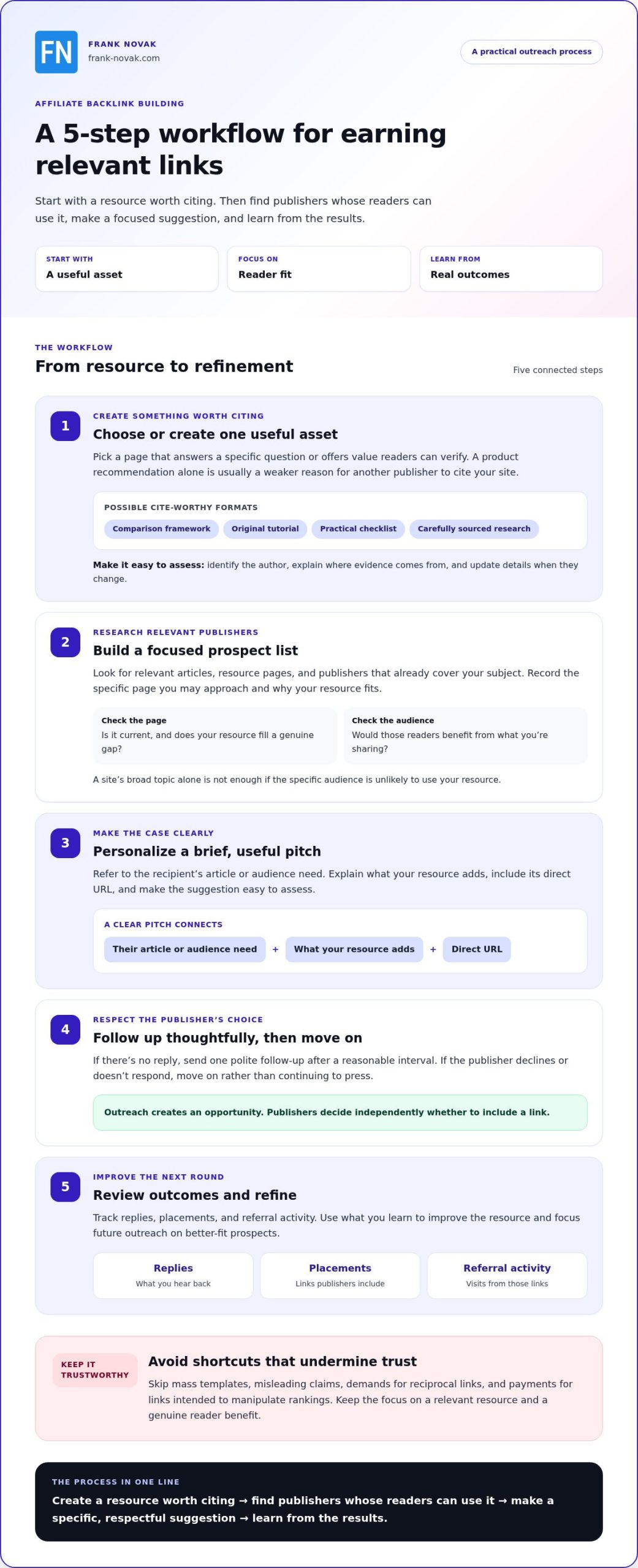
- Choose one asset. Select a page with a clear reader benefit. Check that it’s accurate, accessible, and useful on its own.
- Build a focused prospect list. Find relevant articles, resource pages, and publishers. Record the specific page you’re approaching and why your resource fits.
- Personalize your pitch. Refer to the recipient’s article or audience need, explain what your resource adds, and include its direct URL. Keep the message brief and make your suggestion easy to assess.
- Follow up thoughtfully. If there’s no reply, send one polite follow-up after a reasonable interval. If the publisher declines or doesn’t respond, move on rather than continuing to press.
- Review and refine. Track replies, placements, and referral activity. Use what you learn to improve the resource and focus future outreach on better-fit prospects.
A useful pitch might explain that your guide offers a clear checklist missing from an existing article, then show how adding it could help readers. Avoid mass templates, misleading claims, demands for reciprocal links, or payments for links intended to manipulate rankings. Outreach creates an opportunity, but publishers decide independently whether to include a link.
The workflow is simple: create a resource worth citing, find publishers whose readers can use it, and make a specific, respectful suggestion. If you’re developing a broader affiliate marketing strategy alongside this work, explore online success coaching for guidance on building a consistent approach.
Which backlink strategies suit an affiliate website best?
The right approach depends on what you can offer a publisher and how closely its readers match your subject. For many affiliate sites, useful content and targeted editorial outreach are sensible starting points. They require steady work, but can earn links that make sense to real readers.
| Strategy | Effort | Editorial control | Relationship value | Risks | Likely referral relevance |
|---|---|---|---|---|---|
| Guest contributions | Medium to high | Shared with publisher | High | Weak or promotional content may be rejected | High when the publication and topic fit |
| Resource outreach | Medium | Publisher decides | Medium | Irrelevant pitches can feel intrusive | High if the resource page serves the same audience |
| Broken-link suggestions | Medium | Publisher decides | Medium | Your replacement may not match the dead resource | High when it fills the same reader need |
| Digital PR | High | Low to medium | High | Coverage is uncertain and requires a timely story | Varies with the outlet and topic |
| Link-worthy content | Medium to high upfront | High over your own resource | Indirect | Useful content may still need active promotion | Varies with audience fit and discovery |
Editorial outreach, guest contributions, and digital PR
A guest article or expert comment can work when it answers a question the publisher’s audience already has. Make the contribution complete and useful on its own, not a thin article built around a link. Digital PR follows a similar principle: share a relevant insight, finding, or resource that gives journalists a reason to cover it. Before offering compensation or making endorsements, review current search guidance and applicable advertising rules.
Broken-link outreach and resource-page suggestions
If you find a dead link on a relevant page, check what it originally covered before suggesting a replacement. Your resource should meet the same need for that page’s readers. An affiliate offer alone is rarely a suitable substitute. For a resource page, explain the fit plainly and keep any follow-up polite and limited. The publisher may decide not to add your suggestion.
Buying links may seem faster, especially when a seller emphasizes authority metrics. But a metric isn’t a reader, and paid placements designed to influence rankings can conflict with search policies. If a placement involves payment or another material relationship, review current guidance on how to handle and disclose it. Editorial work may take longer, but it is grounded in relevance and usefulness rather than a shortcut that can put trust at risk. When building backlinks to your affiliate website, choose methods that fit your resource and audience, then assess them by the value they bring, not link counts alone.
How to build backlinks safely without wasting time
A quick quality check before outreach helps you avoid irrelevant prospects and weak placements. Judge each opportunity by its fit for readers and editorial context, not just a third-party score. Check the destination page as well: a relevant publisher is less likely to recommend a resource that’s thin, outdated, unclear, or difficult to use.
Signals of a worthwhile link opportunity
- Topical fit: The publisher regularly covers a subject connected to your resource, and the specific page addresses a related reader need.
- Editorial quality: The site publishes useful, original content, and the link would make sense naturally within the article or resource list.
- Audience match: Readers are likely to find your page relevant, not just share a broad interest in online business.
- Destination readiness: Your page delivers what the pitch promises, has clear authorship and evidence where needed, and makes its affiliate relationship easy to understand.
- Realistic evaluation: Authority scores may help compare sites, but they’re third-party estimates, not proof of audience quality or link value.
Link-building practices to avoid
Be cautious of private networks created primarily to pass ranking signals, automated link blasts, irrelevant directories, excessive exact-match anchor text, and anyone promising guaranteed rankings. Buying links intended to manipulate rankings can create policy risks. Search guidance can change, so check Google’s current documentation before describing link attributes, paid placements, or potential policy consequences. Don’t rely on outdated advice about how a particular link attribute should be used.
Keep affiliate disclosures clear wherever you recommend products or services. If an endorsement or paid relationship is involved, review current FTC guidance before publishing. Transparency helps readers understand your relationship with an offer; it doesn’t make an unsuitable link opportunity worthwhile.
Use a simple tracker to keep the process focused. For each prospect, record the publisher and target page, why its audience fits, the resource you pitched, the date and status of each outreach message, and whether a link was earned. Then review referral visits and affiliate conversions for linked pages. This helps you identify promising relationships and stop spending time on approaches that aren’t reaching relevant readers.
For building backlinks to your affiliate website, a short review routine can be more useful than chasing a large link count. Recheck your list regularly, prioritize strong editorial fits, and update the destination page if it no longer serves the need you pitched.
Turn backlink building into a sustainable affiliate growth system
A backlink works best as part of a broader system: a resource attracts attention, relevant visitors find it, and your site offers them a useful next step. Organic content can support this process, especially when it works alongside other traffic sources and a thoughtful way to stay in touch with interested readers.
Build a repeatable monthly backlink routine
Keep the workload manageable by focusing on one strong resource and a small, relevant group of prospects. Over a 30-day start, aim for steady progress rather than treating a particular number of links as a target.
- Week 1: Review one resource for accuracy, clear authorship, and usefulness. Improve it where needed, then note the audience it serves.
- Week 2: Find relevant publishers and pages that reach that audience. Record why each prospect is a fit before deciding whether to reach out.
- Week 3: Send personalized messages that explain the resource’s specific value. Track replies and placements without assuming outreach will result in a link.
- Week 4: Review the results, update your resource or prospect criteria, and choose a sensible next step for the following month.
In your tracker, record relevant referring domains, outreach status, and response quality. Then review referral visits, engaged sessions, and affiliate conversions from those visits. These measures help you judge whether links are connecting your resource with the right people, even if they don’t lead to an immediate sale. Periodically check older links for broken destinations, outdated context, and whether the linked page still gives visitors what they expect.
Connect organic visibility to the wider affiliate funnel
A link can bring someone to a useful guide, but the rest of the experience matters too. Plan how you’ll serve that visitor next: offer related information, explain a relevant affiliate recommendation clearly, or invite them to join an email list with an appropriate disclosure. A broader traffic plan can also balance organic discovery with other channels. If you use an automated marketing funnel, make sure each step follows naturally from the content that brought the visitor in.
For building backlinks to your affiliate website, steady review connects link activity to business signals rather than treating rankings or link counts as the whole goal. Use what you learn to improve your resources, refine your outreach, and build an affiliate business that supports visitors beyond their first click.
If you’d like broader guidance as you develop your online business strategy, explore Online Success Coaching.
Build links that support your next stage of growth
Building backlinks to your affiliate website works best when you start with a resource people can use, approach relevant publishers with a clear reason to share it, and avoid shortcuts that put trust at risk. Look beyond link counts: relevant referring domains, referral visits, engaged sessions, and affiliate conversions help show whether your efforts are reaching the right audience.
Keep the process steady. Improve one useful page, focus your outreach, and use what you learn to strengthen the next round. Organic visibility can support your wider traffic and email strategy, while a connected funnel gives interested visitors a thoughtful next step.
Frank Novak focuses on affiliate marketing and business automation. If you’re working to scale a digital business, Online Success Coaching and the site’s affiliate and funnel-building resources can help you develop a broader growth strategy.
Choose one useful resource and take the first step. Consistent, reader-focused progress can give your affiliate business a stronger foundation over time.
Frequently Asked Questions
Can a new affiliate website build backlinks?
Yes, a new affiliate website can begin earning backlinks by publishing useful resources, sharing relevant expertise, and contacting publishers whose readers would benefit. For building backlinks to your affiliate website, start with one or two strong pages rather than pitching every offer. A practical comparison or clear how-to guide gives editors a reason to cite it. Expect the process to take time, and track relevant visits and engagement alongside links earned.
How do I get backlinks to affiliate product reviews?
Make a review useful enough to cite by explaining your evaluation criteria, including first-hand observations where available, and comparing options accurately. Keep affiliate disclosures clear. Then find publishers who cover the same topic and explain how your review helps their readers. Don’t ask for a link simply because the page contains an affiliate offer. The editorial reason should be clear to both the publisher and anyone who follows the link.
Are backlinks important for affiliate websites?
Backlinks can help search engines discover pages and may contribute to how search systems assess a site, but they don’t guarantee rankings, traffic, or commissions. Prioritize topical relevance and genuine editorial context over a high third-party score. Affiliate sites also need useful content and a sound user experience. Before making strong claims about ranking effects, check current search guidance and avoid presenting a backlink as a guaranteed growth lever.
Is buying backlinks safe for an affiliate website?
Buying links intended to manipulate search rankings can create policy risks, so it isn’t a dependable shortcut. Paid advertising and sponsorships are different arrangements, but they still need transparent handling and appropriate qualification under current search and disclosure guidance. Before agreeing to a paid placement, understand how it will appear to readers and how the link will be treated. Earning editorial links through useful resources is a steadier foundation.
How long does it take to build backlinks to an affiliate website?
There’s no fixed timeline for building backlinks to your affiliate website. One publisher may respond quickly, while another may not reply or may need time to review your resource. Timing depends on the usefulness of the page, its fit with the publisher’s audience, your outreach, and the publisher’s editorial process. Treat link building as ongoing content and relationship work, and review progress over a consistent period instead of expecting instant rankings.
What is the best backlink strategy for affiliate marketing?
A strong starting point is to create a resource that helps readers beyond making a purchase, then introduce it to relevant publishers through personalized outreach. Depending on your topic, that might be an original guide, comparison framework, or carefully sourced research. No single tactic suits every site. Choose an approach based on audience fit, effort, editorial value, and risk, then assess whether it attracts relevant visitors as well as links.
Should affiliate links be disclosed in articles used for link building?
Clearly disclose affiliate relationships to readers in line with applicable rules and guidance. A disclosure helps readers understand that a publisher may earn a commission, but it doesn’t make an otherwise weak article worth citing. Keep the disclosure easy to notice, and review current FTC guidance for your situation. Don’t assume that disclosure alone meets every platform or legal requirement; consider the context of the endorsement and link.

Article by
Frank Novak
Frank Novak is an online marketing professional and coach who focuses on affiliate marketing and business automation. Through his website, frank-novak.com, he shares insights and strategies for leveraging social media platforms like Facebook to generate traffic and commissions.
Affiliate / Sponsored Content Disclaimer
This [website/post] contains affiliate links. If you click through and make a purchase, we may receive a commission at no additional cost to you. We only recommend products or services we believe will add value to our readers.