

Before you put an affiliate commission back into traffic, content, or tools, separate money that has arrived from money the business can actually spend. Knowing how to reinvest affiliate marketing profits starts with accounting for operating costs, upcoming obligations, and a cash reserve. A strong commission report is not the same as available cash.
If you’re deciding between content, paid traffic, software, or education, start with the problem that is slowing your business down. More tools won’t fix a shortage of relevant visitors, and more traffic won’t necessarily help if visitors aren’t taking the next step. Without a clear measure of success, spending can rise without showing what is working.
This guide walks through how to identify profit available for reinvestment, prioritize spending around a specific business constraint, and evaluate whether an investment is helping. You’ll learn how to set a budget, track results, and adjust when a test misses its goal. The aim is steady, informed growth without putting essential cash under unnecessary pressure.
Key Takeaways
- Learn how to reinvest affiliate marketing profits by identifying income that remains available after obligations and reserves.
- Choose investments based on your current bottleneck, whether it involves content, audience growth, email systems, analytics, tools, or relevant education.
- Set a limit for each reinvestment test and track a signal that fits its purpose, such as qualified clicks, opt-ins, or net commission.
- Review cash, commitments, and test results regularly so spending can adapt as your affiliate business develops.
- Use a repeatable decision process to strengthen your marketing systems without risking money the business needs.
What Does It Mean to Reinvest Affiliate Marketing Profits?
Reinvestment means putting retained business profit back into something that can strengthen your capacity, systems, or future marketing. In affiliate marketing, that might mean improving content, learning more about your audience, or refining a process that supports sales. The key is to invest money the business can spare, not a commission total that looks promising on a dashboard but is not available to spend.
Affiliate revenue is commission income generated by referrals; profit available for reinvestment is the portion left after accounting for received income, business costs, and money set aside for obligations. Keeping those figures separate helps you make growth decisions based on your cash position, not just a strong sales report.
This video offers another perspective on turning commissions into a longer-term business asset:
Which affiliate earnings are actually available to reinvest?
Start with commissions that have been paid and cleared, not pending estimates or sales that may still be adjusted. Then account for business costs you’ve incurred and set aside funds for tax obligations. What remains may be available for reinvestment, reserves, or an owner withdrawal. A withdrawal is money taken for personal use, so keep it separate from spending intended to improve the business.
Affiliate commissions can arrive unevenly. A strong sales month doesn’t guarantee the same cash flow next month, and a dashboard total may not reflect money in your account. Tax treatment depends on your circumstances, so consult a qualified tax professional about your obligations and records.
Why reinvestment matters at different business stages
If you’re early in the process, useful priorities may include learning, audience research, and basic systems for understanding where visitors come from and what they respond to. That groundwork can be more useful than adding complexity before you know what your audience needs.
If you have repeatable sales, look for improvements to the traffic or conversion processes already producing results. For example, test a content improvement or refine one step in your funnel, then check whether the relevant measure changes. These stages are planning lenses, not guaranteed steps or promises of growth. To decide how to reinvest affiliate marketing profits, focus on the business’s current needs and the cash it can responsibly commit.
How to Calculate a Responsible Affiliate Marketing Reinvestment Budget
Build a reinvestment budget from your cash position, not a fixed percentage copied from another business. Commissions can fluctuate, and expenses and personal obligations differ. A percentage that works for one affiliate may leave another short on operating cash. Base your budget on cleared income and your own commitments.
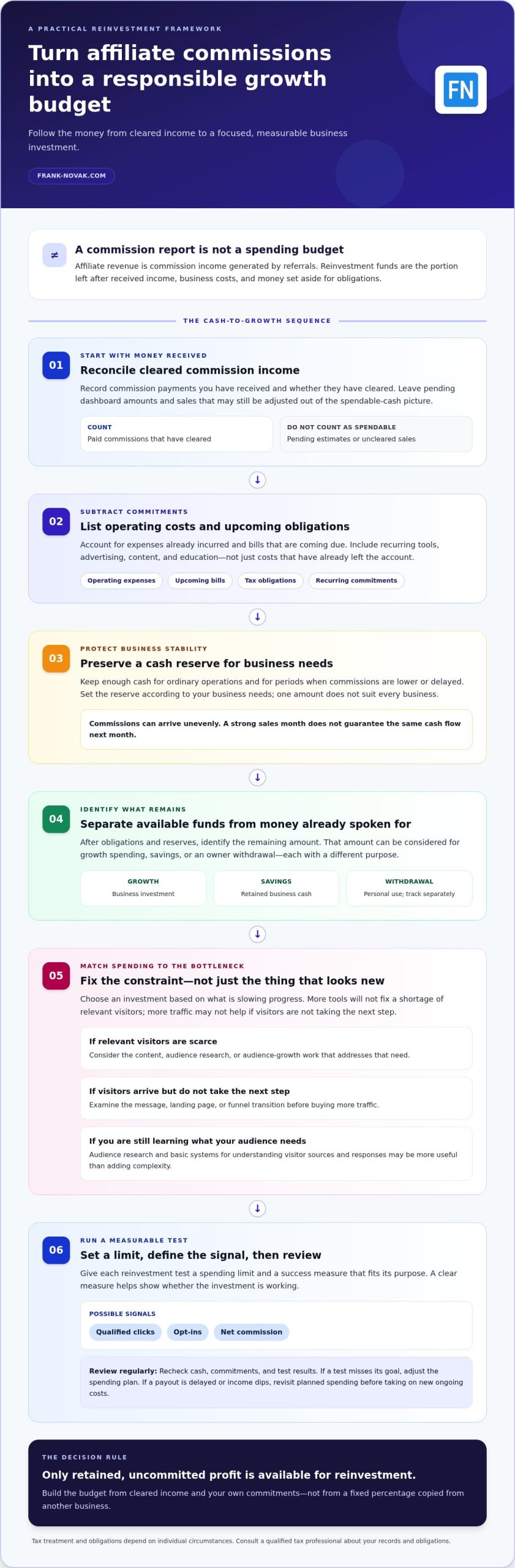
Only retained, uncommitted profit is available for reinvestment. Use this sequence before approving a new business expense:
- Reconcile income: Record commission payments you’ve received and whether they’ve cleared. Don’t count pending dashboard amounts as spendable cash.
- List obligations: Account for existing operating expenses and upcoming bills, including recurring tools, advertising, content, and education.
- Preserve reserves: Keep enough cash for ordinary operations and periods when commissions are lower or delayed. Set a reserve based on your business needs rather than assuming one amount suits everyone.
- Decide what’s available: After obligations and reserves, identify the remaining amount you can consider for growth spending, savings, or an owner withdrawal.
Build a simple cash-flow snapshot before spending
A separate business account can make it easier to track business activity and avoid mixing it with personal spending. Keep consistent income and expense records, including each commission’s date, source, amount, and cleared status. This helps you see how payouts arrive over time.
List regular costs and less frequent commitments, then note when they’re due. Include tax reserves in your planning, but don’t treat a rough estimate as personalized tax advice. Tax obligations vary with individual circumstances, so bring your records and questions to a qualified tax professional.
Set boundaries for reserves, withdrawals, and growth spending
Before spending, decide how much cash needs to stay in the business and what amount, if any, can go toward reinvestment. Record owner withdrawals separately from business expenses. This distinction shows whether cash is supporting operations, building the business, or paying you.
Review your cash-flow snapshot regularly, especially when commissions or recurring costs change. If a payout is delayed or income dips, revisit planned spending before taking on new ongoing expenses. A repeatable review is more useful than relying on a universal reinvestment rule.
If you’re weighing growth decisions alongside your broader online business goals, explore online success coaching for structured support with planning and business growth.
Which Affiliate Marketing Investments Should You Compare First?
Choose an investment by identifying what’s limiting progress, not by comparing features or following the newest tactic. If qualified visitors are scarce, more software may not solve the problem. If visitors arrive but rarely take the next step, examine the message, landing page, and funnel transitions before buying more traffic.
Separate foundational operating costs, such as essential analytics or email systems, from growth experiments intended to improve results. Foundational costs keep your current process running and may recur. Experiments, such as a new content format or a limited paid campaign, test a specific idea. Give each type a clear purpose and a way to assess its value.
Match each investment to the business bottleneck
Start with the weakest point in your process. Organic content can help build an audience over time, but its impact may take longer to assess. Paid traffic can support a quicker test, but set a spending limit and track visits through to meaningful actions. If follow-up is inconsistent, consider whether permission-based email and automation workflows could address the gap.
Use this comparison to narrow your options:
| Investment | Best-fit constraint | Measurement signal | Principal risk |
|---|---|---|---|
| Content production | Few relevant resources for the audience or limited organic discovery | Qualified organic visits, engaged readers, or affiliate clicks | Results can take time; recurring production may consume capacity |
| Audience development | Too few relevant people discovering your recommendations | Qualified visitors, referrals, or audience growth from the chosen channel | Effort may not attract the right audience |
| Email system | Inconsistent follow-up with people who have chosen to hear from you | Opt-ins, email engagement, or clicks to relevant offers | Ongoing platform costs and maintenance without useful follow-up |
| Analytics and tools | Unclear traffic sources, tracking gaps, or repetitive manual work | More complete attribution, fewer tracking gaps, or time saved | Recurring subscriptions and unused features |
| Paid traffic | A need to test a defined audience or offer with controlled reach | Cost per qualified click, opt-in, conversion, or net commission | Spend can outpace results if limits or tracking are weak |
| Relevant education or coaching | A specific knowledge or decision-making gap | A completed implementation or a clearer, testable business decision | Learning without applying it to the business |
Compare organic growth, paid traffic, tools, and education
For each option, ask what problem it addresses, whether it adds a recurring commitment, and what signal would show progress. Coaching or education is most useful when it relates to a decision you need to make or a process you’re ready to improve. Frank Novak offers Online Success Coaching, and the ClickBank Super Funnel is a resource for affiliate marketing. Compare each option with a specific need before committing funds. This makes it easier to decide how to reinvest affiliate marketing profits without confusing more spending with better systems.
How to Reinvest Affiliate Profits in Small, Measurable Tests
A small test turns a reinvestment decision into a learning opportunity. Instead of changing several parts of your business at once, focus on one constraint, choose an intervention that could address it, and decide in advance what evidence would make you continue, adjust, or stop. That keeps the decision tied to a business need rather than hope alone.
Design a test with a clear success signal
Write down the bottleneck, the change you’ll make, the time window for reviewing it, and the maximum amount you’re prepared to spend. For example, if a useful page gets visitors but few affiliate-link clicks, test a clearer call to action on that page. Keep other major variables steady so you can better judge what may have influenced the result.
Choose a metric that matches the test. A traffic experiment might be judged by qualified clicks, while an email signup change could be measured by opt-ins. A landing page test might use conversion rate. If your goal is financial impact, consider net commission after relevant expenses rather than commission totals alone. If you’re planning a traffic experiment, the affiliate traffic strategy guide can help you think through the traffic side of your test.
- Name the problem: Identify the specific step that needs improvement.
- Choose one intervention: Make a focused change that addresses that problem.
- Set limits: Define your spending cap and review window before you begin.
- Track the path: Where possible, distinguish traffic sources and funnel steps to see where activity comes from and what happens next.
- Review the evidence: Compare results with your original objective before deciding what to do next.
Review results without mistaking activity for profit
Clicks and impressions can show that people saw or interacted with a campaign, but they don’t prove that it produced profitable activity. Assess results against the test’s purpose. If you wanted more qualified visitors, look beyond raw visits. If you wanted stronger conversions, review the relevant conversion rate and commissions actually earned.
Allow enough time for results to become meaningful. Affiliate reporting can lag, and refunds or commission adjustments may change what initially appears in a dashboard. Incomplete tracking can also make a promising or weak result hard to interpret. Note these limits in your review rather than treating early figures as final.
Then keep the test, refine it, or stop it based on the evidence and the cash available for continued spending. This measured cycle is a practical way to apply how to reinvest affiliate marketing profits without treating every new tactic as a must-buy opportunity.
Build a Sustainable Reinvestment Plan for Your Affiliate Business
A reinvestment plan works best as a recurring decision, not a one-time allocation. Set a monthly or quarterly review and consider your cash position, upcoming obligations, and experiment results together. Then choose one priority that addresses the most important constraint in your business. Regular reviews help you adapt without assuming that a strong sales period will continue unchanged.
Create a recurring review around evidence and capacity
At each review, compare cleared income with business expenses and the reserves you need to maintain. Check what you learned from recent tests: did the change address the problem, and is the evidence clear enough to justify continuing? If results are inconclusive, tracking is incomplete, or necessary operating funds could be at risk, pause or reduce spending instead of automatically renewing it.
Your next priority may shift as the business develops. Before you’ve established a reliable source of relevant visitors, audience-building may deserve attention. Once traffic is more consistent, you may learn more by improving the steps that turn visits into opt-ins or affiliate conversions. If those systems are working, the next constraint could be follow-up, analysis, or the time required to maintain the process. Treat each change as a planning decision, not a guaranteed growth stage.
Use systems and guidance to support deliberate growth
As you refine the business, connect your processes rather than treating traffic, content, and follow-up as separate activities. A well-planned funnel can help you examine how people move from discovery toward an offer. Frank Novak offers the ClickBank Super Funnel as a resource for affiliate marketers building their systems.
As you assess where a more organized process could support your business, consider the principles behind an automated marketing funnel. The right investment still depends on your current constraint, available cash, and ability to evaluate what changes.
Frank Novak also offers Online Success Coaching for entrepreneurs planning and reviewing digital business growth. Coaching can support planning, but it doesn’t guarantee commissions or business outcomes.
Make Your Next Reinvestment Decision with Confidence
Building a stronger affiliate business doesn’t require spending every commission. Start with cash that’s genuinely available, protect what the business needs to operate, and choose investments that address a clear constraint. Test one change at a time, measure the result that matters, and adjust as your traffic and conversion systems develop.
That’s the practical foundation of how to reinvest affiliate marketing profits: thoughtful allocation, evidence-based decisions, and regular reviews of what your business needs next. Progress can be steady. A carefully chosen improvement is more useful than spending simply because funds have arrived.
Frank Novak focuses on affiliate marketing and business automation, with resources including Online Success Coaching and the ClickBank Super Funnel. If structured support would help you plan and evaluate your next growth decisions, explore coaching to bring greater clarity to your approach.
Keep learning from your results, protect your financial breathing room, and take the next step when the evidence and your available cash support it.
Frequently Asked Questions
How much of my affiliate marketing profits should I reinvest?
There’s no single percentage that fits every affiliate business. First identify cleared commission income, subtract business expenses, set aside money for obligations, and preserve enough cash for operations and changing payouts. Then decide what portion of the remaining profit can go toward growth without putting essential funds at risk. If income is irregular, base your decision on available cash and recent business needs, not just one strong month.
What should I reinvest affiliate marketing profits in first?
Invest first in the constraint that most limits your business. If you’re struggling to attract relevant visitors, consider audience research or focused content. If people visit but don’t take the next step, review your messaging and funnel. If you can’t tell what’s working, improve basic tracking before adding more traffic. Choose one priority, define a signal that would show progress, and avoid recurring costs that don’t address the problem.
Should I reinvest affiliate income before paying taxes?
Set aside funds for tax obligations before deciding how much income is available for reinvestment. Affiliate income may have tax implications, but the details depend on your individual circumstances and location. Don’t treat a dashboard commission estimate as cash you can spend, or assume that reinvesting removes tax responsibilities. Keep clear income and expense records, and speak with a qualified tax professional about estimating and managing your obligations.
Is paid advertising a good way to reinvest affiliate marketing profits?
Paid advertising can be useful as a controlled experiment if you have a clear goal, spending limit, and reliable way to track results. Before increasing spend, define whether you’re testing qualified clicks, opt-ins, conversions, or net commission. Make sure the traffic leads to a relevant offer and that you can assess the path it takes. If tracking is incomplete or you can’t afford to lose the test budget, improve the fundamentals first.
How do I know whether reinvesting in affiliate marketing is working?
Compare results with the purpose of the investment rather than treating activity alone as success. For a content test, review relevant organic visits or affiliate clicks; for an email change, examine opt-ins and meaningful engagement. For a financial assessment, consider commissions after relevant expenses and adjustments. Allow for reporting delays, refunds, and incomplete data before making a decision. Keep, refine, or stop the investment based on evidence and available cash.
Should I reinvest profits in affiliate marketing tools or education?
Choose tools when they solve a specific operational problem, such as a tracking gap or a time-consuming task. Choose education when you’ve identified a knowledge gap that is getting in the way of a decision or implementation. In either case, prioritize relevance over a long list of features or topics. Before spending, name the problem, decide how you’ll apply what you learn or use, and identify a practical signal of value.
Can I reinvest affiliate commissions if my income changes every month?
Yes, but base spending on cleared funds and protect cash needed for expenses, reserves, and other obligations. With variable income, avoid committing to recurring costs based on a single strong payout. Use a regular review to compare recent cash flow, upcoming commitments, and the results of previous tests before choosing a new investment. If commissions fall or arrive late, pause optional spending until the business can support it comfortably.
When should I stop reinvesting in an affiliate marketing strategy?
Pause or stop when a strategy repeatedly misses its stated goal, tracking can’t show whether it’s helping, or continuing would put necessary operating funds at risk. First check whether the review period allowed for reporting delays or commission adjustments. If the evidence is mixed, consider a smaller refinement rather than automatically increasing the budget. Continue investing only when the approach addresses a real business need and available cash supports it.

Article by
Frank Novak
Frank Novak is an online marketing professional and coach who focuses on affiliate marketing and business automation. Through his website, frank-novak.com, he shares insights and strategies for leveraging social media platforms like Facebook to generate traffic and commissions.
Affiliate / Sponsored Content Disclaimer
This [website/post] contains affiliate links. If you click through and make a purchase, we may receive a commission at no additional cost to you. We only recommend products or services we believe will add value to our readers.