
You might believe that having thousands of daily visitors is the only way to catch the eye of a high-paying brand. In reality, affiliate managers often care more about your professional “digital footprint” than your current traffic stats. If you’ve been wondering how to get approved for affiliate programs without a massive following, the secret lies in demonstrating a professional business infrastructure. It’s about showing that you’re a safe, reliable bet for their brand.
It’s incredibly frustrating to spend hours on an application only to receive a generic rejection email without any feedback. You’re not alone if you feel confused by technical requirements like privacy policies or the latest FTC disclosure rules. This guide provides the exact blueprint you need to master professional standards and secure approvals from high-paying programs, even if you’re just starting out. We will provide a clear checklist of “must-haves” for your site, proven application templates, and the confidence to approach high-ticket programs with a system that works.
Key Takeaways
- Understand the gatekeeper role of Affiliate Managers and why a custom domain is a non-negotiable first step for establishing professional credibility.
- Learn how to get approved for affiliate programs by using bridge pages and micro-influence strategies to bypass the need for high traffic volumes.
- Follow a clear blueprint for crafting application pitches that specifically detail your traffic sources, whether you use SEO, email, or Facebook ads.
- Ensure your site meets 2026 legal standards with essential privacy policies and transparent FTC disclosures to build immediate trust with brands.
- Develop the communication habits needed to turn one-off approvals into sustainable, high-paying brand partnerships through consistent updates and performance.
Understanding the Affiliate Approval Process in 2026
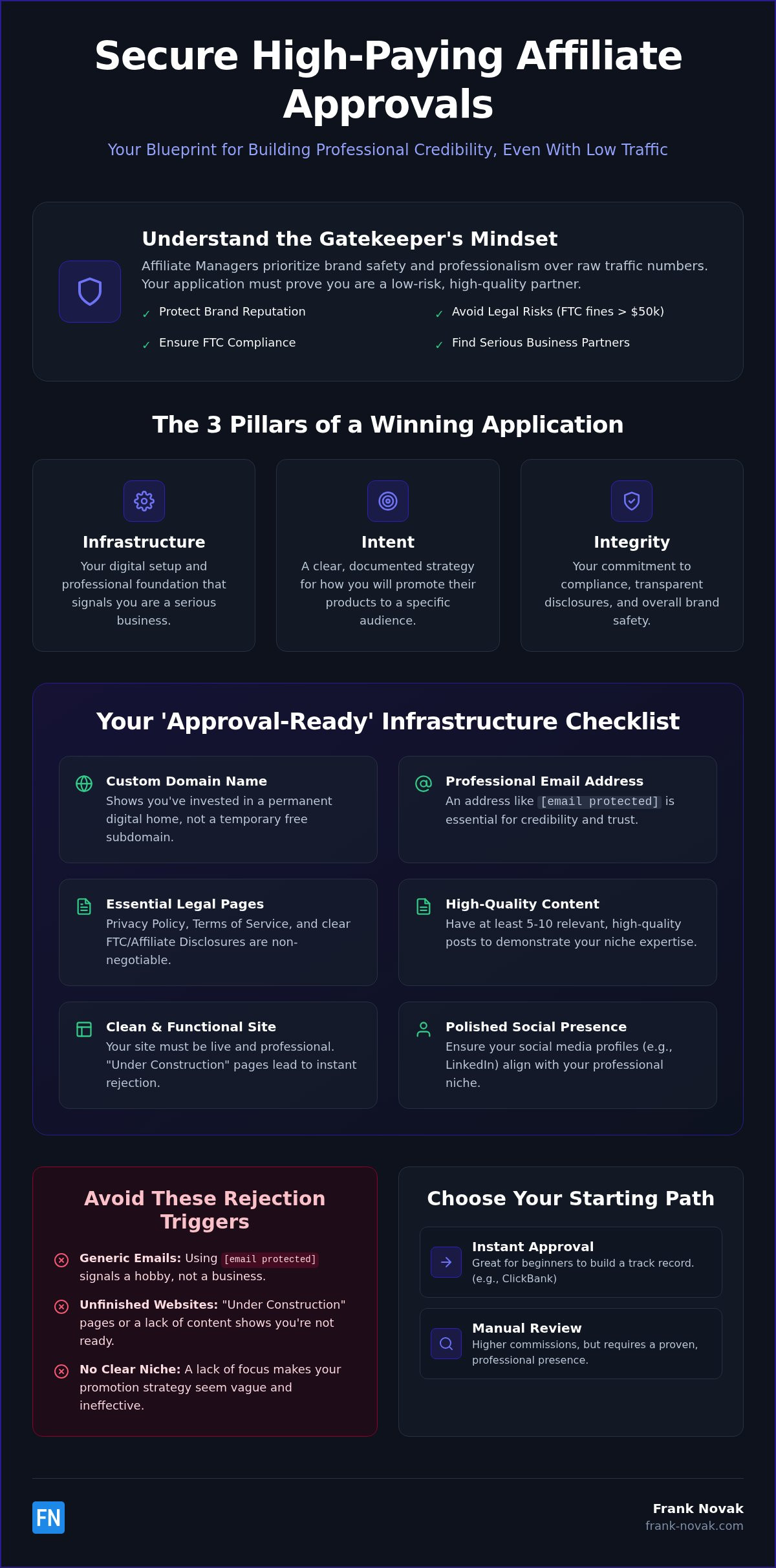
The Affiliate Manager (AM) is far more than just an administrator; they are the primary gatekeeper of a company’s brand reputation. Their job is to ensure that every partner represents the brand with professional standards and follows strict guidelines. If you are researching how to get approved for affiliate programs, you need to recognize that 2026 standards are stricter than ever before. Brands now face significant legal risks, with FTC fines for non-compliance potentially exceeding $50,000 per violation. This means managers aren’t just looking for traffic; they’re looking for partners who prioritize transparency and follow clear disclosure rules, such as using “#ad” or “Sponsored” near every recommendation link.
A successful application rests on three pillars: Infrastructure, Intent, and Integrity. Infrastructure refers to your digital setup and professional foundation. Having a solid system in place, like the one we help you build through Online Success Coaching, signals that you are a serious business owner rather than a casual hobbyist. Intent is about your strategy; managers want to see a clear plan for how you’ll promote their products to a specific audience. Finally, Integrity covers your commitment to compliance and brand safety. Understanding Affiliate Marketing at a foundational level helps you see why these pillars matter for long-term growth and trust.
Why Programs Reject Applicants (And How to Avoid It)
Most rejections happen because of simple, avoidable red flags that signal a lack of professionalism. Using a generic email address like “user123@yahoo.com” instead of a domain-based email immediately suggests you aren’t invested in your business. Similarly, if your site is “under construction” or lacks a clear niche focus, an AM will likely hit the reject button. They fear unvetted affiliates who might use aggressive or non-compliant tactics that could damage their reputation. To stay safe, ensure your site is fully functional and clearly targets a specific audience before you submit your application.
Instant vs. Manual Approval: Choosing Your Starting Point
If you’re just starting, it’s wise to understand the two main approval paths available. Networks like ClickBank often offer instant approval, making them an excellent place to begin your journey. You can use professional assets like the ClickBank Super Funnel to get your systems running quickly and effectively. Manual review programs, on the other hand, require a human to check your site and content quality. While these are harder to enter, they often provide higher commissions and less competition. A smart strategy is to build a track record with instant-approval programs first, then use that performance data to prove your worth to manual-review managers later.
Building Your ‘Approval-Ready’ Digital Infrastructure
Before you click “apply,” your digital presence must act as a silent advocate for your business. A custom domain name is the first signal of professional intent. It shows you’ve invested in a permanent home rather than relying on free subdomains that can disappear overnight. Along with your domain, a professional email address like name@yourdomain.com is essential for establishing credibility. Many managers view generic Gmail addresses as a red flag that suggests a lack of long-term commitment. If you are looking for tips to get approved as an affiliate, starting with these basic technical foundations is the most effective way to build immediate trust.
Compliance is no longer optional in 2026. Your site must include updated legal pages, including a Privacy Policy, Terms of Service, and clear Affiliate Disclosures. These pages prove you understand the regulatory environment, especially regarding data privacy and transparency. Additionally, aim to have at least 5 to 10 high-quality, relevant posts live on your site. This content demonstrates your expertise and gives the Affiliate Manager a clear idea of how you will present their products to your audience. If you use AI-powered tools for content creation, ensure the final output is polished and provides original value, as brands are increasingly wary of generic, low-effort pages.
The ‘Minimum Viable Presence’ for New Affiliates
If you don’t have a massive website yet, focus on creating a clean, professional landing page. This serves as your business card and primary point of contact. Your social media profiles also act as a secondary resume, so ensure your LinkedIn or Facebook presence reflects your professional niche. Using a ready-to-use asset like the ClickBank Super Funnel can demonstrate to managers that you have a high-level marketing setup ready to generate results immediately. This infrastructure makes the process of how to get approved for affiliate programs much easier by removing technical guesswork for the brand.
Compliance and Brand Safety Standards
Brands in 2026 are highly sensitive to how their products are marketed. Brand Safety is the protection of a company’s image through ethical marketing practices. You must ensure your traffic methods, such as Facebook ads or email lists, align strictly with the program’s terms. For instance, most programs forbid trademark bidding, which is using the brand’s name in your own paid search ads. Being transparent about your lead generation methods from the start will separate you from low-quality applicants who hide their sources. If you need help structuring these systems, Online Success Coaching can provide the roadmap for building a compliant business.
Crafting a Winning Affiliate Application Pitch
Once your professional infrastructure is in place, your focus must shift to the actual communication with the Affiliate Manager. Managers review hundreds of applications every week, so a generic or empty submission is the fastest way to get rejected. Mastering the pitch is a critical skill when learning how to get approved for affiliate programs, as it allows you to stand out by speaking the manager’s language. Instead of asking for a chance, position yourself as a partner who provides a solution to their primary problem: finding high-quality, compliant traffic that converts.
Managers don’t want a mystery. When you describe your traffic sources, avoid vague terms like “social media” or “website traffic.” Instead, be specific about your methods, such as targeted Facebook groups, SEO-driven product reviews, or a segmented email list. If you’re just starting out and don’t have massive traffic numbers yet, focus on the quality and engagement of your audience. You might explain that while your volume is currently growing, your followers are highly niche-specific and have shown a high intent to purchase. This “value-first” approach shifts the conversation from your current size to your future potential.
The ‘Perfect Pitch’ Template
If you feel stuck on what to write, follow this simple three-step structure to ensure your application remains professional and persuasive. First, clearly state your niche and the demographics of your audience so the manager knows exactly who you reach. Second, describe your promotional strategy in detail; for example, you could mention that you use educational content followed by a structured email sequence. Finally, mention any professional training or resources you are utilizing, such as Online Success Coaching, to show you are following a proven business model. This transparency builds immediate confidence in your ability to represent their brand ethically.
Following Up Without Being a Nuisance
If you don’t hear back within a week, it’s perfectly acceptable to send a polite follow-up. The 7-day rule is a good standard to follow; it gives the manager enough time to review your site without making you seem impatient. You can also use LinkedIn to find the affiliate manager and send a brief, professional message introducing yourself. This extra step shows initiative and puts a human face to your digital application. If you receive a standard rejection, don’t take it personally. Use it as an opportunity to ask for feedback or to reapply once you’ve reached a specific milestone, such as adding more content or refining your traffic strategy.
Strategies for Getting Approved with Little to No Traffic
A common misconception is that high traffic is the only currency in this industry. If you’re learning how to get approved for affiliate programs, you’ll find that many brands actually prefer “micro-influencers” who maintain high engagement rates within a specific niche. Managers are often more impressed by a clear strategy and a professional technical setup than by a large, generic audience that doesn’t convert. By shifting your focus from volume to quality, you can prove your worth as a partner before your traffic numbers explode.
You can also use the “Bridge Page” strategy to show managers your planned funnel before you even send a single click. This involves showing them a mockup of your landing page or a flowchart of your email sequence to demonstrate your intent and professional planning. If premium programs feel out of reach, start by applying to Tier 2 programs or smaller independent brands that offer more personal review processes. Building a portfolio of successful, compliant partnerships creates the social proof you need to move up to high-ticket offers later. If you’ve worked with a coach, you can also mention their results as evidence that you’re following a proven, high-standard methodology.
Proving Your Potential via Business Automation
Brands look for partners who can deliver consistent results. By explaining your automated lead nurture sequences, you prove that you’re building a sustainable business rather than just chasing one-off clicks. Demonstrating a technical setup using tools like the ClickBank Super Funnel shows that you have a professional infrastructure ready to go. A professional system often matters more than raw numbers because it ensures brand safety and a high-quality user experience. Managers feel much more comfortable approving an applicant who has a clear, automated system for educating and converting leads.
Niche Specialization as a Competitive Advantage
In 2026, “Small and Targeted” consistently beats “Large and Generic.” Positioning yourself as a subject matter expert allows you to speak directly to the pain points of a specific audience, which leads to higher conversion rates for the brand. When you apply, emphasize your deep understanding of your niche rather than trying to be a generalist. Managers often value an affiliate with 500 highly engaged email subscribers more than someone with 50,000 disinterested followers. For more details on moving from approval to actual clicks, check out our guide on Strategic Traffic Generation for Affiliate Links.
Scaling Your Approved Partnerships into a Sustainable Business
If you’ve successfully navigated the initial steps of how to get approved for affiliate programs, you’ve already cleared the hardest hurdle. The transition from a new applicant to a trusted partner happens when you move beyond the “one-off” mindset and start treating your affiliate links as a professional asset. To reach high-ticket, invite-only programs, you must show a history of consistent, compliant performance. Managers are far more likely to grant you “Ambassador” status if they see you are a reliable source of quality traffic who doesn’t require constant supervision.
By maintaining a consistent dialogue with your Affiliate Manager, you can often unlock higher commission rates or exclusive landing pages. Don’t wait for them to contact you; instead, send a brief monthly update on your traffic growth and any new promotional plans you have in place. When you start seeing your first commissions, it’s wise to reinvest those profits back into your business. For many successful practitioners, this means moving into paid traffic sources like Facebook Ads to scale their reach rapidly. This strategic reinvestment allows you to grow your audience much faster than relying on organic search alone.
The Role of Mentorship in Scaling
Scaling a business often brings new challenges that can lead to account bans or technical pitfalls if you aren’t careful. Working with a mentor allows you to see around these corners and maintain your hard-earned approvals. You can learn why Online Success Coaching is Your Shortcut to Growth by following a roadmap that has already been tested. A coach helps you build a resilient mindset, ensuring you stay focused on long-term sustainability rather than “get rich quick” schemes. This steady approach builds the professional reputation required to stay in good standing with the world’s top networks.
Advanced Automation and Funnel Optimization
If you want to move from manual promotion to a truly scalable model, you must master the art of the Automated Marketing Funnel. Automation ensures that your leads are nurtured even when you aren’t at your desk, which is essential for handling high volumes of traffic. You should constantly test and tweak your Super Funnel to find the best-performing headlines and email sequences. This data-driven approach proves to your partners that you are a sophisticated marketer who understands conversion optimization. As your systems become more efficient, you’ll find that getting approved for even the most exclusive programs becomes a natural result of your professional standing.
Join the Never Succeed Online community to master these strategies and connect with other professional affiliates.
Step into Your Professional Affiliate Future
The path to securing high-ticket partnerships is much clearer once you focus on professional standards and a reliable digital infrastructure. You’ve learned that getting accepted is less about your current traffic volume and more about demonstrating business automation and a commitment to brand safety. By presenting a clear promotional plan and a polished digital presence, you position yourself as a long-term asset that managers want on their team. Mastering the mechanics of how to get approved for affiliate programs is the essential first step toward a sustainable career in this space.
If you feel uncertain about technical setups or compliance rules, remember that every successful affiliate started exactly where you are. Having access to specialized resources like the ClickBank Super Funnel and expert guidance can help you bypass common pitfalls and account bans. You have the potential to build a resilient business that thrives on long-term, sustainable growth rather than temporary shortcuts. It’s about moving forward with a steady, intentional pace.
It’s time to stop letting rejections hold you back and start building a foundation that commands respect. Your journey toward professional independence is waiting for you to take the next step.
Frequently Asked Questions
Is it hard to get approved for affiliate programs as a total beginner?
It is not inherently difficult to learn how to get approved for affiliate programs if you focus on building a professional foundation first. Many beginners face rejection because they apply with incomplete sites or generic email addresses. If you demonstrate a clear promotional strategy and a clean digital infrastructure, managers see you as a low-risk partner. Using a structured approach like Online Success Coaching can help you set up these systems correctly from day one.
Do I absolutely need a website to get approved for affiliate marketing?
While some networks allow social media profiles, having a dedicated website is still the gold standard for high-paying programs. A website acts as a permanent business hub that you own and control. It allows you to host essential legal pages and disclosures that brands require for compliance. If you don’t have a full site yet, a professional landing page often serves as a sufficient minimum viable presence for most affiliate managers today.
What should I say in my affiliate application if I have no sales yet?
You should focus on your promotional strategy and the specific value you bring to the brand’s niche. Instead of worrying about sales numbers, explain how you plan to generate traffic through methods like Facebook ads or educational content. Detailing your technical setup, such as using the ClickBank Super Funnel, shows you have a professional system ready to convert. Managers value a well-thought-out plan over empty promises of high volume or past results.
How long does it usually take to get an approval or rejection?
Approval times vary significantly depending on the program’s review process. Instant-approval networks provide access immediately after you sign up. For manual reviews, you can typically expect a response within 24 to 72 hours, though some high-ticket programs may take up to two weeks. If you haven’t heard back after seven days, it is appropriate to send a polite follow-up email to the affiliate manager to check on your status and offer more information.
Why was my affiliate application denied, and can I reapply?
Applications are often denied due to a lack of professional infrastructure or a mismatch between your content and the brand’s niche. Common red flags include “under construction” pages or missing legal disclosures. Most programs allow you to reapply once you have addressed the specific reasons for rejection. Improving your site’s quality and refining your pitch are the best ways to learn how to get approved for affiliate programs on your second attempt.
Are there any affiliate programs that offer instant approval in 2026?
Yes, several major networks still offer instant approval to help new marketers get started quickly. ClickBank remains a popular choice for beginners because it allows you to promote products immediately without a manual review process. While these programs have lower barriers to entry, you should still maintain professional standards. Using ready-made assets like the ClickBank Super Funnel ensures that your automated systems are compliant and professional from the very first click you generate.
Can I use social media profiles instead of a website for approval?
You can use social media profiles for approval in many modern programs, especially if you have high engagement in a specific niche. Platforms like Facebook and YouTube are often accepted as primary traffic sources. However, you must ensure your profiles look professional and clearly state your promotional methods. Many managers still prefer seeing a bridge page or a simple landing page to ensure you have a controlled environment for your essential affiliate disclosures.
How do I find the contact information for an affiliate manager?
Most contact information is located within the affiliate network dashboard once you’ve created an account. If it isn’t listed there, you can check the “Affiliate” or “Partner” page in the footer of the brand’s website. LinkedIn is another powerful tool for finding affiliate managers by searching for the company name and job title. Reaching out directly shows initiative and can help you stand out from the sea of generic, automated applications.

Article by
Frank Novak
Frank Novak is an online marketing professional and coach who focuses on affiliate marketing and business automation. Through his website, frank-novak.com, he shares insights and strategies for leveraging social media platforms like Facebook to generate traffic and commissions.
Affiliate / Sponsored Content Disclaimer
This [website/post] contains affiliate links. If you click through and make a purchase, we may receive a commission at no additional cost to you. We only recommend products or services we believe will add value to our readers.