

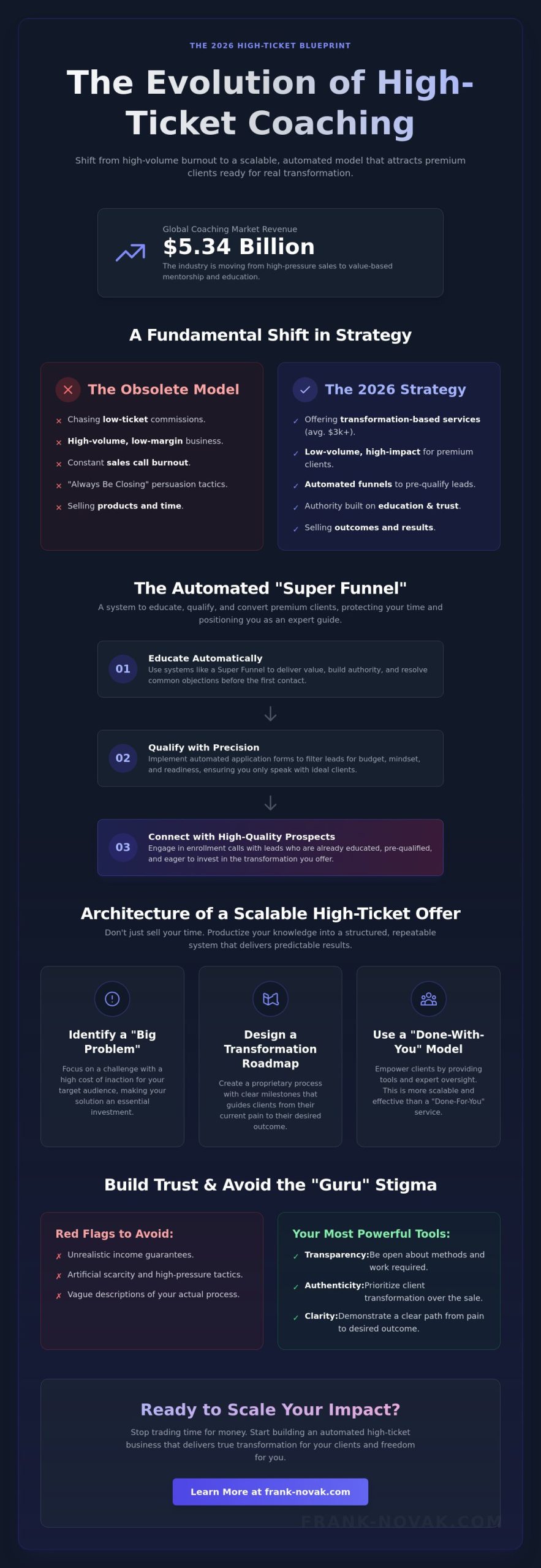
What if the secret to a thriving practice wasn’t finding more customers, but rather finding the right ones who are ready to pay for real transformation? If you’ve spent months chasing low-ticket commissions or feel drained by sales calls with unqualified leads, you aren’t alone. Many professionals find that selling high ticket coaching feels daunting because they fear being perceived as aggressive or insincere. However, with the global coaching market revenue reaching an estimated $5.34 billion, the industry is shifting toward a model where authority is built on education rather than high-pressure persuasion.
You’re likely looking for a way to provide a genuine impact without the constant burnout of a high-volume, low-margin business. This guide will show you how to transition to a high-ticket model that uses automated systems to pre-qualify and educate your leads before you ever hop on a call. We’ll explore the 2026 strategy for building a scalable funnel that protects your time, increases your profit margins, and positions you as a trusted guide for premium clients who are ready to invest in their own success.
Key Takeaways
- Understand the shift toward transformation-based services and why high-ticket offers are now defined by outcomes rather than hourly rates.
- Learn to design a “Transformation Roadmap” that effectively balances personal mentorship with scalable digital assets and group dynamics.
- Discover how a Super Funnel can automate the process of selling high ticket coaching by educating leads and resolving objections before the first contact.
- Master the use of automated application forms to filter for budget and mindset, ensuring you only invest time in high-quality prospects.
- Identify the path to scaling your impact through Online Success Coaching and transitioning your role from a daily operator to a strategic business owner.
The Evolution of Selling High Ticket Coaching in 2026
By 2026, the definition of success in the digital space has shifted away from volume and toward depth. High-ticket coaching is now recognized as a transformation-based service, usually starting at $3,000 and scaling much higher. Unlike digital products that offer passive information, this model offers a specific, guided outcome. The traditional “Always Be Closing” mindset has become obsolete; today’s clients are sophisticated and can sense high-pressure tactics instantly. They aren’t looking for a salesperson. They’re looking for a mentor who can guide them through a complex journey with clarity and patience.
In this environment, trust and authority have become the primary currencies for anyone selling high ticket coaching. While the broader field of Coaching has grown to include over 122,000 practitioners worldwide, the most successful ones have moved away from hype-based selling. They focus on value-based mentorship instead. If you can demonstrate a clear path from a client’s current pain point to their desired destination, the sale becomes a natural next step rather than a forced persuasion. It’s about being a steady guide in an often noisy marketplace.
Why High-Ticket is the Natural Step for Affiliate Marketers
If you’ve been grinding in the affiliate world, you’ve likely felt the burnout of chasing small commissions. The math of selling high ticket coaching is simply more sustainable for long-term growth. It’s much easier to provide a deep, meaningful impact for 10 premium clients than it is to manage the support needs of 1,000 low-ticket buyers. By moving from selling “products” to selling “results,” you leverage your existing audience as a testing ground for higher-level access. Your followers already trust your recommendations; offering them a direct path to success through your mentorship is the logical progression of that relationship.
Addressing the “Guru” Stigma: Authenticity as a Strategy
Skepticism is at an all-time high, especially on platforms like Reddit where coaching programs are frequently scrutinized. To stand out, you must avoid the common red flags that trigger this distrust. These include making unrealistic income guarantees, using artificial scarcity, or being vague about your actual process. Transparency is your most powerful tool in 2026. If you’re open about your methods and the work required to see results, you build a brand that is inherently trustworthy. In the modern digital age, coaching ethics means prioritizing the client’s long-term transformation over the immediate profit of the transaction.
The Architecture of a Scalable High-Ticket Offer
Building a high-ticket offer requires more than just picking a premium price point. It’s about creating a structured roadmap that guides a client from their current struggle to a specific, measurable result. When you’re selling high ticket coaching, you aren’t selling your time by the hour; you’re selling the bridge to a new reality. This journey, often called a Transformation Roadmap, clarifies exactly what happens at every stage of the engagement. It removes the guesswork for the client and builds immediate confidence in your professional authority.
Justifying a price point of $5,000 or more depends on the perceived return on investment and the speed at which that result is achieved. Many successful mentors utilize a “Done-With-You” model, which provides the client with the necessary tools while offering expert oversight. This approach is often more effective than a “Done-For-You” service because it empowers the client to maintain their own success long after the coaching ends. Research into Effective Sales Coaching suggests that avoiding a rigid, one-size-fits-all method is crucial for high-level outcomes. By tailoring the pace to the individual while maintaining a core structure, you ensure the client feels supported without becoming a bottleneck in your own business growth.
Designing Your Core Transformation
To scale effectively, you must identify a “Big Problem” that carries a high cost of inaction for your target audience. Once this problem is clear, you can productize your knowledge into a proprietary process. For example, using a framework like the ClickBank Super Funnel allows you to provide a repeatable system that leads to predictable milestones. These milestones act as psychological wins, keeping your clients motivated and engaged as they move toward their ultimate goal. It’s this sense of steady progress that separates professional coaching from simple information products.
Packaging Your Expertise for Maximum Value
High value doesn’t have to mean more manual work for you. In fact, it often means more efficiency for the client. You can combine live mentorship sessions with a 24/7 digital knowledge base to provide a hybrid experience that fits into a busy professional’s schedule. Including a “Value Stack” of templates, scripts, or exclusive software access helps the client implement your advice much faster. If you’re looking to refine your own delivery model, exploring Online Success Coaching can help you identify the specific assets your business needs to grow. Remember that in the high-ticket world, less is often more. Your clients are paying for the fastest path to their results, not the highest number of hours spent on a call.
Automated Systems: Selling Without the Sales Call Burnout
If you’ve ever spent a whole day on back-to-back sales calls with people who aren’t ready to invest, you know the exhaustion of the old coaching model. Traditional advice focuses heavily on “closing” the prospect during a live conversation. In 2026, the strategy has shifted toward building an ecosystem that does the heavy lifting before you ever say hello. By selling high ticket coaching through an automated “Super Funnel,” you ensure that every person you speak with is already pre-sold on your expertise and methodology. This system isn’t about avoiding people; it’s about making sure your time is spent only with those who are truly ready for transformation.
Educational content is the backbone of this automated approach. Instead of defending your price on a call, you use videos and articles to explain the “Transformation Roadmap” we discussed earlier. This handles 90% of common objections regarding ROI and process long before a lead books a session. It’s about moving from the role of a salesperson to that of a sought-after authority. This shift is supported by a Harvard Business Review study on coaching, which highlights how the industry has evolved from fixing performance issues to developing high-potential performers. When you position your offer this way, you attract clients who view your fee as an investment in their future rather than a cost.
The “Application Only” model further strengthens this dynamic by creating natural scarcity. It flips the script; the client is now applying to work with you, which increases their commitment to the process. Since 72% of coaches now deliver their services virtually, as recorded in 2023, your automated systems can reach a global audience without requiring you to be awake in every time zone. This allows you to maintain a “warm” relationship with prospects through email automation that feels personal and supportive.
The High-Ticket Nurture Sequence
A successful nurture sequence follows a logical, three-step progression to build trust at scale:
- The Lead Magnet: You solve a small, immediate problem for free to prove your competence.
- The Education Phase: You share case studies and “how-it-works” insights, often featuring tools like the ClickBank Super Funnel to show a clear path to success.
- The Call to Action: You invite only the most qualified leads to apply for your mentorship program.
Using Facebook Traffic to Fuel Your Coaching Funnel
Facebook Groups serve as excellent “incubators” for high-ticket leads because they allow for community building and social proof. You can balance organic engagement with paid retargeting ads to stay top-of-mind for interested prospects. While organic content builds deep trust, retargeting ensures that those who have visited your application page but didn’t finish are gently reminded of the value you offer. This creates a consistent flow of leads into your funnel without requiring you to constantly hunt for new business on your own.
Qualifying Leads: The Art of Saying “No” to the Wrong Money
Success in this business isn’t just about the number of sales you close. It’s about the quality of the relationships you build. When you’re selling high ticket coaching, accepting a client who isn’t a good fit can actually be more expensive than losing the sale. A bad-fit client often requires triple the support, struggles to see results, and may eventually damage your reputation through frustration. By prioritizing long-term impact over immediate revenue, you protect both your brand and your peace of mind.
The most effective way to manage this is through an automated application form that filters for mindset and budget before a conversation even begins. This is where many former affiliate marketers struggle; they’re used to casting a wide net to catch any possible commission. However, high-ticket mentorship requires a narrower focus. Think of yourself as a doctor rather than a salesperson. A doctor doesn’t try to “sell” a surgery. They diagnose a problem and recommend a solution only if it’s necessary. If you approach your discovery calls with this consultative mindset, you’ll find that your authority increases naturally.
The 4 Vetting Criteria for High-Ticket Clients
To ensure a high success rate, you should evaluate every prospect against four specific pillars before welcoming them into your program:
- Financial Readiness: Do they have the resources not just for the coaching, but to implement the strategies you’ll teach?
- Coachability: Are they open to new perspectives, or will they spend their sessions defending the habits that kept them stuck?
- Problem/Solution Fit: Does your specific expertise, such as the ClickBank Super Funnel, solve the exact “Big Problem” they’re facing?
- Values Alignment: Since coaching is a partnership, is this someone you’ll enjoy working with for the next several months?
The “Anti-Sales” Call Strategy
If a lead passes your initial filters, the call itself should feel like an interview. You’re looking for reasons why the partnership might not work just as much as why it will. Start by asking the “Why Now?” question. This helps uncover their deep motivation and confirms whether they’re truly ready for the work ahead. If you realize during the call that they aren’t the right fit, it’s your responsibility to decline gracefully. You can still provide value by pointing them toward a different resource or specialist that fits their current stage better.
If you’re ready to start attracting and qualifying these premium leads with confidence, you can explore how our Online Success Coaching helps you build this exact vetting infrastructure. Handling the “I can’t afford it” objection becomes much easier when you’ve already established a high level of trust and clear criteria. If the investment is truly outside their current means, the most ethical choice is to offer them a different path rather than pressuring them into a financial burden they can’t sustain.
Scaling Your Impact with Online Success Coaching
Moving from a hands-on operator to a strategic business owner is the final frontier for many high-level mentors. Once you’ve mastered the mechanics of lead generation and lead qualification, the next logical step is to integrate your offers into a broader digital ecosystem. This transition allows you to hire support for daily administrative tasks, freeing you to focus entirely on the high-level strategy that drives client results. Frank Novak’s Online Success Coaching provides the specific blueprint needed for this evolution, helping you move away from the “hustle” and toward a business model that prioritizes longevity and genuine impact.
Client success stories serve as the most potent fuel for your marketing engine. In an industry where the global coaching market is projected to grow at a compound annual growth rate of 8% to 9% through 2028, social proof is what separates the leaders from the noise. When you share the measurable transformations your clients achieve, you build a level of trust that no traditional advertisement can replicate. These stories prove that your methods work, making the process of selling high ticket coaching feel less like a pitch and more like a shared celebration of potential.
From Affiliate to Mentor: Your Growth Roadmap
If your foundation is built on automated affiliate systems, you’ve already mastered the first step of digital growth. You’ve proven that you can identify high-value solutions and present them to an audience that needs them. Eventually, you’ll notice an “Aha!” moment when your followers stop asking which tools you use and start asking how you achieved your specific lifestyle or business results. This shift in audience inquiry is your signal to step into a mentorship role. By establishing your authority through consistent, supportive education, you prepare your audience for the deeper level of access that high-ticket coaching provides.
Next Steps: Launching Your High-Ticket Offer
Transitioning into a premium offer is a process that benefits from a structured launch. Many successful practitioners start with a “Beta” group, which allows you to refine your coaching curriculum based on real-time feedback from a small group of dedicated students. This ensures your final offer is polished and highly effective. Once your curriculum is set, you can implement the ClickBank Super Funnel to automate your lead flow, ensuring a steady stream of prospects without manual hunting. When you commit to selling high ticket coaching, you aren’t just adding a product; you’re evolving your entire business model. Ready to scale? Explore Online Success Coaching with Frank Novak to see how this methodical approach can help you reach your professional and personal goals.
Building Your Legacy through High-Ticket Mentorship
Transitioning your business model is a significant step toward professional freedom and greater client impact. By moving away from high-pressure tactics and toward a system built on authority and education, you create a sustainable foundation for growth. We’ve explored how a clear transformation roadmap and automated vetting processes allow you to focus your energy on the clients who are truly ready for your guidance. Success in selling high ticket coaching isn’t about working harder; it’s about working with more intention and better systems.
If you’re ready to stop the burnout of low-ticket sales and start building a scalable digital ecosystem, now is the time to take the next step. Our approach combines personalized mentorship for digital business scaling with proven ClickBank Super Funnel systems and a focus on automated lead generation to streamline your growth. You don’t have to navigate this transition alone. Apply for Online Success Coaching and scale your business today to begin your journey toward a more profitable and meaningful practice. Your potential for impact is vast, and with the right roadmap, your growth is well within reach.
Frequently Asked Questions
Is selling high-ticket coaching really possible for beginners?
Yes, it is entirely possible if you have a specific, valuable result you can deliver. Many beginners successfully transition by leveraging a skill set they’ve mastered in a previous career or through a personal transformation. The key is to focus on the value of the outcome you provide rather than the number of years you’ve spent with a “coach” title. If you can solve a high-cost problem, you can offer a high-ticket solution.
Do I need a large following to sell high-ticket programs?
No, you don’t need a massive audience because this model relies on depth rather than breadth. Since your goal is to work with a smaller number of premium clients, a tiny but highly engaged audience is much more valuable than a large, disinterested one. You can build a thriving business by focusing on targeted lead generation within niche communities where your specific expertise is in high demand.
How do I price my coaching program for the first time?
Pricing should be determined by the value of the transformation and the complexity of the problem you’re solving. Instead of calculating an hourly rate, look at the financial or emotional impact the result will have on your client’s life. It’s helpful to research what similar outcomes are worth in the marketplace to ensure your offer is competitive while still reflecting the high-level access and support you provide.
What is the best traffic source for high-ticket coaching leads?
Facebook and LinkedIn remain the most effective platforms for finding high-intent leads because they facilitate direct community engagement. These spaces allow you to build trust through educational content and supportive interactions in groups. By selling high ticket coaching on these platforms, you can identify prospects who are already actively seeking solutions to the specific challenges you are qualified to solve.
How do I handle “scam” accusations or skepticism from prospects?
Transparency and consistent social proof are your best tools for dismantling skepticism. You should share clear case studies, explain your methodology in detail, and be honest about the effort required to see results. When you act as a steady, reliable guide rather than a high-pressure salesperson, you naturally distance your brand from the negative “guru” stereotypes found in unregulated digital industries.
Can I sell high-ticket coaching without doing sales calls?
While some close sales through long-form pages or messaging, most high-ticket engagements still benefit from a final consultative conversation. This call isn’t about “closing” a reluctant lead; it’s about confirming that the prospect is a good fit for your mentorship. Automated systems like the ClickBank Super Funnel handle the education and vetting, but the final human connection often ensures the long-term success of the partnership.
How much should I spend on ads to get a high-ticket client?
Ad spend varies based on your niche, but the focus should always be on your return on investment. Many mentors start with organic methods to validate their offer before moving into paid traffic. Because high-ticket margins are substantial, you can often afford a higher cost per lead than a business selling low-cost products, provided your funnel effectively converts those leads into premium clients.
What is the difference between a course and a high-ticket coaching program?
A course is a self-paced information product, whereas a high-ticket program focuses on personalized implementation and accountability. selling high ticket coaching involves providing the specific “how-to” along with direct feedback to ensure the client actually reaches their goal. This added layer of personal mentorship is what justifies the higher investment and leads to much more consistent transformations than passive learning alone.

Article by
Frank Novak
Frank Novak is an online marketing professional and coach who focuses on affiliate marketing and business automation. Through his website, frank-novak.com, he shares insights and strategies for leveraging social media platforms like Facebook to generate traffic and commissions.
Affiliate / Sponsored Content Disclaimer
This [website/post] contains affiliate links. If you click through and make a purchase, we may receive a commission at no additional cost to you. We only recommend products or services we believe will add value to our readers.