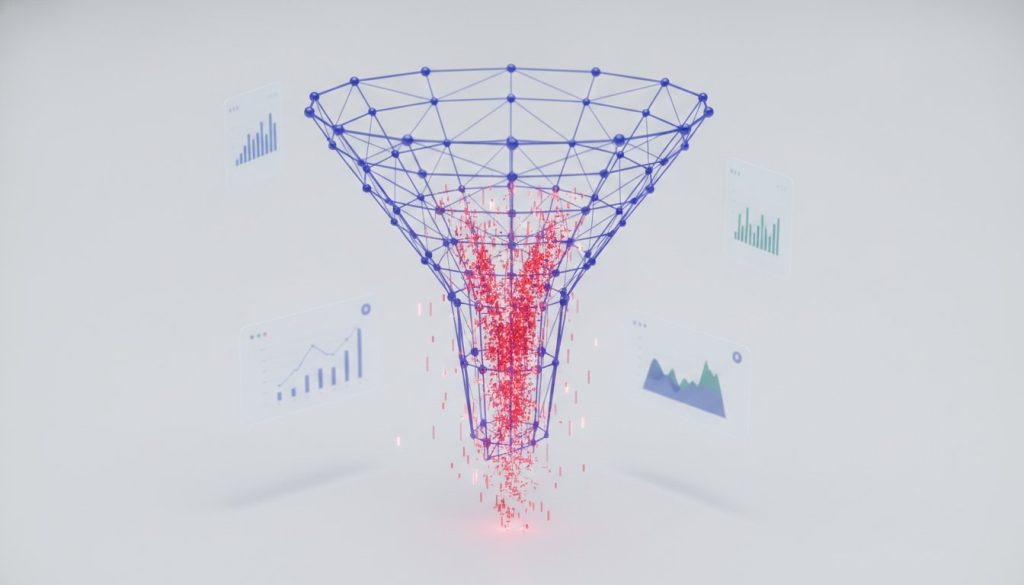

You have spent the last week carefully monitoring your ad campaigns, watching the “hop” count climb steadily, yet your order form impressions remain stubbornly at zero. It’s a discouraging moment that many affiliate marketers face, where high ad spend feels like it’s disappearing into a void without returning a single commission. If you feel as though you’re working against a system that’s designed to be difficult, please know that this is a common hurdle on the path to growth. Often, the issue isn’t your work ethic or the product you’ve chosen, but rather a few common ClickBank funnel mistakes that are quietly draining your budget and triggering compliance flags on platforms like Facebook.
This guide is here to act as your steady resource to identify and fix those critical errors that are sabotaging your affiliate success in 2026. I’ll show you exactly how to plug the leaks in your current setup by using ClickBank analytics to diagnose where your visitors are dropping off. We’ll move step by step through the process of building an automated, profitable system that allows you to scale with confidence. By understanding the mechanics of why funnels fail, you can finally stop guessing and start building a business that provides the results you deserve.
Key Takeaways
- Identify the signs of “data blindness” to ensure every dollar of your ad spend is tracked back to a specific sale.
- Learn how to fix common ClickBank funnel mistakes such as broken HopLinks and mismanaged Tracking IDs that prevent your campaigns from scaling.
- Understand the architectural requirements of a high-converting bridge page to maintain Facebook compliance and bridge the congruency gap.
- Discover which specific ClickBank analytics, such as Earnings Per Order, are the most reliable indicators of your funnel’s long-term health.
- Explore how moving toward an automated system can eliminate the manual technical errors that often discourage new affiliate marketers.
Why Most ClickBank Funnels Fail in 2026 (The ‘Data Blindness’ Trap)
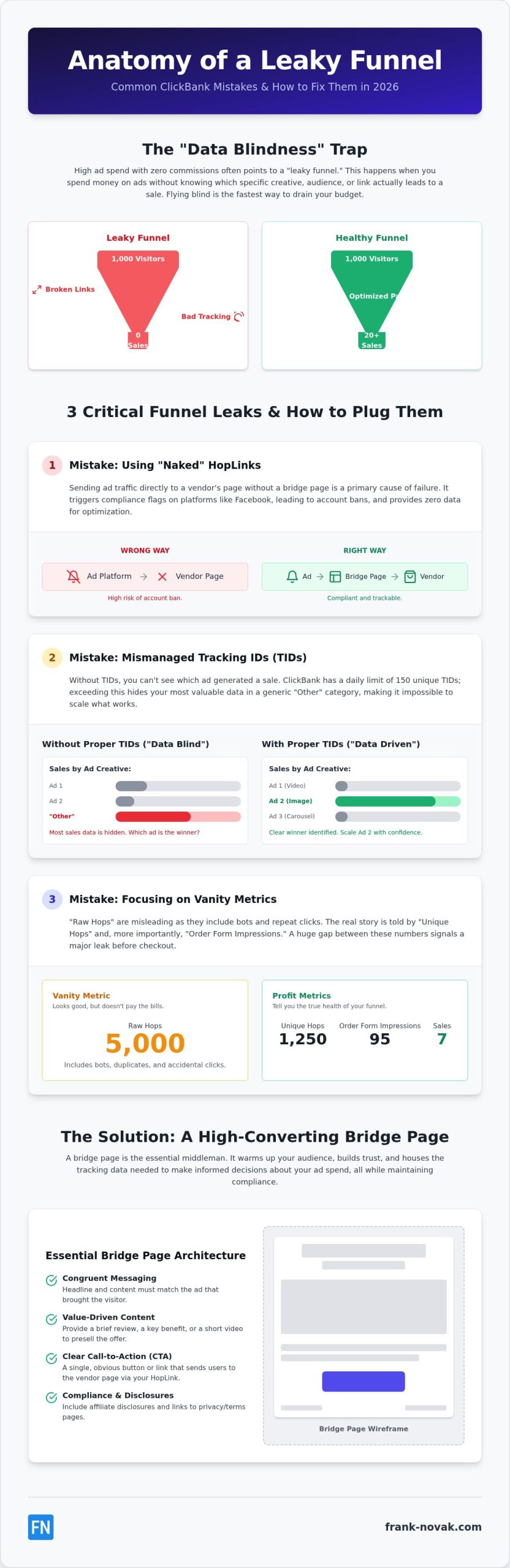
If you’ve ever felt the sting of an empty ClickBank dashboard after a week of running ads, you aren’t alone. This often happens because of a “leaky funnel,” which is a system where potential traffic is lost due to technical friction or a lack of proper tracking. You might be suffering from “data blindness,” which is the costly habit of spending money on ads without knowing which specific creative or audience actually produced a sale. In the current affiliate marketing environment, flying blind is the quickest way to exhaust your budget before you’ve had a chance to optimize.
The 2026 landscape is far more sophisticated than the early days of digital sales. Simply grabbing a raw hoplink and hoping for the best is one of the most common ClickBank funnel mistakes you can make. Platforms like Facebook and Google are increasingly strict about where they send their users, and a direct link to a vendor page often results in an immediate account ban. This is why the bridge page has become the essential middleman. It acts as a buffer that warms up your audience and provides the tracking data you need to make informed decisions about your ad spend.
The Myth of the ‘Magic Product’
Many beginners believe that a high gravity score is a guaranteed ticket to success. While gravity shows that other affiliates are making sales, it doesn’t mean the product will work with your specific funnel architecture. If you don’t understand how to evaluate a vendor’s sales page from a data perspective, you’re essentially gambling with your ad budget. This is where online success coaching becomes invaluable. A coach can help you look beyond the hype to see if a product’s funnel is actually built to convert cold traffic or if it’s just riding a temporary wave of popularity.
Vanity Metrics vs. Profit Metrics
It’s vital to differentiate between “Raw Hops” and “Unique Hops” when you’re analyzing your dashboard. Raw hops include every single click, including bots and accidental double-taps, which can create a lot of misleading noise in your reports. Unique hops represent the actual individuals interested in your offer. If you’re seeing 1,000 clicks but your “Order Form Impression” rate is sitting at zero, there’s a major break in your system. Funnel leakage is the percentage of unique visitors who drop off before they ever see the checkout page. If you don’t fix these common ClickBank funnel mistakes, you’re just pouring water into a broken bucket.
Technical Pitfalls: Broken HopLinks and Mismanaged TIDs
While choosing a product is the first step, the technical execution of your links determines whether you actually get paid. One of the most common ClickBank funnel mistakes involves using “naked” hoplinks. Sending traffic directly to a vendor’s URL without a bridge page or proper disclosures is a fast track to getting your Facebook ad account disabled. Beyond compliance, raw links often lack the tracking depth required to understand your traffic. If you want to stay compliant with modern standards, reviewing the ClickBank Analytics to Fix Your Funnel through the lens of proper endorsement guidelines is a necessary step for any professional affiliate.
Tracking IDs, or TIDs, are the lifeblood of a scalable campaign. Without them, you can’t see which specific ad or headline is driving your sales. In the 2026 ClickBank dashboard, there is a functional limit of 150 unique TIDs per day before the system begins grouping your data into an “Other” category. If you’re running dozens of ad sets and don’t manage your TIDs carefully, your most profitable data will be hidden in this generic bucket. This makes it nearly impossible to know which ads to scale and which to kill. It’s also vital to test your links on mobile and desktop browsers alike, as a link that works on Chrome might occasionally break on Safari or in-app mobile browsers, leading to lost commissions.
Decoding Unique vs. Raw Events
Following the major reporting shifts in 2024 and 2025, ClickBank has moved toward prioritizing unique event tracking. Raw events often include bot traffic or a single user refreshing a page, which can inflate your metrics and give you a false sense of activity. For example, if you have 500 raw hops but only 50 unique hops, your conversion rate based on raw data would look much lower than it actually is. By focusing on unique events, you get a clear picture of your true ROI. If you’re spending $100 to get 50 unique people into your funnel, you can accurately calculate your cost per lead, whereas raw data would suggest you’re reaching 500 people for that same price.
Strategic TID Architecture
To avoid data clutter, you should adopt a consistent naming convention for your TIDs, such as “FB_Niche_AdSet_Date.” This structure allows you to quickly filter your reports and see exactly where your money is working. You can also use TIDs to A/B test bridge page elements, like seeing if “Headline A” produces more order form impressions than “Headline B.” TIDs are the only way to connect front-end ad spend to back-end ClickBank profit. If you’re feeling overwhelmed by these technical requirements, you might find that using a pre-configured ClickBank Super Funnel helps you bypass these manual setup errors entirely. Taking a moment to audit your current tracking setup can often reveal exactly where your commissions are leaking.
The ‘Bridge Page’ Blunder: Architecture Errors That Kill Conversions
While many marketers focus solely on their ad creative, the bridge page is where the actual conversion begins or ends. One of the most common ClickBank funnel mistakes is attempting to use direct linking, which is a 2010-era strategy that simply does not work in today’s environment. If you send traffic directly to a vendor’s sales page from Facebook or Google, you’ll likely find your ad account disabled within hours. These platforms prioritize user experience, and they view direct affiliate links as a disruption to that journey. By building a well-structured bridge page, you create a professional buffer that acts as the heart of your conversion funnel, guiding the visitor from curiosity to a state of readiness for the offer.
If you find that your clicks are high but your sales are low, you might be suffering from a “congruency gap.” This happens when your ad promises a specific benefit, but your bridge page looks and feels completely different. If your ad features a calm, blue color palette and discusses wellness, but your bridge page is a bright red “get rich quick” style layout, the visitor feels an immediate sense of distrust. Consistency in design, tone, and messaging is vital for maintaining the momentum of the sale. Furthermore, failing to capture leads is a missed opportunity to build a long-term asset. When you use automated marketing funnels, you ensure that every click has the potential to become a lead you can follow up with, rather than a one-time visitor who is lost forever.
Facebook Ad Compliance for Affiliates
Modern ad platforms use sophisticated bots to scan your landing pages for “trigger words” that violate their policies. If your bridge page uses aggressive claims such as “guaranteed results” or “make money fast,” you’re inviting an immediate ban. To remain compliant with Meta’s 2026 policies, your page should focus on providing educational value or a personal recommendation. It’s also essential to include visible links to your Privacy Policy and Terms of Service. These small technical details signal to ad networks that you’re a legitimate business owner rather than a fly-by-night operator, which is a key step in avoiding common ClickBank funnel mistakes that end campaigns prematurely.
Maximizing Order Form Impressions
If your unique order form impressions are low despite healthy traffic, your page load speed is often the culprit. If a bridge page takes more than three seconds to load, most mobile users will abandon the site before they even see your headline. You can reduce this friction by optimizing your images and using a clean, lightweight layout. Additionally, incorporating social proof, such as genuine testimonials or results from others, helps build the necessary trust before the visitor clicks through to the ClickBank checkout. When the transition from your bridge page to the vendor’s page feels seamless and credible, your conversion rates will naturally begin to climb.
Diagnosing the Leak: Using ClickBank Analytics to Fix Your Funnel
If you have organized your Tracking IDs as we discussed, the ClickBank analytics dashboard becomes your most powerful diagnostic tool for growth. By reviewing the Traffic Table, you can pinpoint exactly which ad sets are performing and which are failing to move users forward. One of the most common ClickBank funnel mistakes is checking your sales total without looking at the journey that led there. If you notice a high number of unique hops but zero order form impressions, you’ve found a leak that usually points to a technical error on your bridge page or a disconnect in your marketing message.
When you’re deciding how to allocate your ad budget, you must look at Earnings Per Order (EPO) rather than just Earnings Per Click (EPC). While EPC gives you a broad average, EPO shows you the true value of a customer, including any upsells they purchased. If a specific product has a high EPO, it means the vendor’s back-end funnel is doing its job well. This data allows you to spend more on your ads because you know the eventual payout is high enough to cover the cost. If you’re only looking at the surface-level clicks, you might accidentally kill a highly profitable campaign just because the initial conversion seems low.
The Three Pillars of Sales Analytics
To truly master your funnel, you should focus on three specific reports in your dashboard. The Traffic Report helps you identify where your highest-quality unique visitors are coming from, allowing you to ignore the noise of bot traffic. The Checkout Report is where you can spot cart abandonment trends. If people are reaching the order form but not buying, the price point or the shipping costs might be causing friction. Finally, the Earnings Report provides your net profit after any refunds or chargebacks. This is the only number that truly matters for the long-term health of your business.
Turning Data into Scaling Decisions
Scaling a campaign should always be a logical “if-then” progression based on hard numbers. If an ad set has reached a significant number of unique hops without a single order form impression, it’s time to stop the spend and investigate the bridge page. You can identify “winner” products by looking for a high Average Order Value (AOV), which suggests that customers are buying the entire product suite rather than just the entry-level offer. It’s essential to focus on driving traffic to affiliate links based on these objective metrics rather than a gut feeling about what might work. When you let the data lead the way, you remove the emotional stress of affiliate marketing.
Get a professional audit of your ClickBank funnel data to stop the leaks today.
Eliminating Errors with the ClickBank Super Funnel
Building your first affiliate system from scratch is a significant achievement, yet the manual nature of the process often leads to unintentional technical errors. Most common ClickBank funnel mistakes stem from the sheer number of technical connections required to link an ad to a checkout page. When you’re responsible for every tracking ID, lead capture form, and compliance check, it’s easy for one small detail to slip through the cracks. This is why many successful marketers choose to move away from manual builds and toward a more reliable, automated approach that handles the heavy lifting.
The ClickBank Super Funnel serves as a pre-optimized, error-proof system designed to handle these complexities for you. By using a structure that has already been battle-tested, you ensure that every visitor is tracked correctly and every potential lead is captured. This system automatically maintains Facebook ad compliance, removing the guesswork that often leads to account bans. It allows you to focus on high-level strategy and scaling rather than getting bogged down in the technical weeds of link redirects and pixel placements.
Automation as a Scaling Safeguard
An automated system acts as a safeguard against the human error that typically occurs during link generation and tracking setup. If you’ve ever realized too late that a tracking tag was misspelled, you know how frustrating lost data can be. The architecture of the Super Funnel is specifically designed to maximize your Earnings Per Order from day one. Instead of hoping your bridge page converts, you’re using a layout that has been refined through thousands of visitors to ensure the highest possible return on your ad spend. This level of consistency is what allows you to scale with confidence.
Next Steps: Auditing Your Current Funnel
Before you transition from a leaky manual setup to a high-ticket automated engine, it’s helpful to understand the current state of your system. You can perform a quick audit of your ClickBank funnel by following this five-point checklist:
- Test your hoplinks on at least two different mobile devices to ensure they redirect correctly.
- Check your ClickBank dashboard to confirm your TIDs are populating without being grouped into “Other.”
- Scan your bridge page copy for aggressive “income claim” trigger words that might alert ad bots.
- Use a speed test tool to verify your landing page loads in under three seconds on a standard 4G connection.
- Confirm that your email service provider is successfully receiving data from your opt-in forms.
If you find that your technical setup is sound but you’re still struggling to see progress, it might be time to look at the psychological side of the business. Resources like Never Succeed Online can help you identify the mental blocks that often stop entrepreneurs from reaching their full technical potential. Moving toward a professional, automated system is a journey, and having the right tools makes that path much clearer and more rewarding.
Building a Sustainable Path to Commissions
You now have a clear roadmap to move past the “data blindness” that stalls so many affiliate journeys. By refining your tracking with TIDs and ensuring your bridge pages are both compliant and congruent, you can effectively plug the leaks in your sales process. Addressing these common ClickBank funnel mistakes isn’t just about saving your ad spend; it’s about creating a foundation where your business can actually breathe and grow. When you understand why visitors drop off, you gain the power to guide them back toward the checkout with confidence.
If you’re ready to move away from the frustration of manual troubleshooting, it’s helpful to lean on a system that is expertly designed for Facebook compliance. When you use a setup with built-in advanced TID tracking, you’re better positioned to capture those high-ticket ClickBank commissions without the technical headaches. You’ve done the hard work of learning the mechanics, and now you’re ready to see the results of that dedication. Every adjustment you make is a building block for your future success.
Stop guessing and start scaling. Access the ClickBank Super Funnel now.
The path to a professional, automated business is within your reach. Stay focused on the data, keep your audience’s trust at the center of your work, and remember that consistent progress is the result of intentional action. Success in the affiliate world is rarely about luck; it’s about having the right architecture to support your vision. I’m here to support your progress as you step into this next phase of your career.
Frequently Asked Questions
What is the most common reason a ClickBank funnel fails to convert?
The most common reason for failure is a lack of congruence between the initial advertisement and the bridge page. If your ad promises a specific solution but your landing page looks and feels completely different, visitors will lose trust and leave before reaching the offer. This disconnect is one of the most common ClickBank funnel mistakes that beginners make, and it’s easily fixed by aligning your headlines, colors, and core message across the entire journey.
How do I know if my ClickBank hoplink is working correctly?
You can verify your hoplink by clicking it yourself and then checking your ClickBank analytics dashboard for a recorded “Unique Hop” from your location. If the hop appears in your reporting within a few minutes, your tracking is functional. It’s also a good practice to look at the bottom of the vendor’s checkout page to ensure your affiliate nickname is listed as the referring partner.
Why is my Facebook ad traffic not showing up in ClickBank analytics?
Facebook traffic often fails to appear if you aren’t using Tracking IDs (TIDs) or if ClickBank’s security filters identify the traffic as bot activity. If you don’t assign a specific TID to your link, your traffic data gets jumbled, making it difficult to distinguish between real visitors and automated ad scans. Using a structured TID naming convention ensures your human traffic is properly attributed and visible in your reports.
What is a good conversion rate for a ClickBank bridge page in 2026?
A healthy conversion rate for an affiliate bridge page typically ranges between 20% and 40% for lead capture, depending on the quality of your traffic. If you’re seeing rates lower than this, it’s often a sign that your page load speed is too slow or your headline isn’t hitting the right pain point. Monitoring these percentages allows you to fix common ClickBank funnel mistakes before you increase your advertising budget.
Should I use a custom domain for my ClickBank bridge page?
Yes, you should always use a custom domain for your bridge page to build authority and maintain compliance with major ad networks. Using a raw hoplink or a generic subdomain looks unprofessional and frequently triggers security warnings on platforms like Facebook and Google. A custom domain makes your funnel feel like a legitimate business, which significantly improves your click-through rates.
How many Tracking IDs (TIDs) can I use on ClickBank?
ClickBank allows you to track up to 150 unique TIDs per day before the system begins grouping your data into a generic “Other” category. If you run more than 150 different ad variations, you’ll lose the ability to see exactly which specific creative is producing your sales. Managing your TID count helps you keep your scaling decisions based on accurate, granular data.
What does ‘Order Form Impression’ mean and why is it low?
An Order Form Impression occurs when a visitor clicks the link on your bridge page and successfully loads the vendor’s checkout screen. If this number is low compared to your total hops, it means there is too much friction on your bridge page or the visitor doesn’t feel ready to buy. You can improve this by adding more social proof or simplifying the call-to-action on your landing page.
Is direct linking to ClickBank offers still allowed on Facebook?
While direct linking isn’t technically prohibited by ClickBank, it’s the fastest way to get your Facebook ad account permanently banned. Facebook’s 2026 policies prioritize high-quality user experiences, and they view direct affiliate links as low-value disruptions. Using a compliant bridge page is the only sustainable way to run affiliate offers on the platform while keeping your account safe.

Article by
Frank Novak
Frank Novak is an online marketing professional and coach who focuses on affiliate marketing and business automation. Through his website, frank-novak.com, he shares insights and strategies for leveraging social media platforms like Facebook to generate traffic and commissions.
Affiliate / Sponsored Content Disclaimer
This [website/post] contains affiliate links. If you click through and make a purchase, we may receive a commission at no additional cost to you. We only recommend products or services we believe will add value to our readers.