

Most people trying to figure out how to use Facebook groups for affiliate marketing are making the same costly mistake: they join a group, drop a link, and wonder why they get banned before they ever make a sale. If that sounds familiar, you’re not alone, and it’s not your fault. The standard advice online treats Facebook groups like a billboard, when they’re actually much closer to a dinner party.
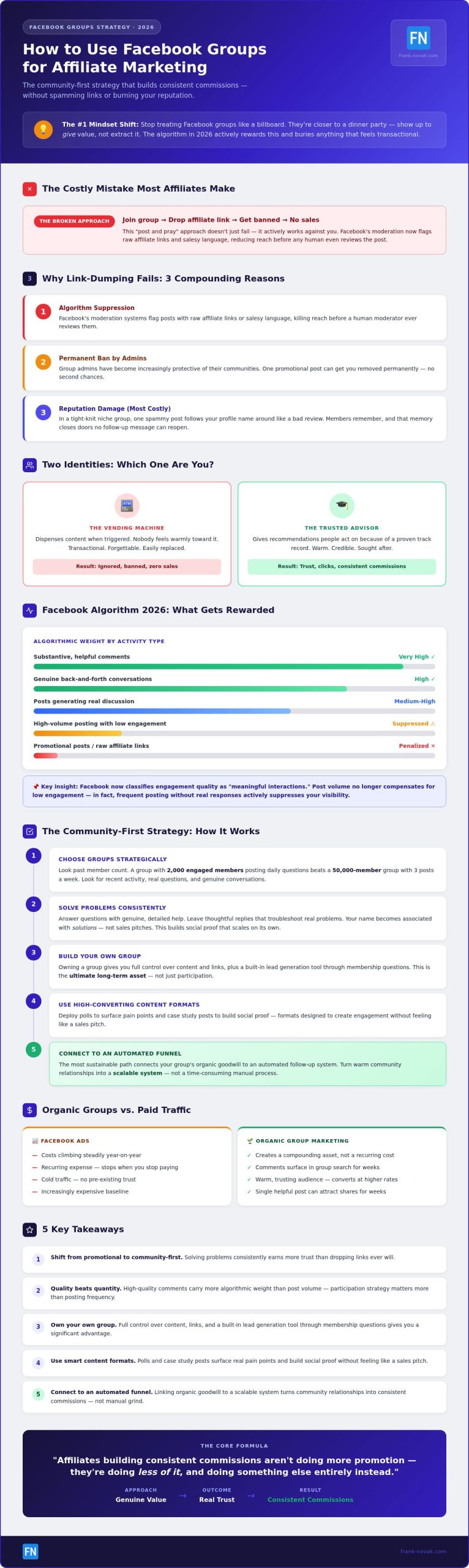
Here’s the truth that changes everything: in 2026, Facebook’s algorithm actively rewards community engagement and quietly buries anything that feels transactional. That means the old “post and pray” approach doesn’t just fail to work, it actively works against you. The affiliates who are quietly building consistent commissions from groups aren’t doing more promotion; they’re doing less of it, and they’re doing something else entirely instead.
This guide will walk you through a community-first strategy that shows you how to build genuine trust inside Facebook groups, position your recommendations so people actually want to click, and connect that organic goodwill to an automated follow-up system that handles the heavy lifting for you.
Key Takeaways
- Understanding how to use Facebook groups for affiliate marketing in 2026 means shifting from a promotional mindset to a community-first approach, where solving problems consistently earns more trust than dropping links ever will.
- The Facebook algorithm now actively rewards genuine engagement, so high-quality comments and helpful contributions carry more weight than post volume, making participation strategy more important than posting frequency.
- Owning your own Facebook group gives you a significant advantage over simply joining others, including full control over content, links, and a built-in lead generation tool through membership questions.
- Specific content formats, like polls and case study posts, are designed to surface your audience’s real pain points and build social proof without feeling like a sales pitch.
- The most sustainable path to consistent commissions connects your group’s organic goodwill to an automated funnel, turning warm community relationships into a scalable system rather than a time-consuming manual process.
The Evolution of Facebook Group Marketing: Community vs. Traffic
There’s a fundamental question worth asking before you post anything in a Facebook group: are you there to extract value, or to create it? That distinction sounds philosophical, but it has very real consequences for your results. The community-first approach to affiliate marketing is built on a simple premise: when you consistently solve problems for real people, you earn something no paid ad can buy, which is genuine trust. And trust, in a group environment, converts at a level that raw traffic never will.
Think of it this way. A vending machine dispenses something when you insert a coin. Nobody feels warmly toward a vending machine. A trusted advisor, on the other hand, gives you a recommendation and you act on it because you’ve seen their track record. That’s the psychological shift at the heart of this strategy, and it’s the one most affiliates never make. They keep trying to be the vending machine in a room full of people who are looking for the advisor.
Facebook’s algorithm in 2026 has made this shift less optional and more mandatory. The platform now prioritizes what it classifies as “meaningful interactions,” which means substantive comments, genuine back-and-forth conversations, and posts that generate real discussion. A thoughtful reply that helps someone troubleshoot a problem carries more algorithmic weight than a promotional post ever could. Post volume no longer compensates for low engagement quality; in fact, posting frequently without generating real responses can actively suppress your visibility in a group’s feed.
There’s also a practical financial argument here. Facebook Ad costs have climbed steadily, making paid traffic an increasingly expensive baseline for affiliate campaigns. Organic group marketing, done well, creates a compounding asset rather than a recurring cost. Every helpful comment you leave is a piece of content that can surface in search results within the group for weeks afterward.
Why Spammers Fail in 2026
The “link-dumping” approach fails for three compounding reasons. First, Facebook’s moderation systems now flag posts containing raw affiliate links or overtly salesy language, often reducing their reach before a human moderator even reviews them. Second, group admins have become increasingly protective of their communities, and a single promotional post can get you removed permanently. Third, and most damaging, is the reputational cost. In a tight-knit niche group, one spammy post follows your profile name around like a bad review. Other members remember, and that memory closes doors that no follow-up message can reopen.
The Benefits of a Nurtured Group Audience
When you invest time in genuinely helping a group’s members, something useful starts to happen. Your name becomes associated with solutions rather than sales pitches, and that association builds a layer of social proof that scales on its own. A single helpful post can attract comments, shares, and saves for weeks, continuously introducing your profile to new members without any additional effort from you. That audience, already warm and already trusting, is exactly the kind of community that responds to a well-placed recommendation or a resource like Online Success Coaching, because they’re not being sold to; they’re being guided by someone they already respect.
Strategic Participation: Providing Value in Established Groups
Knowing how to use Facebook groups for affiliate marketing effectively starts with a decision that most people skip entirely: choosing the right groups in the first place. Not all Facebook groups are created equal, and spending your time in the wrong communities is one of the most common ways affiliates burn hours without ever building meaningful momentum. The groups worth your attention are the ones where members are actively asking questions, sharing problems, and looking for guidance, not just broadcasting their own content into the void.
Finding the Right Neighborhoods
When evaluating a group, look past the member count. A group with 2,000 engaged members who post daily questions is worth ten times more than one with 50,000 members and three posts a week. Prioritize groups where the activity is recent, the conversations are substantive, and the moderators are visibly active without being so restrictive that helpful responses get removed on a hair trigger. That last point matters more than people expect: a well-moderated group is a sign of a healthy community, but overly aggressive moderation can make genuine participation feel impossible.
One group type to avoid entirely is the “link-sharing” or “promo” group. These exist specifically for members to post their affiliate links, which sounds convenient until you realize that everyone in the group is there to promote, not to buy. There’s no audience in a room full of sellers. Your time is far better spent in niche-specific problem-solving communities where members are genuinely seeking answers.
A practical technique that many affiliates overlook is setting up keyword monitoring within Facebook’s search function. By regularly searching for phrases like “best tool for [your niche]” or “struggling with [specific problem]” and filtering by Groups, you can surface real, time-sensitive conversations where your expertise is directly relevant. These are the threads where a well-placed, helpful response carries the most weight.
The Art of the Helpful Response
The 80/20 rule is a useful mental framework here. Roughly 80% of your activity in any group should be purely educational or supportive, with no promotional angle whatsoever. The remaining 20% can include what might be called a soft mention, which is a natural reference to a resource or approach that genuinely fits the conversation. This ratio isn’t arbitrary; it reflects the pace at which trust actually builds in a community setting.
When you do respond to a question, structure your reply in three parts. First, validate the problem so the person feels understood rather than lectured. Second, provide a quick, actionable insight they can use immediately, something concrete enough to demonstrate that you know what you’re talking about. Third, offer a “next step” that opens a door without pushing them through it. That might sound like: “If you want to go deeper on this, I’ve put together some notes on the process, feel free to message me.” This is the bridge comment in practice, and it works because it’s genuinely useful before it’s ever promotional.
On the question of direct messages: use them sparingly and only when someone has already shown interest, either by responding to your comment or reaching out first. Sending unsolicited DMs to group members is the fastest way to damage the credibility you’ve worked to build. When you do send a DM, keep it conversational and focused on continuing the help you started publicly, not on closing a sale.
One more element that’s easy to overlook is compliance. If your helpful response does reference a product you’re affiliated with, even subtly, you have a legal obligation to disclose that relationship. The FTC disclosure requirements for affiliate marketers are clear on this point: endorsements in online communities must be transparent, regardless of how casual the context feels. A simple, honest note like “I’m an affiliate for this, but I use it myself and genuinely recommend it” is all it takes, and it actually tends to increase trust rather than reduce it.
Your personal profile is the final piece of this participation strategy. When someone reads your helpful comment and clicks your name out of curiosity, your profile is what they land on. Treat it like a quiet introduction: a clear description of who you help and how, a pinned post that offers something useful, and a tone that matches the helpful, knowledgeable persona you’re projecting in the group. If you’re at the stage where you want a more structured approach to converting that curiosity into consistent results, exploring the ClickBank Super Funnel is worth a look as the system designed to do exactly that.
Owning the Space: Why Starting Your Own Group is the Ultimate Asset
Participating in other people’s groups is a solid starting point, but it has a ceiling. You’re always a guest, working within someone else’s rules, and one policy change or admin decision can erase months of relationship-building overnight. Starting your own group removes that ceiling entirely. As the owner, you control the narrative, the culture, the content, and critically, the links. That’s a fundamentally different position, and it’s one that most guides on how to use Facebook groups for affiliate marketing never adequately address.
The owner advantage isn’t just about freedom. It’s about architecture. When you build the community, you design the experience from the first moment someone finds your group to the moment they become a paying customer. Every touchpoint is intentional, and every interaction compounds toward a relationship that you own rather than borrow.
Think of your group as the warm, community-facing front door to a more structured back-end system. The organic goodwill you build inside the group is what makes your audience receptive when they encounter a more formal offer. That’s exactly how an automated marketing funnel works most effectively: not as a cold mechanism, but as a natural next step for people who already trust you.
Setting Up Your Group for Conversion
Your group name is your first SEO decision. Facebook’s internal search engine indexes group names the same way Google indexes page titles, so naming your group something like “Affiliate Marketing for Beginners: Tools, Tips, and Strategies” will surface it in relevant searches far more reliably than a clever but vague brand name. Lead with the problem your audience is searching for, then layer in your brand identity once they’re inside.
Once members join, your pinned Welcome Post does the heavy lifting. This isn’t a rules list; it’s a high-value lead magnet disguised as an introduction. Pin a post that offers something genuinely useful, a checklist, a short guide, or a resource library, and include a clear, low-friction call to action that moves interested members toward your email list. This single post works continuously in the background without any ongoing effort from you.
Facebook’s Guides feature is underused and genuinely powerful. You can organize a sequence of posts into a structured mini-course that walks new members through a learning journey, with each module building naturally toward a relevant affiliate recommendation. It feels like education because it is education, and that’s precisely why it converts.
Generating Leads from Membership Requests
Every membership request is a lead generation opportunity that most group owners ignore. When someone asks to join, you can require them to answer up to three questions before they’re approved. Used strategically, those three questions become a lightweight segmentation survey. A practical set might look like this:
- Question 1 (intent): “What’s your biggest challenge with [your niche] right now?” This surfaces pain points and helps you tailor your content.
- Question 2 (email opt-in): “Would you like a free [resource] to help with that? If yes, drop your email below and we’ll send it over.” This is the ethical path to collecting email addresses: it’s voluntary, transparent, and clearly tied to a benefit the member is choosing to receive.
- Question 3 (qualification): “Where are you in your journey?” with options like beginner, intermediate, or advanced. This tells you immediately how to communicate with each person.
It’s worth being clear about the compliance side of this. Collecting emails through membership questions is acceptable under Facebook’s terms when it’s genuinely opt-in, but the moment you start using those addresses, you’re operating under broader marketing regulations. The FTC disclosure requirements for social media affiliate marketing apply to any follow-up communications where you recommend products, so building that transparency into your email sequences from the start protects both your audience and your business.
The answers you collect don’t just feed your email list; they tell you exactly how to position resources like Online Success Coaching to different segments of your audience. Someone who identifies as a beginner needs a different entry point than someone who’s already running campaigns and hitting a growth wall. That segmentation, built from day one, is what separates a group that generates consistent commissions from one that simply accumulates members.
The 2026 Engagement Blueprint: Content That Converts
Building trust inside a Facebook group is one thing. Turning that trust into consistent engagement, and eventually consistent commissions, requires a deliberate content strategy. Most affiliates who understand how to use Facebook groups for affiliate marketing get the relationship-building part right but then default to random posting when it comes to content. What follows is a more intentional approach, built around four formats that work specifically because they serve the community first and promote second.
The Poll to Profit method is the most underused tool in a group owner’s content kit. A simple poll asking “What’s your biggest challenge with [niche topic] right now?” does two things simultaneously: it generates immediate engagement because polls are frictionless to answer, and it hands you a prioritized list of your audience’s real pain points. Those answers become your content calendar. If 60% of respondents say they’re struggling with a specific problem, you now know exactly what your next educational post, live session, or resource should address. The poll doesn’t just collect data; it signals to your members that you’re paying attention to what they actually need.
Case study posts are the next tier up. Sharing a “beta result” or a member win, with their permission, builds social proof without feeling like a sales pitch because the story belongs to someone in the community, not to you. A post structured around a real person’s before-and-after experience is far more persuasive than any claim you could make about a product directly. Keep these posts specific: name the problem, describe the process, and show the measurable outcome. Vague success stories don’t convert; specific ones do.
Live Q&A sessions add a layer that no static post can replicate: real-time credibility. When your audience watches you answer unpredictable questions without a script, their confidence in your expertise grows quickly. Lives also let you handle objections in the moment, which is something a written post can never do as naturally. Keep your sessions focused on a single topic, run them consistently, and close with a soft, natural mention of a resource that extends the conversation.
Curated news posts are the quietest strategy here, but they compound steadily over time. When you regularly share relevant industry updates with a brief, practical commentary, your name becomes associated with staying current. Members start to rely on your group as their first stop for what’s happening in the niche, and that kind of authority is genuinely difficult to replicate.
Writing Posts That Stop the Scroll
The Hook-Story-Offer framework translates cleanly to Facebook’s 2026 feed: open with a single sentence that names a specific problem your audience recognizes, follow with a brief personal or observed story that makes the problem feel real, and close with a resource or next step that feels like a natural conclusion rather than a sales pivot. White space and selective emoji use aren’t aesthetic choices; they’re readability tools that keep members reading past the first three lines. A curiosity gap headline, one that hints at a surprising outcome without revealing it, such as “I tried posting in Facebook groups every day for 30 days. Here’s what actually happened,” gives readers a reason to click “See More” before they’ve consciously decided to engage.
Leveraging Video and Lives
Facebook’s notification system still treats Live broadcasts differently from standard posts, pushing alerts to members who have engaged with your content before. That reach advantage is meaningful. A focused 10-minute training session that delivers genuine value earns the right to close with a soft pitch: something like “If you want the full framework I just walked through, I’ve put it together in one place.” Repurposing that Live recording into a Guide within your group, or trimming it for a YouTube upload, extends its lifespan well beyond the original broadcast and drives cross-platform traffic without additional production effort.
If you’re at the stage where you want a structured system to connect this kind of organic group engagement to a proven back-end funnel, the approach outlined through the ClickBank Super Funnel is built around exactly this workflow.
Explore the ClickBank Super Funnel and see how it connects your group’s warm audience to a scalable commission system
Integrating Groups into Your ClickBank Super Funnel
There’s a meaningful difference between doing affiliate marketing and building an affiliate business. When you manually share links, answer messages, and track conversations one by one, you’ve created a job for yourself. A well-structured funnel, connected to the warm audience your group generates, is something else entirely: a system that works while you’re not watching it. That’s the shift this section is about, and it’s the one most guides on how to use Facebook groups for affiliate marketing never get around to explaining.
Your Facebook group is not the destination. It’s the warm-up. Every helpful post, every genuine conversation, every poll response is quietly doing something important: it’s moving people from strangers to trusted community members. The question is what happens next. Without a deliberate hand-off point, that trust evaporates. With one, it flows into a structure that converts at a pace no manual effort can match.
The hand-off moment is specific. It’s not when someone joins your group, and it’s not when they like a post. It’s when they take a voluntary action that signals readiness: downloading a resource, answering a membership question with their email, or responding to a direct prompt in a Live session. That’s the signal to move them from the social environment into your email sequence, where the relationship can deepen on a more structured timeline. The ClickBank Super Funnel is designed to receive exactly this kind of warm, pre-qualified traffic and carry it through to conversion without requiring your constant involvement.
The Role of the Webinar Profit Engine
A group-exclusive webinar is one of the most effective bridges between social interaction and a buying decision. When you promote a live training as a members-only event, you’re doing two things at once: rewarding the community with genuine access, and creating a contained environment where you can deliver concentrated value and present an offer naturally at the close. The Webinar Profit Engine is built around this exact workflow, converting engaged group members into buyers through a format that feels like education rather than a sales call. The transition from helpful community figure to trusted professional consultant happens inside that session, and it happens organically.
Scaling to High-Ticket with Coaching
Inside every active group, a smaller subset of members will stand out. They comment consistently, ask sharper questions, and implement what they learn faster than anyone else. These are your Power Members, and they’re the most natural candidates for personalized mentorship. You don’t need to pitch them; you need to notice them. A direct message that says “I’ve seen your questions in the group, and I think you’re further along than you realize. I’d like to talk about what’s next for you” is a conversation, not a close.
The most persuasive marketing for Online Success Coaching isn’t a sales page. It’s the success stories already living inside your group, real people whose results you can point to with their permission. That social proof does the positioning for you.
If you’re ready to stop treating your group as a standalone effort and start connecting it to a system that scales, the next step is clear.
Join the ClickBank Super Funnel today and start turning your group’s organic goodwill into automated, consistent growth.
Your Next Step Toward Consistent Commissions
Understanding how to use Facebook groups for affiliate marketing in 2026 comes down to three things that this guide has walked through step by step: showing up as a genuine contributor rather than a promoter, building a community you own and control, and connecting that organic goodwill to a back-end system that scales without requiring your constant attention.
The affiliates who will thrive this year aren’t the ones posting the most links. They’re the ones who’ve made themselves genuinely useful to a specific group of people, and then built a structure that turns that trust into something sustainable. That’s a repeatable process, not a lucky outcome.
Frank Novak’s Online Success Coaching and the ClickBank Super Funnel are designed specifically for this workflow, built for 2026 algorithm compliance and focused on automated, long-term growth rather than short-term wins that fade.
If you’re ready to stop guessing and start building something that compounds over time, the next step is straightforward.
Ready to automate your affiliate commissions? Discover the ClickBank Super Funnel here.
You’ve got the strategy. Now it’s just a matter of putting it to work.
Frequently Asked Questions
Can I post affiliate links directly in Facebook groups?
Technically you can, but whether you should depends entirely on the group’s rules and your relationship with its members. Many group admins prohibit raw affiliate links outright, and Facebook’s own algorithm tends to reduce the reach of posts that look overtly promotional. The safer and more effective approach is to direct people to a landing page or resource first, letting the link live somewhere you control rather than dropping it cold into a thread.
If a group does permit promotional posts, read the pinned rules carefully before sharing anything. Some groups designate specific days or threads for promotions, and respecting that structure keeps you in good standing with the admin, which matters more than any single link ever will.
How do I find Facebook groups that allow affiliate marketing?
Search Facebook using niche-specific problem phrases rather than searching for “affiliate marketing groups” directly. Terms like “best tools for [your niche]” or “[specific problem] help” will surface communities where members are actively seeking solutions, which is where your contributions carry the most weight. Once you’ve found a group, spend a few days reading through recent posts before participating so you understand the culture and what the admin tolerates.
Look for groups where questions get genuine replies, where the admin is visibly present, and where the conversation is recent. A group with steady daily activity and a moderator who engages with members is a healthier environment than a large but quiet community where posts go unanswered.
What is the best way to promote ClickBank products in groups?
The most effective approach to promoting ClickBank products in groups is to lead with education and let the product emerge as a natural solution. Answer a real question thoroughly, demonstrate that you understand the problem, and then reference the product as part of a broader response rather than the point of the post. When people feel helped first, they’re far more receptive to a recommendation that follows.
Connecting your group activity to a structured back-end system makes this approach scalable. The ClickBank Super Funnel is designed to receive warm traffic from exactly this kind of community engagement, moving interested members through a sequence that converts without requiring you to manually follow up with every person who shows interest.
How many Facebook groups should I join for affiliate marketing?
Quality participation in a small number of groups consistently outperforms scattered activity across dozens of them. A practical starting point is three to five groups where you can genuinely contribute several times a week. Spreading yourself across too many communities means your name never becomes familiar in any of them, and familiarity is what builds the trust that leads to conversions.
If you’re also building your own group at the same time, reduce that number further. Running your own community well takes real attention, and dividing your energy too broadly tends to produce mediocre results everywhere rather than strong results somewhere.
Do I need to disclose that I am an affiliate in my posts?
Yes, disclosure is a legal requirement, not a suggestion. The FTC is clear that any material connection between you and a product you recommend must be disclosed, regardless of how casual or conversational the context feels. A straightforward note like “I’m an affiliate for this product, but I use it myself and genuinely recommend it” satisfies the requirement and tends to build credibility rather than undermine it.
Transparency signals confidence in what you’re recommending. If you’re hesitant to disclose because you think it will hurt your conversions, that hesitation is worth examining. Audiences who trust you will respect honesty; audiences who feel misled won’t convert and won’t return.
How can I automate my Facebook group marketing without getting banned?
The parts of your workflow that can be automated safely are the ones that happen off Facebook: your email sequences, your lead magnet delivery, and your follow-up messaging to people who’ve already opted in. Automating activity inside Facebook itself, such as using bots to comment, like, or send DMs, violates the platform’s terms of service and risks permanent account suspension.
A smarter structure is to use your group as the organic, relationship-building layer and let an automated funnel handle everything downstream. When a member downloads a resource or answers a membership question with their email, that’s the handoff point where automation takes over, freeing you to focus on genuine community participation rather than manual follow-up.
What should I do if a moderator deletes my helpful post?
Don’t take it personally and don’t push back publicly. Moderators manage communities under rules that aren’t always fully visible to members, and a deleted post is information, not a rejection. If you have a respectful relationship with the admin, a brief private message asking what guidelines to follow going forward is completely appropriate and often appreciated.
Use the experience to recalibrate. If your post was genuinely helpful and still got removed, the group may simply have a zero-tolerance policy on anything resembling promotion, even subtle mentions. That’s useful to know early, and it tells you whether this community is worth your continued time or whether your energy is better directed elsewhere.
Is it better to start my own group or join existing ones?
Both serve different purposes, and the most effective approach to how to use Facebook groups for affiliate marketing combines them. Joining established groups builds your visibility and credibility within existing audiences relatively quickly, while starting your own group gives you full control over the environment, the content, and critically, the ability to collect leads through membership questions and post links without restriction.
If you’re early in your affiliate journey, spending a few months contributing to established groups first gives you a feel for what your audience actually needs before you invest in building your own community. Once you have that clarity, launching your own group with a focused purpose and a lead generation structure in place from day one puts you in a significantly stronger position than building it without that foundation.

Article by
Frank Novak
Frank Novak is an online marketing professional and coach who focuses on affiliate marketing and business automation. Through his website, frank-novak.com, he shares insights and strategies for leveraging social media platforms like Facebook to generate traffic and commissions.
Affiliate / Sponsored Content Disclaimer
This [website/post] contains affiliate links. If you click through and make a purchase, we may receive a commission at no additional cost to you. We only recommend products or services we believe will add value to our readers.