

What if your declining affiliate traffic isn’t a sign that your site is failing, but a signal that your most valuable reviews are simply waiting for a 2026 makeover? If you’ve watched your page-one rankings slip away after the March 2026 Core Update, you’re certainly not alone in feeling frustrated. Many creators worry that AI-generated content is pushing their hard-earned insights out of the search results. However, learning how to update old affiliate reviews for more traffic is often more effective than starting from scratch. It’s understandable to feel a bit overwhelmed by the shifting landscape of E-E-A-T and new FTC regulations, but these changes actually provide a logical roadmap for your comeback.
This guide will show you how to revitalize your underperforming content with a proven 2026 framework designed to reclaim your rankings and boost your commission rates. You’ll gain access to a clear checklist for content audits, learn how to meet the latest “clear and conspicuous” disclosure standards, and discover ways to increase your click-through rates on existing links. We’ll walk through a step-by-step process that moves your reviews from static descriptions to dynamic, expert-led resources that Google and your readers will trust.
Key Takeaways
- Identify “content decay” in your analytics to prioritize refreshing the reviews that offer the highest potential for a rapid recovery in rankings and revenue.
- Apply the 2026 E-E-A-T standards by replacing generic product descriptions with unique, hands-on insights that demonstrate your real-world experience.
- Learn how to update old affiliate reviews for more traffic by avoiding the “Salesman Trap” and implementing a balanced comparison framework that builds reader trust.
- Signal fresh relevancy to search engines through the “Last Updated” strategy while fixing internal link leakage to guide traffic toward your modern marketing funnels.
- Scale your results by transforming refreshed reviews into effective bridge pages that lead readers directly into the ClickBank Super Funnel.
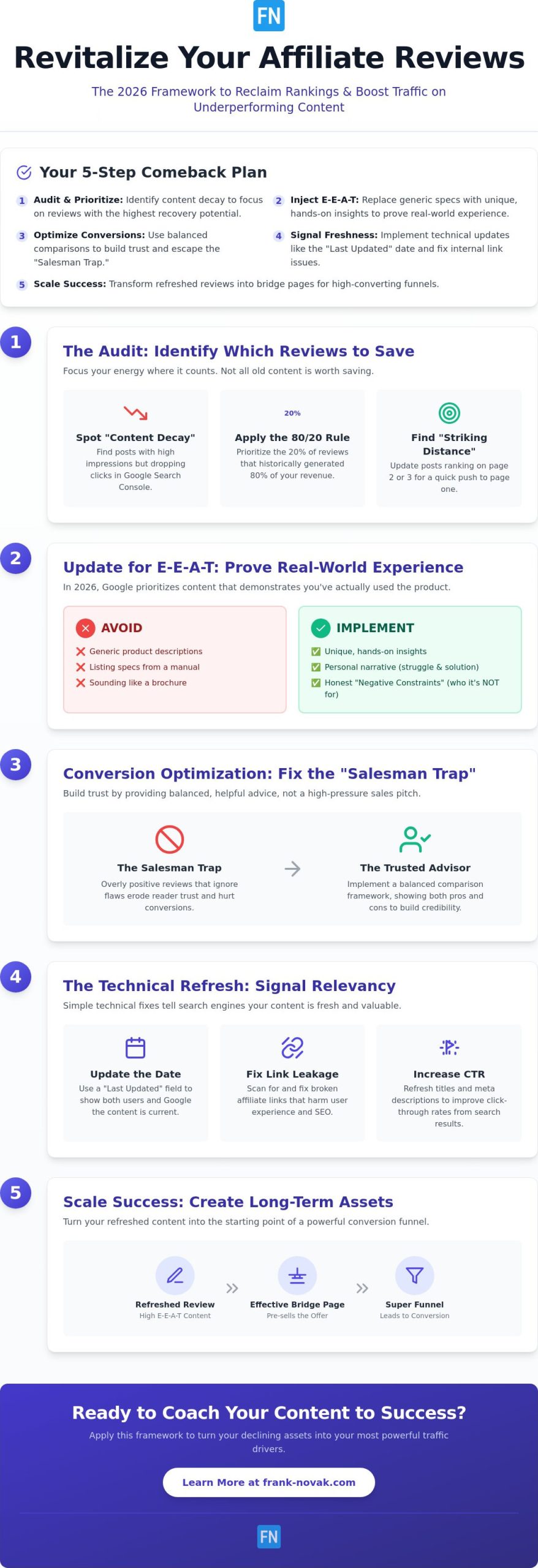
The Audit: Identifying Which Affiliate Reviews Are Worth Saving
Successful Affiliate marketing isn’t just about publishing new posts. It’s about maintaining the assets you’ve already built, ensuring they stay relevant as the industry evolves. Content decay happens when a post that used to perform well slowly loses its grip on the search results. You can spot this in your analytics by looking for a steady downward slope in traffic, even if your rankings haven’t plummeted yet. If you see impressions staying high but clicks dropping, it’s a clear sign that your title or information is no longer meeting the reader’s needs.
The 80/20 Audit Rule for affiliate portfolios suggests that 80% of your revenue typically comes from just 20% of your content. To maximize your time, prioritize reviews with high historical conversion rates that are now seeing declining traffic. You should also look for “Striking Distance” keywords, which are posts currently ranking on pages two or three of Google. By learning how to update old affiliate reviews for more traffic, you can nudge these specific posts onto page one with far less effort than writing something brand new.
To better understand the mechanics of refreshing your content for better rankings, watch this helpful video:
Tools for the Affiliate Content Audit
Using Google Search Console is the most effective way to find declining click-through rates. Look for pages where the average position is stable but the click volume is shrinking. You should also use automated scanners to identify broken affiliate links that might be hurting your user experience. Mapping old reviews against current online success coaching goals ensures that your refreshed content actually supports your current business direction. If a review no longer aligns with what you’re teaching or selling, it’s likely not worth the time it takes to update.
The ‘Keep, Kill, or Combine’ Framework
Not every post deserves a second life. If you have thin content that no longer serves the reader, it’s often better to delete the post and redirect the URL to a more relevant page. You can also combine multiple short reviews into a single “Ultimate Comparison” pillar post to build more authority. A full manual refresh is necessary when the product features have changed significantly, while a light technical update might suffice for posts that just need a few fresh links and a date change. When you understand how to update old affiliate reviews for more traffic strategically, you avoid wasting energy on assets that have no future potential.
Updating for E-E-A-T: Proving Real-World Experience in 2026
If you want to stay relevant in the current search landscape, you have to realize that Google’s algorithms are now sophisticated enough to distinguish between a summary of a manual and a record of actual usage. This is why understanding Google’s E-E-A-T guidelines is so vital for your strategy. The first “E” stands for Experience, and in 2026, it’s the most significant factor for affiliate success. When you’re figuring out how to update old affiliate reviews for more traffic, your first priority should be injecting “Experience” into every paragraph. This means moving away from dry, technical descriptions and toward a narrative that shows you’ve actually held the product or used the software in a real-world setting.
A personal narrative that details a specific struggle and solution will always beat a list of generic product specifications when it comes to building trust with your audience. To do this effectively, look at your old text and identify areas where you can add “Negative Constraints.” These are honest admissions about who the product is not for. If a software is too complex for beginners or a physical product is too heavy for travel, say so. This transparency doesn’t just satisfy search engines; it builds immense credibility with your readers. If you feel stuck on how to translate your unique experiences into a professional brand, online success coaching can help you find your voice and scale your authority.
Adding ‘Proof of Use’ Elements
One of the fastest ways to signal experience is to replace every stock photo with original, timestamped imagery. If you’re reviewing software, use screenshots that show your specific data or a unique setup you’ve created. You should also include a dedicated “Testing Methodology” section that explains exactly how you evaluated the product. Did you use it for thirty days? Did you test it against three competitors? Be specific. Finally, update your author bio to reflect your ongoing journey as a practitioner. Linking your bio to your profile as a coaching professional helps establish the “Expertise” and “Authoritativeness” parts of the E-E-A-T equation.
Refining the ‘Helpful Content’ Score
To improve your helpful content score, you must aggressively remove fluff and “salesy” language that triggers AI-content filters. Google’s March 2026 update heavily penalized sites that sounded like they were written by marketing bots. Instead, focus on answering the specific “People Also Ask” questions that have emerged since your original post was published. These questions represent the current concerns of your audience. If you can provide a unique perspective that isn’t found in the product’s official manual, you’ll be much more likely to regain your page-one rankings. Learning how to update old affiliate reviews for more traffic is ultimately about being more human and more helpful than the competition.
Conversion Rate Optimization: Fixing the ‘Salesman Trap’ in Old Posts
Many older affiliate reviews fall into a common pattern known as the “Salesman Trap.” This occurs when the content sounds so overwhelmingly positive that it loses all credibility with a modern audience. If your readers feel like they are being sold to rather than guided, they will likely leave your page before ever clicking a link. When you are evaluating how to update old affiliate reviews for more traffic, you must shift your perspective toward Conversion Rate Optimization (CRO). This involves refining the user experience so that the path to a purchase feels like a logical next step in their journey rather than a high-pressure pitch.
In 2026, the most effective reviews utilize a “Comparison Framework” where you evaluate product A against products B and C. Providing options helps reduce the “Paradox of Choice” by giving the reader a clear context for why one item stands out over another. You should also take this opportunity to update your calls to action (CTAs). Instead of aggressive “Buy Now” buttons, try using benefit-driven language such as “View the time-saving features” or “Check current availability.” These micro-commitments reduce friction and encourage readers to take small steps toward a final decision without feeling rushed.
Building a 2026 Comparison Table
A responsive comparison table is no longer optional; it is a requirement for keeping busy readers engaged. Your table should highlight “Best For” categories to help users self-segment based on their specific needs. If you focus on “Value per Dollar” rather than just the lowest price, you help the reader justify the investment in higher-quality tools. Using the “Law of Contrast” by positioning a premium high-ticket item next to a standard model can also help clarify the unique benefits of each, making the decision process much simpler for your audience.
The Psychology of the ‘Verdict’ Section
Modern readers are often in a hurry, so moving your final verdict or summary to the top of the post can actually improve your conversion rates. This “Bottom Line Up Front” approach respects the reader’s time and builds instant rapport. You can further strengthen this trust by using risk-reversal language, such as clearly highlighting money-back guarantees or trial periods. If your reader is skeptical about a specific claim, providing a direct, honest comparison to a well-known competitor builds the kind of transparency that search engines and humans both reward. Learning how to update old affiliate reviews for more traffic is as much about psychological refinement as it is about technical updates.
The Technical Refresh: Signaling Relevancy to Search Engines
While improving your prose is vital, search engines also need clear technical signals to recognize that your content is fresh and reliable. The ‘Last Updated’ strategy involves updating the metadata and the visible date on your page, but it only works if you’ve made substantive changes to the body of the text. If you simply change the date without revising the information, you risk being penalized for deceptive practices. Learning how to update old affiliate reviews for more traffic requires you to be honest with both your readers and the algorithms. This is also the perfect time to fix “Internal Link Leakage” by ensuring your older reviews point toward your current automated marketing funnels, which helps keep visitors within your ecosystem for longer periods.
Link Health and Compliance
Your technical refresh must include a thorough check of your legal disclosures. As of 2026, the FTC has increased its enforcement, with potential penalties reaching up to $53,088 per violation for inadequate disclosures. Make sure your affiliate statements are “clear and conspicuous,” appearing before any links. You should also replace any dead links with high-performing alternatives to avoid frustrating your users. Additionally, verify that all your commercial links are marked with the “rel=sponsored” attribute. This helps search engines understand the nature of your relationships and protects your site’s authority.
Mobile and Speed Optimization
Since Google’s March 2026 update, site performance is measured using a composite Core Web Vitals score. This makes overall speed and user experience more critical than ever, especially on mobile devices where 62% of affiliate traffic now originates. If your old reviews contain large, unoptimized images, they will likely drag down your rankings. Compressing these files and simplifying your layout ensures that your “Buy” buttons remain easily accessible on smaller screens. If you find the technical side of growth intimidating, online success coaching can provide the structured guidance you need to master these systems and scale your business with confidence.
Scaling the Success: Turning Updated Reviews into Long-Term Assets
Once you’ve mastered the mechanics of the refresh, the next logical step is to consider how these assets fit into your broader business ecosystem. Refreshed reviews shouldn’t just sit on your blog waiting for search traffic; they can be powerful entry points for the ClickBank Super Funnel. By positioning your updated content as a “Bridge Page,” you create a smooth transition from a helpful product review to a high-ticket coaching offer. This approach ensures that your traffic isn’t just passing through but is being nurtured toward a deeper professional relationship. Learning how to update old affiliate reviews for more traffic is only the beginning. The real growth happens when you turn that traffic into a consistent stream of leads.
To prevent your content from falling into decay again, you need to automate your update cycle. This means setting up a recurring schedule to revisit your top-performing assets every six months. Professional mentorship plays a vital role in this process, as a seasoned guide can help you spot industry shifts before they become mandatory. This proactive approach allows you to maintain your rankings without the stress of reacting to sudden algorithm changes. If you understand the mechanics of how to update old affiliate reviews for more traffic, you can build a portfolio that grows more valuable with each passing year.
From Content to Lead Generation
If you want to maximize the ROI of your efforts, adding email opt-ins to your most popular reviews is essential. You can offer a “Review PDF” or a “Comparison Checklist” in exchange for an email address, which provides immediate value to the reader. This turns a one-time visitor into a long-term subscriber. Once they are on your list, an automated sequence can follow up with review readers, providing additional insights and building the trust necessary for higher-ticket conversions. This strategy transforms a simple review into a sophisticated lead-generation tool.
Your 90-Day Refresh Roadmap
Consistency is the foundation of any successful content strategy. Set a manageable goal to update two high-potential reviews per week. As you monitor the ranking lift in your analytics, you can adjust your strategy based on which categories are showing the strongest recovery. This data-driven approach ensures that your time is always spent on the tasks with the highest impact. If you’re ready to move beyond basic tactics and master the art of business automation, you can join the Online Success Coaching program to gain the insights needed for sustainable, long-term growth.
Taking Control of Your Content Future
Refreshing your existing content is one of the most efficient ways to grow your digital presence without the exhaustion of constant creation. By auditing your portfolio for content decay and injecting real-world experience into your reviews, you satisfy both the latest search algorithms and the needs of your human readers. Mastering how to update old affiliate reviews for more traffic allows you to leverage the authority you’ve already built while ensuring your technical foundations remain compliant with 2026 standards. These small, methodical changes build the trust that is essential for long-term success.
If you’re ready to move beyond isolated updates and want to build a truly resilient income stream, it’s time to think about the systems behind your success. Based on years of digital business scaling experience, I’ve seen how high-trust, conversion-first strategies can transform a struggling site into a reliable asset. You can scale your digital business with the ClickBank Super Funnel, which is specifically designed for sustainable growth through automation.
The path toward a more profitable site is a steady journey of refinement. With the right roadmap and a bit of patience, you can turn your old reviews into your most powerful assets. You have the tools and the knowledge; now it’s just a matter of taking that first step toward a more organized and automated future.
Frequently Asked Questions
How often should I update my affiliate reviews in 2026?
You should aim for a comprehensive review of your affiliate content every six months to ensure it stays relevant. If a product is in a fast moving industry like technology or software; quarterly or even monthly check-ins might be necessary. This regular maintenance helps you stay ahead of content decay and ensures your disclosures meet the latest 2026 FTC requirements, protecting your business from potential penalties.
Is it better to update an old post or write a brand new one?
Updating an old post is generally superior because you can leverage the existing authority and backlinks the page has already earned. If you have a URL that search engines already trust, it is much easier to regain rankings than starting from zero with a fresh page. You should only write a brand new post if the original product is completely irrelevant or if you are targeting a significantly different keyword.
Does changing the ‘Published Date’ on an old review help with SEO?
Changing the date can help your rankings, but only if you have made substantive improvements to the content itself. Search algorithms are smart enough to detect if you have simply “faked” an update without adding new value. If you provide fresh insights or original photos; updating the “Last Modified” date signals to both users and search engines that the information is current and reliable.
How much of an old review do I need to change for it to count as an ‘update’?
Focus on changing enough content to provide a noticeably better user experience rather than hitting a specific word count. When you are learning how to update old affiliate reviews for more traffic, adding original photos and hands-on testing data is more important than minor text edits. If you can honestly say the new version provides unique insights that weren’t there before, you’ve done enough to signal a meaningful update.
What should I do if the product I reviewed is no longer available?
If a product is discontinued, you should update the post to recommend the most relevant current alternative. Instead of deleting the page, use it as a comparison guide that explains why the old product is gone and why the new one is a better choice. This preserves your organic traffic while providing a helpful solution to users who were searching for the original item in your niche.
Can I use AI to help me update my old affiliate reviews?
You can use AI for brainstorming or outlining, but the final content must be heavily edited to include your unique human experience. Google’s 2026 updates heavily penalize generic AI-generated text that lacks real-world insights. If you want to maintain your authority, ensure that the core of your review focuses on your personal journey and specific testing results that a machine simply cannot replicate.
Will updating my review cause a temporary drop in rankings?
A temporary ranking fluctuation is normal as search engines re-evaluate your refreshed page. If you have improved the quality and relevance of the information, this “ranking dance” usually resolves into a higher position within a few weeks. By understanding how to update old affiliate reviews for more traffic through better E-E-A-T signals, you’re building a foundation for sustainable growth rather than chasing temporary spikes.
How do I handle negative feedback in an old review during an update?
Address negative feedback directly by incorporating it into your “Who this is NOT for” section. If users have complained about specific features, test those features yourself and provide an honest assessment of the current version. This transparency builds immense trust with your audience and proves that you are an objective guide rather than just a salesperson looking for a quick commission from a click.

Article by
Frank Novak
Frank Novak is an online marketing professional and coach who focuses on affiliate marketing and business automation. Through his website, frank-novak.com, he shares insights and strategies for leveraging social media platforms like Facebook to generate traffic and commissions.
Affiliate / Sponsored Content Disclaimer
This [website/post] contains affiliate links. If you click through and make a purchase, we may receive a commission at no additional cost to you. We only recommend products or services we believe will add value to our readers.