

Did you know that a single overlooked link in your email sequence could result in a civil penalty of up to $53,088 per violation? It’s a sobering figure, but in 2026, the FTC guidelines for affiliate marketers are more than just legal suggestions; they’re the blueprint for a sustainable, professional business. If you’ve felt a sense of anxiety that a wall of legal text might scare away your hard-earned leads, you aren’t alone. Most marketers worry that being transparent will hurt their conversion rates, but the reality is often the opposite.
We understand that trying to keep up with shifting platform rules can feel overwhelming, especially when you’re focused on scaling your automated funnels. This guide is designed to replace that confusion with clarity. You’ll learn how to implement “clear and conspicuous” disclosures that actually build trust with your audience rather than driving them away. We’ll walk through a practical checklist for compliance and provide natural-sounding templates you can use immediately. By the end of this handbook, you’ll have the confidence to grow your business knowing your legal foundation is secure.
Key Takeaways
- Understand why the FTC classifies affiliate links as personal endorsements and how to correctly identify every material connection in your content.
- Master the four pillars of the “clear and conspicuous” standard to ensure your disclosures are always visible, prominent, and easy for your audience to understand.
- Learn how to integrate the latest FTC guidelines for affiliate marketers into your automated sales funnels and social media posts while maintaining high conversion rates.
- Discover how to avoid common compliance pitfalls, such as relying solely on a brand’s marketing materials or using deceptive review structures.
- Build a more responsive mailing list by using transparency as a tool to establish professional authority and long-term trust with your subscribers.
Understanding the Core FTC Guidelines for Affiliate Marketers in 2026
The digital marketplace has changed significantly over the last few years. As we move through 2026, the Federal Trade Commission has made it clear that transparency isn’t optional. If you’re building a business through what is affiliate marketing, you’ve likely seen how quickly the rules can shift. The core of the FTC guidelines for affiliate marketers rests on a single principle: consumers have a right to know when a recommendation is backed by a financial incentive. This isn’t just about legal safety; it’s about the professional success mindset required to build a long-term brand.
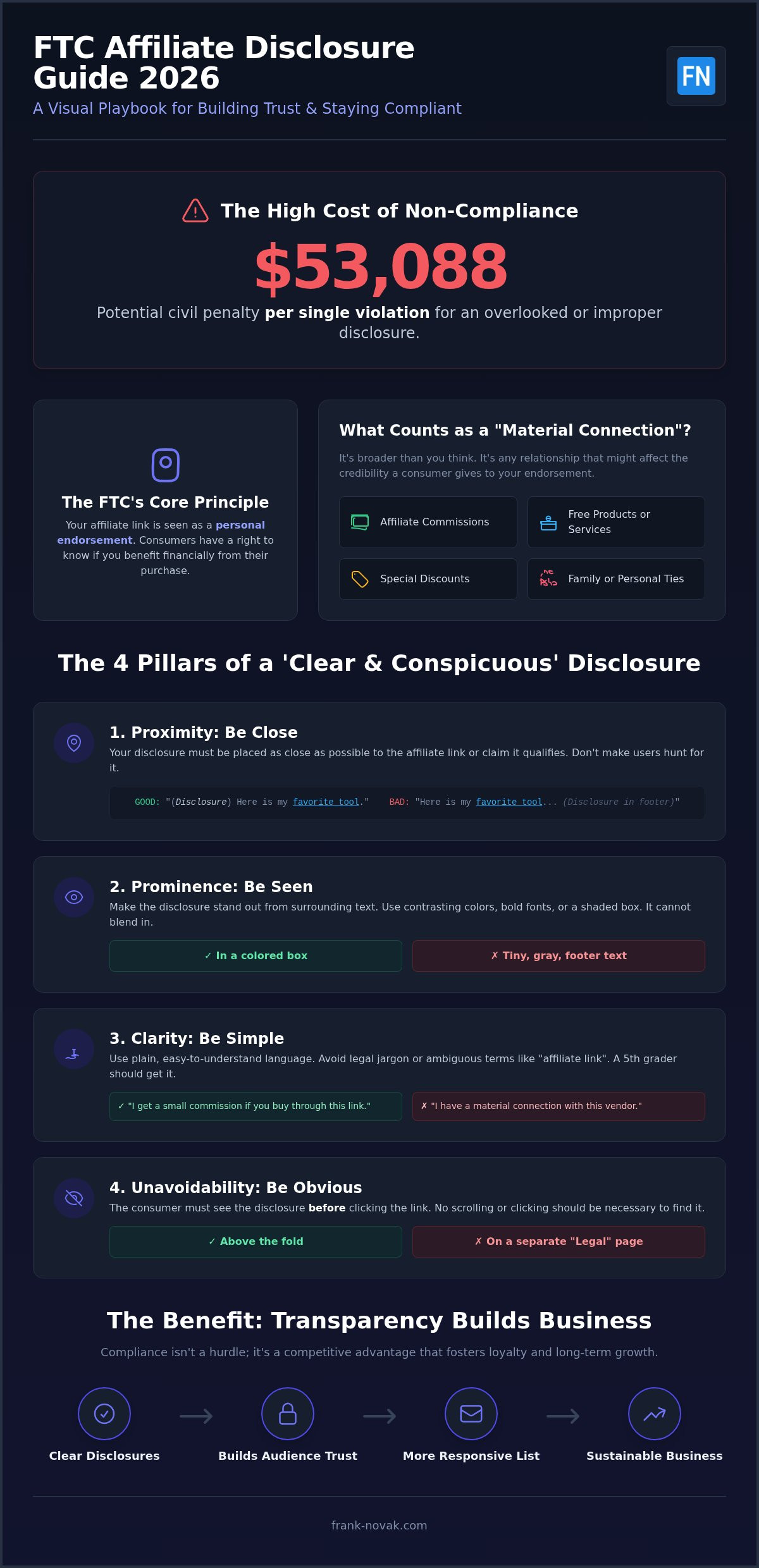
The FTC doesn’t see your affiliate links as simple advertisements. Instead, they view them as personal endorsements. When you share a link within your content, you’re telling your audience that you trust the product. Because that trust has a monetary value, the law requires you to be upfront about it. This is especially true now that the industry is projected to reach $17 billion this year, leading to stricter enforcement than we’ve seen in previous decades. In 2026, the focus has expanded to include AI-generated content and automated influencers, meaning every part of your digital presence must be compliant.
What is a Material Connection?
You might think a material connection only exists if you receive a direct commission check. However, the definition is much broader. It includes any relationship that could change how a customer views your recommendation. This covers affiliate commissions, but it also includes receiving free products, special discounts, or even having a personal or family tie with the business owner. A material connection is any relationship between an endorser and a seller that might affect the weight or credibility a consumer gives to an endorsement. If you’re using automated systems to scale, every touchpoint where a recommendation occurs needs to account for these ties. Ignoring this is a quick way to never succeed online, as the FTC now enforces civil penalties of up to $53,088 per violation.
The Purpose of FTC Oversight
The goal of these regulations isn’t to punish honest entrepreneurs. It’s to protect the integrity of the online marketplace. In the past, the internet operated under a “buyer beware” mentality, but that has shifted toward a “marketer disclose” standard. When you follow the FTC guidelines for affiliate marketers, you’re actually building a competitive advantage. Transparency fosters a higher quality, more responsive mailing list because your subscribers know you aren’t trying to trick them. By being a steady and reliable guide for your audience, you move away from “get rich quick” schemes and toward a sustainable business model built on real authority.
The ‘Clear and Conspicuous’ Standard: Making Disclosures Work
Meeting the “clear and conspicuous” standard is the most critical part of following FTC guidelines for affiliate marketers. If a reader has to go looking for your disclosure, you’ve likely already violated the rule. The FTC mandates that these notices be unavoidable, meaning the consumer should see them before they ever have the chance to click your link. This rules out placing your disclosure only on a “Terms and Conditions” page or tucked away in a footer that most people never scroll to. To stay compliant, you must focus on four main pillars: proximity, prominence, clarity, and unavoidability.
The language you use matters just as much as where you put it. You don’t need complex legal jargon to satisfy the FTC’s Endorsement Guides. In fact, simple is better. Use plain English that a fifth grader could easily understand. Instead of saying “I have a material connection with this vendor,” try something like “I get a small commission if you buy through this link.” If your audience can’t immediately tell that you’re being compensated, your disclosure isn’t doing its job.
Proximity and Placement Rules
Proximity refers to how close the disclosure is to the claim or link it qualifies. Ideally, your disclosure should appear “above the fold” on your landing pages, ensuring it’s visible without any scrolling. When you’re using high conversion tools like the ClickBank Super Funnel, it’s a good idea to place your disclosure right at the top of the page or immediately preceding your first call to action. Never make the disclosure itself a hyperlink; the text must be fully visible on the page so that the reader doesn’t have to click a second time just to see your legal notice.
Visual Prominence Requirements
Prominence is all about making the text stand out from the rest of your content. You should use a font size that’s easy to read and choose a color that provides strong contrast against the background. If your disclosure is in tiny, light grey text on a white background, it fails the prominence test. On very long articles or sales pages, you shouldn’t rely on a single disclosure at the top. It’s better to repeat the notice near different sets of links as the reader scrolls down. Always test your pages on mobile devices, as a disclosure that looks great on a desktop might become hidden or unreadable on a smaller screen. If you’re looking for a way to ensure your entire business model is built on this kind of solid, compliant foundation, online success coaching can provide the personalized guidance you need to scale safely.
Platform-Specific Compliance: Social Media, Funnels, and Video
Every digital platform has its own rhythm, and your disclosure strategy must adapt to each one. While the core principles of transparency remain the same, the way you present information on a TikTok video is vastly different from how you’d handle it in a long-form email sequence. If you want to protect your business while scaling, you need to understand these nuances. The FTC guidelines for affiliate marketers are platform-agnostic, meaning the responsibility to be clear and conspicuous rests entirely on your shoulders, regardless of the tech stack you use.
Disclosures in the ClickBank Super Funnel
If you’re using a high-performance system like the ClickBank Super Funnel, your disclosure strategy should focus on bridge pages and opt-in forms. These are the critical moments where a prospect transitions from a lead to a potential buyer. You should place a clear disclosure statement above the fold on your bridge page, ensuring it’s visible before the user interacts with your primary call-to-action button. When you design an automated marketing funnel, it’s easy to overlook compliance in favor of conversion. However, being transparent about your affiliate relationship actually increases the quality of your leads. People appreciate honesty, and a compliant funnel builds the “know, like, and trust” factor that’s essential for long-term growth.
Social Media and Video Guidelines
Social media compliance has become much stricter in 2026. If you’re posting short-form video on platforms like TikTok or Instagram Reels, the FTC now requires disclosures to be both visual and audible. This means you should include a text overlay that stays on screen long enough to be read and verbally mention the partnership within the first few seconds of the video. Simply using a hashtag like #ad or #sponsored in the caption isn’t enough if the caption is hidden behind a “read more” link. For link-in-bio strategies, don’t assume one general disclosure covers everything. It’s safer to include a brief note next to each specific affiliate link in your list.
Email Marketing Compliance
Email marketing requires a different kind of precision. The general rule of thumb is the “First Link” rule: your disclosure should appear before or immediately adjacent to the very first affiliate link in your email body. You don’t need to be overly formal. A natural-sounding sentence works best. For example, you might write: “I’m a proud partner for this product, which means I may earn a commission if you choose to buy through my link.” This approach satisfies the FTC guidelines for affiliate marketers without breaking the conversational flow of your message. If your email is purely promotional, you might even consider adding “Ad:” or “Sponsored:” to the beginning of your subject line to ensure total transparency from the moment the email hits the inbox.
Common Compliance Pitfalls and How to Avoid Them
Even with the best intentions, it’s easy to stumble into compliance traps that could jeopardize your business. Many marketers rely on “done-for-you” materials provided by brands, assuming these assets are already vetted for legal safety. This is a dangerous assumption. If a brand gives you a banner, a pre-written blog post, or a swipe file that lacks a disclosure, you’re still the one responsible for adding it. The FTC doesn’t accept “the brand didn’t tell me” as a valid defense. You’re an independent business owner, and your compliance is your responsibility, not the brand’s.
The rise of automated AI tools presents another modern challenge. While AI can help you generate content quickly, many of these systems aren’t programmed to follow the specific FTC guidelines for affiliate marketers. If you’re using AI to draft product reviews or social media captions, you must manually audit every piece of content. If the AI omits a disclosure or makes a claim that sounds like a personal testimonial when you haven’t used the product, you’re the one at risk for legal action. Taking a few extra minutes to verify your automated output can save you from a very expensive mistake.
The “Honest Review” Trap
One of the most frequent violations involves deceptive reviews. The FTC’s Rule on the Use of Consumer Reviews and Testimonials, which was finalized in August 2024, explicitly prohibits fake reviews and suppressing negative feedback. You should never claim that you bought a product or used it personally if that isn’t true. If you received a free sample, you must disclose that connection clearly. Framing affiliate content as “neutral” is a major red flag; instead, be upfront about your commission to build real trust with your audience.
Liability for Both Sides
The FTC operates under a “circle of liability” that includes brands, agencies, and individual marketers. This means if you violate the rules, the brand you’re promoting can also be held responsible. Because of this, reputable brands monitor their affiliates closely. If you ignore the FTC guidelines for affiliate marketers, they’ll ban you from their program to protect their own interests. This is why professional online success coaching focuses so heavily on building a secure legal foundation. Protecting your business from risks is just as important as generating traffic.
Building a Sustainable and Compliant Affiliate Business
Adopting a long-term perspective is what separates a professional entrepreneur from someone just looking for a quick win. When you integrate compliance into your daily operations, you aren’t just avoiding legal trouble; you’re building a brand that stands on a foundation of integrity. Following the FTC guidelines for affiliate marketers should be viewed as a strategic advantage rather than a regulatory burden. In a digital environment where consumers are increasingly skeptical, being the person who is open and honest about their business relationships makes you a breath of fresh air. This transparency naturally filters your audience, attracting high-quality leads who value your expertise and are more likely to remain responsive to your mailing list over time.
Automation plays a vital role in this professional shift. By using systems that bake disclosures into every template, you remove the risk of human error. Whether it’s a footer on your bridge page or a standardized note in your email signature, consistency is key to staying safe. When your business processes are organized and predictable, you have more mental space to focus on growth and strategy. This methodical approach ensures that as you scale, your compliance scales with you, preventing the kind of oversight that often leads to platform bans or damaged reputations.
Compliance as a Success Mindset
If you find yourself tempted to hide your affiliate links or omit disclosures to “save” a conversion, it’s time to re-evaluate your business model. Cutting corners is one of the primary reasons why many people never succeed online. A six-figure entrepreneur understands that trust is their most valuable currency. By committing to full transparency, you’re adopting the habits of a professional who is proud to show their business to the world. You don’t have to worry about a sudden algorithm change or a regulatory audit when you know every link you’ve shared follows the rules. This peace of mind allows you to build a business that is truly sustainable.
Professional Coaching and Tools
Getting the right support can make the process of professionalization much smoother. If you’re feeling uncertain about how to apply the latest FTC guidelines for affiliate marketers to your specific niche, Online Success Coaching provides the mentorship needed to navigate these complex regulations with confidence. In addition to expert advice, utilizing a proven system like the ClickBank Super Funnel allows you to automate ethical marketing practices from day one. By combining expert guidance with high-conversion tools, you can ensure your business is built right the first time. The goal is to build it once, build it right, and enjoy the rewards of a secure, compliant affiliate career.
Taking the Next Step Toward a Secure Affiliate Future
Navigating the FTC guidelines for affiliate marketers doesn’t have to be a source of stress. By embracing the “clear and conspicuous” standard and prioritizing the disclosure of every material connection, you’re doing more than just avoiding potential fines. You’re establishing yourself as a trustworthy authority in a crowded marketplace. Transparency acts as a bridge to your audience, not a barrier to your sales. When people know you’re being honest, they’re much more likely to value your professional recommendations.
Treating compliance as a core business strategy allows you to build a foundation that can weather any regulatory change. True marketing success comes from ethical automation and sustainable list building. Frank Novak’s coaching is built on years of professional experience, focusing on strategies that prioritize long-term growth over risky shortcuts. If you’re ready to move away from uncertainty and toward a steady path of development, now is the perfect time to professionalize your operations.
You now have the knowledge and the roadmap to grow your business safely. Focus on building an affiliate brand that you’re genuinely proud of, and you’ll find that the results follow.
Frequently Asked Questions
Do I need an affiliate disclosure if I only make a small commission?
Yes, you must include a disclosure regardless of the commission size. The FTC focuses on the existence of a “material connection” rather than the specific dollar amount involved. Even if you only earn a few cents per click, that financial incentive could influence your recommendation in the eyes of a consumer. Staying compliant with FTC guidelines for affiliate marketers ensures that your business is protected as it grows into a larger operation.
Where is the best place to put an affiliate disclosure on a blog post?
The most effective placement is at the very beginning of your post, before any affiliate links appear. You want your readers to see the disclosure while they’re still in the consideration phase of reading. Placing it “above the fold” ensures it’s visible on all devices without requiring the user to scroll. This proactive approach builds immediate trust and satisfies the requirement that disclosures be difficult for a reader to miss.
Can I just put a disclosure in my “About Me” or “Privacy Policy” page?
No, placing a disclosure only on a secondary page like “About Me” is not sufficient. The FTC requires that the notice be on the same page as the endorsement itself. Consumers shouldn’t have to click away or hunt for information to understand your relationship with a brand. If you want to build a professional success mindset, you should treat every piece of content as a standalone asset that must meet compliance standards.
What happens if I forget to include an FTC disclosure on a post?
Forgetting a disclosure can lead to serious consequences, including civil penalties of up to $53,088 per violation. Beyond the financial risk, you may find yourself banned from affiliate programs as brands move to protect their own reputations. If you realize you’ve missed a disclosure, the best course of action is to update the content immediately. Maintaining a clean record is essential for anyone who wants to avoid the mistakes of others.
Does the FTC really monitor small affiliate marketers and social media influencers?
Yes, the FTC has significantly increased its monitoring of marketers of all sizes. They use automated tools to scan social media and websites for non-compliant content. While they often focus on larger brands, individual affiliates are frequently caught in broader enforcement sweeps. It’s much safer to assume that your content is being reviewed and to build your business with a compliance-first mentality from the very beginning of your professional journey.
Is #affiliate sufficient as a disclosure on Instagram or TikTok?
No, using #affiliate is generally considered insufficient by the FTC because it may not clearly communicate the nature of the relationship to all consumers. Terms like #ad or #sponsored are much clearer and more widely understood. If you’re working on platforms like Instagram or TikTok, you should also ensure the disclosure is visible before the “read more” break in your caption. Clarity is always more important than trying to hide your status.
Do I need to disclose if I am promoting my own digital products?
You typically don’t need a specific affiliate disclosure when promoting your own products because the relationship is usually obvious to the reader. However, you must still be honest about your results and avoid making deceptive claims. If you’re using a separate brand name that doesn’t clearly link back to you, it’s a good idea to clarify that you are the owner. Transparency about your role helps maintain the professional authority you’ve built.
How do FTC guidelines apply to AI-generated content and reviews?
FTC guidelines for affiliate marketers apply to AI-generated content in the exact same way they apply to human-written work. If an AI drafts a review for a product you’re promoting, you are still legally responsible for disclosing your material connection. You must also ensure that the AI doesn’t fabricate personal experiences or testimonials that didn’t actually happen. Always review and edit AI output to ensure it reflects your honest opinions and complies with current laws.

Article by
Frank Novak
Frank Novak is an online marketing professional and coach who focuses on affiliate marketing and business automation. Through his website, frank-novak.com, he shares insights and strategies for leveraging social media platforms like Facebook to generate traffic and commissions.
Affiliate / Sponsored Content Disclaimer
This [website/post] contains affiliate links. If you click through and make a purchase, we may receive a commission at no additional cost to you. We only recommend products or services we believe will add value to our readers.