

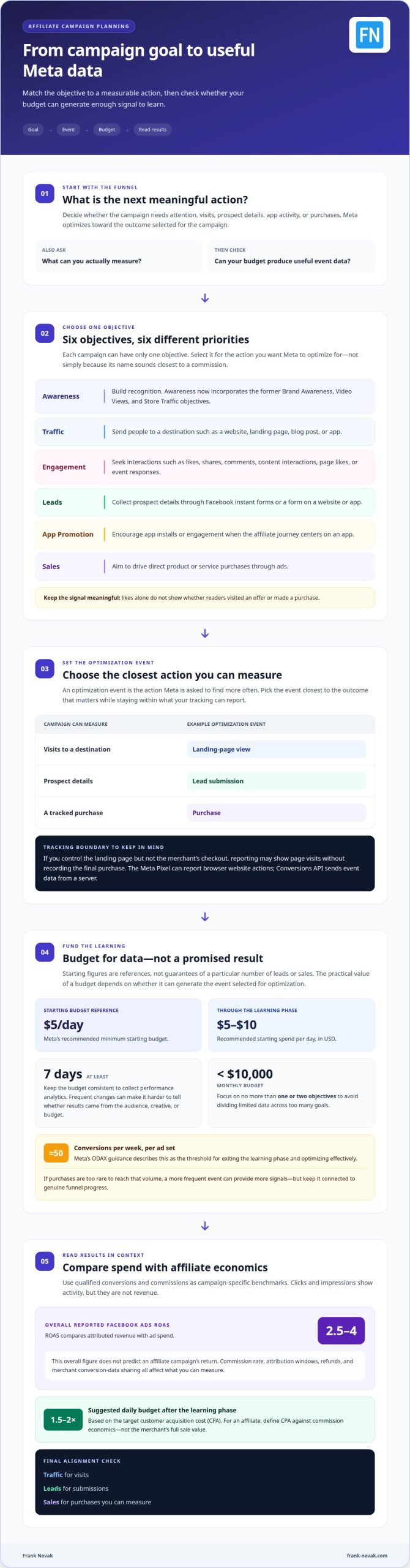
The right Meta objective isn’t necessarily the one closest to a commission. Facebook ad campaign objectives for affiliates are easier to choose when you start with the result you want. Meta offers six objectives: Awareness, Traffic, Engagement, Leads, App Promotion, and Sales. Each campaign can have only one. The objective tells Meta which kind of action to optimize for, so choose based on your campaign goal, not just the ad format.
If you’re deciding whether to send people to a landing page, collect a lead, or promote an offer directly, start with three questions: Where are people in your funnel? What can you measure? Can your budget generate enough of the selected optimization event to give you useful results?
This guide explains what each objective is designed to do and how affiliates can match it to funnel stage, budget, and measurable events. You’ll also learn when a traffic-focused campaign may make more sense than optimizing for sales, and how to select an objective that supports the next step in your affiliate journey.
Key Takeaways
- Choose among Awareness, Traffic, Engagement, Leads, App Promotion, and Sales according to the action you want Meta to optimize for.
- Match the objective to the funnel stage: build attention, bring people to a destination, capture leads, or pursue conversions.
- Pick an optimization event that reflects meaningful progress toward your affiliate goal, not simply the easiest action to generate.
- Keep your budget and conversion volume in mind when deciding how far down the funnel to optimize.
- Recognize common selection mistakes, such as choosing an objective for its name rather than the outcome your campaign needs.
Awareness, Traffic, Engagement, Leads, App Promotion, and Sales
Meta’s six objectives tell its ad system which campaign outcome to prioritize. For affiliates, the practical choice depends on the next action that matters, from getting someone to notice an offer to completing a tracked purchase.
Awareness, Traffic, and Engagement Objectives
Awareness builds recognition, Traffic sends people to a destination, and Engagement seeks interactions with content or events. These objectives can help when your funnel needs attention or visits before a potential customer is ready to act. Awareness now incorporates the former Brand Awareness, Video Views, and Store Traffic objectives. Traffic can direct people to a website, landing page, blog post, or app.
Engagement can optimize for likes, shares, comments, content interactions, page likes, and event responses. An affiliate reviewing a product, for example, could use Traffic to send people to a detailed comparison article. Engagement may suit a post designed to prompt discussion, but likes alone don’t show whether readers visited the offer or made a purchase.
Lead, App Promotion, and Sales Objectives
Leads collects prospect details, App Promotion encourages app installs or engagement, and Sales aims to drive purchases. Each objective focuses Meta on a different action. Leads can use Facebook instant forms or send people to a form on a website or app. Instant forms can make submission easier, while a website form gives visitors a place to continue exploring.
App Promotion is relevant when the affiliate journey centers on an app rather than a web page. Sales is intended to drive direct product or service purchases through ads. If you’re sending people to an offer, choose based on whether your campaign can measure a meaningful purchase event or should first optimize for an earlier action.
Can Facebook ads link directly to affiliate offers, or is a landing page required? Ads can direct people to a destination, including a website page, but both the destination and ad must comply with Meta’s policies. A landing page can explain the offer and provide context before someone follows an affiliate link.
What Meta advertising policies apply to affiliate marketing and affiliate links? Meta’s advertising policies apply to both the ad and its destination. Using an affiliate link doesn’t bypass review. Keep the ad and landing page clear, accurate, and consistent about what the offer provides.
How do Meta Pixel and Conversions API track affiliate conversions? The Meta Pixel can report website actions from a browser, while Conversions API sends event data from a server. If you control the landing page but not the merchant’s checkout, tracking may show page visits without recording the final purchase.
Meta consolidated some Facebook ad objectives in 2023, and the six current choices group different outcomes. Choose the one closest to the action you can measure: Traffic for visits, Leads for submissions, or Sales for purchases. That alignment helps distinguish campaign activity from progress toward affiliate revenue.
Budget and optimization-event selection
In the United States, there isn’t one typical Facebook ad cost for affiliate campaigns. Auction costs vary by audience, competition, placement, creative, and the action you ask Meta to optimize for. Set a campaign-specific benchmark: compare spend with qualified conversions and commissions, rather than treating clicks or impressions as revenue.
Set a budget that can produce useful data
Meta recommends starting a Facebook ad budget at a minimum of $5 per day. A recommended starting spend through the learning phase is $5-$10 USD/day. These are starting references, not promises of a particular number of leads or sales. The budget’s practical value depends on whether it can generate the event selected for optimization.
Keep the budget consistent for at least seven days to collect performance analytics. Frequent changes can make it harder to understand whether results came from the audience, creative, or budget. For campaigns with a monthly budget under $10,000, focus on no more than one or two campaign objectives. This concentrates spend and avoids dividing limited data across too many goals.
Choose an event Meta can learn from
An optimization event is the action Meta is asked to find more often, such as a landing-page view, lead submission, or purchase. Choose the closest measurable event to the outcome that matters. If the merchant’s checkout doesn’t share purchase data with your campaign, you may be able to measure landing-page visits while the final sale remains outside your reporting.
Meta’s ODAX guidance describes about 50 conversions per week per ad set as the threshold for exiting the learning phase and optimizing effectively. If purchases are too rare to reach that volume, optimizing for a more frequent event can provide more signals. Keep that event connected to genuine funnel progress, rather than choosing an easy action with little value.
Read benchmarks in context
Overall reported Facebook ads ROAS is between 2.5 and 4. ROAS compares revenue attributed to advertising with ad spend, but an overall figure doesn’t predict an affiliate campaign’s return. Commission rate, attribution windows, refunds, and whether the merchant shares conversion data all affect the result you can measure.
After the learning phase, a suggested daily budget is 1.5-2x the target customer acquisition cost (CPA). For an affiliate, define CPA against the commission economics, not the merchant’s full sale value. For example, a campaign can show affordable clicks yet lose money if few visitors complete an eligible purchase.
For a broader framework on affiliate campaign planning, explore these online marketing insights.
Choosing an objective based on business goals
Which Facebook ad objective is best for affiliate marketing? No single objective fits every affiliate campaign. Choose the one that best matches your primary business goal, the customer’s next action, and the result you can measure.
Start by naming one campaign outcome, such as introducing an offer, building an audience, or earning commissions. Then identify the action closest to that outcome. An affiliate promoting a software trial, for example, might value completed trial sign-ups more than article views.
- Build recognition: If a new offer needs an introduction, consider Awareness. Judge the campaign by whether it reaches the audience you want to familiarize with the topic, not by immediate commission alone.
- Test interest in content: If your goal is to bring potential buyers to a review or comparison page, consider Traffic. A useful measure is whether visitors continue from the article toward the offer.
- Encourage interaction: If a campaign’s purpose is to prompt discussion around a product topic, consider Engagement. For example, comments on a tutorial post may reveal questions your next piece of content should answer.
- Collect prospects: If your affiliate funnel includes a newsletter or other follow-up, consider Leads. Decide whether the priority is a completed form or a visitor’s further exploration on your site.
- Promote an app: If the affiliate offer depends on an app installation or app activity, consider App Promotion. Define the valuable action beyond an install, such as using a feature connected to the offer.
- Seek purchases: If your main goal is tracked transactions, consider Sales. This makes most sense when the campaign can connect ad activity with purchase outcomes and commission reporting.
Objectives aren’t interchangeable just because they can support the same offer. A review campaign testing which product claims attract readers has a different immediate goal from a campaign designed to produce purchases. Align the objective with the test you’re actually running.
Separate the campaign’s business goal from metrics that may look impressive. A high number of clicks can still be unhelpful if visitors don’t take the next step. Assess a Leads campaign by lead relevance, and consider a Sales campaign alongside reported commissions.
Before launch, write one sentence describing success: “This campaign succeeds when the intended audience completes the action we can measure.” If that action is only an early funnel signal, choose an objective suited to that step. If the goal is revenue, prioritize the closest purchase event you can reliably observe. This keeps Meta’s optimization aligned with the business decision the campaign needs to support.
Common objective-selection mistakes
Meta campaigns can underperform when the selected objective and business outcome point in different directions. For an affiliate, check the goal, measurable action, and destination before deciding that an ad or audience is the problem.
What are common reasons Meta rejects or restricts affiliate ads and accounts? Meta may reject an ad or restrict an account if its review identifies a policy issue. Affiliate status alone doesn’t explain a decision, so read the specific notice to understand what needs attention.
- Optimizing for activity instead of business progress. A Traffic campaign can attract page visits without producing qualified prospects or commissions. For example, if people read a review but never reach the offer, clicks alone don’t demonstrate that the campaign is meeting its business goal.
- Choosing Sales without a measurable purchase signal. The Sales objective is harder to assess if the affiliate can’t connect ad activity to purchases. If the merchant controls checkout and doesn’t share conversion data, campaign reporting may stop at the affiliate’s landing page.
- Changing too many variables at once. If you change the objective, creative, audience, and destination together, you can’t easily tell which change affected performance. Adjust one major element at a time, then compare the same outcome across the test.
- Reading short-term results as a verdict. A small number of early clicks or leads can make performance appear stronger or weaker than it is. Keep the measurement period and campaign conditions consistent when assessing whether an objective fits.
- Sending people to a mismatched destination. If an ad promises a product review but opens on a generic offer page, visitors may not find the information they expected. Align the ad’s claim, landing-page content, and next step.
- Ignoring the merchant’s role in attribution. An affiliate may control the ad and landing page, while the merchant records the purchase. Map which events are visible at each stage before treating reported conversions as the full picture.
For a practical review, write down the campaign’s intended outcome, the event Meta optimizes for, and the event you can actually observe. Compare the three. If the campaign aims to earn commissions but reports only page visits, treat that gap as a measurement limitation, not proof of sales.
For ad-review issues, distinguish a rejected creative from an account restriction before making changes. Read Meta’s notice, identify the ad or account action it names, and revise the relevant material instead of rebuilding the entire campaign without a clear reason. Keep the destination consistent with the ad, and avoid claims the offer page can’t support.
Campaign objectives by funnel stage
A funnel connects someone’s first exposure to an offer with later actions, such as visiting a review or making a purchase. Map each campaign to the stage it serves, then choose the objective that supports that stage’s next measurable step. One Meta campaign has one objective, so don’t expect a single campaign to serve every funnel purpose equally.
At the discovery stage, people may not recognize the product or understand the problem it solves. Awareness can introduce a topic with an educational video or concise product explanation. For example, an affiliate promoting a budgeting app might describe a common budgeting challenge before presenting the app as one possible solution. The immediate goal is familiarity, not an instant commission.
At the consideration stage, potential buyers are comparing options or seeking more detail. Traffic can send them to a review, tutorial, or comparison page that answers specific questions. Engagement may suit content where comments or shares help surface reader reactions, such as a post comparing two product features. Match the objective to what the content asks the audience to do.
At the decision stage, the audience is closer to taking a concrete action. If a form is the next meaningful step, Leads can support a path through an instant form or website form. If the campaign aims for an app installation or app activity, App Promotion aligns with that action. Sales fits a purchase-focused campaign when purchase outcomes can be connected to ad reporting.
Affiliates don’t need to run six campaigns for these stages. One funnel may start with a review page; another may include educational content, a lead form, and a merchant checkout. Use only the stages that reflect the actual path to the offer. If visitors move from a guide to a merchant page, for instance, a Traffic campaign can support the guide visit, but it won’t automatically measure a later purchase.
Keep the journey coherent at each transition. An ad about choosing running shoes should lead to useful shoe-selection content, not an unrelated checkout page. A comparison for people considering a purchase should make the next step clear, while a decision-stage ad should accurately describe the action ahead. This consistency helps readers understand what happens after each click and makes each campaign’s role easier to evaluate.
Use the funnel as a planning map, not a promise that everyone follows the same sequence. Identify which stage needs support, define its next action, and assign an objective to that campaign. Then evaluate the stage by its intended contribution instead of expecting an awareness campaign to perform like a purchase campaign.
Frank Novak
Frank Novak’s Online Success Coaching can help you apply these objective choices to your affiliate business and broader online marketing decisions. Never Succeed Online offers another resource for building your understanding of online business. Consider these resources when turning campaign goals into a workable affiliate marketing approach, especially if you’re deciding how paid traffic fits your funnel.
Connect each campaign’s objective with the action you can measure and the role it plays in your business. This keeps planning grounded in your offer and audience, rather than treating one Meta objective as a universal solution.
Contact Frank Novak to discuss your affiliate marketing goals.
Put your next campaign decision into practice
Start your next campaign with a clear decision: Which audience action matters now, and how will you recognize it? Understanding Facebook ad campaign objectives for affiliates gives you a framework for making that choice, but your offer and funnel should guide how you apply it. Set one campaign goal, then use what you learn to shape the next step instead of expecting one ad to serve the entire customer journey.
If you’d like support connecting your affiliate goals with a practical marketing plan, explore Frank Novak’s ClickBank Super Funnel and resources for online business development. Online Success Coaching can help you clarify where to begin and what your campaign should aim to achieve.
Your next objective doesn’t need to solve everything at once. Choose a purposeful first step, learn from its results, and build from there.
Frequently Asked Questions
What is a Facebook/Meta ad objective?
A Facebook or Meta ad objective is the campaign-level direction that tells Meta what outcome to prioritize during delivery. It influences which people the system seeks and what action it tries to generate. For affiliates, Facebook ad campaign objectives explained in this guide connect that choice to the action the campaign can measure, rather than assuming a click will lead to a purchase.
How do Sales, Traffic, Leads, and Engagement objectives differ?
Sales focuses on purchase actions, Traffic on visits to a destination, Leads on form submissions or similar prospect actions, and Engagement on interactions such as comments or shares. An affiliate promoting a downloadable guide might choose Leads when completed sign-ups matter most. If the immediate goal is to bring readers to a detailed review, Traffic better reflects that action.
How should affiliates choose a campaign objective based on their conversion funnel?
Choose the objective that matches the next useful action in the customer journey, rather than asking one campaign to cover every stage. An affiliate sharing a tutorial could send interested readers there, then use a separate campaign for a measurable sign-up or purchase action. This practical, funnel-based view of Facebook ad campaign objectives for affiliates helps keep each destination and call to action aligned.
How should affiliates optimize and test Facebook campaign objectives?
Begin with a clear hypothesis, such as whether a product comparison page attracts more qualified prospects than a general review. Keep the audience, destination, and creative consistent as you evaluate the chosen objective, then compare the result that matters to your affiliate funnel. If visits rise but sign-ups don’t, examine the page and next step before assuming the objective alone caused the gap.

Article by
Frank Novak
Frank Novak is an online marketing professional and coach who focuses on affiliate marketing and business automation. Through his website, frank-novak.com, he shares insights and strategies for leveraging social media platforms like Facebook to generate traffic and commissions.
Affiliate / Sponsored Content Disclaimer
This [website/post] contains affiliate links. If you click through and make a purchase, we may receive a commission at no additional cost to you. We only recommend products or services we believe will add value to our readers.