

What if the reason you’re stuck isn’t a lack of traffic, but the way your business is built? Most marketers assume that learning how to scale an affiliate business simply requires a bigger ad budget or more hours spent posting links. In reality, the top 10% of affiliates who generate 90% of the industry’s revenue aren’t necessarily working harder than you are. They’ve simply replaced manual hustle with automated systems. If you’re tired of inconsistent monthly commissions or the constant fear of ad account bans, it’s time to shift your focus from individual sales to a scalable architecture.
You likely started this journey for freedom, yet you’ve found yourself tied to a screen, managing manual content and hoping for a positive ROI. We understand how exhausting it is to feel like your income is a rollercoaster that stops whenever you take a break. This article promises to show you a methodical framework to transition into a high-volume, automated system that functions while you sleep. We’ll walk through a specific case study in automation, showing you how to build a predictable 5-figure monthly income without increasing your daily workload.
Key Takeaways
- Identify the common scaling plateau where manual effort no longer yields growth and learn why simply increasing your output isn’t a sustainable path forward.
- Master the core pillars of how to scale an affiliate business, including the strategic alignment of high-ticket offers and the implementation of automated lead capture systems.
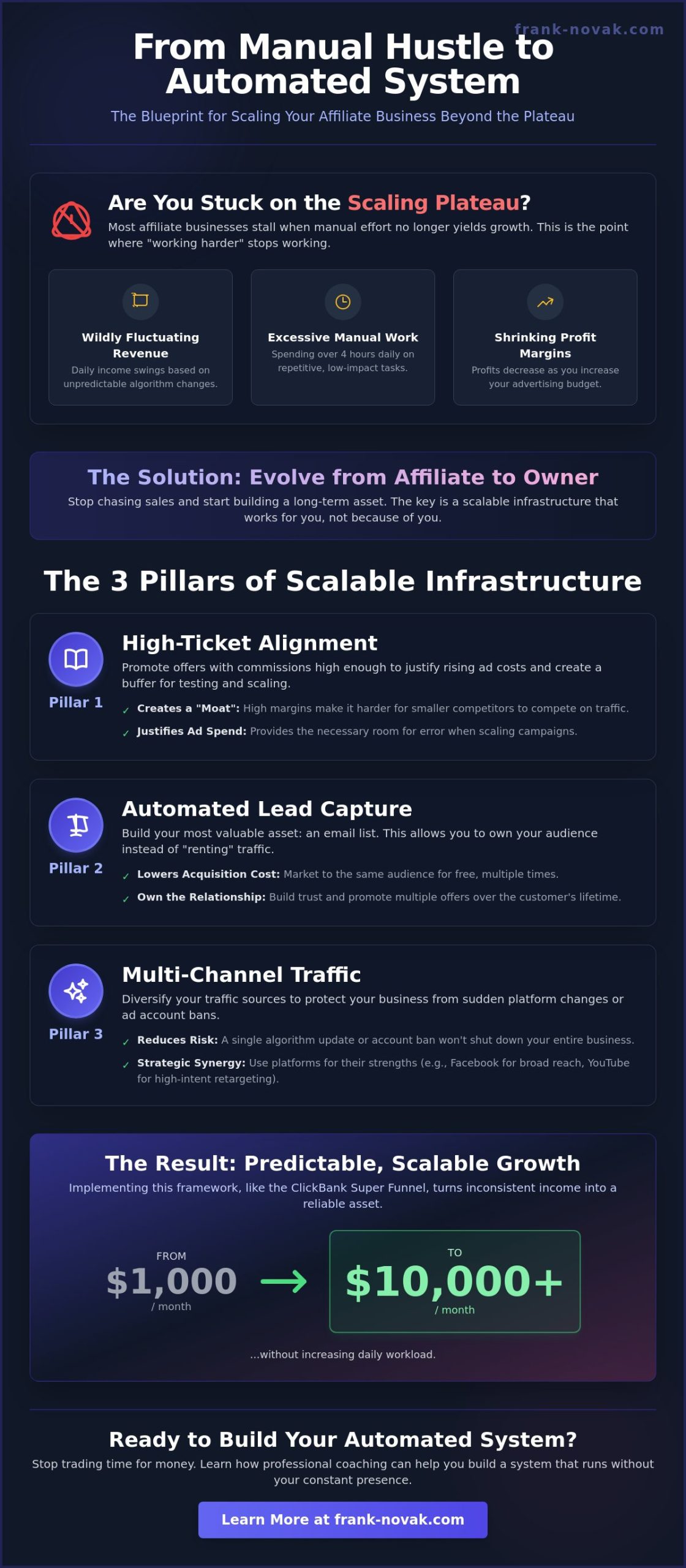
- Follow a detailed case study that demonstrates how to transition a ClickBank campaign from $1,000 to $10,000 monthly through methodical testing and the ClickBank Super Funnel.
- Protect your revenue from sudden platform changes by diversifying your traffic across multiple channels, using Facebook for reach and YouTube for effective retargeting.
- Explore why the solopreneur model often reaches its limit at the $10,000 monthly mark and how professional coaching can help you build a system that runs without your constant presence.
Identifying the Scaling Plateau: Why Most Affiliate Businesses Stall
Many dedicated marketers eventually hit a ceiling where their manual efforts no longer produce proportional returns. This is often called the Scaling Plateau. It happens when you’ve maximized your personal bandwidth, leaving no room for further growth without a fundamental change in strategy. While traditional affiliate marketing models focus on the direct link between a click and a sale, scaling requires a more sophisticated approach.
To better understand how these systems evolve, watch this helpful video on scaling within a specific vertical:
If you’re currently stuck, you might think the solution is simply to post more links or find more products. However, “more of the same” usually leads to diminishing returns because you’re operating on a linear growth curve. In a linear model, your income is strictly tied to your active hours. To learn how to scale an affiliate business effectively, you must transition to exponential growth. This shift is only possible when you stop being the only engine driving the car. The biggest bottleneck for most is the lack of a “middle-man” asset, specifically an email list. Without this, you’re forced to buy every click over and over again, which kills your margins as you try to grow.
The Symptoms of a Business That Cannot Scale
Recognizing the signs of a stagnant model is the first step toward fixing it. If your business feels like a treadmill, look for these specific indicators:
- Daily revenue fluctuates wildly based on platform algorithm changes.
- You’re spending more than 4 hours a day on repetitive manual tasks.
- Your profit margins shrink the moment you increase your ad budget.
The Transition from Affiliate to Business Owner
Moving beyond the plateau requires a mindset shift from “promoting products” to “owning the customer relationship.” It’s about building a steady, methodical system rather than chasing the next “gold rush” offer. If you want to build a long-term asset, you need a clear roadmap for the next 90 days. This plan should focus on building infrastructure that works even when you don’t. Utilizing a tool like the ClickBank Super Funnel can help bridge this gap, allowing you to capture leads automatically while you focus on high-level strategy. This transition is what separates the hobbyist from the professional who understands how to scale an affiliate business into a sustainable, predictable income.
The 3 Pillars of Scalable Affiliate Infrastructure
Scaling an affiliate business isn’t just about throwing more money at ads. If you try to grow without the right framework, you’ll likely see your profits vanish as costs rise. Instead, you need a system that protects your margins and your time. This is where the three pillars of infrastructure come into play. They act as a “moat” around your business, making it harder for competitors to disrupt your progress while ensuring your growth remains steady. To develop business growth strategies that actually last, you must move beyond the simple “link-to-offer” model.
The first pillar is High-Ticket Alignment, which means promoting offers that pay enough to justify the rising costs of traffic. If your commission is too small, your room for error is tiny. The second pillar is Automated Lead Capture. By building an email list, you can market to the same audience for free, which drastically lowers your average acquisition cost over time. Finally, the third pillar is Multi-Channel Traffic. Relying on one platform is dangerous. Diversifying your traffic sources ensures that a single algorithm change won’t shut down your entire operation. Together, these pillars create a foundation that supports long-term expansion and, ultimately, financial freedom through online business by decoupling your income from your active hours.
Selecting Scalable Offers with Broad Appeal
Not every product is built for high volume. When you’re looking at how to scale an affiliate business, you should prioritize offers with high “gravity” on platforms like ClickBank. This indicates that many other affiliates are currently making sales. You also want to look for low refund rates and recurring commission potential. While niche products are great for starting out, they often hit a ceiling quickly. Mainstream categories like health, wealth, and relationships have a much broader appeal, allowing you to scale your ad spend without exhausting the audience.
The Automated Funnel: Your 24/7 Salesman
An automated funnel is the engine of a scalable business. Instead of sending traffic directly to a vendor’s page, you use a bridge page. This simple step protects your ad accounts from being flagged and allows you to pre-sell the visitor, increasing the chance of a conversion. It also gives you the chance to capture an email address. A well-crafted email sequence then takes over, following up with leads and increasing the lifetime value (LTV) of every person who enters your system. If you’re ready to stop the manual hustle, setting up a ClickBank Super Funnel is a practical way to start automating your lead generation today.
Case Study: Scaling a ClickBank Campaign from $1,000 to $10,000 Monthly
Moving from a modest side income to a substantial monthly revenue requires more than just luck; it requires a disciplined execution of phases. In this case study, we examine how a standard campaign was transformed by applying the three pillars of infrastructure we discussed earlier. If you’re wondering how to scale an affiliate business, it’s helpful to view the journey as a series of controlled experiments rather than a single leap of faith. By following a structured path, you can manage risk while systematically increasing your returns.
Phase 1 & 2: Building the Engine and Finding the Spark
The first step in this transition involved removing technical friction. Instead of spending weeks building custom pages, the campaign utilized the ClickBank Super Funnel to establish a professional bridge page and lead capture system immediately. With the foundation in place, the testing phase began with a modest daily budget. The goal here wasn’t immediate profit, but data collection. We tested five different ad angles to see which message resonated most with the target audience.
Patience is vital during these first seven days. It’s tempting to kill an ad after 48 hours if it isn’t profitable, but algorithms need time to learn. By resisting the urge to tinker, we identified one specific “winning” creative that had a significantly higher click-through rate than the others. This data provided the green light to move into the next stage of growth.
Phase 3 & 4: Turning Up the Volume Without Breaking the System
Once we identified the winning angle, the focus shifted to optimization. We didn’t just spend more money; we worked to improve your affiliate marketing process by cutting the underperforming audiences and doubling down on the successful ones. After reaching 100 conversions, we were able to create Lookalike Audiences. This allowed the platform to find new users who shared characteristics with our actual buyers, which is a critical component of how to scale an affiliate business to the five-figure mark.
To maintain a 2.0+ Return on Ad Spend (ROAS), we followed the “20% Rule.” This means we only increased the daily ad budget by 20% every few days. Sudden, massive budget spikes often trigger algorithm resets that can destroy a campaign’s performance. By the end of the month, the campaign reached the $10,000 milestone. Interestingly, the automated email follow-ups accounted for 40% of that total revenue. This proves that the “moat” we built through lead capture wasn’t just a safety net; it was a primary driver of the business’s growth.
Masterclass in Traffic Diversification: Moving Beyond a Single Source
Relying on a single traffic source is one of the most significant risks you can take when growing your company. If that platform changes its algorithm or updates its terms of service overnight, your entire revenue stream could disappear. This is known as a “Single Point of Failure.” To understand how to scale an affiliate business for the long term, you must view diversification as a form of insurance. By spreading your reach across multiple channels, you ensure that no single external change can shut you down. A robust strategy often uses Facebook Ads as a primary driver for new leads while using YouTube as a retargeting layer to build deeper trust.
Leveraging organic social proof is another way to strengthen your foundation. When you combine paid ads with a presence on social platforms where users share their results, you naturally lower your blended Customer Acquisition Cost (CAC). People are more likely to click an ad if they’ve seen your brand mentioned elsewhere. These “safe” traffic sources, where you own the relationship through an email list or a community, become the backbone of a business that doesn’t just grow, but lasts for years.
Facebook Ad Compliance for High-Volume Scaling
If you’re planning to scale on Facebook, compliance must be your top priority. Many affiliates face account bans because they try to grow too quickly without a “Warm-up” protocol for their Business Manager. It’s best to start with low-spend engagement ads to build a positive history with the platform before launching aggressive conversion campaigns. Interestingly, your landing page copy is often more important for compliance than the ad itself. Facebook’s AI scans your destination page for “get rich quick” language or unsubstantiated claims. If your landing page is helpful and transparent, you’ll find it much easier to maintain high spending limits without interruption.
Retargeting: The Secret to 6-Figure Profit Margins
Most of your visitors won’t buy the first time they see your offer. Retargeting allows you to reach people who “clicked but didn’t buy” with automated reminders and new angles. A highly effective way to do this is by setting up a Webinar Profit Engine. This system takes those warm leads and puts them into a more educational environment, which is perfect for high-ticket offers. By providing more value through a webinar, you increase the lifetime value of every lead you’ve already paid to acquire. If you want to see how these systems fit into a complete growth plan, you can explore our Online Success Coaching to get a personalized roadmap for your business.
Building Your Long-Term Asset: The Role of Coaching and Systems
Many marketers find that the solopreneur model, while effective for getting started, eventually breaks down once they hit the $10,000 per month mark. At this stage, the sheer volume of tasks; from tracking compliance to managing multiple traffic sources; becomes too much for one person to handle without sacrificing quality. If you want to understand how to scale an affiliate business beyond this ceiling, you have to stop treating it as a series of tasks and start treating it as a structured system. This shift allows you to move from chasing a monthly check to building a sellable asset that has value independent of your daily input. For those who are simultaneously building toward this goal while still employed, following a structured plan to quit your job for affiliate marketing can help you make the transition without sacrificing financial stability.
Building a protection plan for your business is essential for long-term survival. We often refer to this as the Never Succeed Online protocol, which focuses on identifying and neutralizing the common pitfalls that cause most digital businesses to fail. By anticipating these risks, such as offer fatigue or platform shifts, you can create a more resilient operation. When your business is built on systems rather than just your personal hustle, it becomes much more attractive to potential buyers or partners in the future.
The ROI of Online Success Coaching
If you’ve ever felt like you’re too close to your own work to see what’s wrong, you’re not alone. A coach’s primary role is to identify the “blind spots” in your funnel that are costing you money but remain invisible to you. Whether it’s a weak headline on your bridge page or a technical glitch in your email automation, having an outside expert can save you months of expensive trial and error. You can learn more about why Online Success Coaching is your shortcut to avoiding these common mistakes. Beyond the technical help, there’s a significant psychological benefit to having a steady, reliable guide who has already navigated the path you’re currently on. It builds the confidence you need to make big moves with less anxiety.
Your Scaling Roadmap for 2026
Your journey toward a high-volume, automated business can be summarized in four clear stages. First, you must audit your current offers to ensure they have the gravity and margins to support growth. Second, you automate your lead generation using tools like the ClickBank Super Funnel. Third, you diversify your traffic to protect against platform instability. Finally, you find a mentor to help you refine your systems. It’s helpful to remember that learning how to scale an affiliate business is a marathon, not a sprint. If you take the time to build it right, you’ll create something that lasts for years to come. If you’re ready to take the next step and implement these systems with professional guidance, we invite you to join our Online Success Coaching program today.
Take the Next Step Toward a Scalable Future
Transitioning from a manual affiliate to a business owner is a journey that requires both the right infrastructure and a shift in mindset. You’ve seen how the combination of high-ticket alignment, automated lead capture, and traffic diversification creates a moat that protects your revenue. By moving away from the linear hustle and toward an exponential system, you’re not just earning a commission; you’re building a sustainable asset. Success in this field comes down to the systems you build and the guidance you follow.
If you’re ready to master how to scale an affiliate business without the expensive trial and error, professional guidance is the logical next step. With over 8 years of digital marketing expertise and as the creator of the ClickBank Super Funnel, I specialize in helping marketers navigate Facebook ad compliance and complex automation. You don’t have to figure out every technical hurdle on your own when you have a steady, reliable guide by your side.
Apply for Online Success Coaching to Scale Your Business Today
Your potential for growth is significant. With a clear roadmap and the right support, you can achieve the predictable, automated results you’ve been working toward.
Frequently Asked Questions
How much capital do I need to start scaling an affiliate business?
You should ideally have a dedicated budget for testing and optimization before you attempt high-volume scaling. While you can start with a few hundred dollars to find a winning offer, true scaling often requires enough capital to cover at least 30 days of ad spend and software costs. This ensures you can collect enough data to make informed decisions without being forced to stop your campaigns prematurely due to cash flow issues.
Can I scale an affiliate business without using paid ads?
It’s possible to scale using organic traffic, but it generally takes much longer than using paid methods. If you choose this path, you’ll focus on high-authority content and SEO to build a steady stream of visitors. While this reduces your direct costs, the “time cost” is much higher. Most professionals who want to learn how to scale an affiliate business quickly eventually incorporate paid ads to speed up the data collection and growth process.
What are the best niches for scaling to 6 figures in 2026?
Evergreen niches like health, wealth, and relationships remain the most reliable options for reaching six-figure levels in 2026. These markets have a massive audience and high demand, which allows for almost unlimited scaling. Specifically, digital products in the personal finance and bio-hacking spaces are performing well because they offer high commissions and satisfy deep-seated consumer needs. Choosing a niche with broad appeal is essential if you want to avoid hitting a growth ceiling too early.
How do I prevent my Facebook ad account from being banned while scaling?
Compliance is the key to longevity on Facebook. You can protect your account by strictly following their advertising policies and using a warm-up protocol for new Business Managers. It’s also vital to use a bridge page between your ad and the affiliate offer rather than linking directly. This simple step ensures that your destination page meets Facebook’s standards for transparency and user experience, which significantly reduces the risk of automated flags and bans.
Is it better to scale one offer or promote multiple products?
Focusing on a single, high-performing offer is usually the best strategy when you’re first learning how to scale an affiliate business. Spreading your budget and attention across too many products can dilute your data and lead to mediocre results across the board. Once you have one offer running profitably on autopilot, you can then use those profits to test and scale a second or third product to diversify your income streams.
When is the right time to hire a coach for my affiliate business?
The right time to seek mentorship is when you find that your own efforts are no longer producing the growth you expect. If you’ve hit a revenue plateau or feel overwhelmed by the technical aspects of automation, a coach can provide the clarity you need. Hiring a guide early in the scaling process can also prevent you from making expensive mistakes that often cost far more than the coaching itself.
How do I track conversions accurately across multiple traffic sources?
Accurate tracking requires a combination of robust third-party tracking software and the consistent use of UTM parameters. These tools allow you to see exactly which ad, creative, and traffic source is responsible for every sale. Without this data, you’re essentially flying blind, which makes it impossible to optimize your spending. Proper attribution ensures that you’re only putting more money into the channels that are actually generating a positive return on investment.
What is the most common mistake affiliates make when trying to scale?
The most frequent error is increasing ad spend too aggressively without having a solid backend system in place. Many affiliates focus only on the initial sale and ignore the long-term value of their leads. If you don’t capture emails and follow up with your audience, you’re leaving a massive amount of profit on the table. Scaling should be a methodical process of increasing budget while simultaneously improving your conversion rates and lead nurturing sequences.

Article by
Frank Novak
Frank Novak is an online marketing professional and coach who focuses on affiliate marketing and business automation. Through his website, frank-novak.com, he shares insights and strategies for leveraging social media platforms like Facebook to generate traffic and commissions.
Affiliate / Sponsored Content Disclaimer
This [website/post] contains affiliate links. If you click through and make a purchase, we may receive a commission at no additional cost to you. We only recommend products or services we believe will add value to our readers.