

What if you could gather evidence for your business idea before giving up a dependable paycheck? Learning how to transition from employee to entrepreneur doesn’t have to begin with a dramatic leap. If you’re unsure whether customers will pay, worried about losing income and benefits, or struggling to make progress after work, a gradual approach can help you make the next decision with more confidence.
It’s sensible to want proof before taking on greater financial risk. A promising idea is only one part of the decision. Customer demand, personal savings, essential obligations, and the time you can realistically commit all matter. You don’t need every answer on day one, but you do need a way to test assumptions and decide what evidence would make you ready for the next step.
This guide lays out a staged transition plan: how to test demand while employed, assess your financial runway, and prepare for the practical demands of running a business. You’ll find decision points for continuing alongside your job, adjusting your idea, or considering a bigger change. The aim is to replace guesswork with manageable steps that fit your circumstances.
How to transition from employee to entrepreneur
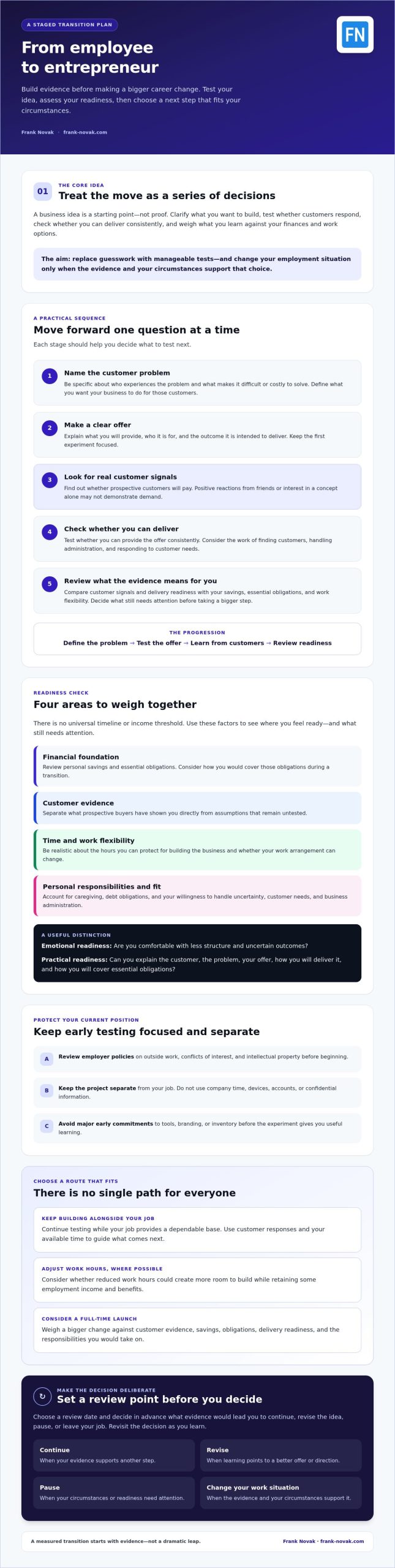
Think of the transition as a series of decisions, not a single resignation date. First, define what you want your business to do for customers. Then test whether people respond to a clear offer, check whether you can deliver it consistently, and review how the results fit your personal finances and work options. Each step should answer a specific question and help you decide what to test next.
Key Takeaways
- Learn how to transition from employee to entrepreneur by treating the move as a series of decisions, not a one-time leap.
- Use a focused customer experiment to find out whether people will pay before committing heavily to tools, branding, or inventory.
- Compare savings, essential obligations, customer signals, and work flexibility to see where you’re ready and what still needs attention.
- Weigh gradual growth, reduced work hours where possible, and a full-time launch against your circumstances. No single path suits everyone.
- Set a review date and decide in advance what evidence would lead you to continue, revise your idea, pause, or leave your job.
Transitioning to Entrepreneurship Without Rushing
Moving from employee to entrepreneur doesn’t have to hinge on one dramatic resignation. A grounded way to approach the change is to clarify what you want to build, test whether customers respond, and use what you learn to choose a next step. This makes it easier to separate enthusiasm for an idea from evidence that it can work for a specific audience.
A staged transition is a deliberate process of testing a business, preparing for its demands, and changing your employment situation only when your evidence and circumstances support that choice. Entrepreneurship can mean working independently or building a company designed to grow beyond your own capacity. Neither goal is automatically better. Understanding entrepreneurship starts with recognizing how varied the paths and responsibilities can be.
For a broader perspective on the employee-to-entrepreneur shift, watch this TEDx talk:
Is entrepreneurship the right next step for your goals?
Start by naming what feels limiting at work. Is it your schedule, the type of work, or the lack of control over decisions? Then list what your job provides that you value, such as predictable pay, benefits, routine, or time away from work. Comparing the two can help you tell whether you want entrepreneurship itself or simply a role with more autonomy.
Greater independence also means taking responsibility for finding customers, handling administration, and responding to customer needs. Ask yourself which of those tasks you’re willing to own, not just which parts of the business sound appealing. Consider caregiving, debt obligations, and the hours you can realistically protect for building a business. These constraints don’t rule out entrepreneurship; they help you choose a workable route.
What should you understand before leaving a job?
A promising idea is a starting point, not proof of demand. Interest from friends or positive reactions to a concept may not show that prospective customers will pay for it. Before making a major career decision, identify what you’ve learned directly from potential buyers and what remains an assumption.
Separate emotional readiness from practical readiness. Are you comfortable with less structure, uncertain outcomes, and making decisions without a manager’s direction? Can you explain who the customer is, what problem you solve, how you’ll deliver the offer, and how you’ll cover essential obligations during the transition? Your answers can point to the next experiment instead of forcing a yes-or-no decision.
There’s no universal timeline or income threshold that makes the change right for everyone. One person may aim for a stable self-employed practice; another may want to develop a scalable company. Either way, decide what evidence would justify continuing, revising the idea, or changing your work arrangement. Revisit that decision as you learn.
How to Build and Test a Business While You Still Have a Job
Use your current job as a base while you find out whether your idea solves a problem people will pay to address. Keep the first test small enough to generate useful learning without major commitments to software, branding, or inventory. Before you begin, review your employer’s policies on outside work, conflicts of interest, and intellectual property. Keep the project separate from your job: don’t use company time, devices, accounts, or confidential information.
A simple sequence can turn a broad idea into a focused experiment:
- 1. Choose a customer problem. Describe who experiences it and what makes it difficult or costly to solve.
- 2. Shape a clear offer. Explain what you’ll provide, who it’s for, and what outcome it is intended to help with.
- 3. Speak with prospects. Ask how they handle the problem now, what alternatives they’ve tried, and what still falls short.
- 4. Review the evidence. Look for actions, such as inquiries or purchases, as well as repeat interest and objections. Use the pattern to choose what to test next.
How do you validate a business idea before quitting?
Start with questions, not a pitch. Ask potential customers to describe the last time they faced the problem and what they did about it. Then offer a simple, clearly scoped solution to a defined audience and track the responses. Note who inquires, takes a next step, returns with interest, or raises the same concern. Early feedback can guide your next decision, but a small test doesn’t guarantee future sales. Treat it as evidence about what to investigate, not a promise about what will happen.
As the idea becomes more concrete, practical launch requirements may come into view. The SBA guide to launching your business outlines considerations such as business structure, registration, and licenses. Use it to identify questions to research for your circumstances rather than assuming every step applies to every business.
How can you make time for a business while employed?
Choose recurring work blocks that match your actual energy and commitments. A short session you can protect each week is more useful than an ambitious schedule that repeatedly clashes with caregiving, rest, or your job. Give each session a purpose, such as customer conversations, refining the offer, or following up on responses. Prioritize those customer-facing tasks before polishing a logo or building complex systems.
Once you’ve confirmed a process works, an automated marketing funnel may help organize repeated steps. Automation can’t replace learning what customers need. If you’re exploring an online business and want guidance on digital growth, learn more about Online Success Coaching.
How to Compare Your Financial Readiness and Business Evidence
Deciding how to make the transition means weighing two kinds of readiness: your ability to cover personal obligations and the evidence that your business can attract and serve customers. Consider them together. Strong customer interest may not offset a short personal runway, while savings alone can’t show that a business has a workable market.
Use this comparison to identify what’s solid, what needs testing, and what questions remain:
| Area | What to assess | Questions to ask |
|---|---|---|
| Personal runway | Available savings, essential expenses, obligations, and possible income sources | How long could I meet my needs if business income is delayed or uneven? |
| Validated demand | Paying customers, serious inquiries, and customer feedback | Have people taken meaningful steps to buy, or mainly expressed interest? |
| Repeatability | Your ability to attract customers, deliver the offer, and fulfill orders consistently | Can I repeat the process without relying on a one-time opportunity? |
| Job flexibility | Options such as continuing full-time, adjusting hours, or changing roles | Can my current work arrangement support another round of testing? |
How much financial runway should you plan for?
Runway is the time you can meet personal and business obligations while income develops. There’s no universal savings target. The right reserve depends on your household needs, existing commitments, access to other income, and how predictable your business costs are. Map essential expenses, debt and caregiving obligations, savings you can actually use, and realistic income sources. Keep personal and business estimates distinct so the business doesn’t appear more sustainable by drawing on money already needed for essentials.
Then model three scenarios: income develops as expected, arrives later than expected, or remains lower for longer. For each, consider what you could adjust, such as delaying a purchase, keeping employment income, or revising the launch plan. If leaving a job affects taxes, health coverage or other benefits, existing contracts, or legal responsibilities, consult qualified U.S. tax, benefits, or legal professionals about your situation.
What evidence suggests a business may be ready to grow?
Paying customers and repeat interest are stronger signals than likes or follows alone, but neither proves long-term viability. Look at whether you can repeat customer acquisition, delivery, and fulfillment without sacrificing quality or overloading your available time. A few sales can justify further testing; they don’t establish steady demand across seasons or changing conditions.
Encouraging signals show that some customers respond and that you can deliver the offer. Proof of long-term viability requires sustained evidence over time, including repeatable demand and an operation you can support. Use the gap between those two stages to decide what to test next, not as a reason to rush your decision.
How to Manage the Risks and Practical Challenges of the Transition
There isn’t one best way to change careers. Your options may include building the business gradually while staying employed, reducing your hours if your employer and circumstances allow, or launching full-time. Each path has trade-offs. Keeping a job can preserve income and benefits, but it may leave less time and energy for the business. Fewer hours could create room to build, though that option may not be available or practical. A full-time launch gives you more focus, but also places more responsibility on the business to support your needs sooner.
What are the benefits and trade-offs of a gradual transition?
A gradual approach gives you time to test an offer and refine how you deliver it while employment remains part of your financial picture. The challenge is pace: limited work blocks can slow customer follow-up or make busy periods harder to manage. An immediate launch may free up time to focus, but it doesn’t remove uncertainty about demand or income. Compare each route against your obligations, customer evidence, and capacity rather than assuming either is universally safer.
Whatever route you choose, write down milestones and set dates to review them. For example, reassess after completing a customer test or after trying to deliver the offer consistently. Specify what you’ll do if results are encouraging, mixed, or weaker than expected. This gives you a reference point when excitement makes a rapid leap feel irresistible, or fear makes every adjustment seem impossible. A first idea can change; revising it in response to evidence is part of the work, not a personal failure.
How can you protect your time, energy, and relationships?
Set boundaries before your schedule fills up. Decide which hours are for your job, business tasks, rest, and family or caregiving commitments. Keep your employer responsibilities separate from side-project work. A plan that depends on using every evening may look productive on paper but be difficult to sustain. Choose a pace that leaves room to recover and reassess.
Entrepreneurship can also feel isolating, especially when you’re responsible for decisions that once belonged to a team. Identify trusted people who can ask useful questions and offer honest feedback, while keeping the final decision yours. If you’re exploring affiliate marketing, an affiliate marketing success mindset guide may offer additional perspective. Treat advice as input to weigh against your circumstances, not a substitute for customer evidence or professional guidance.
If you want structured support as you explore online business, Online Success Coaching is one possible resource. It won’t replace your readiness checks, but it may help you think through digital business growth and automation once you’ve tested your model.
Moving from Employee to Entrepreneur With a Plan
A transition plan turns what you’ve learned into a decision you can review, rather than a resignation date chosen out of excitement or anxiety. Give yourself a clear process for checking your finances, customer evidence, delivery capacity, and work options. Then decide what results would support continuing, adjusting the idea, pausing, or considering a change in employment.
What should your first 30 days of transition planning include?
Keep the first month focused. Choose one customer group and one problem to investigate before expanding your offer or audience. Schedule work sessions that fit your existing commitments, and set aside time for a weekly review. Record what prospects said or did, what tasks took longer than expected, and whether your workload still feels manageable.
Before the month begins, pick a specific date to make your next decision. It’s a review point, not an automatic deadline to quit. Use a checklist like this to prepare:
- Personal finances: Have you mapped essential expenses, obligations, available savings, and possible income sources?
- Customer evidence: Have potential customers shown meaningful interest, and what remains untested?
- Delivery: Can you provide the offer reliably, and do you understand the work involved in fulfilling it?
- Next review: What evidence would lead you to continue, adjust, pause, or explore a change to your work arrangement?
If you see enough promise to continue but still have unanswered questions, run another focused test. If the offer doesn’t connect with the problem customers describe, revise it or pause before investing further. If customer evidence and your personal readiness both support a larger move, consider your employment options carefully. Don’t treat one positive result as a guarantee.
Where can aspiring online entrepreneurs find relevant support?
Online business is one possible route into entrepreneurship, not a requirement. If affiliate marketing interests you, learn how that model works before deciding whether it fits your skills and goals. Automation may help reduce repetitive work after you’ve tested a process, but it won’t replace a clear offer or customer understanding.
Some people prefer to plan independently; others may want structured guidance as they explore online business. Frank Novak offers Online Success Coaching focused on digital business growth and automation. Consider whether that kind of support fits what you’re trying to learn, and review the current program details before making a decision.
Take the Next Step at a Pace That Fits
Building a business doesn’t require you to replace your paycheck before you’ve learned whether your idea can work. Test a clear offer with potential customers, understand your personal financial needs, and review your delivery capacity before changing your employment situation. Decide in advance what evidence would lead you to continue, adjust, pause, or take a larger step.
The practical approach is to make each decision based on what you learn and what your circumstances allow, rather than pressure to follow someone else’s timeline. Online business is one possible path, and affiliate marketing may suit some goals. Neither is a requirement for entrepreneurship.
If you’re exploring online business, Frank Novak offers coaching focused on online business growth and automation, along with resources for affiliate marketing and digital business development. Consider whether this kind of guidance fits your next learning step.
You don’t need to have every answer today. A focused experiment and an honest review can help you build confidence in the next step, one decision at a time. To explore support for your online business plans, visit Frank Novak’s Online Success Coaching.
Frequently Asked Questions
How do I transition from employee to entrepreneur?
You can begin the transition before resigning by turning your idea into a series of manageable tests. Clarify what you want from entrepreneurship, choose a customer problem, shape a small offer, and see how potential buyers respond. Then assess your personal financial runway and whether you can deliver the offer reliably. Set a date to review what you’ve learned. The right sequence depends on your obligations, business evidence, and employment options, not a universal timeline.
Should I quit my job before starting a business?
No, quitting first isn’t necessary for every business model or personal situation. Building while employed can preserve income, but your job may limit the time and energy available to test and serve customers. Leaving sooner can create more focus while increasing financial pressure. Before choosing, review your obligations, employer policies, customer evidence, and support network. Neither path guarantees success, so weigh the trade-offs against your circumstances and decide what evidence would justify a change.
How much money should I save before becoming an entrepreneur?
There’s no single savings amount that fits everyone. Estimate essential personal expenses, existing obligations, likely business costs, and how a delay in revenue could affect your plans. Build conservative scenarios that account for income arriving later or being lower than expected, then consider what you’d adjust in each case. Avoid relying on a general rule of thumb as a personal recommendation. A qualified financial or tax professional can help you assess questions specific to your situation.
Can I start a business while working full-time?
Yes, you can explore a business while working full-time if you respect your employment agreements, confidentiality, and workplace policies. Set realistic work blocks that fit your energy and personal commitments, then use them for customer research and testing your offer. Keep the project separate from your employer’s time, devices, accounts, and information. Limited hours can slow progress, so track both customer response and whether the workload remains sustainable before considering a larger commitment.
How do I know if my business idea is ready to replace my salary?
No single signal can establish that a business will reliably replace your salary. Compliments, social engagement, or one sale may encourage further testing, but examine repeat customer demand, your ability to find customers, and whether you can deliver consistently. Compare conservative cash-flow scenarios with your personal obligations, and write down what evidence would support a change in employment. For personal financial questions, seek qualified advice. Even a careful checklist can’t guarantee future income.
What is the safest way to leave employment and become self-employed?
There’s no risk-free route. Compare a gradual transition with a full-time launch in light of your finances, obligations, employment options, and business evidence. Write down key assumptions, set milestones, and choose dates to reassess rather than making the decision on impulse. Before committing, review relevant contracts and consult qualified professionals about legal, tax, or benefits questions that apply to you. A thoughtful plan can clarify trade-offs, but it can’t remove every uncertainty.
What business can I start while keeping my job?
Start with your skills, a customer problem you understand, the time you can commit, and your startup constraints rather than chasing a popular model. A service, product, or online business may each involve different demands for delivery and customer acquisition. Choose one focused offer and discuss it with potential customers before investing heavily. Then consider whether you can fulfill the work alongside your job. The best fit depends on your strengths, audience, and available capacity.

Article by
Frank Novak
Frank Novak is an online marketing professional and coach who focuses on affiliate marketing and business automation. Through his website, frank-novak.com, he shares insights and strategies for leveraging social media platforms like Facebook to generate traffic and commissions.
Affiliate / Sponsored Content Disclaimer
This [website/post] contains affiliate links. If you click through and make a purchase, we may receive a commission at no additional cost to you. We only recommend products or services we believe will add value to our readers.