

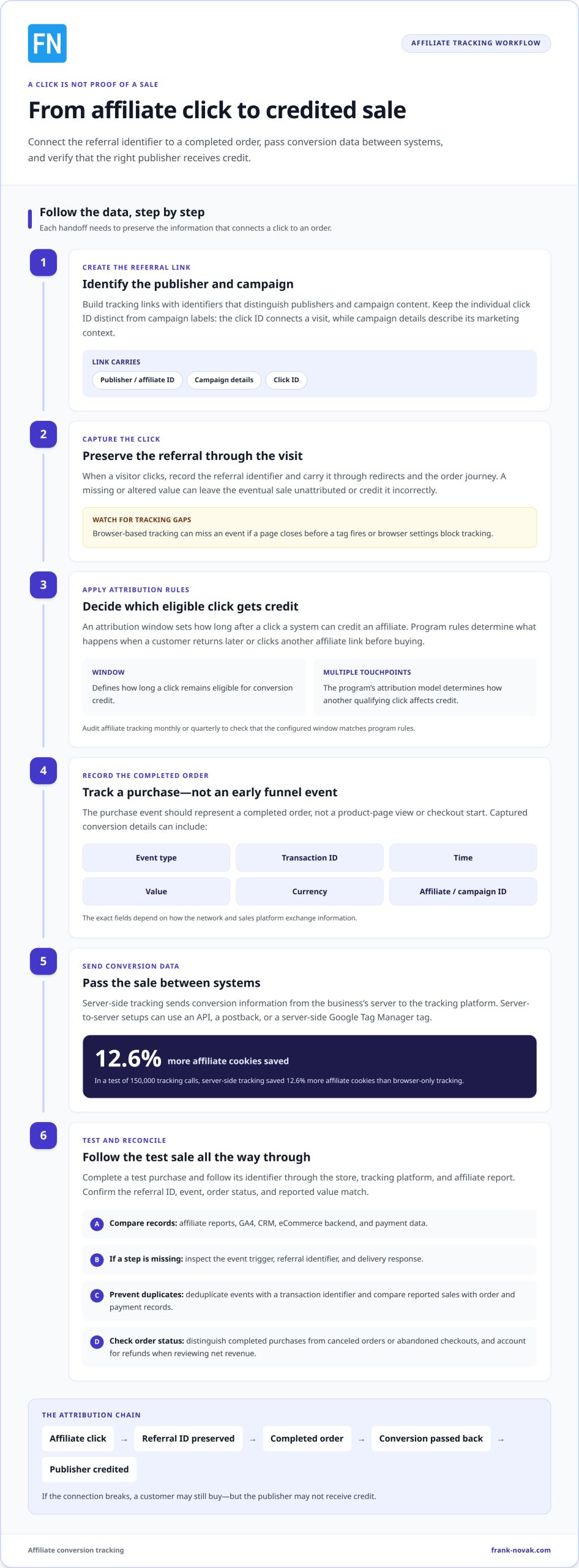
A click isn’t proof of a sale. Setting up conversion tracking for affiliate sales means linking a publisher’s referral identifier to a purchase and passing conversion data back so the sale can be attributed. If that connection breaks, the customer may still buy, but the publisher may not receive credit.
A tracking link alone doesn’t tell the whole story. Attribution also depends on how the sale is recorded and which interaction receives credit. Follow the data from the initial click to the completed order to see how the process works.
This guide explains affiliate conversion tracking, how attribution windows affect credit, and how postbacks pass conversion details between systems. You’ll learn how links and identifiers connect a sale to a publisher, and what to review when reports don’t match. These steps help you see where affiliate sales come from and improve your tracking setup.
Key Takeaways
- Follow the sale from affiliate click to completed order, then compare tracking records with your CRM, eCommerce backend, payment data, and analytics to spot gaps.
- Set attribution rules that clarify how long a click can receive credit and how your program handles more than one touchpoint.
- Use server-to-server postbacks to pass conversion information between systems, and test the flow to catch missing or mismatched data.
- Build tracking links with identifiers that distinguish publishers and campaign content, making it easier to understand which activity led to a sale.
- When you need guidance connecting tracking choices to an affiliate business, explore how Online Success Coaching or ClickBank Super Funnel may fit your next step.
What is affiliate conversion tracking?
Affiliate conversion tracking connects a publisher’s referral to a completed action, such as a purchase. It follows the path from a tracking link or identifier to an order recorded by a business. The aim is to credit the right publisher and capture useful details, including the conversion event, transaction value, and campaign source.
For example, a customer clicks a publisher’s product link, visits a store, and buys later. The affiliate network records the referral identifier, while the store records the sale. If the records match, the network can attribute the purchase. Setting up conversion tracking for affiliate sales means connecting those records and confirming that the key event data arrives intact.
Conversion data can include the event type, transaction identifier, time, value, currency, and affiliate or campaign identifier. The exact fields depend on how the network and sales platform exchange information. A purchase event should represent a completed order, not a product-page view or checkout start, so reports reflect revenue-generating actions.
Browser-based tracking can miss events when a page closes before a tag fires or browser settings block tracking. Server-side tracking sends conversion information from a business’s server to the tracking platform. Server-to-server setups commonly use an API, postback, or server-side Google Tag Manager tag. In a test of 150,000 tracking calls, server-side tracking saved 12.6% more affiliate cookies than browser-only tracking.
Completeness still depends on accurate event mapping, identifiers, and order records. Compare affiliate reports with GA4, the CRM, eCommerce backend, and payment data. If GA4 records a purchase but the network shows no conversion, inspect the referral identifier and event delivery. If the payment record shows a refund, account for that status when reviewing net revenue.
To send conversion data to advertising platforms such as Google Ads, configure a purchase conversion action and connect the site tag or a supported import method. Map the sale value and transaction identifier, then test whether a completed purchase appears in the intended campaign report.
Affiliate tracking platforms and tools have different pricing models. Compare the features, tracked activity, integrations, and support offered with your actual tracking needs rather than assuming every network or tool costs the same.
To optimize campaigns, use verified conversion data to identify which publishers, placements, or creative variations lead to completed sales. Review tracked campaign data after a month; if a campaign has no sales, pause it or adjust its ads and keywords.
How do you test and troubleshoot affiliate conversion tracking? Complete a test purchase and follow its identifier through the store, tracking platform, and affiliate report. If a step is missing, inspect the event trigger, identifier, and delivery response.
Prevent duplicate conversions by deduplicating events with a transaction identifier, then compare reported sales with order and payment records. Review unusual referral or conversion patterns before treating them as valid campaign results.
Affiliate conversion tracking and attribution
Attribution connects an affiliate link or click to an order, then assigns credit according to program rules. Clear rules help marketing teams interpret reports and compare publisher contributions consistently.
Referral-Link Order Attribution
To check referral-link attribution, trace a purchase from the affiliate link to the order record and network report. Confirm that the referral identifier appears with the order and that the reported publisher matches the link used. For example, if a test click comes from a product review, the resulting order shouldn’t appear under an unrelated campaign.
Compare the order’s status and value across records. A completed purchase should be distinguishable from a canceled order or abandoned checkout. If the affiliate report credits the wrong publisher, inspect the path from click to landing page to checkout. Redirects or missing referral details can break the connection before the order is recorded.
Attribution Windows and Cookie Periods
An attribution window determines how long after a click a system can credit an affiliate with a conversion. A cookie may retain referral information in the browser during that window. Program rules determine which eligible click receives credit if a customer returns later or visits through another affiliate link.
For example, a customer might click a review link, leave, then return directly to buy. If the referral remains eligible, the original affiliate may receive credit. If another qualifying click occurs before purchase, the program’s attribution model determines how it affects credit. Brands should audit affiliate tracking monthly or quarterly and check that the configured window matches program rules.
Click ID Attribution
A click ID is a unique value attached to a visit or referral. When a visitor clicks an affiliate link, the platform can pass that identifier into the order journey. At conversion, the network or integrated system uses the matching ID to connect the purchase with the originating click, even when multiple publishers drive traffic.
Check that the ID survives every redirect and remains available when the conversion is recorded. A missing or altered value can leave a sale unattributed or assign it incorrectly. Keep identifiers distinct from campaign labels: a click ID connects an individual visit, while campaign details describe its marketing context.
Consistent attribution makes publisher reports more useful for decisions about campaign investment and partner credit. If you’re building an affiliate business and want broader guidance on its marketing foundations, explore affiliate marketing guidance.
Affiliate conversion tracking with server-to-server postbacks
A server-to-server postback sends conversion data directly between systems after a sale. To connect affiliate links, pixels, and postbacks, link the referral identifier to the purchase event, then test each route before relying on its reports.
Client-Side and Server-to-Server Tracking
Client-side tracking runs in the visitor’s browser, often through a pixel or tag on the confirmation page. It can record a purchase when the page loads, but browser settings or an interrupted visit may prevent the event from reaching the platform.
Server-to-server tracking sends the event from the seller’s server to the affiliate network. It can provide a separate route for conversion data instead of relying only on a browser event. In a test of 150,000 tracking calls, server-side affiliate tracking saved 12.6% more affiliate cookies than browser-only tracking.
That result applies to the calls tested, not necessarily every setup. For your traffic, compare completed orders with recorded conversions, then find where identifiers or events are missing. Server-to-server tracking is commonly set up through an API, a postback, or a server-side Google Tag Manager tag.
Choose the tracking route based on the systems involved. If an affiliate network supports a postback, the seller can send purchase details directly to it. If Google Ads or Google Analytics also needs conversion data, map the purchase event separately for each platform rather than assuming one connection covers every report.
Links, Pixels, and Postbacks
Start with the affiliate tracking link. It should carry the publisher or referral identifier through redirects and into the purchase flow. A pixel can record the conversion in the browser, while a postback can pass the completed event between servers.
For example, a visitor clicks a publisher’s link and receives a click identifier. At checkout, the store retains that identifier with the order. When payment completes, the server sends the network a postback containing the matching identifier and relevant conversion data.
During implementation, align event names and fields across the order system and affiliate platform. Use a transaction identifier to distinguish a new order from a repeated event. Send only the fields needed for attribution and reporting, such as event type and order value.
Test the full route with a controlled purchase: click the affiliate link, complete the order, then inspect the network’s event record. If the click appears but the conversion does not, check the postback response and identifier first. If both the pixel and server event fire, deduplicate the purchase before using results to optimize campaigns.
Document which integration sends each event. This helps explain differences between affiliate reports, Google Analytics, and Google Ads, whose totals aren’t necessarily interchangeable.
Affiliate tracking links and identifiers
An affiliate link carries information that connects a visitor’s click with a publisher and campaign. Define the affiliate or publisher identifier, the conversion action, and the fields that connect the click to an order. Useful fields include a click ID, transaction ID, campaign label, order value, and currency.
Agree on an identifier format across the affiliate program, tracking platform, and checkout flow. For example, a publisher ID can identify who referred the visitor, while a campaign label distinguishes a review article from an email promotion. If the store records these values with the order, the network can use them to attribute a commission to the right referral.
UTM codes add context to an affiliate link. They can identify the content or creative, traffic source, and path associated with a conversion. A campaign might use a source label for the publisher and a content label for a comparison article. Keep labels consistent so reports group similar activity instead of splitting it across spelling variations.
Keep identifiers distinct by purpose. A click ID represents an individual visit, campaign parameters describe the marketing activity behind it, and a transaction ID identifies the completed order. This distinction prevents a campaign label from being mistaken for proof of a particular click or sale.
Map each identifier to the system field that stores it. The affiliate link should pass publisher and campaign details to the landing page, and the checkout or order system should retain the values needed for attribution. If the customer buys later, the conversion event can use those stored values to connect the order to the earlier referral.
A browser may follow redirects between an affiliate link, a landing page, and checkout. Test that the publisher ID and click ID remain available along the way. For example, click a link, move through the product pages, and confirm that the test order carries the expected identifiers. If a redirect drops a field, the affiliate report may not assign credit correctly.
Keep the conversion action specific. A purchase, lead submission, and account registration are different outcomes, so each event needs a clear name and definition. For a purchase, match the event to the order record and include the transaction ID. This lets the platform distinguish a completed sale from another event tied to the same visitor.
Before importing conversion data into a network or advertising platform, align field names and formats. Confirm that order value and currency use the expected fields and that identifiers aren’t overwritten by blank values. Clean mapping helps connect affiliate links with sales and supports accurate commission calculations.
Document the link structure and naming rules. A short reference for publisher IDs, campaign labels, and conversion actions helps keep affiliate marketing records consistent as new links are created. When a report shows an unattributed order, those definitions make it easier to trace the gap from click to final action.
Conversion tracking support for affiliate publishers
Publishers need tracking that connects their content and referral traffic with reported outcomes. Review the journey from an affiliate link to the landing page, then check whether the program records the resulting action under the right publisher.
Start from the publisher’s view. Identify the article, email, or social post containing the link, then note its campaign parameters. For example, a product comparison page and an email promotion should use distinct labels. That separation helps analytics show which content attracts visits and which brings visitors closer to a purchase.
Review the landing page and its path to conversion. Confirm that referral details remain available as visitors move between pages or enter checkout. If an affiliate link uses a redirect, test that route and check whether the expected publisher identifier persists. A missing parameter can make a valid referral hard to connect with an order.
Publisher reports and analytics answer different questions. A program report focuses on tracked referrals, attributed actions, and commission status. GA4 can help explain on-site behavior, such as whether visitors reach product details or leave during checkout. Compare those views by matching dates, campaign labels, and conversion definitions, rather than assuming every platform counts the same way.
When a report shows clicks but few attributed sales, examine the funnel in order. First, confirm that the affiliate link opens the intended landing page. Then check whether visitors reach the relevant offer and whether the purchase event appears in the program report. This helps distinguish a tracking break from a page or offer that isn’t converting.
Keep a concise log of discrepancies. Record the affected link, campaign parameters, landing page, order reference, and reporting platform. These details help trace a referral if the program manager needs to investigate. Leave out customer details that aren’t necessary.
Publishers can use tracking results to guide content decisions. If one review page attracts clicks but another drives recorded orders, compare audience intent, page structure, and offer placement. Treat the data as a prompt for a focused test, such as changing a call to action while keeping the campaign label consistent.
Brands should audit affiliate tracking monthly or quarterly. A repeatable review can cover active links, parameter consistency, landing-page routing, and report alignment. This gives publishers and program managers a shared way to spot broken paths and see whether reported performance changes reflect tracking or campaign activity.
Track each link as a journey, not just a click count. When publisher identifiers, landing pages, analytics, and program reports align, it’s easier to find attribution gaps and identify which content merits closer attention.
Frank Novak
Frank Novak supports affiliate marketers and online entrepreneurs through Online Success Coaching, which provides personalized guidance on digital business growth and automation. If you’re applying these tracking principles to your campaigns, coaching can help you connect the mechanics to your wider affiliate strategy. Never Succeed Online is another resource for building your online business knowledge.
If you understand the tracking mechanics but want help applying them to your affiliate strategy, Online Success Coaching offers a practical next step. Bring clear goals and questions about your links, campaigns, and conversion records to focus your learning.
Turn Tracking Clarity Into Your Next Move
Reliable attribution gives you a stronger basis for deciding what to test next. Rather than changing several campaign elements at once, ask a specific question, such as whether a landing page or a publisher’s content leads to more completed sales. Use consistent campaign labels and order records to interpret the result.
A thoughtful approach to setting up conversion tracking for affiliate sales makes campaign decisions easier to explain and refine. Record what changed, which audience it reached, and how the results appeared in your reports. Over time, this helps you make choices based on clearer evidence rather than isolated clicks.
If you’re building a ClickBank-focused business, explore ClickBank Super Funnel alongside Online Success Coaching and Never Succeed Online. Choose the resource that fits the work you want to tackle next, and keep developing your affiliate strategy at a pace that suits you.
Each careful improvement gives you a better-informed starting point for the next campaign.
Frequently Asked Questions
How difficult is the setup?
The difficulty depends on how many systems need to share conversion information. A program using an existing affiliate network and standard purchase event may need less coordination than one connecting a custom checkout, analytics platform, and advertising account. List each system and its role first. If a checkout change or server integration is involved, technical support from the relevant platform may be needed.
How do I get started?
Choose the outcome you want to measure, such as a completed sale or qualified lead. Identify the affiliate platform, checkout system, and reporting tools involved, then write down the event name and order fields needed for reports. Set up one campaign as a pilot, document its link and naming rules, and review the results before extending the structure to other campaigns.
Is It Worth Setting Up?
Tracking is useful when you need to understand which affiliate activity contributes to meaningful business outcomes. A publisher may generate fewer visits but attract customers who complete higher-value orders. Compare attributed revenue, order quality, and commission obligations rather than judging performance by click volume alone. Consistent tracking can ground decisions about partners and campaigns.
How does affiliate conversion tracking work?
Affiliate tracking records a referral and connects it with a later action under the program’s attribution rules. For example, a visitor follows a creator’s link and later signs up for a paid plan. The system uses referral information and the recorded event to associate that action with the creator. The key question is whether the event represents the business outcome you want to measure, rather than an earlier step.
How do affiliate networks track and attribute conversions?
Networks receive referral details from tracking links and conversion information from the business or its integration. Program rules determine whether a recorded event qualifies and which publisher receives credit. If a customer uses more than one affiliate link before buying, the applicable attribution rule determines the outcome. Review approved, pending, canceled, and adjusted statuses separately, since each can affect commission reporting.
What are common affiliate tracking attribution models and cookie windows?
Last-click attribution credits the final eligible affiliate interaction, while first-click credits the initial one. Multi-touch approaches can distribute credit across interactions, depending on program rules. A cookie window sets how long after a click a referral can qualify for credit. Choose definitions that fit the buying journey and explain them clearly to publishers before campaigns begin.
What privacy laws and consent requirements apply to affiliate tracking in the US?
Privacy obligations depend on the data collected, how it is used, and the people or jurisdictions involved. Before activating tracking, identify whether links or tools collect persistent identifiers, disclose relevant sharing with affiliate networks, and provide consent choices where applicable. Keep a record of data flows and retention practices. For a specific US campaign, consult qualified counsel about the laws that apply to its audience and setup.
How to track affiliate sales in Google Analytics 4?
Track completed purchases in GA4 and compare them with affiliate network records. If GA4 records a purchase but the network does not, inspect the referral identifier and event delivery.

Article by
Frank Novak
Frank Novak is an online marketing professional and coach who focuses on affiliate marketing and business automation. Through his website, frank-novak.com, he shares insights and strategies for leveraging social media platforms like Facebook to generate traffic and commissions.
Affiliate / Sponsored Content Disclaimer
This [website/post] contains affiliate links. If you click through and make a purchase, we may receive a commission at no additional cost to you. We only recommend products or services we believe will add value to our readers.