

Imagine logging into your dashboard only to find that your highest-converting link now leads to a dead page because the merchant suddenly pulled the plug. It’s a sinking feeling that can make even the most experienced marketer feel a sense of panic about lost income and broken trust with their audience. If you’ve spent months carefully placing those links across your blog and social media, then wondering what to do when an affiliate product is discontinued is a natural response to a situation that feels like a major professional setback. It’s frustrating to see your hard work potentially go to waste, but this moment is actually a chance to build a more resilient business.
You don’t have to watch your commissions vanish or spend weeks manually fixing every single post. This guide provides the exact step-by-step process to save your revenue, update your funnels efficiently, and pivot your strategy with confidence. We’ll explore how to find high-quality replacement products quickly and use automation to handle link updates. By the time you finish reading, you’ll have a long-term strategy to ensure your affiliate ecosystem remains profitable and professional, no matter what changes the merchants make.
Key Takeaways
- Learn how to execute a 24-hour recovery roadmap by auditing your active links and pausing paid traffic so you don’t waste budget on dead pages.
- Discover how to evaluate new offers using performance data like EPC and Gravity to ensure your new recommendation is just as profitable as the last.
- Understand exactly what to do when an affiliate product is discontinued by using tools like the ClickBank Super Funnel to update your entire strategy in minutes.
- Master the “Honesty First” communication strategy to explain product pivots to your audience in a way that actually builds more professional credibility.
- Implement a diversification plan that focuses on building your own assets, like an email list, so your income isn’t tied to the decisions of a single merchant.
Immediate Damage Control: The 24-Hour Recovery Roadmap
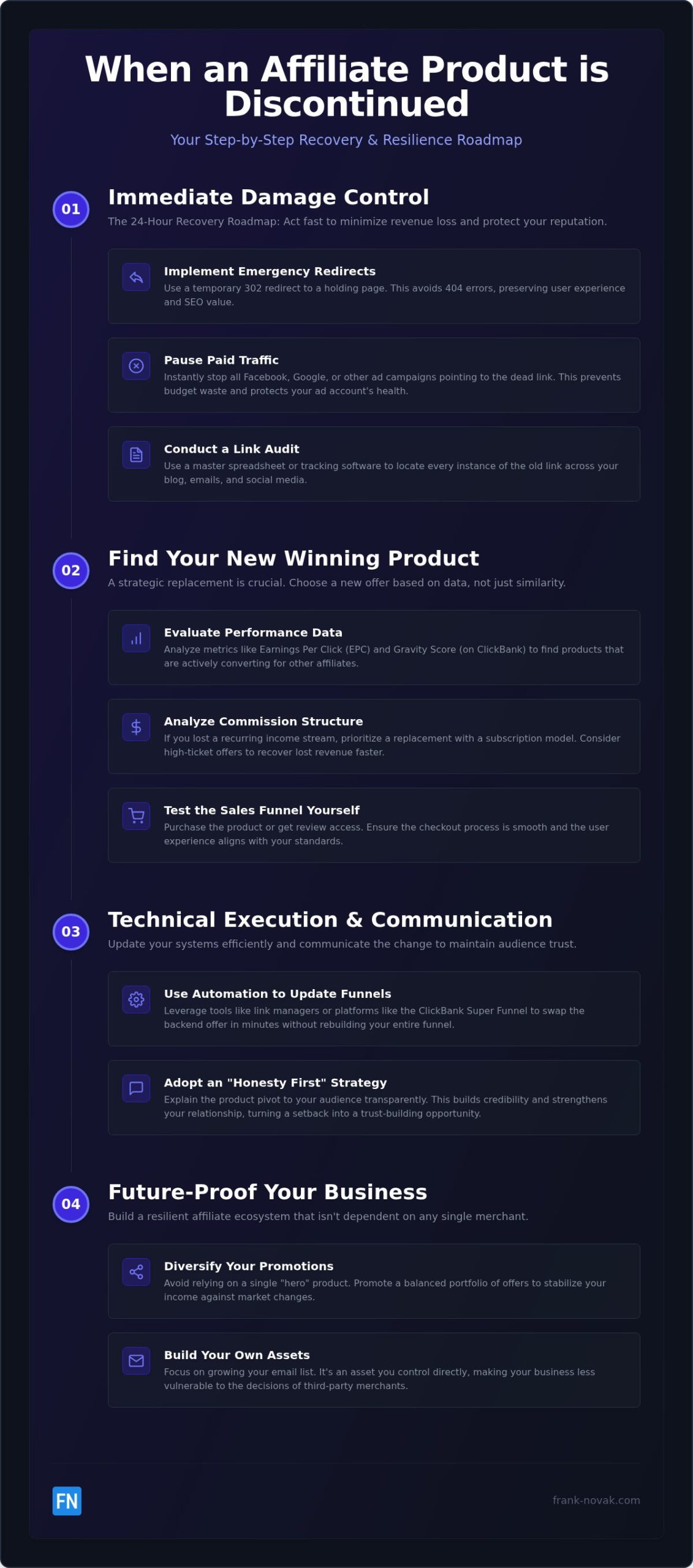
Finding out a top-tier offer has vanished is a shock, but your immediate response determines whether this is a minor hiccup or a total revenue collapse. Deciding what to do when an affiliate product is discontinued requires a calm, methodical approach to stop the bleeding. Within the first 24 hours, you need to execute a clean break from the old offer. Start by performing a comprehensive link audit using your tracking software or a simple master spreadsheet. If you’re running paid traffic on platforms like Facebook or Google Ads, pause those campaigns immediately. Every click sent to a 404 page is money down the drain and a hit to your ad account’s quality score. Once the immediate waste is stopped, implement a holding page redirect for your primary traffic sources and comb through your most recent email autoresponders for any lingering dead links.
Mapping Your Affiliate Footprint
Maintaining high standards for link hygiene is what separates hobbyists from professionals. You need a master list of every location where your affiliate link is active. This includes obvious spots like your bio links, but also deep links buried in old blog posts or YouTube descriptions. Understanding the product life cycle stages helps you realize that every offer eventually enters a decline phase. If you’ve mapped your footprint, you can swap links systematically rather than hunting for them in a panic. Tools like broken link scanners help, but a manual spreadsheet of your high-traffic assets is often the most reliable way to ensure nothing is missed. This organization builds a foundation of traffic resilience that protects your business long after this specific product is gone.
The Emergency Redirect Strategy
If you’re stuck wondering what to do when an affiliate product is discontinued, the answer starts with your redirect strategy. Instead of letting a link break, use a 302 redirect. This is a temporary redirect that sends visitors to a generic “Coming Soon” or “We’re Updating This Recommendation” page. It’s a much better experience than a 404 error, which makes you look unprofessional to your audience. You can even set up a temporary bridge page to capture email leads while you evaluate a replacement. Using a structured system like the ClickBank Super Funnel makes this process significantly easier. It allows you to swap the backend offer without rebuilding your entire front-end traffic source. This level of automation ensures that your business stays resilient, even when individual merchants change their minds.
The Replacement Strategy: Finding Your New Winning Product
Once you’ve stopped the immediate traffic leak, your focus shifts to finding a suitable replacement. Knowing what to do when an affiliate product is discontinued involves more than just picking a similar name from a list. You need to look at hard data. Earnings Per Click (EPC) and Gravity scores are your best friends here. A high Gravity score on ClickBank suggests that many affiliates are making sales, which indicates a healthy, converting offer. However, you should also consider the commission structure. If you lost a recurring income stream, look for a replacement that offers monthly subscriptions rather than just a one-time payout. This helps rebuild your passive income faster. High-ticket offers can also be a great way to recover lost revenue quickly, provided they align with your audience’s budget.
Before you commit your entire email list to a new offer, test the sales funnel yourself. Buy the product or ask the vendor for review access. You need to ensure the checkout process is smooth and the upsells aren’t overly aggressive. As you transition to a new offer, remember that transparency is vital. According to the FTC Endorsement Guides, you must clearly disclose your affiliate relationship with the new brand just as you did with the old one. If you’re feeling overwhelmed by these choices, seeking Online Success Coaching can provide you with a personalized recovery roadmap tailored to your specific niche.
ClickBank and Digital Marketplace Alternatives
When you’re browsing marketplaces, look for “Gravity-stable” products. These are offers that maintain consistent performance over months, rather than those that spike and vanish. Check the “Vendor Spotlight” for a track record of reliability and see what affiliate support resources they offer. A vendor who provides high-quality swipes, images, and demographic data is usually more invested in their affiliates’ long-term success. This support makes it much easier to pivot your strategy without starting from scratch.
The “Gap Analysis” for Your Audience
Does the new product solve the exact same problem as the old one? If there’s a slight difference, you’ll need to adjust your marketing angle to fit the new product’s unique selling proposition. If the old product was a “fast fix” and the new one is a “comprehensive system,” emphasize the depth and long-term results of the new solution. The perfect replacement is one that offers equal or better value to the end-user.
Technical Execution: Updating Funnels and Automation
When a product disappears, the technical cleanup can feel like a mountain of work. If you’ve built your business on a solid foundation, however, this process becomes a manageable series of updates rather than a total rebuild. An automated marketing funnel is your best asset in this situation because it decouples your traffic from the specific merchant’s sales page. Instead of sending people directly to a link you don’t control, you’re sending them to a bridge page where you own the relationship. This setup is the gold standard for what to do when an affiliate product is discontinued. You simply update the bridge page copy to reflect the new benefits and swap the outbound button link.
Knowing what to do when an affiliate product is discontinued also means protecting your data integrity. When you move to a new offer, you must re-verify your Facebook Pixel and any custom conversion events. If the new vendor has a different checkout process, your old tracking might stop reporting accurately. Using a global link cloaker like PrettyLinks or Bitly also saves hours of manual labor. By updating the destination URL in one central location, you instantly fix every link across your social media profiles and older blog posts. This ensures that your brand remains professional and your traffic never hits a dead end.
Leveraging the ClickBank Super Funnel
A modular design is the most effective defense against a merchant pulling an offer. The ClickBank Super Funnel is designed with this exact scenario in mind. Because the system separates the lead capture phase from the product recommendation, you can pivot the back-end upsells without touching your front-end ads. This automation ensures that your business stays operational even during a transition. If one product enters a decline stage, you just plug in the next high-converting offer and keep the momentum going without having to redesign your entire workflow.
Email Sequence Overhaul
Your autoresponder series needs a thorough find and replace session to remove any mentions of the old brand. If your lead magnet was a specific guide for the discontinued product, you’ll need to update it to remain relevant. Ensure your traffic generation strategy still aligns with the new product’s intent. If you were targeting reviews for the old product, your bridge page copy must work harder to explain why the new choice is superior. This keeps your funnel profitable and your audience engaged while you transition to your new winning offer.
Maintaining Trust: Communicating the Pivot to Your Audience
While the technical side of a product phase-out is important, the psychological impact on your audience is what truly determines your long-term success. If people have been following your advice, a sudden change in direction can feel jarring if it isn’t explained properly. When you’re deciding what to do when an affiliate product is discontinued, an “Honesty First” approach is your most powerful tool. Instead of quietly swapping links and hoping nobody notices, address the change head-on. You don’t need to bash the old vendor; in fact, doing so can make you look unprofessional. Simply explain that the product is no longer available and that you’ve used this opportunity to find a solution that offers even better performance or value.
Building this narrative helps you maintain your position as a trusted advisor. You can use social media stories to document your search for a replacement, showing your audience the behind-the-scenes work you do to vet new offers. This transparency builds massive authority. It shows that you aren’t just a salesperson, but a curator who is looking out for their best interests. If you find yourself struggling to find the right words for this transition, personalized mentorship can help you craft a message that resonates with your specific community.
The Pivot Narrative Template
A structured communication plan ensures that your message is clear and consistent across all channels. We recommend drafting a three-part email series to introduce your new recommendation. The first email should acknowledge that the previous offer is gone and explain why. The second email should focus on the “Improved Results” of the new product, highlighting the specific features that make it a superior choice. Finally, the third email provides the direct call to action. Your primary loyalty is always to your audience, not the merchant who provides the product.
Handling Refunds and Support Queries
One of the trickiest parts of what to do when an affiliate product is discontinued is managing customers who bought the old product right before it vanished. If someone reaches out with a support issue or a refund request, you should direct them to the original merchant’s support team for billing matters. However, you can protect your own reputation by offering “pivot bonuses” to these users. By using “Bonus Stacking,” you can incentivize them to try your new recommendation while providing extra value that makes up for the inconvenience of the change. This proactive support turns a potential PR crisis into a loyalty-building moment.
Future-Proofing: Building a Resilient Affiliate Ecosystem
While the immediate crisis of a discontinued product is stressful, it serves as a vital wake-up call for your business structure. If you’ve been relying on one “Hero Product” for the majority of your income, you’ve essentially built your house on someone else’s land. Learning what to do when an affiliate product is discontinued is just the first step in a larger journey. The ultimate goal is to evolve into a resilient ecosystem where no single merchant has the power to shut down your entire revenue stream. This requires a shift toward building your own assets, such as a dedicated email list and a private community, which remain under your control regardless of external market changes.
Regularly auditing your portfolio is a critical habit for long-term growth. If you treat your affiliate business like an investment portfolio, you’ll naturally look for vulnerabilities that could lead to a sudden loss of income. Ask yourself if your earnings are too heavily weighted toward one specific vendor or a single marketing channel. By identifying these “Single Point of Failure” risks early, you can proactively diversify before a crisis occurs. This proactive stance is much more effective than reacting only when a link breaks. It’s about moving from a state of uncertainty to one of steady, predictable growth.
Developing a Multi-Vendor Strategy
A robust strategy involves balancing various types of offers to ensure income stability. If you rotate between ClickBank products, private JV partnerships, and high-ticket coaching offers, you create a diversified portfolio that is much harder to disrupt. We recommend aiming for at least three core offers within your specific niche. This approach keeps your audience engaged with fresh solutions and protects you from sudden merchant decisions. If one vendor pulls a product, your other streams continue to flow, giving you the breathing room to find a replacement without financial panic.
Scaling with Professional Mentorship
Developing a sustainable mindset is perhaps the most important part of future-proofing your career. It’s easy to fall into the Never Succeed Online trap, which often involves over-dependence on third-party platforms or a single traffic source. Through Online Success Coaching, you can learn to navigate industry shifts with a seasoned practitioner who has seen these cycles before. Mentorship helps you build a business that survives even if your favorite affiliate network disappears. By focusing on traffic resilience and business automation, you ensure that you always know exactly what to do when an affiliate product is discontinued because your system is designed for flexibility from the start.
Turning Your Affiliate Pivot into a Profitable Milestone
While finding a dead link feels like a roadblock, it’s actually an invitation to strengthen your digital business. You’ve now learned how to audit your links quickly, evaluate high-performing replacements using data, and maintain the trust of your audience through transparent communication. If you apply these steps methodically, then you’ll transform a potential loss into a more diversified and robust income stream. Knowing what to do when an affiliate product is discontinued is a vital skill that separates long-term entrepreneurs from those who struggle to adapt to market shifts.
If you’re ready to move beyond reactive fixes and build a truly resilient ecosystem, expert guidance can help you scale with confidence. With over 8 years of digital marketing experience and a specialty in ClickBank Super Funnels, I provide results-oriented mentorship designed for sustainable growth.
You have the tools and the strategy to turn this temporary challenge into your next big win. Stay focused on building your own assets, keep providing value to your community, and watch your business thrive in any market condition.
Frequently Asked Questions
Will I still get paid commissions for sales made before the product was discontinued?
You are generally entitled to all commissions earned before the official shutdown date. Reputable networks like ClickBank or Impact usually process these final payments according to their standard schedule. If you haven’t reached the minimum payout threshold, you might need to contact the merchant’s affiliate manager to see if they can issue a manual payment for your remaining balance.
How long do I have to remove my affiliate links after a program ends?
You should aim to remove or redirect your links within 24 to 48 hours of the announcement. While there isn’t typically a legal penalty from the network, leaving dead links active hurts your conversion rates and damages your reputation. If you’re wondering what to do when an affiliate product is discontinued, prioritizing your user experience by fixing links immediately is the most professional move.
Can I still use the old products branding or images in my new marketing?
You should stop using a merchant’s proprietary branding and images as soon as the partnership ends. Most affiliate agreements grant a limited license that expires when the program or product is terminated. Continuing to use these assets could lead to trademark infringement issues. It’s much safer to create your own generic visuals or use assets provided by your new replacement partner.
What is the fastest way to find a similar replacement for a ClickBank product?
The most efficient method is to use the ClickBank Marketplace search filters to find products in the same category with a similar Gravity score. Look for offers that address the same customer pain points and provide high-quality affiliate tools. This ensures that the transition feels natural for your audience and maintains your earning potential without requiring a long research phase or a total strategy overhaul.
Should I delete my old blog posts about the discontinued product or just update the links?
You should update the links and copy rather than deleting the posts entirely. Deleting them removes the SEO value and traffic you’ve already worked hard to build. Instead, add a clear update at the top of the post explaining that the product is no longer available. You can then introduce your new recommendation as a superior alternative that solves the same problem for your readers.
How do I handle negative feedback from customers who liked the old product?
Acknowledge the feedback with empathy and explain the reason for the change with total honesty. If customers are upset, it’s often because they felt the old product was their only solution. By highlighting how the new replacement addresses their specific needs more effectively, you can turn a negative interaction into an opportunity to demonstrate your commitment to their long-term success and satisfaction.
Is it legal to redirect an old affiliate link to a new, different product?
It’s generally legal to redirect your own traffic to a different offer, provided your disclosures remain accurate and transparent. You must ensure that your bridge page copy clearly describes the new product so you aren’t misleading your visitors. Understanding what to do when an affiliate product is discontinued involves staying honest with your audience to comply with standard consumer protection guidelines and maintain your integrity.
What happens to my recurring commissions if a subscription product is discontinued?
Your recurring commissions usually continue as long as existing customers remain subscribed, even if the product is no longer open to new buyers. If the merchant is shutting down the service entirely, those payments will stop when the service ends. You should review the “Grandfathering” clause in your affiliate agreement to see how the vendor handles existing accounts during their specific phase-out process.

Article by
Frank Novak
Frank Novak is an online marketing professional and coach who focuses on affiliate marketing and business automation. Through his website, frank-novak.com, he shares insights and strategies for leveraging social media platforms like Facebook to generate traffic and commissions.
Affiliate / Sponsored Content Disclaimer
This [website/post] contains affiliate links. If you click through and make a purchase, we may receive a commission at no additional cost to you. We only recommend products or services we believe will add value to our readers.