

The right affiliate ad budget isn’t always a fixed monthly number. Budgeting for affiliate marketing ad spend means setting limits for paid campaigns while recognizing that affiliate commissions depend on finalized sales and can vary month to month. If you’re buying traffic, set a daily or campaign limit that reflects your goals and the results you can track.
It’s reasonable to want a clear figure before spending, but a budget that ignores your funnel, conversion rate, or cost per click can restrict a promising campaign or let an underperformer keep spending. Start by working backward from the campaign’s goal, then measure whether each stage is earning its share of the spend.
This guide explains how to decide whether to set a budget for affiliate activity, allocate paid spend across funnel stages, and use performance metrics and CPC context to assess what you can afford. It also explains how affiliate commissions differ from fixed-budget advertising, helping you make more informed spending decisions.
Key Takeaways
- Use a small, controlled paid test to learn how a campaign performs before deciding whether to increase its spend.
- Match channel allocations to your goal and the point in the funnel you’re trying to reach, rather than splitting spend evenly by default.
- Set a target acquisition cost and track conversions and return on ad spend so performance, not clicks alone, guides budget changes.
- Compare cost per click with conversion rate and the value of a resulting customer to judge whether paid traffic can fit your economics.
- Distinguish paid-media limits from affiliate commissions: ad platforms can stop delivery at a set budget, while commissions vary with finalized sales.
Should you set a budget for the affiliate channel?
Set a spending limit for paid affiliate campaigns when you need to control testing costs and learn what performs. Keep that limit separate from affiliate commissions, which are paid on finalized sales.
Testing Campaigns with Smaller Budgets
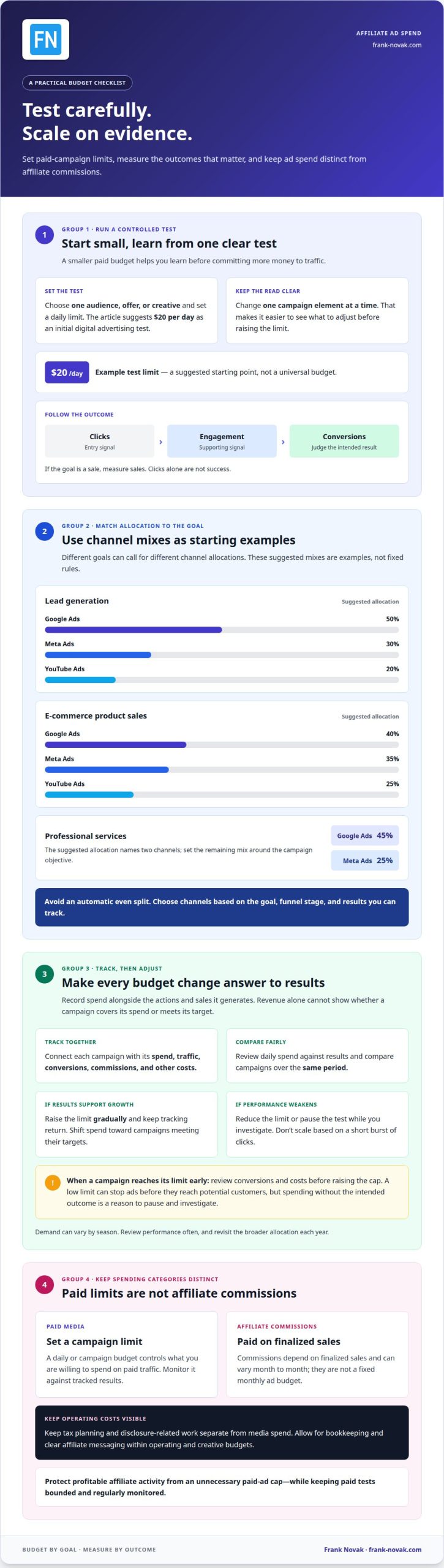
A smaller budget lets you test a campaign before committing more money to paid traffic. Start with one audience, offer, or creative and set a daily limit, such as the suggested $20 per day for an initial digital advertising test. This gives you a defined amount to learn from, rather than spreading spend across several untested ideas.
Use the test to see whether clicks lead to meaningful engagement and conversions. If the goal is a sale, measure sales rather than treating clicks as success. Change one campaign element at a time so the results show what to adjust before you raise the limit.
Tracking Performance and Expenses
Tracking performance and expenses means recording campaign spend alongside the actions and sales it generates. A tracking system can connect each campaign with its traffic, conversions, commissions, and other costs. This matters because revenue alone doesn’t show whether a campaign covers its spend or meets its target.
Review daily spend against results, then compare campaigns over the same period. If one campaign uses more of its daily limit but produces fewer conversions, investigate its audience or offer. Treat engagement as a supporting signal, not a substitute for sales.
Monitoring and Scaling Campaigns
Monitoring means reviewing spend and results regularly, then adjusting limits as the evidence changes. Daily tracking can reveal when a campaign is spending too quickly or another is producing stronger results. This helps you decide whether to shift spend toward better-performing campaigns.
When results support expansion, raise a campaign’s limit gradually and keep tracking its return. Don’t scale based on a short burst of clicks alone. If performance weakens after an increase, reduce the limit or pause the test while you investigate. Demand can also vary by season, so a higher limit may make sense during peak periods.
Setting Limits and Pausing Campaigns
A campaign spending limit caps what you’re willing to spend within a set period. A daily budget can help control ad spending, though what happens when the limit is reached may vary. This helps contain unexpected losses, but a limit set too low can stop ads before they reach potential customers.
If a campaign repeatedly reaches its limit early, review its results before raising the cap. Increase it when conversions and costs support the change; pause it when spending continues without the intended outcome. Base the decision on tracked performance, not engagement alone.
Distinguish paid-ad limits from the commissions associated with affiliate sales. A profitable affiliate channel shouldn’t be constrained in a way that limits sales, while paid tests still need clear limits and regular monitoring. Review campaign performance often and revisit your broader allocation each year.
Allocating ad spend across the marketing funnel
Keep tax planning and disclosure-related work separate from media spend, and allow for bookkeeping and clear affiliate messaging within operating and creative budgets. Allocate funds across testing, scaling, and creative production according to the campaign goal and the evidence each stage provides.
Allocating Spend Across Channels
Channel allocation divides available advertising funds among platforms and affiliate activity. It matters because channels can reach different audiences or support different funnel stages, so an even split may not serve your goal.
For lead generation, one suggested mix is 50% Google Ads, 30% Meta Ads, and 20% YouTube Ads. For e-commerce product sales, a suggested allocation is 40% Google Ads, 35% Meta Ads, and 25% YouTube Ads. Treat these as starting examples, not fixed rules. Affiliate placements can complement paid channels by reaching audiences through relevant publisher content; assess their contribution separately from media bids.
Budgeting by Marketing Goal
Goal-based budgeting assigns spend according to the outcome a campaign needs, such as leads, product sales, or awareness. This matters because a channel that supports discovery may not be the best fit for capturing purchase intent.
For professional services, one suggested allocation assigns 45% to Google Ads and 25% to Meta Ads. The remaining allocation should reflect the campaign’s specific objective and channel mix, rather than assuming every goal needs identical spending. For a new product, a larger initial budget may help generate attention, while a mature offer can prioritize channels already producing conversions.
Balancing Testing, Scaling, and Creative Production
A balanced plan reserves resources to test ideas, expand proven campaigns, and produce the assets they need. Scaling without testing can amplify weak results, while testing without fresh creative can limit what you learn.
Start with a defined test allocation across a small number of audiences or messages. Shift more spend toward campaigns that meet their targets, while keeping room to test new creative or refine a landing page. There’s no universal split: the right allocation depends on campaign maturity, available assets, and the results you track.
Geographic allocation can also reflect performance. Set separate daily budgets for regions, then direct more spend toward areas with higher conversion rates. This helps distinguish a strong audience-location match from a campaign that performs well only in aggregate.
Review the funnel as a connected path: an awareness campaign creates engagement, while a conversion-focused campaign aims to turn that interest into an action. If clicks rise but conversions don’t, reassess the offer, audience, or landing-page message before increasing spend. For help thinking through how offers and funnels fit together, explore affiliate funnel planning.
Goals, tracking, and advertising performance metrics
Set a measurable goal before judging whether advertising spend is working. Track conversions, acquisition costs, and customer value together to connect campaign activity with business outcomes.
Tracking and Optimizing Affiliate Performance
Affiliate performance tracking connects each partner or campaign to clicks, conversions, revenue, and commissions. Total sales alone can hide which sources contribute profitable customers.
Use consistent tracking identifiers for affiliate links, then review performance by campaign and offer. Compare conversions with the traffic each source generated instead of ranking partners by clicks alone. If a source drives visits but few sales, examine the offer and audience match before shifting spend. This makes each optimization decision traceable to a specific metric.
Choose metrics that match your goal. For acquisition, track customer acquisition cost (CAC), the amount spent to gain a customer. For revenue efficiency, compare revenue with advertising cost using return on ad spend (ROAS). A campaign can attract engagement yet miss its target if conversions or revenue remain low.
Using Performance Data to Optimize Spend
Spend optimization uses tracked results to move advertising budget toward campaigns meeting their targets. It matters because reallocating based on conversions and cost can be more useful than relying on impressions alone.
Set a target CAC from customer economics, then compare actual campaign costs against it. One example uses $1,200 in revenue per customer and a $600 target acquisition cost. If a campaign’s CAC rises above its target, review its conversion path before increasing spend. If results stay within target, the data can support a measured increase.
ROAS adds another view: the page’s guidance suggests optimizing one platform until it earns at least a 4x return on ad spend before launching another. Treat that as a decision threshold, not a universal target. Your margin, customer value, and campaign goal affect what return makes sense.
Plan for retention as well as acquisition. A subscription example assigns a customer an average lifetime value of $2,000, showing why first-purchase revenue may not capture the full value of a customer relationship. Track new and returning customers separately when possible; compare acquisition costs with the revenue each group contributes over time.
For a revenue goal, work backward from the customer count and allowable acquisition cost. An example targeting $600,000 in revenue over 12 months requires 500 customers at $1,200 revenue each. With a 50% gross profit target, the example sets CAC at $600 per customer. These linked metrics make the spending goal easier to evaluate.
Affiliate payouts should follow finalized sales, not clicks or uncompleted orders. Track commissions alongside sales status so reported performance reflects payable conversions. This ties campaign economics to completed transactions and gives you a clearer basis for future budget decisions.
Industry competition and cost-per-click considerations
Google, Facebook, Instagram, TikTok, and native ad networks don’t have a fixed CPC ranking. Auction competition, audience, and campaign goal shape costs. Compare each platform’s cost per click with its conversion rate and customer value instead of choosing by click price alone.
Remarketing Budget Considerations
Remarketing directs ads to people who have already interacted with a business or offer. It matters because prior engagement may support a different budget decision than reaching a completely new audience. One example states that remarketing CPC rates cost half as much as regular ad rates, while remarketing ads can convert over 50% better.
Use those figures as context, not as a guaranteed result for every campaign. Track remarketing spend and conversions separately from prospecting, then compare their cost per customer. If a smaller audience converts efficiently, allocate accordingly. Keep reach in view, too: a limited pool of previous visitors can restrict how much spend it can absorb.
Comparing Affiliate Ad Costs Across Platforms
Platform cost comparison measures CPC alongside each channel’s conversion rate and outcome. A low-cost click can still be inefficient if visitors rarely convert.
For example, a buyer-focused PPC campaign using $20-per-click traffic converted 3.3% of visits into customers. Another example uses $10 per click and a 1% conversion rate, producing 15 customers from 1,500 visits after $15,000 in ad spend. These examples show why click cost alone doesn’t settle which channel is better.
Calculate an affordable CPC from your target acquisition cost and conversion rate. At a 1% conversion rate and a $600 target acquisition cost, the maximum affordable CPC is $6. If the actual CPC exceeds that level, improve conversion performance or change targeting before scaling.
Costs also depend on competition for the audience and the campaign’s intent. A Google Ads example gives $250 per month as a logical starting budget when one customer conversion costs $25. Use such context to estimate the testing room needed, then judge the campaign by resulting conversions.
Publisher relationships require a different lens from paid clicks. If an affiliate program pauses after exhausting its budget, publishers may shift attention to programs that pay consistently. Plan commission capacity alongside media spend, and avoid abrupt pauses when performance and cash flow support continued sales.
For social media and native placements, compare each campaign’s CPC, conversion rate, and customer acquisition cost over the same tracking window. This consistent view helps you allocate spend to the audiences and programs producing the strongest results, rather than assuming a platform is cheaper based on its name.
How affiliate spending differs from fixed-budget paid channels
Affiliate commissions are tied to finalized sales, while paid channels spend against limits set before results arrive. Affiliate program terms determine whether partners can use paid search, social ads, or brand keywords. Because restrictions vary by program, they affect which acquisition tactics can receive budget.
Paid advertising platforms can use a daily spending limit or a fixed total campaign amount. When the limit is reached, ads may stop even if the campaign hasn’t met its revenue target. This makes spend predictable, but the cash is spent before a sale is certain. A campaign can use its allocated budget without producing enough conversions to cover acquisition costs.
Affiliate commission expense behaves differently. Commissions are paid after a sale is finalized, and spending may fall below budget for one or more months because it follows sales volume. This can make the affiliate channel 100% cash flow positive in the sense that commission payments follow completed transactions. It doesn’t mean every affiliate program is profitable: revenue, commission terms, refunds, and the cost of supporting the program still affect the overall result.
That difference changes how you plan. Treat paid media as a committed operating expense, then compare its spend with conversion and revenue data. Treat commissions as variable acquisition costs that rise with sales. If paid campaigns generate more affiliate sales, track both costs together so revenue is assessed against the traffic expense that helped produce it.
A program can set a maximum paid-media limit while estimating commission obligations from expected finalized sales. If ads reach their cap before converting, pause or adjust the campaign based on its performance. If sales increase, account for the related commissions rather than assuming the original budget covers every cost. This keeps cash-flow planning tied to actual campaign activity.
Affiliate terms also affect channel selection. Some programs restrict paid search or brand-keyword bidding, while others set conditions for social advertising. These are program-specific rules, not universal features of affiliate marketing. Include permitted promotion methods in your acquisition plan before allocating paid spend, so the campaign doesn’t depend on a disallowed tactic.
To optimize the mix, review paid spend and affiliate commissions as separate line items, then assess their combined effect on revenue. A fixed cap contains advertising exposure; commissions can vary with completed transactions. Budget for both mechanisms rather than treating every affiliate-related expense as fixed or purely performance-based.
Depending on the program, affiliates may be barred from paid search or bidding on brand keywords, while social advertising may have conditions. Use only promotion methods the program permits.
Frank Novak
Frank Novak’s Online Success Coaching offers personal coaching for affiliate marketers who want to turn budget principles into a practical plan. Work through campaign goals, spending limits, and performance measures as part of your broader online business. If you’re building around ClickBank, the ClickBank Super Funnel and Clickbank Profit Club may also support your affiliate marketing activities. Choose the next step that fits your needs, whether that’s guidance on your overall approach or a resource for your campaigns. Keep decisions grounded in tracked results and suited to your goals and current stage.
Make Your Next Budget Decision More Deliberate
Make budgeting for affiliate marketing ad spend a repeatable decision process, not a figure you choose once and leave untouched. Keep a brief record of what each campaign should do, what you’ll measure, and what would prompt a change. Over time, these notes can help distinguish a genuine performance shift from a temporary fluctuation.
As your offer, audience, or traffic mix changes, revisit the assumptions behind your spending plan. A campaign that once fit your goals may need a different role, while new data can show where further testing makes sense. The aim isn’t to spend more by default. Make each adjustment intentionally and connect the next decision to what your business needs.
Steady, informed decisions can build confidence in your approach. Keep learning from each campaign and let the evidence guide your next step.
Frequently Asked Questions
How Much Should I Spend?
Spend an amount your business can absorb while testing whether an offer and audience can convert. Estimate the commission from a completed sale and the share of clicks likely to become sales. Then set a campaign limit that keeps your possible acquisition cost within that commission. Include refunds and other campaign expenses, since gross commission alone can overstate what you can afford.
What is a Marketing Budget?
A marketing budget is money reserved for activities intended to attract and convert customers. It can cover paid placements, creative work, campaign tools, and affiliate commissions, which may behave differently from platform advertising charges. For example, a business can set a fixed cap for paid clicks while recording commissions as sales occur. Separating these categories makes it easier to see where funds are committed and where costs vary.
What makes an ad budget effective?
An effective ad budget connects a business goal with measurable campaign limits and a decision rule for changing spend. Before launching, define the outcome, such as a completed sale, and decide which results would support continuing, revising, or stopping. Track spend with conversions and commission revenue, not impressions alone. If the campaign attracts attention but misses its sales target, the budget should prompt investigation rather than automatic expansion.
How much should beginners budget for affiliate marketing ad spend?
For an initial digital advertising test, a suggested starting point is $20 per day, but treat it as a testing example rather than a required beginner budget. Choose a cap based on what you can afford to learn from without relying on future commissions to cover the spend. Keep the first test focused on one offer and audience, then use recorded conversions to decide whether the next test deserves more funding.
What percentage of affiliate revenue should be reinvested in paid advertising?
There isn’t a universal affiliate-specific percentage to reinvest, because commission rates, profit margins, and cash-flow needs differ. As broader context, common marketing-budget guidance includes allocating 5-10% of revenue, while a Profit-First approach uses 12% of revenue after expenses. Those are general marketing approaches, not a rule for paid affiliate ads. First account for operating costs and commission obligations, then decide what remaining funds can support testing.
What are typical costs per click and conversion rates for affiliate marketing ads?
There’s no single typical CPC or conversion rate across affiliate campaigns; the offer, audience, platform, and purchase intent all affect results. For context, examples include $10 per click with a 1% conversion rate, and a buyer-focused campaign at $20 per click converting 3.3% of visits. These are illustrations, not industry averages. Compare your own cost per click with tracked sales and commission value before judging affordability.
How do you calculate affiliate campaign break-even cost per click and return on ad spend?
Estimate break-even CPC by multiplying the commission from a finalized sale by the share of clicks that become sales. For example, if one click in a hundred is likely to produce a payable sale, the expected commission per click is one-hundredth of that sale’s commission, before other costs. Calculate ROAS by dividing attributed revenue by ad spend. Include refunds and non-ad expenses when assessing profit.

Article by
Frank Novak
Frank Novak is an online marketing professional and coach who focuses on affiliate marketing and business automation. Through his website, frank-novak.com, he shares insights and strategies for leveraging social media platforms like Facebook to generate traffic and commissions.
Affiliate / Sponsored Content Disclaimer
This [website/post] contains affiliate links. If you click through and make a purchase, we may receive a commission at no additional cost to you. We only recommend products or services we believe will add value to our readers.