

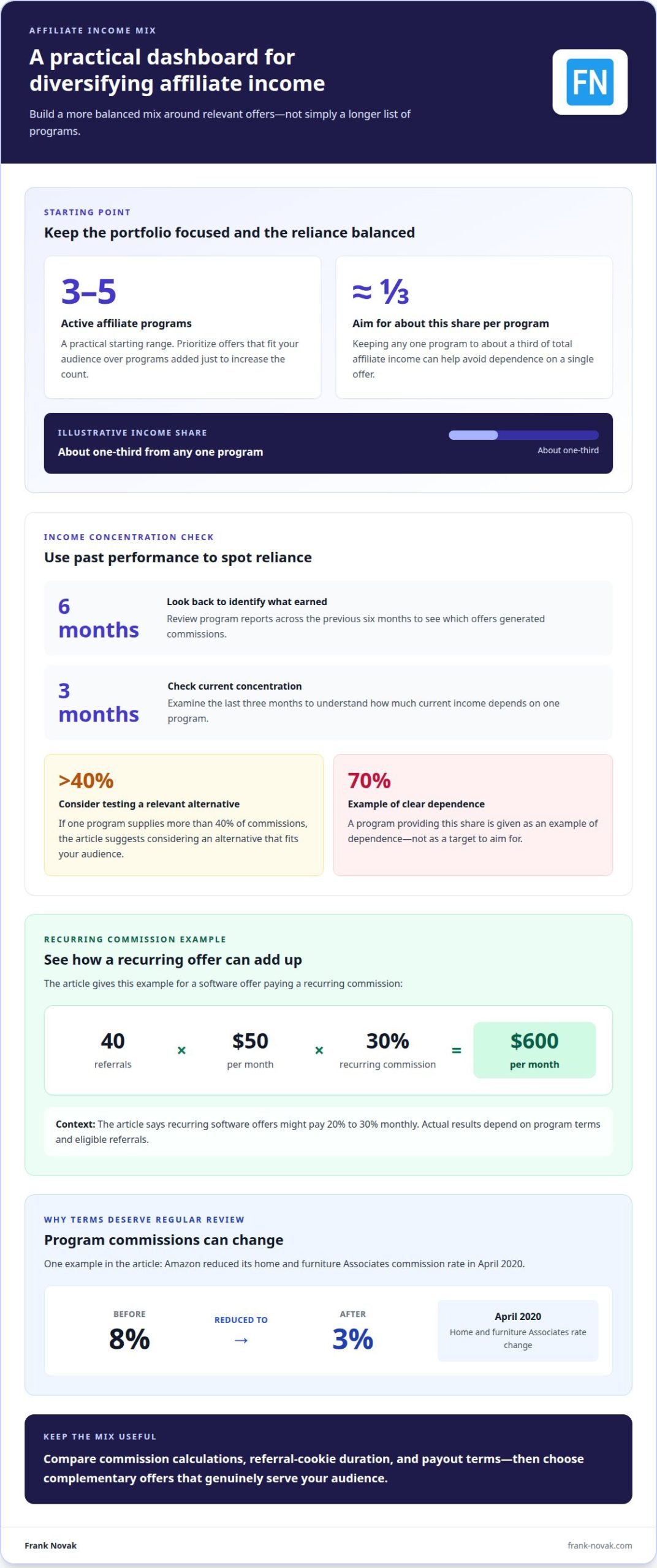
More affiliate programs don’t automatically make your income more secure. A practical starting point for how to diversify your affiliate income is to promote three to five active programs and aim to keep any one program to about a third of your total affiliate income. The right mix matters more than adding offers that don’t fit your audience.
It’s understandable to want a steadier business without overwhelming your readers or spreading your effort too thin. Diversifying can mean choosing complementary affiliate offers and developing other ways to earn within your niche, such as a course, workshop, or group. Weigh the options, balance hands-on work with assets that may keep earning over time, and choose a next step that fits your audience and capacity.
The following strategies start with your existing affiliate promotions, then explore additional revenue streams and how they can work together. The goal is a balanced income mix that supports your business while continuing to serve the people who trust your recommendations.
Key Takeaways
- Start with products and services you genuinely use, then assess whether they solve a real need for your audience.
- Separate income that depends on your ongoing time from income that can continue through existing content or resources, and plan for the work each requires.
- Build resilience by avoiding dependence on a single affiliate offer and preparing alternatives that serve the same audience.
- Within one niche, consider complementary ways to earn, such as affiliate promotions, courses, workshops, and groups.
- Use your past performance and audience needs to choose what to test next, then refine your income mix as you learn what fits.
2. Promoting affiliate products and services you already use
Products you already use can make relevant affiliate recommendations easier to explain. Start by listing the tools, services, and products you use for work or daily tasks. For each, note the audience problem it solves, your firsthand experience, and who might benefit. Promote only offers that fit your content, rather than adding links simply to increase your program count.
Compare programs by looking beyond the commission rate. Review how commissions are calculated, how long a referral cookie lasts, and the payout terms, including payment schedules and thresholds. A higher rate may be less useful if the product poorly fits your audience or the referral window is short. Choose terms that align with how your readers discover and consider recommendations.
There is no single best affiliate network or platform for every U.S. publisher. Look for relevant products, clear reporting, and terms you can assess against your audience and content. Before joining, consider whether the available offers complement what you already recommend rather than duplicating the same solution.
For FTC-focused disclosures, make the relationship clear and easy to notice near the affiliate recommendation. Use plain language, such as explaining that you may earn a commission if someone buys through your link. A disclosure hidden in a footer may be missed, while a nearby statement helps readers understand your connection before they act.
Google search should not be your only route to readers. Share useful recommendations through an email newsletter, social posts, video demonstrations, and podcast discussions. A newsletter can explain why you use a tool, while a video can show how it fits a workflow. Each channel gives readers another way to encounter a relevant offer.
Email lists, social media, video, and podcasts can each support affiliate income when recommendations suit the format. An email can include a contextual link; a social post can highlight a specific use; a video or podcast can explain benefits and limitations. Keep the audience’s needs central and disclose the affiliate relationship alongside the recommendation.
Track revenue across programs using each dashboard’s reports, then record commissions by program and period in one simple spreadsheet. Review the previous six months to identify which offers earned, and examine the last three months for current income concentration. If one program supplies more than 40% of commissions, consider testing a relevant alternative; a 70% share is a clear example of dependence. A recurring software offer might pay 20% to 30% monthly; one example, 40 referrals to a $50-per-month tool paying 30% recurring commission, produces $600 per month. Amazon reduced its home and furniture Associates commission rate from 8% to 3% in April 2020, illustrating why program terms deserve regular review.
3. Active versus passive income
Active income depends on work you do directly, such as consulting, coaching, or leading a workshop. Passive income can continue from assets created earlier, such as a recorded course or an article with affiliate links. Neither is effortless: active offers need your time, while digital assets still need promotion, updates, and audience support.
A live workshop, for example, requires preparation, delivery, and follow-up each time you run it. A recorded version takes focused work to create but can be offered repeatedly. An affiliate article may continue attracting readers after publication, though you’ll need to refresh recommendations when a product changes or no longer serves your audience.
To diversify between recurring and one-time commissions, pair a relevant subscription offer with products that pay once. Recurring commissions can provide continuing earnings while referrals remain eligible, whereas one-time commissions depend on new conversions. Compare each offer’s terms and audience fit, then balance them according to the value they provide.
Think of this as a mix of time-based work and reusable assets, not a choice between working and doing nothing. A workshop can reveal questions that later shape a self-paced course. A helpful tutorial can introduce an affiliate product, while an email sequence can guide readers through related resources. Each format serves a different stage of the audience’s decision.
Use a simple planning exercise to see where your effort goes:
- List active offers, such as consulting sessions or live workshops, and record the tasks each requires.
- List reusable assets, such as evergreen articles, recorded lessons, and email sequences.
- Mark which assets need regular updates, audience interaction, or fresh promotion.
- Choose one asset to improve, then set a review point based on its performance.
This inventory helps show whether your income depends heavily on scheduled work or existing content. It also clarifies which next step fits your available time. If live delivery fills your calendar, a recorded lesson might extend a workshop’s value. If content attracts readers but offers no next step, a relevant affiliate recommendation or paid resource may better support their needs.
Plan patiently. Building substantial passive-income investments often takes over 5 years, so treat passive income as a longer-term part of your model, not an immediate substitute for active work. Start with one useful asset, learn from how your audience responds, and improve it before adding more. For practical support as you develop an online business, explore online business guidance.
4. Benefits of multiple income sources
Multiple income sources can reduce the effect of a single program change, closure, or decline in referrals. Consider four equally profitable affiliate programs: if one ends, the remaining programs still contribute income, and the hypothetical loss is 25% rather than the whole amount. This example illustrates risk distribution, not a promise that every source will perform equally.
Compare that with a business where one program accounts for 80% of income. If that program closes, most revenue disappears at once, even if other offers remain active. A second relevant program can reduce dependence, while a course or workshop creates a different way to earn from the same expertise. The aim is resilience through a mix that fits your audience, not a longer list of unrelated offers.
Several income streams can help balance changes in demand. An affiliate product may attract readers seeking a quick solution, while a workshop serves people who want guidance and practice. If interest in one offer slows, another may continue serving a different need. Reviewing performance across offers helps you decide where to invest your time and what to adjust.
More streams require coordination. Each offer needs clear messaging, useful content, and accurate performance tracking. Adding a course, a group, and several affiliate offers at once can divide your attention too widely. Connect each revenue source to a real audience need, then add another when your content and support can sustain it.
Use this practical sequence to assess resilience:
- List each source, such as affiliate commissions, course sales, workshops, or group memberships.
- Identify what could interrupt each one, including program closure, reduced demand, or a pause in your own delivery.
- Mark sources that depend on the same product, audience, or content channel.
- Choose a complementary offer that reduces a clear dependency without creating unnecessary workload.
Relying on one income stream carries a broad risk: if a role disappears or a company closes, that income can end altogether. For an affiliate business, the equivalent might be losing its only program or the channel that sends most referrals. A more balanced mix gives you other ways to serve customers while you adapt, though it still requires regular attention and sound decisions.
One reported benchmark says the average millionaire in USD has 7 streams of income. That figure isn’t a target every affiliate should copy; a manageable mix depends on your expertise, audience, and available time. Start by strengthening one useful alternative, then assess how it complements your existing work before expanding again.
5. Diversifying within one niche
You can diversify across product categories by matching complementary offers to different needs within the same niche. A home gardening audience, for example, might value seeds, tools, and learning resources, provided each recommendation fits your experience and readers’ interests.
Staying focused helps keep your content coherent. A fitness creator could cover beginner equipment, meal-planning tools, and training courses without shifting into unrelated categories. If you serve adjacent niches, connect them through a clear audience need, such as helping new parents balance wellness and family routines. Don’t promote an offer simply because it pays commission.
A small audience can still support a thoughtful mix. An email list with fewer than 2,000 subscribers can support four or five affiliate income streams when the offers fit its audience. The deciding factor is relevance: a list about home cooking might include kitchen equipment, recipe resources, and meal-planning tools, rather than unrelated products.
If you’re a beginner, build resilience deliberately instead of adding multiple offers at once. First, identify the problems your audience asks about. Group those needs into related categories, then choose one offer that addresses a genuine gap. Publish useful content explaining who the offer helps, how it fits, and where its limits matter.
Use audience feedback to refine your mix. A free or paid event can reveal what participants want help with, while comments and email replies can surface repeated questions. If readers ask how to use a tool, a tutorial may help; if they need structured instruction, a workshop could be a better fit. Treat market research as an ongoing process of testing content and offers for your ideal customer.
- Map common audience needs to a small set of related product categories.
- Choose offers that solve distinct problems instead of duplicating one another.
- Use questions from emails, events, and comments to shape useful content.
- Review how each offer serves readers, then adjust the mix based on fit.
Your expertise can also become an income stream beyond affiliate links. Start with a simple offering, such as a focused guide or workshop, and expand it as you learn what customers need. Ask what would make a task easier for them. A cooking creator, for example, might turn recurring meal-preparation questions into a practical class.
Expanding into another niche can make sense when your experience and audience overlap. A gardening educator might add beginner landscaping resources, while unrelated finance offers would weaken the connection. Keep your core topic clear, test adjacent ideas with useful content, and let audience needs guide what you develop next.
5. What are the main ways to diversify affiliate income?
Build a mix around what your audience already needs. A practical model can combine affiliate recommendations with a small course, a focused workshop, or a paid group. A home-baking creator might recommend useful baking tools, teach a decorating workshop, and offer a recipe course. Each stream serves a related need while giving readers different ways to learn or take action.
List what you know well and what you would willingly do for income. A personal-finance educator might be comfortable explaining budgeting tools, teaching a class, or leading a group discussion. Then connect each idea to a specific audience problem. A useful offer solves a clear need rather than simply adding another product to promote.
Audience research can help shape your next income stream. Use a free or paid event to hear which questions come up repeatedly, then test a relevant resource or lesson. If attendees at a photography workshop ask about editing, for example, a short tutorial could help you assess interest before developing a larger course. Treat each test as a way to learn what your audience values.
Extend an existing product or service before jumping into an unrelated niche. A meal-planning educator could expand from recipes into a practical workshop on preparing meals ahead. Alternatively, reach an adjacent audience with content clearly connected to your expertise. A gardening creator might make beginner-friendly landscaping content while keeping the focus on plants and growing skills.
Use this sequence to plan a balanced mix:
- Write down your strengths and the work you’d enjoy doing.
- Match each strength to an audience need and a suitable format.
- Test interest with useful content, an event, or a simple offering.
- Keep what serves readers and fits your capacity, then refine it.
Revenue sources can also vary in the work they require. Affiliate content may support product discovery, while a workshop gives participants direct instruction. A course can organize lessons for independent learning, and a group can make space for continued discussion. Choose formats that suit both the subject and how your audience prefers to get help.
For help shaping your next online business step, explore online business guidance.
Identify potential income streams by listing what you do well and what you would be willing to earn money doing. Use free or paid events to learn what your ideal customers want.
Develop services by considering what potential customers need and how an offer could make their lives easier. Look for a fit between your abilities, the questions customers raise, and the practical help a service could provide. This keeps a new income stream relevant to your audience instead of making it an unrelated addition.
Frank Novak
Frank Novak offers online business resources for readers planning a more balanced income mix. If you’re deciding how affiliate promotions could fit alongside other ways of earning within your niche, Online Success Coaching can help you think through your business direction and which income streams match your expertise and audience.
For readers exploring affiliate-focused options, ClickBank Super Funnel, Never Succeed Online, and Clickbank Profit Club are also available. Consider them when you’re ready to explore online business learning beyond the practical steps in this guide.
Choose a manageable next step
A useful next move in deciding how to diversify your affiliate income is to choose one small experiment that fits your current work. Rather than redesigning your business all at once, identify an audience need you can serve more effectively. Decide what you’ll create, how you’ll introduce it, and what response would help you assess its value.
Give the experiment room to teach you. Notice which questions people ask, where they engage, and what feels practical to maintain alongside your existing work. Those observations can shape your next decision, whether you refine the idea, develop a related offer, or focus on what best serves your audience.
If you’d like support thinking through your options and next steps, reach out to discuss your business direction.
Build at a pace that lets you learn and keep serving your audience with care. Each thoughtful step can give your business clearer direction.
Frequently Asked Questions
How many affiliate programs should you promote?
A small selection of active programs can be a practical starting point, provided the offers suit your audience. To diversify your affiliate income, choose programs that address different, relevant needs. Treat the number of programs as a guide, not a quota: a couple of well-matched options may be more useful than several unrelated recommendations. Add another only when you can explain its value clearly.
Why diversify your income?
Diversifying gives your business alternatives if one source changes or stops contributing. If a merchant changes its program terms, for example, income from a course or workshop may still come from your expertise. A mix can also serve readers who prefer different ways to learn or buy. Review how each stream supports your audience, since extra offers add work and don’t automatically make a business more stable.
How many affiliate programs should a marketer join to diversify income?
Aim to actively promote three to five programs that fit your content, rather than joining every network or merchant you encounter. To decide how to diversify your affiliate income, consider whether each program complements your current recommendations and gives readers a useful option. Joining a program doesn’t mean you need to promote it immediately. A focused selection is easier to manage and keeps recommendations relevant.
What are the risks of relying on one affiliate program or traffic source?
Depending on one program exposes your earnings to its decisions, such as changing terms or ending the program. Relying on one traffic source creates a separate vulnerability: a change in visibility or access can reduce potential buyers. A business driven only by search traffic, for example, may struggle if that traffic falls. Build alternatives across programs and audience channels, then track them separately.

Article by
Frank Novak
Frank Novak is an online marketing professional and coach who focuses on affiliate marketing and business automation. Through his website, frank-novak.com, he shares insights and strategies for leveraging social media platforms like Facebook to generate traffic and commissions.
Affiliate / Sponsored Content Disclaimer
This [website/post] contains affiliate links. If you click through and make a purchase, we may receive a commission at no additional cost to you. We only recommend products or services we believe will add value to our readers.