

A physical product is a tangible good customers can see, handle, and use. A digital product is delivered electronically, such as an ebook, course, or software. Choosing between promoting digital products vs physical products depends partly on your budget: even a modest first run of physical goods can cost thousands of dollars before sales, while a digital product can be listed and make a first sale the same week. These are possible starting points, not guaranteed outcomes.
Look beyond the product format. Physical products involve production, inventory, and shipping; digital products require upfront creation time and a plan for reaching buyers. Either can work, but the better fit depends on your skills, available capital, and audience.
This comparison covers product examples, startup costs, time to a first sale, and illustrative sales and revenue to help you weigh the trade-offs. You’ll also see how each model changes as it grows and how to choose a starting point that fits your circumstances.
Key Takeaways
- Match the product model to your skills, available capital, and the audience you can reach, rather than choosing on margins alone.
- Compare tangible goods with digital options such as ebooks, workbooks, software, and courses to see which format fits your strengths.
- Use the article’s illustrative sales examples to understand how price, costs, and unit volume affect revenue before overhead.
- Plan for physical-product expenses like production and shipping, or digital-product work like creation, maintenance, and marketing.
- Use the decision guide to weigh your starting resources and choose a model that feels practical to test and grow.
Choosing a product model based on skills, capital, and audience
In the United States, state tax rules for digital goods vary. When advertising either format, describe the offer clearly and make sure your claims match what buyers receive.
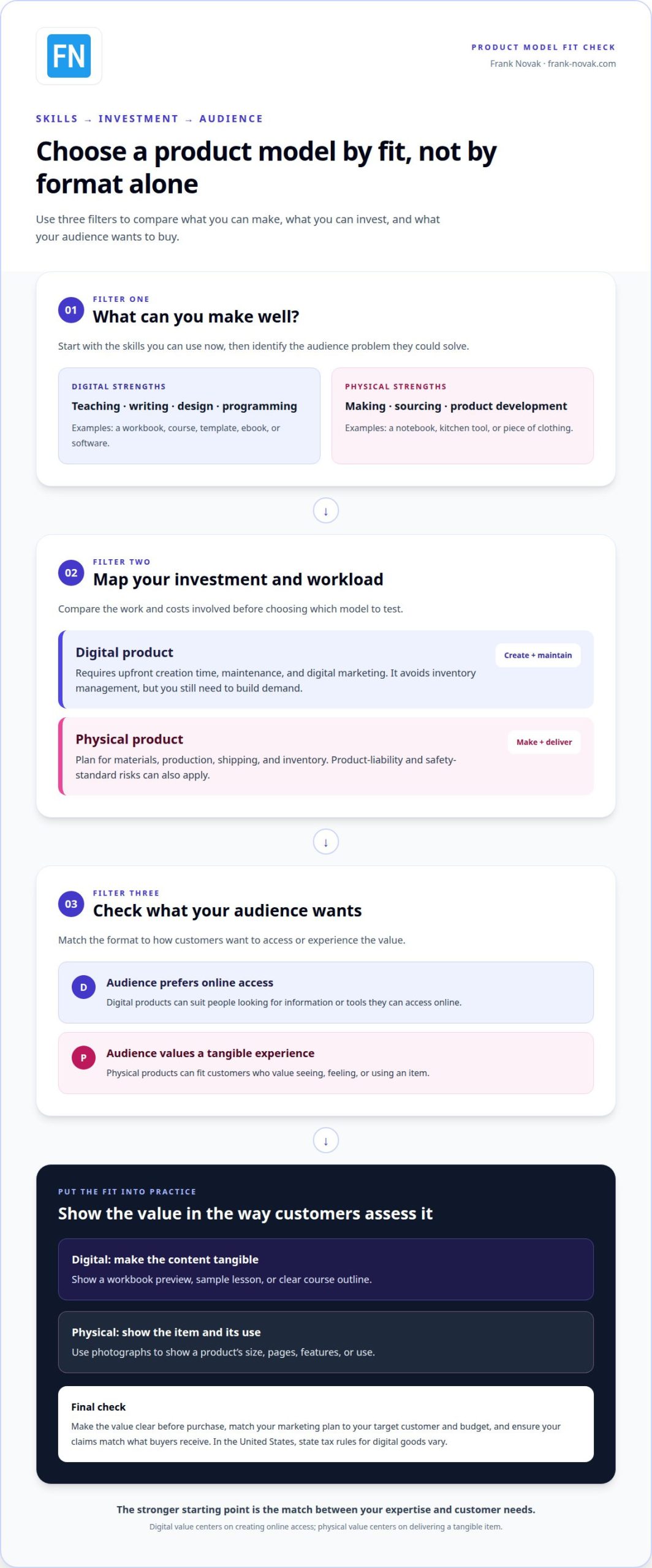
Use three filters: what you can make well, what you can invest, and what your audience wants to buy. A teacher with useful expertise might test a downloadable workbook, while someone skilled at sourcing could explore a physical product.
Digital Product Model
Digital products include ebooks, courses, templates, and software delivered electronically. They can suit people skilled in teaching, writing, design, or programming, and avoid inventory management. But they still take time to create, and you need to build demand. Selling digital products fits an audience looking for information or tools they can access online.
Physical Product Model
Physical products are tangible goods, such as a notebook, kitchen tool, or piece of clothing. They can suit makers and sellers with sourcing or product-development skills, especially when their audience values seeing, feeling, or using an item. Plan for materials, production, shipping, and inventory. Physical products can also involve product-liability and safety-standard risks.
Promote each product in a way that reflects how customers assess it. Introduce a digital course with a sample lesson or clear outline; show a physical notebook’s size, pages, and use in photographs. For either format, make the value clear before purchase. Match your marketing plan to your target customer and budget.
| Model | Useful skills | Upfront demands | Audience fit | Promotion example |
|---|---|---|---|---|
| Digital product | Teaching, writing, design, or programming | Creation, maintenance, and digital marketing | People seeking online information or tools | Show a workbook preview or course lesson |
| Physical product | Making, sourcing, or product development | Materials, production, shipping, and inventory | People who value a tangible item | Show the product in use and explain its features |
First, list the skills you can use now and identify the audience problem each could solve. Then map the costs and work involved: creating and marketing a digital product, or producing and delivering a physical one. Finally, compare your offer with actual audience demand. A strong match between your expertise and customer needs matters more than choosing a format because it seems easier to promote.
Choose a digital model if your strongest asset is knowledge or a repeatable tool and your audience prefers online access. Choose a physical model if you can manage making or sourcing goods and customers value the tangible experience. Both formats need clear promotion. The main difference is whether your work centers on creating digital value or delivering a physical item.
Digital and physical product examples
Picture what the customer receives to clarify the product format. A budgeting spreadsheet, a set of audio lessons, and a ceramic mug serve different needs, even if they target the same audience. Their creation, delivery, and promotion also differ, so compare actual offers rather than abstract categories. A practical comparison of promoting digital products vs physical products starts with how customers plan to use the product.
Digital product examples
A digital product is delivered electronically, often as a download, email file, app, or online access. Examples include a meal-planning spreadsheet, a Lightroom preset pack, an ebook about home gardening, and a language-learning audio series. Online courses are another option, with lessons organized around a skill such as beginner photography or bookkeeping.
Each format requires different upfront work. A spreadsheet needs clear formulas and instructions; audio lessons need useful scripts and clean recordings. A course takes lesson planning and an accessible learning structure. Once created, digital files can be sold repeatedly without making a new physical copy for each buyer. Sellers can also update a guide when its instructions or examples need revision.
- Reference tools: A printable checklist or digital guide helps customers complete a specific task.
- Creative assets: Presets, fonts, and design templates give customers materials for their own projects.
- Learning products: An audio series or online course teaches a process through organized lessons.
Physical product examples
A physical product is a tangible item delivered to the customer. Examples include a ceramic mug, a yoga mat, a gardening hand tool, or a reusable lunch container. Customers can inspect product details in photographs and, where available, see or handle items before buying. Sensory details such as fit, texture, shape, or material can influence a purchase.
Physical products also need a practical delivery plan. A mug needs protective packaging; a yoga mat takes more shipping space than a digital guide. Production and inventory needs vary, too. A handmade item may require making each order, while a sourced item requires coordinating stock and replenishment.
Almost any topic can inspire either format, but let the customer’s intended use guide your choice. A gardening expert could sell a seasonal planting guide or a set of hand tools. The guide shares instructions; the tools help customers put them into practice. A digital version may be easier to update, while a physical item lets buyers experience its materials directly.
Promoting digital products vs physical products also changes what a demonstration should show. A spreadsheet preview or short course lesson illustrates digital use; photographs of a lunch container being packed can show a physical item in context. Make the product’s contents and purpose clear, so customers can judge how it fits their needs. If you’re shaping an online offer and its promotion, explore online business guidance.
Illustrative monthly revenue and sales-volume comparison
Revenue examples help illustrate the trade-offs, but revenue isn’t profit. The figures below are illustrations, not forecasts; overhead, advertising, returns, and other costs affect how much a seller keeps.
Selling about 310 units in one month produces about $5,000 before overhead. The example assumes a 5% return rate, so returns can further affect the result.
About 128 sales at $40 each would net about $5,000, while selling 310 bundles would generate more than $12,000. These examples use different assumptions, so compare their cost structures rather than treating them as equivalent forecasts.
| Illustration | Price per unit | Sales volume | Result before overhead or stated costs |
|---|---|---|---|
| Physical product | $40 | About 310 units | About $5,000 before overhead |
| Digital template bundle | $40 | About 128 sales | About $5,000 net |
| Digital template bundle | $40 | 310 sales | More than $12,000 |
Channels shape how each model reaches buyers. Digital products are commonly sold through websites, app stores, and software subscriptions. Physical goods can move through wholesalers and brick-and-mortar retail, as well as online stores. A digital store can accept orders and deliver downloads 24 hours a day, 7 days a week; physical sales depend on stock and delivery.
Promotion differs because customers assess different things. To sell a digital product, demonstrate its contents with a preview, webinar, or testimonial. For a physical product, show the item in use, highlight its features, and explain where customers can buy it. In both cases, tailor the message to your audience and track responses.
Conversion rates and customer acquisition costs depend on the offer, audience, channel, and campaign. Track click-through rate (CTR), cost per click (CPC), customer acquisition cost (CAC), and return on investment (ROI) to assess whether promotional spending supports profit. These measures help you compare campaign performance, but they aren’t fixed benchmarks for either model.
To promote a digital product, define its audience, show a preview or webinar, direct interested buyers to a purchase page, and measure campaign results. For a physical product, identify its audience, demonstrate how it’s used, show where it’s available, and monitor sales and returns.
International shipping can add customs fees and regulatory issues for physical goods. Digital delivery avoids shipping parcels, but sellers still need to make access and delivery instructions clear. The main advantages depend on the product: digital distribution can simplify delivery, while physical channels let customers experience a tangible item.
Startup costs and time to first sale
Startup spending depends on what you need to create, produce, and promote before buyers can order. Digital products often avoid physical stock, while tangible goods require production and logistics in the initial plan.
Digital Startup Costs and Time to First Sale
A digital product’s main startup costs typically include development, maintenance, and marketing. An online course, for example, may require lesson planning, recording, editing, a sales page, and delivery setup. A seller can list a digital product and make a first sale the same week, but timing depends on having a ready offer and reaching buyers. Each additional sale usually has a lower marginal cost than creating the product.
Physical Startup Costs and Time to First Sale
A physical product may require samples, minimum order quantities, packaging, and storage before the first sale. Even a modest first run can cost thousands of dollars before sales. A new kitchen tool, for example, may also involve materials, production, shipping, and inventory management. Manufacturing, distribution, and sales can take months or years, particularly when sourcing or supply-chain delays slow the process.
There is no reliable average marketing cost for either model. Costs depend on your audience, chosen channels, creative work, and whether promotion relies on paid campaigns or existing reach. A digital guide promoted through search ads has different spending needs from a physical product promoted through retail displays and online campaigns.
Separate one-time setup costs from expenses that continue after launch. Digital sellers may pay for development and ongoing maintenance, then spend to improve visibility and sustain demand. Physical sellers need to account for production and shipping, as well as storage and inventory management as stock moves. A physical product may also require machinery, production lines, or packaging prototypes before it is ready to sell.
- Define the offer: Specify what buyers receive, such as a downloadable guide or a finished household item.
- List pre-sale inputs: Include digital development and setup, or physical samples, production, packaging, and storage.
- Plan promotion: Identify the channels and materials needed to reach the intended audience.
- Allow for ongoing costs: Include digital maintenance and marketing, or physical replenishment, shipping, and inventory handling.
A first sale depends on more than product readiness. A digital listing can go live quickly once the file, payment process, and delivery are ready, but buyers still need to find it. A physical product needs to be ready for purchase and have a workable delivery path. Minimum order quantities or unpredictable supply issues can extend preparation, while digital sellers may spend more time refining the offer or attracting customers.
Compare startup costs by asking what you must pay before the first buyer can receive the product, then which expenses repeat with each sale. This distinction helps show whether your main constraint is creating the digital offer or financing physical stock and logistics.
Ebooks, workbooks, and guidebooks
An ebook, workbook, or guidebook can package useful knowledge as a downloadable file. The best format depends on what readers need to do: learn a topic, follow a process, or complete tasks. Ebook publishing revenue was expected to reach $6.95 billion by 2025, but a large market doesn’t guarantee demand for every subject.
An ebook suits readers who want an organized explanation, such as a beginner’s guide to meal planning. A workbook adds prompts, worksheets, or exercises to help readers apply ideas as they go. A guidebook can focus on practical steps, such as preparing a garden for seasonal planting. Each format should solve a clear reader problem, not simply collect information.
Plan the content before deciding how to package the file. Start with the reader’s goal, outline the sections needed to reach it, then add examples or exercises where they clarify an idea. A budgeting workbook, for instance, might pair explanations with fill-in spending categories. Clear headings and useful instructions help buyers use the material after downloading it.
Digital products can be delivered instantly through downloads or email. Platforms such as Etsy and Gumroad can automatically deliver uploaded files after purchase. Explain how buyers will receive and access the file before they order. A short preview, sample pages, or clear contents list shows what the product includes.
Consider pricing and perceived value carefully. Digital products can have high margins after creation, but readers may expect low prices or free content, particularly in crowded niches. Make the practical outcome clear: describe what the guide teaches, who it serves, and how its exercises or examples support the reader. Avoid broad promises the content can’t substantiate.
Plan for risks, too. Buyers can share or copy digital files without permission, so sellers may use watermarks, license agreements, or trusted selling platforms to help protect intellectual property. Secure payment systems matter as well. Refunds can be difficult to manage when a buyer keeps a file after receiving money back, so explain purchase and access terms clearly.
Printed books offer a different experience. Readers can hold and mark a physical workbook, but printing adds production, packaging, and delivery work. A digital edition is easier to distribute repeatedly once created; a printed edition may suit customers who prefer paper. A manuscript can be adapted into both formats, but each version needs a layout suited to its medium.
Before publishing, test the file as a buyer would: open the download, follow its instructions, and make sure the exercises work. Then provide a concise product description, a preview, and clear access details. These steps help an ebook, workbook, or guidebook feel like a complete product, not just a document.
Frank Novak
Frank Novak helps aspiring entrepreneurs evaluate digital business models, marketing, and automation. If you’re considering a digital offer and how to reach its audience, Online Success Coaching and resources such as Never Succeed Online, ClickBank Super Funnel, and Clickbank Profit Club can support that next step. His focus on affiliate marketing and social media strategies can help you assess how traffic and commissions fit into a digital business plan.
This support is most relevant if you’ve chosen to explore an online offer and want guidance on promotion or business systems. If developing and shipping tangible goods is your priority, this digital-business focus may not address that particular need.
Contact Frank Novak to discuss your next step.
Choose a First Step You Can Learn From
Your next move doesn’t need to settle your entire business direction. Treat your choice as a focused test: define who the offer serves, what problem it addresses, and how you’ll introduce it. A clear plan for promoting digital products vs physical products helps you compare the work involved without assuming one format suits every audience.
Before investing further, write down what you want the first launch to teach you. You might learn whether customers respond to a particular benefit, which channel brings relevant interest, or what questions arise before purchase. Use those observations to refine your offer and messaging. If the model depends on inventory or production, match your next step to those commitments; if it’s digital, focus on the content and delivery experience.
Frank Novak’s online business resources can suit readers building a digital business and seeking guidance on promotion and automation. If that’s the direction you’re exploring, reach out to discuss a practical next step.
Start with a decision you can explain, then build on what you learn. Make progress through thoughtful steps taken with purpose.
Frequently Asked Questions
What are physical products?
Physical products are goods customers can touch, store, and use, such as clothing, kitchen equipment, or printed planners. Their physical form shapes the customer experience: a planner’s paper and binding may matter as much as its layout. Sellers also need a way to get the product to buyers, so the offer includes both the item and the process for delivering it.
What should you pick?
Choose the model that fits your strongest skills and the way your audience prefers to solve a problem. If you can explain a process clearly, a digital guide might be a sensible test. If you can source or make an item customers want to handle, consider a physical offer. Before committing, describe the buyer, the problem, and the product’s role in solving it. That makes the choice easier to evaluate.
Which one should you sell in 2025?
There wasn’t one best product type for every seller in 2025. The right choice depended on customer demand, the seller’s capabilities, and available capital. For example, someone with a useful method to teach could test it as a downloadable resource, while someone with a distinctive household item could explore physical sales. Treat the year as a planning context, not a reason to follow a trend without evidence of customer interest.
Which channels work best for marketing digital and physical products?
The best channel is one where the intended customer can understand and act on the offer. Search content, social platforms, and email can introduce a digital resource; previews or sample lessons help show its value. For a physical item, product demonstrations, retail displays, and detailed product pages can answer questions about use and fit. Test your message in a relevant channel, then assess engagement and sales rather than choosing based only on popularity.
How do profit margins and lifetime value compare for digital and physical products?
Digital products can retain more revenue from additional copies because each sale doesn’t require another manufactured item. Physical products have production and fulfillment expenses. Lifetime value, however, depends on repeat purchases, complementary offers, customer retention, and the costs of serving buyers. A digital course may lead to related learning materials, while a physical product line may encourage repeat purchases. Compare contribution after relevant costs, not revenue alone.
How do shipping, inventory, and fulfillment affect physical product marketing?
Shipping and stock shape the promises a physical-product campaign can make. If a promoted item is unavailable, customers may abandon the purchase or lose confidence. Delivery costs and timing also affect whether an offer feels worthwhile, while damaged goods and returns can require extra handling. Coordinate promotion with stock and fulfillment capacity, and keep product pages aligned with actual availability. A campaign works best when its promises match the buying experience.
What are the risks of promoting digital products versus physical products?
Digital sellers may face unauthorized copying, refund difficulties after file access, and customer doubts about value, especially in crowded topics. Physical sellers may face theft, product-liability exposure, safety-standard considerations, returns, and supply or shipping disruptions. Promotion also carries the risk of claims that don’t match the product. For either format, use accurate descriptions and show customers what they’ll receive. The risks differ, so plan protections around the product’s delivery and use.
What legal and advertising rules apply to digital and physical products in the United States?
State tax rules for digital goods vary across the United States. For either format, make advertising claims match what buyers receive; physical products may also involve product-liability and safety-standard risks.

Article by
Frank Novak
Frank Novak is an online marketing professional and coach who focuses on affiliate marketing and business automation. Through his website, frank-novak.com, he shares insights and strategies for leveraging social media platforms like Facebook to generate traffic and commissions.
Affiliate / Sponsored Content Disclaimer
This [website/post] contains affiliate links. If you click through and make a purchase, we may receive a commission at no additional cost to you. We only recommend products or services we believe will add value to our readers.