

Affiliate links don’t directly improve or harm SEO rankings, and Google doesn’t treat them as backlinks. To understand how to get your affiliate review articles to rank on Google, focus on whether each page genuinely helps people make a decision and is easy for readers and search engines to understand. The links support the reader’s next step; the review’s usefulness does the heavier work.
It’s understandable to wonder whether adding more affiliate links could boost visibility or hold a page back. In practice, the balance between useful advice and commercial links matters more than the number of links. This guide explains how to match search intent, add original insights instead of repeating product descriptions, refine titles and other page elements, and use internal links to connect reviews with related content. You’ll leave with clear priorities for improving articles without turning them into sales pitches.
Key Takeaways
- Use first-hand product experience and original visuals to give reviews evidence and insights readers can’t get from a product description alone.
- Choose topics by matching the searcher’s intent with the decision your article can help them make.
- Build a useful mix of reviews, comparisons, guides, and content that addresses audience problems.
- Make titles, headings, metadata, structured data, and URLs clear and consistent with each page’s subject.
- Connect related articles with descriptive internal links, and mark affiliate links appropriately.
1. SEO Best Practices for Affiliate Product Reviews
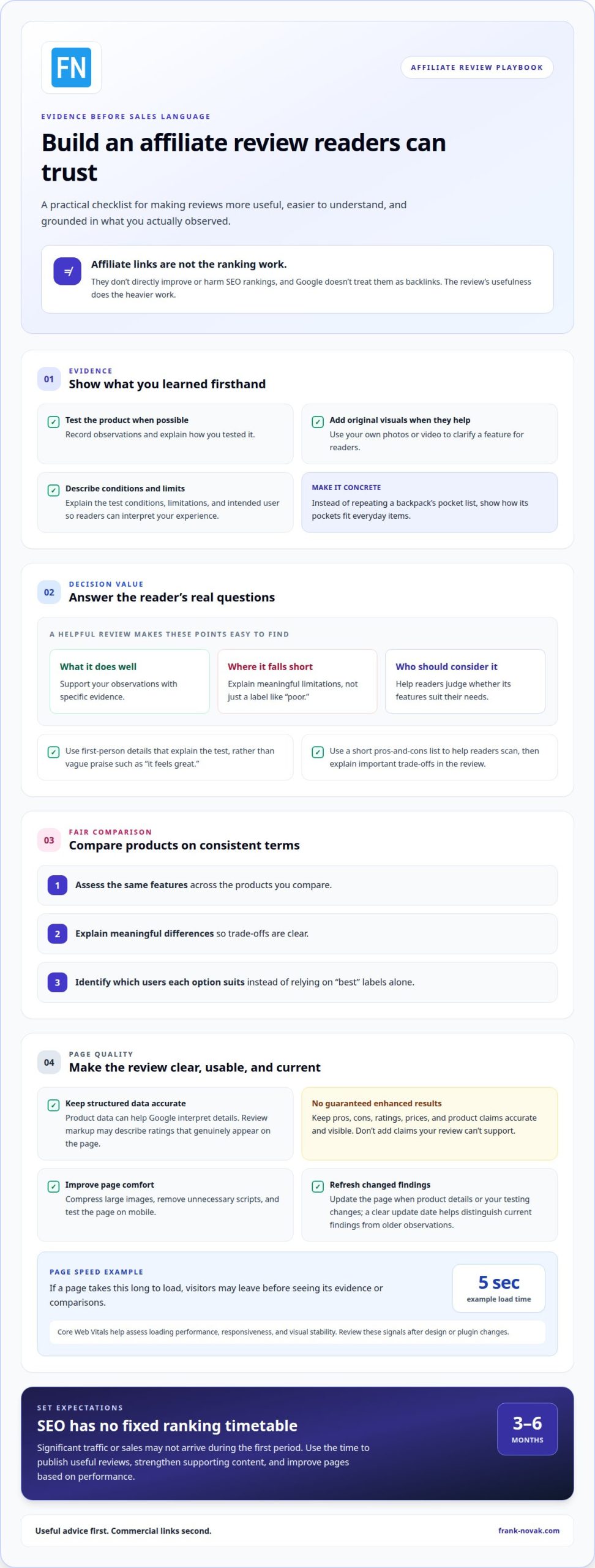
A practical plan for how to get your affiliate review articles to rank on Google starts with evidence, not sales language. Test the product when possible, record what you observe, and explain who is likely to benefit from its features. Original experience gives readers a reason to trust your review rather than a copied product description.
Google’s product review guidance favors reviews that demonstrate knowledge, evidence, and useful comparisons. Include original photos or video when they clarify a feature, and explain how you tested the product. For example, show how a backpack’s pockets fit everyday items instead of repeating the manufacturer’s list.
Google ranks affiliate review articles based on how well they serve searchers’ needs, not simply because they contain affiliate links. Relevant, informative content and a usable page help readers make a decision. Affiliate links alone don’t make a review useful or guarantee better rankings.
Use first-person observations to explain what you learned during testing. Details such as “the handle stayed comfortable during a full afternoon of use” are more helpful than “it feels great.” Describe the test conditions, limitations, and intended user so readers can understand your experience without assuming one person’s result applies to everyone.
An informative review answers practical questions: what the product does well, where it falls short, and who should consider it. Compare relevant features using the same criteria across products. A short pros-and-cons list helps readers scan the trade-offs, but explain important points in the review rather than relying on labels such as “best” or “poor.”
Product structured data can help Google interpret details about a reviewed product, while review markup may describe ratings that genuinely appear on the page. Make sure pros and cons are accurate and visible to readers. Structured data doesn’t guarantee enhanced search results, so don’t add ratings, prices, or product claims your review can’t support.
Page speed also affects whether a review is comfortable to use. If a page takes five seconds to load, visitors may leave before seeing its evidence or comparisons. Compress large images, remove unnecessary scripts, and test the page on mobile. Core Web Vitals help assess loading performance, responsiveness, and visual stability, so review these signals after design or plugin changes.
Compare products consistently: assess the same features, explain meaningful differences, and identify which users each option suits. Update the page when product details or your testing changes. A clear update date and revised examples help readers distinguish current findings from older observations.
There’s no fixed ranking timetable for affiliate reviews. SEO work may not bring significant traffic or sales during the first 3-6 months, so use that period to publish useful reviews, strengthen supporting content, and improve pages based on performance.
2. Search intent, business potential, and keyword difficulty
Start keyword research with the reader’s problem, not a list of popular terms. Someone searching “best noise-cancelling headphones” wants product choices, while someone searching “how noise cancellation works” wants an explanation. These searches have different intent and need different pages and content.
Review search results for each candidate keyword before choosing a format. If results for “best standing desk” show comparison pages, a single-product review may not match the intent. If results focus on one model, a detailed review may fit better. Match the page to what readers find in search, then add a distinct, useful perspective.
A topic’s business potential depends on whether it connects to a decision your content can help readers make. A broad informational query may attract people who are still learning, while “Brand X desk review” signals interest in a specific product. Before investing in an article, consider whether the audience, product, and available affiliate offer align.
Search volume alone doesn’t establish whether a keyword is worth targeting. “Best concrete float” is an example of a phrase searched fewer than 100 times per month, yet a narrowly focused query can still reach people with a clear need. Assess its relevance, likely intent, and the value of serving that audience, rather than chasing volume alone.
Keyword difficulty tools can help estimate competition, but the number of pages in search results isn’t a reliable difficulty score by itself. One comparison uses a query with more than 28 million results and another with nearly 1.4 million. These counts illustrate different result-set sizes, not a guarantee that the smaller set will be easy to rank in.
Build topical coverage by grouping related keywords around one reader need. For a standing desk review, related questions might cover desk height, stability, assembly, and suitability for a small office. Use those questions to shape sections or supporting articles. Keep each page focused rather than forcing every related phrase into one review.
Audience segments make long-tail research more specific. A first-time buyer may need simple setup guidance, while a remote worker may prioritize stability throughout a workday. Pair a product category with an audience or problem, such as “standing desk for a small home office,” then check whether results favor a review, guide, or comparison.
Before drafting, record the target phrase, intended reader, page format, and business relevance in a short brief. This four-part check keeps keywords tied to useful content. Reconsider the topic if search results reveal a different intent or if it can’t support an informative page beyond a product pitch.
3. Balancing affiliate and informational content
A useful affiliate website answers audience questions before presenting products. One content plan suggests devoting 50% of articles to audience problems, 20% to reviews, 20% to product guides or how-to content, and 10% to comparisons. Treat this as a planning model, then adjust topics to fit your readers and niche.
For a clear commission disclosure, say plainly that you may earn a commission when readers buy through your affiliate links. Place the explanation near the recommendation or link, where readers can see it before acting. Don’t rely on a policy page alone to explain the relationship.
Thin affiliate pages repeat product descriptions without helping readers decide. Google considers affiliate websites with little original content and no added value a poor user experience. Add useful context: explain who may benefit from a feature, what trade-off it creates, or how products differ in a real use case.
Affiliate links themselves don’t determine whether a page is helpful. In a 2021 Google Search Central SEO Hangout, John Mueller said their number is irrelevant when the main content helps searchers. Focus instead on making each recommendation relevant to the article’s purpose, with clear explanations before readers reach a link.
A hub-and-spoke structure gives related content a clear home. For a home coffee topic, a central guide could explain equipment choices, while supporting pages cover grinders, brewing methods, and individual product reviews. Link each spoke to the hub and to related pages when those connections help readers continue their research.
Topical authority grows through consistent coverage, not by publishing many similar reviews. A coffee equipment hub might include a beginner’s guide, a comparison of grinder types, and reviews that answer distinct questions. This structure helps readers move from general learning to a specific decision without making every page compete for the same keywords.
AI can assist with routine drafting, but it shouldn’t replace the work that makes a review distinctive. One workflow assigns AI 80% of commodity writing and reserves the remaining 20% for personal experience and unique insights. Use automation for organizing common questions, then edit for accuracy, examples, and a clear editorial point of view.
Before publishing, check for copied passages, unsupported claims, repetitive affiliate links, and missing context. Then ask whether readers can make a better-informed decision without opening another page. Helpful content and clear marketing can coexist when the advice remains valuable even if readers don’t click an affiliate link.
4. Titles, headers, metadata, structured data, and URLs
Structure an affiliate review so readers can move from a clear product summary to evidence, comparisons, and a decision. Use one descriptive page title, a main heading, and subheadings that organize important questions. A desk review, for example, could cover stability, adjustment, assembly, and suitable alternatives in separate sections.
Write the title tag for both relevance and a clear reason to click. A practical target is 60-70 characters, with the product name and the review’s angle near the beginning. “Brand X Desk Review: Stability, Setup, and Who It Suits” tells readers more than “Brand X Desk Review.” Keep the promise accurate to the page.
Odd-numbered titles may attract clicks, and seven has the highest click-through rate in the cited market findings. Treat that as an option, not a formula: “7 Features to Compare” works only when the article genuinely compares seven features. A number that doesn’t match the content can weaken trust and encourage the wrong action.
Write a unique meta description for each review, aiming for 155-162 characters. Summarize the product, the reader’s main decision, and a useful distinction. For instance, mention that a review compares setup and stability if those are central to the page. Google may use other page text in search snippets, so keep the opening paragraph equally clear.
Use headings to make the article scannable without turning them into a string of keywords. A single H1 should identify the review, followed by H2 sections for major topics and H3 headings only for related subtopics. “Battery life” and “Charging options” make clearer headings than repeated versions of the full product keyword.
Product structured data can help Google interpret product details. Product rich results can increase click-through rate by around 35%, but markup doesn’t guarantee a rich result or higher rankings. Add only structured details that match visible page content. If the review includes a rating, ensure the displayed rating and marked-up value agree.
Keep the URL short, readable, and specific to the reviewed item. A path such as “/brand-x-desk-review/” is clearer than a long string with dates, categories, and repeated terms. If the product name changes or the page becomes a broader comparison, revise the URL only for a clear reason. Preserve relevant redirects when changing an established address.
Before publishing, preview the title and description as they may appear in search results, then check the page on mobile. Make sure the main heading, URL, and page content describe the same subject. This small optimization step sets accurate expectations, attracts relevant traffic, and guides readers toward a useful next action.
5. Internal and external linking
Links help readers move between useful pages and help search engines understand how topics connect. In an affiliate review, use links to support the reader’s next step, not as decoration. A link to a setup guide makes sense when the review discusses installation; a link to an unrelated article doesn’t.
Build internal links into a simple publishing routine. Link each new article to 2-3 relevant older posts, then update 2-3 older posts to point back to the new page. For a review of a coffee grinder, related destinations might include a brewing guide or a comparison of grinder types. Choose descriptive anchor text that tells readers what they’ll find.
Another practical guideline is to link each new article to 3-5 relevant existing pages. Use those links where they naturally support a claim or provide further detail. If several pages target the same phrase, clarify each page’s purpose and link between them only when the connection helps the audience.
Internal links are under your control, making them a useful way to guide readers through your site. They can connect an informational guide to a product review without forcing a recommendation into every paragraph. Review older links when products change, URLs move, or an article is updated, and replace broken destinations.
External links serve a different purpose. Link to a manufacturer’s specification page when readers need product details, or to a primary source when explaining a factual claim. Make clear what the destination supports. A credible citation adds context; it doesn’t replace your own analysis or first-hand insights.
Mark affiliate links with rel="sponsored"; rel="nofollow" is also acceptable. Affiliate links are commercial links, so use them transparently and don’t treat them as a shortcut to search visibility. Use clear anchor text so readers can distinguish a commercial link from an editorial citation.
Backlinks are different: they come from other websites linking to your content. They’re characterized as one of Google’s top three ranking factors, and the first result has an average of 3.8 times more backlinks than positions two through ten. Those comparisons don’t make links a ranking guarantee. Focus on publishing material other sites may find worth citing, such as a careful product comparison or original analysis.
As a final link check, open each destination, confirm it supports the sentence, and remove links that no longer work. This keeps the path from a review to related insights useful and makes it easier for readers to move through your site.
Frank Novak
Frank Novak’s Online Success Coaching helps affiliate marketers turn SEO principles into a clearer plan for building an online business. If you understand search intent, useful review content, and internal links but want guidance applying them, coaching is a relevant next step. Work through your priorities and consider how affiliate content fits your wider online efforts.
Bring focused questions, such as how to choose review topics or create a balanced content plan. Online Success Coaching offers practical guidance for affiliate marketers and online entrepreneurs working through these decisions. Contact Frank Novak to discuss your affiliate content goals and next steps.
Turn Your Next Review Into a Focused Improvement
Your next step doesn’t need to be a site-wide overhaul. Choose one review that matters to your audience and treat it as a focused improvement project. Set a clear purpose for the page, then use reader behavior and search performance to decide what deserves attention next. A practical approach to how to get your affiliate review articles to rank on Google is to make steady, evidence-led improvements instead of chasing every SEO tactic at once.
As you refine the page, record what you changed and what happened afterward. This makes it easier to distinguish useful adjustments from busywork and gives you a process to apply to other content. If you’d value a sounding board while deciding what to work on, Online Success Coaching can help you plan your next steps.
Thoughtful improvements build a stronger foundation. Keep learning from your readers and moving forward.
Frequently Asked Questions
Do Affiliate Links Hurt or Help Your SEO Rankings?
Affiliate links don’t inherently help or hurt a page’s rankings. Their presence matters less than whether the page serves the reader’s purpose. A link to a product discussed in a review gives readers a relevant next step, while links that interrupt the explanation can make the page harder to use. Treat each link as part of the reader’s decision process, not as a shortcut to visibility.
What Are the Best Practices for Optimizing Affiliate Product Reviews for SEO?
Make the review useful enough to support a real buying decision. Explain the product’s intended audience, trade-offs, and alternatives, and support every claim with evidence on the page. Before publishing, check that the title reflects the review, the headings organize its main questions, and affiliate links lead to the products described. Readers should understand the page’s purpose without relying on its search snippet.
How to Demonstrate First-Hand Product Experience in Affiliate Reviews?
Record specific observations from using the product, including the situation and task involved. For a kitchen appliance, describe how it handled a particular recipe and what cleanup required rather than simply calling it convenient. Separate what you observed from manufacturer specifications, and explain any limitations in your test. When readers can see how you reached a conclusion, they can judge whether your experience applies to their needs.
How to Research Keywords and Search Intent for Affiliate Product Reviews?
Start with a specific audience and decision, such as a new homeowner choosing an air purifier for a bedroom. Search that phrase and inspect the results: reviews, comparisons, and guides signal different expectations. Note recurring questions and useful subtopics, then choose a format that answers them. If the results focus on broad education, a product review alone may not match the searcher’s intent.
How to Earn Backlinks to Affiliate Review Articles?
Give other publishers a clear reason to reference your work. Original testing details, a useful comparison table, or a carefully explained finding can offer more value than a standard product summary. Share relevant insights with writers covering the same subject, and make cited information easy to locate and understand. Avoid exchanging links just to manipulate rankings; seek references that make sense for both audiences.
What Are Google’s Rules for Affiliate Links and rel=”sponsored”?
Google recommends marking affiliate links with rel="sponsored"; rel="nofollow" is also acceptable. Add the attribute to the link itself, such as a product link in a review, to identify its commercial relationship. Keep the link relevant to the discussion and make its destination clear to readers. This markup doesn’t replace a straightforward explanation that you may earn a commission.

Article by
Frank Novak
Frank Novak is an online marketing professional and coach who focuses on affiliate marketing and business automation. Through his website, frank-novak.com, he shares insights and strategies for leveraging social media platforms like Facebook to generate traffic and commissions.
Affiliate / Sponsored Content Disclaimer
This [website/post] contains affiliate links. If you click through and make a purchase, we may receive a commission at no additional cost to you. We only recommend products or services we believe will add value to our readers.