

A keyword with thousands of searches can be a weaker affiliate opportunity than one with far less traffic. For many niche keyword searches, a useful starting filter is a minimum of 10 and a maximum of 500 searches per month, but volume alone can’t tell you whether the keyword is worth targeting. Finding untapped keywords for your affiliate niche means weighing search demand alongside relevance, competition, and signs of purchase intent.
It’s natural to focus on search volume when choosing what to write about: more searches can seem like a clearer path to more visitors. But visitors matter only when the topic fits your niche and their search goal connects naturally to products or offers you can promote.
This guide shows you how to assess search volume without treating it as a guarantee of value, evaluate competition in the results, and distinguish closely related long-tail searches. You’ll also learn to assess commercial relevance and use low-DR sites with organic traffic to spot opportunities that may be easier to compete for. The goal is a practical shortlist that can attract the right audience, not simply the biggest numbers.
Key Takeaways
- Read the search results to judge how established the competition is and where useful content gaps may exist.
- Use autocomplete, People Also Ask, and related searches to uncover questions and keyword variations worth exploring.
- Choose long-tail phrases that closely match your article’s topic and the searcher’s specific intent.
- Assess whether a keyword connects naturally to relevant affiliate offers, not just whether it attracts visitors.
- Study low-DR sites with organic traffic for keyword ideas and content angles that stronger competitors may overlook.
1. Assessing search results and competition before targeting a keyword
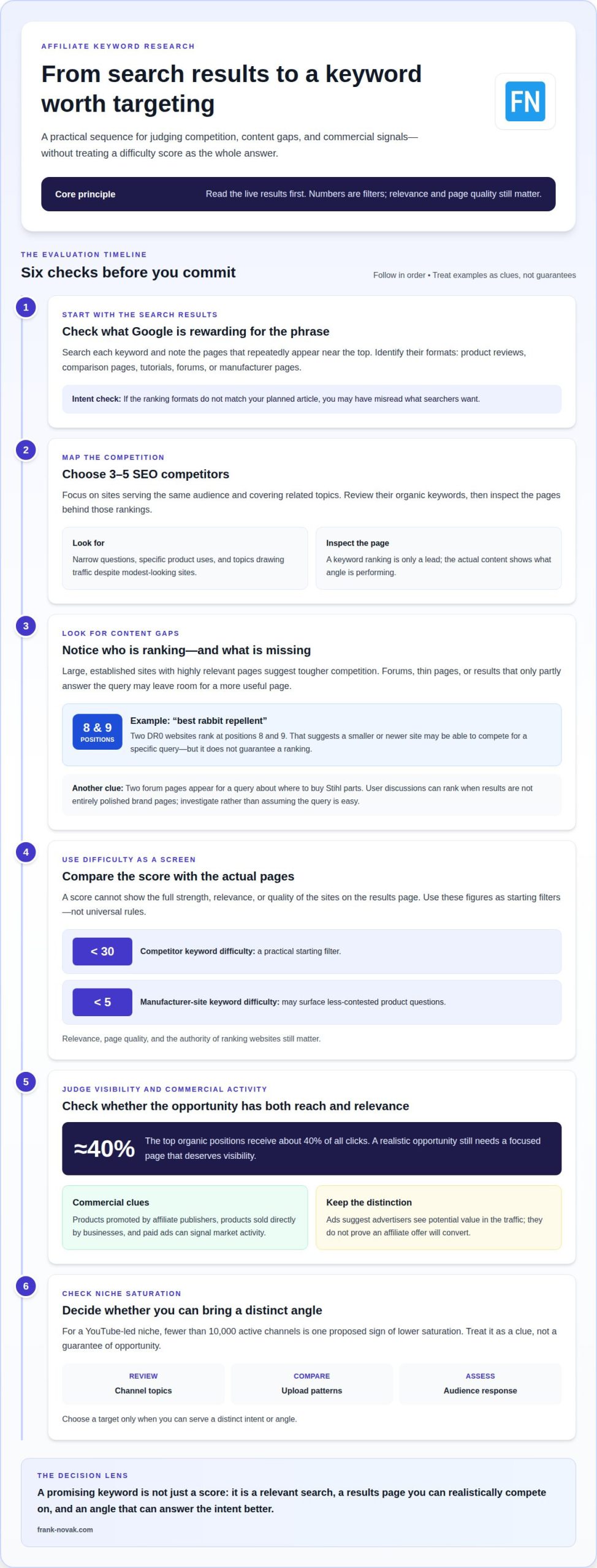
Start with the search results page, not a difficulty score alone. Search each phrase you’re considering and inspect the pages that consistently appear near the top. The top-ranking sites for related niche queries reveal the formats, expertise, and topics Google currently rewards. Note whether the results are product reviews, comparison pages, tutorials, forums, or manufacturer pages. If those results don’t match your planned article, you may have misread the search intent.
Next, identify 3-5 key SEO competitors: sites publishing content for the same audience and topics. Review their organic keywords to spot relevant phrases they rank for, then inspect the pages behind those rankings. Look for narrow questions, specific product uses, and subjects receiving traffic despite modest-looking sites. For example, two DR0 websites rank at positions 8 and 9 for “best rabbit repellent.” That result suggests a newer or smaller site may be able to compete for a specific query, although it doesn’t guarantee a ranking.
Check the strength and variety of the results before committing. If large, established sites dominate with highly relevant pages, competition is likely tougher. If the results include forums, thin pages, or content that only partly answers the query, there may be room for a more useful page. For example, two forum pages appear for a query about where to buy Stihl parts, showing that user discussions can rank when results aren’t entirely polished brand pages. Treat this as a clue to investigate, not proof that every forum-led query is easy.
Compare keyword difficulty with what you see on the page. A competitor keyword with a difficulty score under 30 can be a practical starting filter, while manufacturer-site keywords under 5 may uncover less contested product questions. These are screening points, not universal rules: relevance, page quality, and the authority of ranking websites still matter. The top organic positions receive about 40% of all clicks, so even a realistic opportunity needs a focused page that deserves visibility.
Finally, assess commercial activity and niche saturation. Search for products promoted by affiliate publishers and products sold directly by businesses; both can indicate an established market. Paid ads are another clue that advertisers see potential value in the traffic, but they don’t prove that an affiliate offer will convert. For a YouTube-led niche, fewer than 10,000 active channels is one proposed sign of lower saturation. Review competing channels’ topics, upload patterns, and audience response, then decide whether you can serve a distinct intent or angle before choosing your target.
2. What’s a Good Search Volume for a Niche Keyword?
Keyword research tools estimate search volume, keyword difficulty, and related phrases to help you compare potential topics. Google’s results add context: autocomplete, People Also Ask, and related searches reveal how people phrase questions and what they want to know.
Start with a seed topic, then type it into Google and note autocomplete suggestions. Search the phrase and review People Also Ask and related searches at the bottom. For a pool-care topic, “how much bleach for 10000 gallon pool” has a search volume of 250. Related questions may reveal whether people need a calculation, product recommendation, or safety explanation. Record each phrase and its likely intent.
Build a keyword list with columns for the phrase, estimated monthly volume, difficulty, intent, and relevance to your affiliate niche. Add variations from Google’s search features, then group phrases that address the same underlying question. Keep product comparisons separate from troubleshooting queries. This makes it easier to choose a page format that fits the searcher’s goal instead of treating every phrase as a separate article.
Set filters to narrow the list, not to make the decision for you. A suggested maximum difficulty score around 15 or 20 can help surface less competitive ideas. Search volume needs context: “immediate relief for sciatic pain” has 8,100 monthly searches in the United States and a difficulty score of 29, rated easy. A lower-volume query may still fit your site better if its intent aligns closely with an affiliate offer.
Use Google to check for commercial signals. Search your shortlist and note whether the results show paid ads, product listings, review pages, or informational guides. Ads and visible products can indicate advertiser interest, but they don’t prove that a searcher is ready to buy. Compare these signals with the wording: “best,” “review,” or “versus” often suggests comparison intent, while “how to” usually signals a request for instructions.
Search volume is an estimate, not a stand-alone measure of opportunity. Some niche terms attract thousands of monthly searches without signaling purchase intent, while a smaller query may closely match a product need. Compare the tool’s volume and difficulty with Google’s suggestions and live results. Together, these clues can reveal a useful sweet spot: enough relevant demand to justify a page, with competition you can realistically address.
If you’re developing an affiliate site and want broader guidance alongside keyword research, explore affiliate marketing resources.
3. Choosing related long-tail keywords for an article
Long-tail keywords describe a specific need, question, or situation rather than a broad subject. During keyword research, look for competitor phrases with more than 3 words; they can reveal the actual topics readers want covered. “Best grinder for espresso at home” suggests a product comparison, while “how to clean an espresso grinder” calls for instructions. Since these searches have different intent, they may need separate articles.
A practical approach to finding untapped keywords for your affiliate niche is to start with a central topic, then collect related phrases from Google autocomplete, People Also Ask, related searches, and competitor pages. Group each phrase by the problem it addresses, not just shared wording. In an espresso niche, grinder comparisons, cleaning advice, and grind-size troubleshooting could form distinct clusters. This analysis helps you choose one main question for each article.
Longer wording can reveal useful opportunities. One projection said 70% of online searches would be for long-tail keywords by 2025. Another finding states that keywords containing 10 to 15 words get 2.62 times more clicks than single-word keywords. Treat these figures as reasons to explore specific queries, not as promises of traffic. A long phrase still needs clear intent and a page that answers it directly.
Choose related variations selectively. Naturally include 3-5 long-tail variations and relevant phrases alongside the article’s main keyword. For a guide about espresso grinder cleaning, related terms might cover burrs, residue, cleaning tools, or maintenance steps. Keep them only if they support the same reader task. If a phrase calls for a product review instead, save it for another page rather than forcing both intents together.
Your ability to create useful content matters as much as the keyword list. If you enjoy baking and understand sourdough, you can develop practical topics around starter care, proofing, and equipment. If you know only a little about the subject, it may be harder to answer detailed questions accurately. List the topics you can explain from experience or research, then compare them with actual searches and relevant affiliate products.
Consider whether a topic can support consistent, useful coverage. When finding untapped keywords for your affiliate niche, look for lasting questions, such as equipment selection and routine maintenance, as well as timely topics. A coffee site, for example, could cover brewing methods, grinder care, and bean storage rather than relying only on a short-lived product trend. Before planning an article, review each cluster for unanswered questions and natural affiliate relevance.
Finally, create a simple content map: one central article, supporting long-tail questions, and the intent each page serves. This connects related topics without making several pages compete for the same query. As you refine your list, prioritize specific phrases you can answer well and link naturally to offers in your niche.
4. Evaluating keyword relevance and commercial value
Validate a keyword by matching its search intent to a relevant product, affiliate program, and audience need. Then inspect the search results and offer details to see whether a useful article can connect that need with an appropriate recommendation.
Start by asking what the searcher wants to do. “Best standing desk for back pain” suggests comparison and product research, while “how to adjust a standing desk” mainly asks for instructions. Both can fit an office-equipment site, but the first more naturally supports product links. A keyword’s commercial value depends on that fit, not just its traffic or search volume.
Commercial and transactional phrases often include words such as “buy,” “price,” “review,” “best,” or “versus.” Treat these as clues, then examine the actual results. If Google shows comparison pages and product listings, the query may have purchase-oriented intent. If results focus on definitions or troubleshooting, a sales-heavy article could miss the audience’s goal. The wording and result format together offer a clearer picture than either alone.
Next, connect the searcher’s problem to an offer you can explain responsibly. Check whether an affiliate program covers the product category, what need the product addresses, and whether the program’s terms suit your content approach. With subscription offers, customers’ recurring payments may allow recurring commissions. That model can suit content about ongoing tools or memberships, while a one-time purchase may fit a specific equipment review better.
Search demand can be modest and still commercially meaningful. One example compares a keyword with 50 monthly searches against one with 5,000; the smaller query may be more valuable when it addresses a specific problem your offer solves. A niche keyword with just 20 monthly searches can also carry substantial value when purchase intent is high and it leads to a big-ticket sale. The deciding factors are relevance and the value of the resulting customer action.
Relevance matters even when a page ranks well. One blogger reached the top three search results for “How to make French toast,” but found that searchers weren’t looking to buy related products. This shows why ranking potential and commercial intent need separate checks. Before targeting a phrase, note the audience’s likely goal, the useful answer, and the relevant product connection. If that connection feels forced, choose an informational angle or another keyword.
Before choosing a content angle, compare related queries and affiliate partnerships. An “espresso machine review” query may suit a product-focused page, while “why espresso tastes sour” calls for troubleshooting before recommendations. The second can still support affiliate marketing if a relevant product or tool genuinely helps solve the problem. Put usefulness first, and make the commercial next step clear only when it addresses the reader’s need.
5. Finding keyword ideas from low-DR sites with organic traffic
Find untapped niche keywords by combining organic rankings from low-DR sites with real questions from online communities. Then assess whether those topics fit your audience and connect naturally to affiliate offers.
Start with a site that has modest domain strength but still receives organic traffic. Use an SEO tool to review its ranking keywords, traffic estimates, and pages attracting visitors. A forum page ranks in position 3 for “how much bleach for 10000 gallon pool.” That result suggests the topic earns visibility beyond polished brand content, and may reveal room for a clearer, more complete guide. Study the page’s query, format, and unanswered details before deciding whether your site can add value.
Look for pages with measurable traffic and few referring domains. For example, an Own The Yard post about BBQ party games ideas for adults receives 3% of that site’s organic traffic despite having zero referring domains. The useful insight isn’t that every page with few links will rank. Instead, investigate which specific topics bring visitors to smaller sites, then compare their results pages and intent with your own content strengths.
Online communities can reveal needs that standard keyword tools miss. Read relevant Facebook groups, Reddit discussions, and niche forums for repeated questions, specific product concerns, and the language members use. If a gardening group repeatedly asks how to protect seedlings from pests, record the exact wording and context. Turn the question into a potential article angle, then assess its search demand, competition, and connection to relevant products.
Facebook groups can also help distinguish casual interest from a practical problem. Note whether members ask for comparisons, recommendations, troubleshooting, or ongoing advice. A question about choosing a lightweight hiking stove may support a comparison article; a discussion about repairing a specific valve may call for a detailed tutorial. Keep the audience’s language in your notes, but write an original answer rather than copying posts or private group content.
Before calling a niche profitable, map its content ideas to available monetization. Check whether related affiliate partnerships offer products that solve the problems raised in search results and discussions. If you have an affiliate manager, ask for a list of the top 10 or 20 offers, then look for recurring needs those offers address. An established set of relevant products can help shape useful topics, but product availability alone doesn’t prove that a keyword is worth targeting.
Finally, compare a low-DR site’s ranking page with your ability to create a more helpful resource. Record the query, the page’s angle, community questions, and a possible affiliate connection. This focused approach can turn small-site rankings into research opportunities while keeping each article grounded in an actual reader need.
Frank Novak: Online Success Coaching
If you’ve found promising keywords but need direction for your affiliate business, Frank Novak’s Online Success Coaching offers practical support. The coaching is for aspiring entrepreneurs developing online businesses, with a focus on affiliate marketing and business automation. If your next challenge is turning niche research into a broader traffic and commission strategy, this may suit your goals.
Frank Novak also offers the ClickBank Super Funnel, Never Succeed Online, and Clickbank Profit Club. Consider which resource best aligns with your current focus, whether that’s building your affiliate approach or developing your online business. To explore the available guidance, visit frank-novak.com.
Turn Your Research Into a Clear Next Step
As you continue finding untapped keywords for your affiliate niche, turn your strongest ideas into a focused publishing plan. Choose a topic you can answer well, make the page genuinely useful, and observe how readers respond. Their questions and engagement can guide your next content decisions, helping you build around real needs rather than a collection of disconnected phrases.
Keep refining your approach as you learn. A keyword list is a working tool, not a promise of results, and your best opportunities may become clearer as you publish and improve. If you want help shaping your affiliate direction, explore the resources available for your next step.
Steady, thoughtful progress can turn a promising idea into a stronger foundation for your online business.
Frequently Asked Questions
What’s a Good Search Volume for a Niche Keyword?
There’s no single search-volume figure that makes a niche keyword good. Judge it by your site’s ability to serve the query and the value of the audience. A phrase with modest demand may deserve its own page if it attracts people with a clear, relevant need. Before adding a keyword to your plan, compare its estimated demand with the work involved and the audience it could bring.
How can you identify affiliate keywords with high buyer intent?
Look for wording that signals a decision, such as “best,” “review,” “alternative,” or “versus,” then examine whether the results serve comparison shoppers. For example, “best mortgage refinance for self-employed” suggests evaluating options, not just learning a definition. Check that a suitable affiliate offer addresses the same need. If you use affiliate links, disclose the relationship clearly: “I earn a commission if you apply through my link, but this does not cost you anything extra.”
How do you assess keyword search volume, difficulty, and traffic potential?
Use a keyword tool to compare estimated monthly searches and difficulty, then inspect the actual results for ranking clues. Traffic potential depends on more than the search estimate: one page can address several closely related queries, while a single keyword may represent only part of its likely audience. Compare the estimate with the topics and formats currently ranking, and prioritize phrases your site can answer with relevant, useful content.
How can Google autocomplete, People Also Ask, and forums uncover keyword gaps?
Use Google autocomplete to see how people complete a topic, then examine People Also Ask for related problems and follow-up concerns. Search forums for specific wording, recurring frustrations, and details existing pages overlook. For example, questions about whether a product suits a particular use could suggest a focused comparison or troubleshooting article. Record the question and its context, then check whether the results already offer a useful answer.
How do you analyze competitors to find keywords they are missing?
Compare competitor pages by topic and intent, not just by their ranking keyword lists. Note questions they mention only briefly, audience groups they overlook, and useful subtopics they leave unanswered. Then compare those gaps with search suggestions and relevant community discussions. A potential gap is worth pursuing only if you can create a better answer that fits your site without duplicating another page you already publish.
What are the best long-tail keyword strategies for affiliate marketing?
Build each article around one clear search task, then use closely related phrases to cover useful details. For example, a guide to choosing a home espresso machine could address counter space, drink preferences, and cleaning needs as part of the same decision. Keep separate pages for searches with different goals, such as choosing a machine and fixing one. This structure helps readers find relevant information without blurring the article’s purpose.
What keyword difficulty and search volume benchmarks should affiliate marketers use?
Use difficulty and volume benchmarks as initial filters, then adjust them to your site’s authority, niche, and publishing capacity. A low difficulty score doesn’t guarantee visibility, and search volume doesn’t establish commercial value. Compare several phrases in the same topic cluster, inspect the quality of current results, and ask whether your page can satisfy the intent. The most useful benchmark is one that helps you shortlist realistic, relevant opportunities.
What are common risks and mistakes when targeting low-competition affiliate keywords?
A low competition score can distract you from weak demand, unclear intent, or poor fit with available offers. A forum result or low-authority ranking page also doesn’t prove that a new page can rank. Check whether the result genuinely answers the query, whether your content can improve on it, and whether readers have a reason to consider a relevant offer. Avoid publishing near-duplicate pages for similar phrases.

Article by
Frank Novak
Frank Novak is an online marketing professional and coach who focuses on affiliate marketing and business automation. Through his website, frank-novak.com, he shares insights and strategies for leveraging social media platforms like Facebook to generate traffic and commissions.
Affiliate / Sponsored Content Disclaimer
This [website/post] contains affiliate links. If you click through and make a purchase, we may receive a commission at no additional cost to you. We only recommend products or services we believe will add value to our readers.