

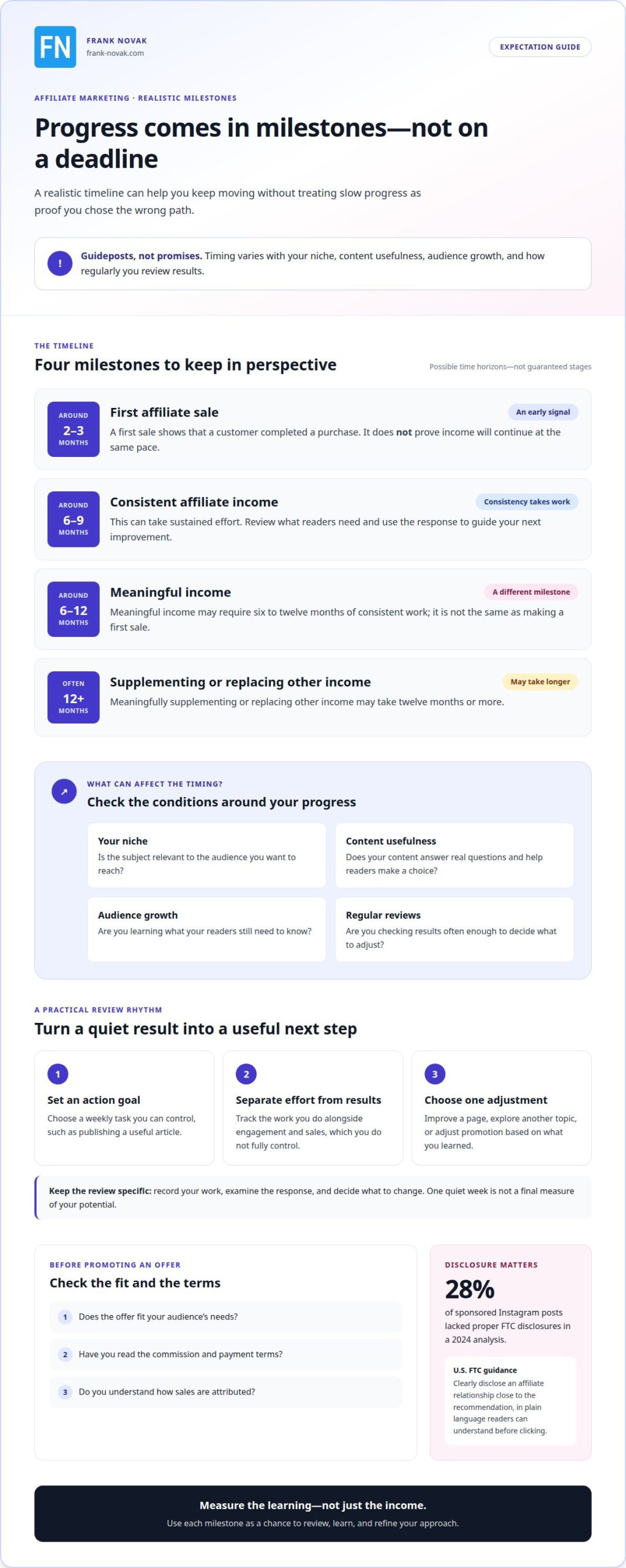
A realistic timeline is one of the most practical tools for overcoming fear of failure in affiliate marketing. A first sale can take two to three months, while meaningful income may require six to twelve months of consistent work. Treat these milestones as guides, not deadlines for judging your potential.
It’s understandable to feel uncertain when you’re investing time in a business that may not pay off right away. Slow progress doesn’t automatically mean you’ve chosen the wrong path; it can show you where to build skills, test your approach, or adjust your expectations.
This article will help you set achievable milestones, make steady progress as you learn affiliate marketing, and use setbacks as useful feedback. You’ll also consider the cost of abandoning a goal before giving yourself a practical chance to pursue it.
Key Takeaways
- Build confidence through focused learning and small, practical tests that help you see what works for your audience.
- Set progress markers around skills and actions, not income alone, so you can assess your approach without expecting instant results.
- Turn setbacks into specific questions about your content, audience, or process, then use what you learn to choose your next step.
- Consider both the risks of pursuing a business goal and the opportunity cost of leaving it unexplored.
- Notice how fear of judgment, uncertainty, and protecting an initial investment can influence your decisions before they shape your strategy.
1. Building knowledge and skills
Confidence grows when you can connect each business decision to something you’ve learned or tested. Start by choosing a niche you can research and explain, then identify your audience’s recurring questions. Look at how potential customers describe their problems, what they need to know before choosing a product, and which content formats can answer them. This gives you useful work to do before expecting a sale.
What low-risk steps can beginners take to test an affiliate marketing niche? Choose a specific audience question, publish a helpful article or short guide, and observe whether readers engage. Then compare another topic or format before investing heavily in promotion. Small tests help you learn whether the subject attracts interest and whether you’re willing to keep creating useful content about it.
Build skills in sequence: understand the audience, assess whether an offer fits its needs, create clear content, and review the response. For example, a beginner writing about home gardening could explain how to choose a hand tool, then note which questions readers ask afterward. That feedback can guide the next article. If readers need more practical detail, improve the explanation before changing the entire niche.
Email marketing is another skill worth learning because it lets you build an ongoing connection with interested readers. An average return of $36 for every $1 spent is reported for email marketing, but that figure isn’t a forecast for an individual affiliate business. Begin by offering a genuinely useful resource, such as a planting checklist, and write emails that answer related questions. Keep the content relevant rather than sending promotions without context.
Coaching can build confidence by turning broad uncertainty into specific practice. A useful coach starts with your circumstances, then helps you identify a skill to work on. For example, if writing product comparisons feels difficult, review a draft together and pinpoint where evidence, audience needs, or explanations could be clearer. Recognizing a concrete improvement gives you a next action, rather than letting difficulty feel like proof that you’re failing.
Keep a simple learning record for each test: the question you explored, the content you created, the response you observed, and what you’ll change next. This makes decisions easier to explain and reduces the pressure to get everything right immediately. If a topic receives little engagement, examine the audience fit and content usefulness before concluding affiliate marketing cannot work for you.
Skill-building also means staying flexible. If readers respond more to beginner guides than product comparisons, adjust your content plan accordingly. Success doesn’t depend on knowing everything before you start; it depends on learning from real audience needs and applying each lesson. This practical cycle of research, creation, observation, and refinement gives uncertainty a manageable place in your work.
2. Managing expectations about how long affiliate marketing takes
A first affiliate sale can realistically take two to three months. Consistent affiliate income may take six to nine months, while meaningful income may require six to twelve months of consistent work. These are different milestones, not promises or deadlines. A first commission shows that a customer completed a purchase; it doesn’t prove income will continue at the same pace.
Meaningfully supplementing or replacing other income may take twelve months or more. Timing depends on your niche, the usefulness of your content, audience growth, and how regularly you review results. For example, publishing useful articles without checking what questions readers still have can leave gaps in your approach. Use each review to decide whether to improve a page, explore another topic, or adjust your promotion.
How can beginners choose a trustworthy affiliate program or network? Compare the offer with your audience’s needs, read its commission and payment terms, and understand how it attributes sales before promoting it. Choose programs whose products you can describe accurately, rather than selecting an offer solely because its commission looks appealing.
In the United States, FTC guidance calls for clear disclosure of an affiliate relationship when you endorse a product. Place the disclosure close to the recommendation, using plain language that readers can understand before clicking. A 2024 analysis found that 28% of sponsored Instagram posts lacked proper FTC disclosures, so make disclosure part of your publishing process, not an afterthought.
How can affiliate marketers set achievable goals and measure progress? Set a weekly action goal, such as publishing a useful article, then review engagement and sales separately. Track the steps you control alongside results you don’t fully control. If readers visit a guide but don’t click its recommendation, examine whether the offer fits their question before changing your entire strategy.
Use a simple review rhythm: record your work, examine the response, and choose one adjustment. After publishing a comparison, for instance, note which sections readers engage with and whether the next step is clear. This gives you a practical focus: assess the evidence, then decide what to do next. Don’t treat one quiet week as a final measure of your potential.
Some new affiliates spend months researching before setting a test budget, which can delay useful feedback. Choose a manageable experiment and define what you want to learn before spending or publishing. Review the outcome at a planned checkpoint, then continue, refine, or stop the test. Taking the work one day at a time ties your goals to today’s actions, not imagined future income.
3. Redefining failure as a source of learning
A disappointing result describes an outcome, not your ability to build a business. If an article earns no commissions, that doesn’t prove you’re incapable; it shows that the article hasn’t produced a sale yet. Treat trying as an action you took, then examine what happened. Separating the result from your identity makes it easier to choose what to do next without letting one setback define your prospects.
Use a short review after each campaign or content update. Write down what you expected, what actually happened, which part you controlled, and what you’ll test next. For example, if a product comparison gets visits but no clicks, check whether the comparison answers the reader’s question and explains the product’s value clearly. That gives you a practical question to investigate instead of a broad conclusion that your strategy has failed.
Keep the next experiment focused. If a page has a clear audience but an unclear call to action, revise that part before replacing the offer, topic, and format all at once. Changing several elements together makes it harder to understand what influenced the result. A focused adjustment gives you a more useful comparison and helps you build strategies from evidence rather than reacting to frustration.
Setbacks can reveal a mismatch between your content and visitors’ needs. Imagine readers arrive looking for beginner guidance, but your article assumes they understand specialist terms. Add plain-language explanations and practical examples, then observe whether the page becomes more useful. The lesson isn’t to keep the same approach indefinitely; a specific obstacle can point to a specific improvement.
Review positive outcomes, too. If a product guide earns a commission, identify what helped: perhaps it matched a clear question, explained trade-offs, or made the next step easy to understand. Success offers clues about what readers value, just as a weak result can highlight a gap. Recording both outcomes helps you avoid copying a strategy blindly or dismissing useful work after a disappointing result.
Reducing fear means becoming less afraid to examine results, not expecting every attempt to succeed. Choose a review point before launching a campaign, and decide what evidence would justify refining, continuing, or stopping it. If readers consistently seek a different solution, changing direction may make sense. If a useful idea needs clearer explanation, improve it. This approach helps you learn from setbacks without treating them as a verdict on your potential.
An attempt that falls short is still evidence that you acted, and the information it leaves can guide your next move. Staying open-minded after a setback makes it easier to look for a solution rather than treating the outcome as inherently bad. Ask what the experience can teach you, then use that lesson to shape your next effort.
Look for lessons in wins as well as losses, without assuming either tells the whole story. The aim is to eliminate fear of failure, not failure itself. After a failed attempt, keep going and use what you learned to choose what to try next.
Considering the consequences of not achieving a business goal
Fear often focuses on what could go wrong if you try, while overlooking what might happen if you never begin. For example, you want to publish helpful guides about a niche but postpone every draft until you feel fully prepared. The immediate risk feels smaller, but you also miss chances to practice, learn from readers, and discover whether the topic fits your abilities and interests.
Affiliate sites can also face changes beyond an individual marketer’s influence. A study of 7,105 niche and affiliate sites found nearly 50% lost more than 90% of their organic traffic between December 2023 and August 2024. The study found 22% lost all their organic traffic during that period. These findings show why relying only on search traffic can make a business vulnerable, not that every site will experience the same outcome.
What are the risks of affiliate marketing, and how can beginners limit financial losses? Risks include spending time or money without earning commissions, relying too heavily on one traffic source, and promoting offers that don’t suit readers. Beginners can limit financial exposure by setting a firm test budget, using it to answer a specific question, and avoiding expenses they can’t afford to lose.
Before investing, write down what the next test will teach you. For example, a beginner might publish a guide and track whether readers click its relevant recommendation. If the response is weak, review the page’s usefulness and audience fit before paying for more promotion. A clear learning goal helps distinguish a controlled experiment from spending driven by impatience or pressure for quick results.
Then compare two potential costs: the resources you might use while testing, and the value of leaving the goal unexplored. That second cost could include missing the chance to develop writing skills, learn audience research, or build a useful body of content. It isn’t a reason to pursue every idea. It’s a prompt to consider both sides rather than deciding from fear alone.
Set boundaries that protect your other responsibilities. Decide how much time you can consistently devote to affiliate work, which expenses are acceptable, and what evidence would lead you to pause. If a test requires more time than your schedule allows, for instance, narrow its scope instead of sacrificing essential commitments. Limits give you control over the experiment, even when audience response remains outside your influence.
Finally, review your decision at a planned checkpoint. Ask whether you followed your process, what the results taught you, and whether the next step remains worthwhile. If you stop, record why and what you learned; if you continue, define the next manageable action. This makes the consequences visible and grounds your decision in reason, rather than letting optimism or fear decide alone.
5. What causes fear of failure in affiliate marketing?
Fear often grows when an affiliate marketer treats a weak result as a public verdict. A post with few responses can feel like proof that readers are judging the creator, rather than simply reacting to one piece of content. That pressure can lead someone to quit early and blame the offer, timing, or platform before examining the work. Separate the observable outcome from the story you’re telling yourself about it.
Money can add another layer. That concern is understandable, especially when expenses compete with household needs. Write down what you can afford to test, what you want the test to teach you, and what result would change your next action. A defined limit helps distinguish a considered experiment from spending to chase a quick win.
Uncertainty also makes it hard to connect effort with results. Affiliate marketing doesn’t necessarily reward intelligence, effort, or creativity in a direct or predictable way. A thoughtful article might reach the wrong audience, while a useful recommendation might not match what readers need at that moment. If you assume effort should produce an immediate sale, normal delays can feel like failure. Track what you control, such as audience research and content quality, alongside the response.
Social pressure can make a private goal feel risky. If friends or family dismiss affiliate marketing, you may hesitate to explain your plans or publish your work. Their doubts can influence your choices, but they don’t tell you whether an article serves its intended readers. Choose one useful piece of work, share it with the right audience, and assess feedback based on its substance. You can take others’ concerns seriously without giving them control of every decision.
Some estimates put the share of people who try affiliate marketing and fail at 95%. Treat that figure cautiously: a broad estimate doesn’t define your prospects or explain why people stop. Instead, ask what “failure” means in your own plan. Is it an unhelpful offer, an unsustainable schedule, or a campaign that needs revision? Clear criteria make it easier to spot a solvable problem instead of adopting a sweeping label.
Success can create its own fear. Greater visibility may bring more accountability and responsibility for scaling, so progress can feel like pressure rather than relief. If that concerns you, decide what growth you actually want before pursuing it. You don’t need to copy someone else’s business model. A personal definition of success helps you respond to opportunities without letting imagined expectations dictate your next move.
To reduce fear’s influence, write down the specific outcome you’re worried about, the evidence you have, and one manageable action. For example, if publishing feels exposing, draft a helpful guide and review its clarity before sharing it. This makes the concern concrete, gives you a decision to make, and keeps one uncertain response from becoming a judgment about your ability.
Explore a different perspective on online business setbacks
Frank Novak: Online Success Coaching
Frank Novak’s Online Success Coaching is a practical next step if you want support turning uncertainty into focused action. Bring a specific challenge, such as choosing what to work on next or making sense of a setback, and focus your learning on decisions that matter to your affiliate marketing goals.
If you’re ready to explore coaching as you build your online business, visit Frank Novak’s website.
Choose a next step you can stand behind
A business goal becomes easier to approach when you define progress for yourself, rather than measuring against someone else’s timeline. Choose one next action that fits your current capacity, and decide how you’ll assess it. That could mean drafting a useful article, improving an existing page, or setting aside time to learn a specific skill. Keep your choice connected to your goals, not pressure to prove yourself.
Overcoming fear of failure in affiliate marketing doesn’t require certainty about every outcome. It starts with making a considered decision, then giving yourself room to respond to what you learn. If you want to explore support and resources for online business, Frank Novak offers Online Success Coaching, ClickBank Super Funnel, and Never Succeed Online.
Your next step doesn’t need to solve everything. Make it purposeful, take it at a sustainable pace, and let each decision build your confidence.
Frequently Asked Questions
How can beginners overcome fear of failure and take action in affiliate marketing?
Start with one small experiment that has a clear purpose and manageable scope. For example, choose one audience question, publish a useful answer, and decide what reader response to observe. A practical approach to overcoming fear of failure in affiliate marketing is to treat each attempt as information, not a test of your worth. Afterward, write down one lesson and one next action, even if the response is quiet.
What are realistic affiliate marketing success rates and timelines?
There isn’t one success rate that predicts an individual beginner’s outcome, because “success” can mean a first commission, consistent income, or replacing other earnings. A first sale can take two to three months; consistent affiliate income may take six to nine months. Meaningful income can take longer. Use these milestones to plan reviews, not as guarantees: assess your content, audience response, and progress toward the specific outcome you’ve defined.

Article by
Frank Novak
Frank Novak is an online marketing professional and coach who focuses on affiliate marketing and business automation. Through his website, frank-novak.com, he shares insights and strategies for leveraging social media platforms like Facebook to generate traffic and commissions.
Affiliate / Sponsored Content Disclaimer
This [website/post] contains affiliate links. If you click through and make a purchase, we may receive a commission at no additional cost to you. We only recommend products or services we believe will add value to our readers.