

A productive first coaching session starts with a clear objective, notes about the challenges you’re facing, and questions you want to explore. Knowing how to prepare for your first coaching session means considering what you hope to change or understand, not arriving with every answer already worked out.
It’s natural to feel unsure about what to bring or where to begin. You don’t need a perfect plan. A little reflection can help you make good use of the conversation and give your coach a clearer picture of what matters to you.
This guide will help you frame a practical session objective, identify the challenges and outcomes you want to discuss, and prepare open-ended questions. You’ll also learn how to agree on useful next steps with your coach, so you can leave the first conversation with a clearer sense of direction.
Key Takeaways
- Define one clear objective for the conversation, then shape it into a practical outcome you can discuss with your coach.
- Note the challenges, recent commitments, and changes you’d like to make so you can explain what’s bringing you to coaching.
- Prepare a few open-ended questions about your goals, motivations, and what progress could look like.
- Use the first session to clarify expectations, how you’ll work together, and what support you need between meetings.
- Before you finish, agree on a manageable next step and how you’ll reflect on progress before your next conversation.
Framing a session objective
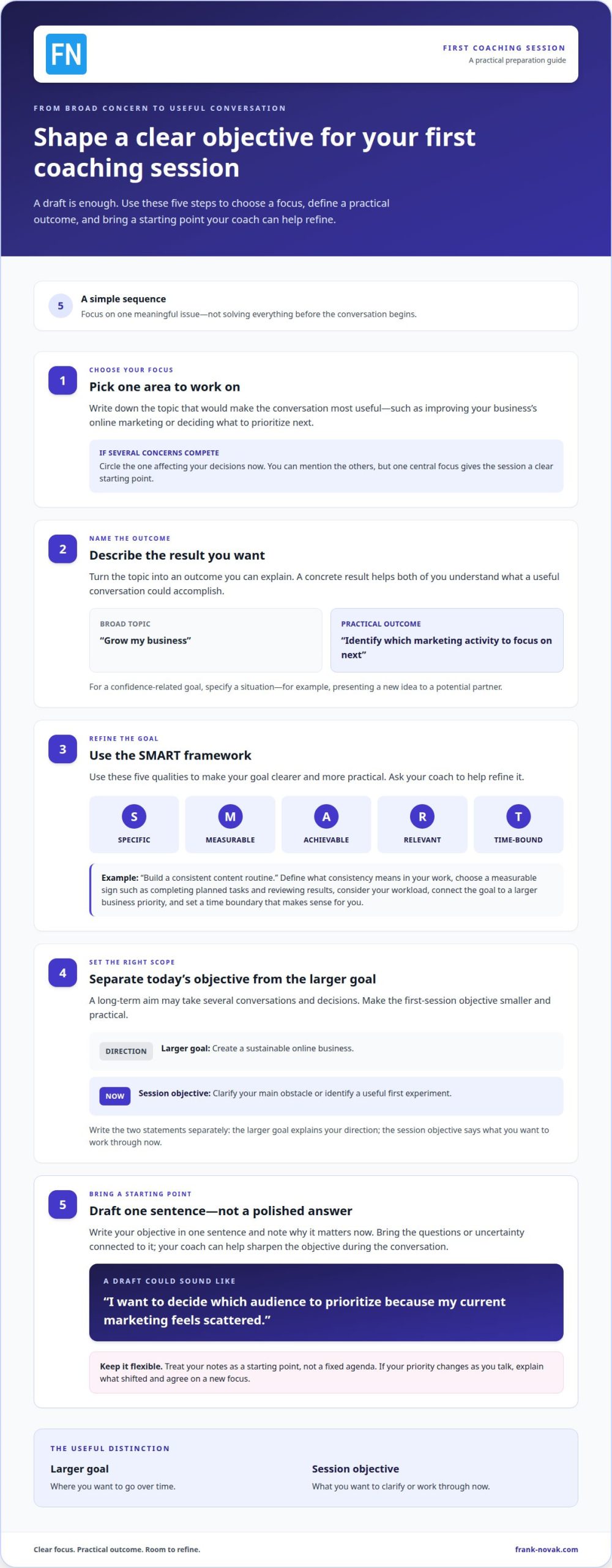
- Choose one area to focus on. Write down the topic that would make the conversation most useful, such as improving your business’s online marketing or deciding what to prioritize next. If several concerns compete for attention, circle the one affecting your decisions now. You can mention the others, but one central focus gives the session a clear starting point. Your objective doesn’t need to solve everything; it should help you make progress on one meaningful issue.
- Describe the result you want. Turn your topic into an outcome you can explain. Instead of writing “grow my business,” try “identify which marketing activity to focus on next.” This names a decision you want to make while leaving room to explore options with your coach. If your goal concerns confidence, specify a situation, such as presenting a new idea to a potential partner. A concrete result helps you both understand what a useful conversation could accomplish.
- Use the SMART framework to refine it. SMART means Specific, Measurable, Achievable, Relevant, and Time-bound. For example, “build a consistent content routine” becomes more specific when you define what consistency means in your work. A measurable sign might be completing planned tasks and reviewing the results. Keep the goal achievable by considering your workload, and relevant to a larger business priority. Set a time boundary that makes sense for you, then ask your coach to help refine it.
- Separate the session objective from the larger goal. A long-term aim, such as creating a sustainable online business, may take several conversations and decisions. Your first-session objective can be smaller: clarify your main obstacle or identify a useful first experiment. Write the two statements separately. The larger goal explains your direction; the session objective says what you want to work through now. This distinction keeps the discussion practical without forcing an ambitious goal into an immediate answer.
- Bring a draft, not a polished answer. Put your objective in one sentence and note why it matters now. For example: “I want to decide which audience to prioritize because my current marketing feels scattered.” Bring any questions or uncertainty connected to it. Your coach can help sharpen the objective during the conversation, so treat your notes as a starting point, not a fixed agenda. If your priority changes as you talk, explain what shifted and agree on a new focus.
Identifying challenges and desired outcomes
Share the goals you’re working toward, the obstacles affecting your progress, and what you hope coaching will help you change. Include recent commitments and relevant context, such as a career decision or business challenge, so your coach understands where you’re starting.
- Describe the challenge in a specific situation. Rather than saying “I’m stuck,” explain what happens and where progress slows. You might be unsure which audience to focus on or find it difficult to turn marketing ideas into consistent action. A real situation gives your coach something concrete to explore. Include what you’ve already tried, such as changing your approach or setting a new routine, and what happened afterward.
- Separate observable facts from your interpretation. Note what happened, then identify the meaning you’ve attached to it. For instance, “I postponed publishing my offer” is an observation; “I’m not capable of building a business” is an interpretation. This distinction helps you discuss the challenge without treating a conclusion as proven. Add the decision or action that became harder as a result.
- Explain what matters about the situation. Connect the challenge to a priority, value, or responsibility. If you’re reconsidering your career direction, describe what you want from your work and what currently feels misaligned. In one-on-one coaching sessions, a participant discussed her needs and career goals, according to the U.S. Government Publishing Office. Sharing both the current concern and your desired direction gives the conversation useful context.
- Bring recent commitments and their outcomes. Write down actions you agreed to take, decisions you made, or experiments you tried. For each, note whether you followed through, what helped, and what got in the way. If you didn’t follow through, describe the practical obstacle instead of labeling yourself unmotivated. This record can help your coach distinguish between an unclear plan, limited capacity, and a barrier that needs closer attention.
- Describe what success would look like. Picture a meaningful change in your work or decisions. You might want to choose a clear business priority, communicate your goals more confidently, or understand what is holding back a project. Add observable signs of progress, such as a decision made, a conversation completed, or a next action chosen, rather than a broad promise to feel better.
- Share relevant preferences and boundaries. Tell your coach what helps you think clearly, which topics feel most urgent, and whether you prefer direct feedback or time to reflect. Mention practical constraints that affect your plans, such as competing work responsibilities. These details help shape the discussion around your circumstances, not an idealized version of your week.
- Choose what to bring into the conversation. Select the notes, examples, or questions that clarify the challenge; you don’t need to prepare a complete history. If your focus is building an online business, online business guidance can help you connect your current obstacles with the direction you want to pursue.
Preparing open-ended questions
- Start questions with “what,” “how,” or “which.” These prompts invite explanation rather than a yes-or-no answer. Instead of asking, “Is my plan realistic?” try, “What would make this plan workable with my current responsibilities?” The revised question gives your coach room to explore assumptions, constraints, and possible adjustments. Write down questions that could lead to a useful conversation, not just confirm what you already think.
- Ask about the motivation behind your goal. A goal can sound clear while its personal importance remains unexplored. Try, “What makes this goal important to me now?” or “What would change if I made progress?” Your answers can reveal whether the objective connects to a priority, a pressure, or someone else’s expectations. That distinction helps you and your coach examine what you genuinely want to work toward.
- Explore what may be getting in your way. Ask, “What do I notice just before I postpone this task?” or “Which part of this decision feels hardest?” These questions focus on specific moments instead of broad judgments about your character. If you tend to delay a difficult conversation, consider what you anticipate and what information could help you prepare. Bring the example, not just the label “procrastination.”
- Include a question about your strengths and resources. Coaching conversations need not focus only on problems. Ask, “When have I handled a similar challenge well?” or “What support or skill could I use here?” A past example might show that breaking a large task into smaller actions helped you follow through. Identifying existing resources gives you more options than treating the obstacle as the whole story.
- Prepare questions that invite your coach’s perspective. You might ask, “What patterns are you hearing in what I’ve shared?” or “What other angle could I consider?” These prompts invite reflection without asking the coach to make your decision for you. If you receive a suggestion, follow up with, “How might that fit my situation?” This keeps the discussion connected to your circumstances and choices.
- Choose a short list and mark your priority. Put your questions in order, then star the one you most want answered. A prepared list is a guide, not a script; a useful response may lead to a better follow-up question. Leave space beside each prompt to note an insight, an assumption to revisit, or a decision that needs more thought.
- Use follow-ups to deepen the conversation. If your coach asks what success means to you, give a concrete example, then ask what might help you move toward it. Questions such as “What makes that difficult?” and “What would be a small first move?” can clarify what to explore next. Let your notes capture new questions as they arise instead of forcing the conversation back to your original list.
Purpose and structure of an initial coaching session
- Match the coach’s focus to your goal. How do you choose between different types of coaches? Start with the outcome you want, then look for a coach whose focus fits that goal. A question about career direction calls for a different focus than building an online business. Choose based on the challenge you want to work through, not just a broad title.
- Plan around the session’s expected length. How long does a first coaching session usually last? Coaching sessions typically last 30 to 90 minutes, according to the U.S. Bureau of Labor Statistics. Your available time shapes how much context you can share and how many topics you can explore. Keep your main objective visible so the conversation can return to it if other concerns arise.
- Use the first meeting to agree on how you’ll work. An initial session can build trust, clarify goals, and set expectations. You and your coach can discuss what you hope to address, how you prefer to communicate, and what each of you will handle between sessions. Treat this as a working conversation, not a test that requires perfect answers. Ask for clarification whenever an approach feels unclear.
- Look for clear communication and a relevant approach. What are signs that a coach is qualified and a good fit? A useful sign is that the coach listens carefully, explains how the conversation will work, and connects questions to your stated goal. Notice whether you can speak openly and whether their approach makes sense for your situation. Ask about relevant experience or training if that information would help you decide.
- Make nerves easier to manage with a small routine. What should you do if you feel nervous before your first coaching session? Write down your main concern and one question, then take a few quiet minutes to review them before joining. If you’re worried about saying the wrong thing, begin by naming that feeling. A direct opening can help your coach understand what would make the conversation more comfortable.
- Close by agreeing on a useful next step. Before the conversation ends, summarize one insight, decision, or question you want to carry forward. Agree on an action that fits your current priorities, then clarify how you’ll reflect on what happens. If you’re exploring a career change, for example, your next step might be identifying what information would help you compare options. This gives the first meeting a practical direction.
What questions should I ask a coach during the first session?
- Ask what the coach hopes you’ll get from the session. A useful opening question is, “What would make this conversation valuable for me?” It helps you both define what a successful first meeting means. Add what you hope to understand, decide, or explore, then compare expectations before discussing the details.
- Clarify how the coach will guide the conversation. Ask, “How do you usually structure a coaching session?” The answer can help you understand whether the coach uses questions, reflection, practical exercises, or a mix. If an approach feels unfamiliar, ask how it connects to the goal you’re discussing.
- Ask what your role will be between sessions. Try, “What kinds of actions or reflection might you suggest between conversations?” This helps you understand how coaching may continue beyond the meeting. If the coach suggests an assignment, ask how it relates to your priority and how you’ll review what you learn from it.
- Discuss how you’ll recognize progress. Ask, “What could we use to notice whether I’m moving forward?” Progress might mean making a decision, completing an action, or understanding a recurring obstacle. Naming a practical indicator gives future conversations something specific to revisit, without assuming every goal can be measured in the same way.
- Find out how feedback will work. Ask, “How do you share observations when you notice a pattern?” Then explain what helps you consider feedback, such as hearing a direct observation followed by a question. This exchange can make it easier to speak honestly and understand how the coach plans to support your thinking.
- Clarify communication and scheduling expectations. Ask how you’ll handle scheduling, communication between sessions, and changes to planned actions. These practical details can prevent confusion later. If your work commitments often shift, explain that constraint and discuss how to keep coaching workable around your responsibilities.
- Close with a question about the next step. Ask, “What should I take away from today, and what would be useful to do next?” Summarize the answer in your own words, then note any action you’ve agreed to take. If you leave with an unresolved question, write it down for your next conversation.
Frank Novak: Online Success Coaching
Frank Novak’s Online Success Coaching is a natural next step if your goals involve building an online business. The coaching addresses practical questions about affiliate marketing, business automation, and growing a digital business. Bring the objective and challenges you’ve identified, then use them to explain what you want to work toward. For a more focused resource, consider Never Succeed Online.
If you’re ready to explore support for your online business goals, visit frank-novak.com.
Take your next step with a clear direction
Your first coaching conversation can start a more deliberate approach to your goals. As you put into practice what you’ve learned about how to prepare for your first coaching session, stay open to refining your priorities as you understand them better. The objective you bring is a starting point, not a commitment to follow one path regardless of what you learn.
If your next step involves developing an online business, consider what kind of support fits your current focus. Frank Novak offers Online Success Coaching and resources such as ClickBank Super Funnel and Clickbank Profit Club. Choose an option that connects with the decisions or challenges you want to work through.
Move at a pace that gives you room to reflect, make thoughtful choices, and build on what you learn. Each clear next step can help you approach your goals with greater confidence.
Frequently Asked Questions
What Should the First Coaching Session Cover?
The first session should help you decide whether the coaching conversation fits the issue you want to address. Explain the situation in your own words, then discuss what kind of support would be useful and what falls outside your coach’s role. If you want help choosing a business direction, for example, clarify whether you’re seeking reflection, practical guidance, or both. This early alignment can shape the work ahead.
What questions should I ask a new coaching client?
If you’re coaching someone new, ask questions that help them describe a recent situation in detail. For example, “What happened the last time this challenge came up?” and “What did you try in response?” can reveal useful context without assuming what the person needs. Invite them to explain what they want to change, then check your understanding before suggesting a direction.
Why bother preparing?
Preparing helps you notice patterns that may be hard to recall during a conversation. Before your session, briefly note a moment that changed your thinking, such as a decision you delayed or feedback that stayed with you. That example can help you explore what influenced your response. Preparation is a prompt for reflection, not a performance or a requirement to have everything figured out.
What should I expect at my first coaching session?
Expect a conversation that helps you and your coach understand the issue you brought in. Your coach may ask about your background, what you want from coaching, and what success would mean in your circumstances. You can also notice whether the coach’s way of listening and responding helps you think clearly. Share your uncertainty if you’re still deciding what matters most.
What should I prepare before a coaching session?
Prepare the context your coach needs to understand your situation, not a complete record of your life or work. If a decision is central, note the options you’re weighing and what makes each difficult. Bring relevant notes or a document only if they help explain the issue. Leave room for new information to emerge, rather than locking yourself into a fixed script.
How do I set goals for a coaching session?
Choose a goal that describes what you want to leave the conversation understanding, deciding, or ready to explore. Instead of aiming to “fix my business,” for example, you could seek clarity about which concern deserves attention first. Keep the wording flexible enough to change if the discussion reveals a more useful focus. A session goal guides the conversation; it doesn’t need to settle your larger plans.

Article by
Frank Novak
Frank Novak is an online marketing professional and coach who focuses on affiliate marketing and business automation. Through his website, frank-novak.com, he shares insights and strategies for leveraging social media platforms like Facebook to generate traffic and commissions.
Affiliate / Sponsored Content Disclaimer
This [website/post] contains affiliate links. If you click through and make a purchase, we may receive a commission at no additional cost to you. We only recommend products or services we believe will add value to our readers.