

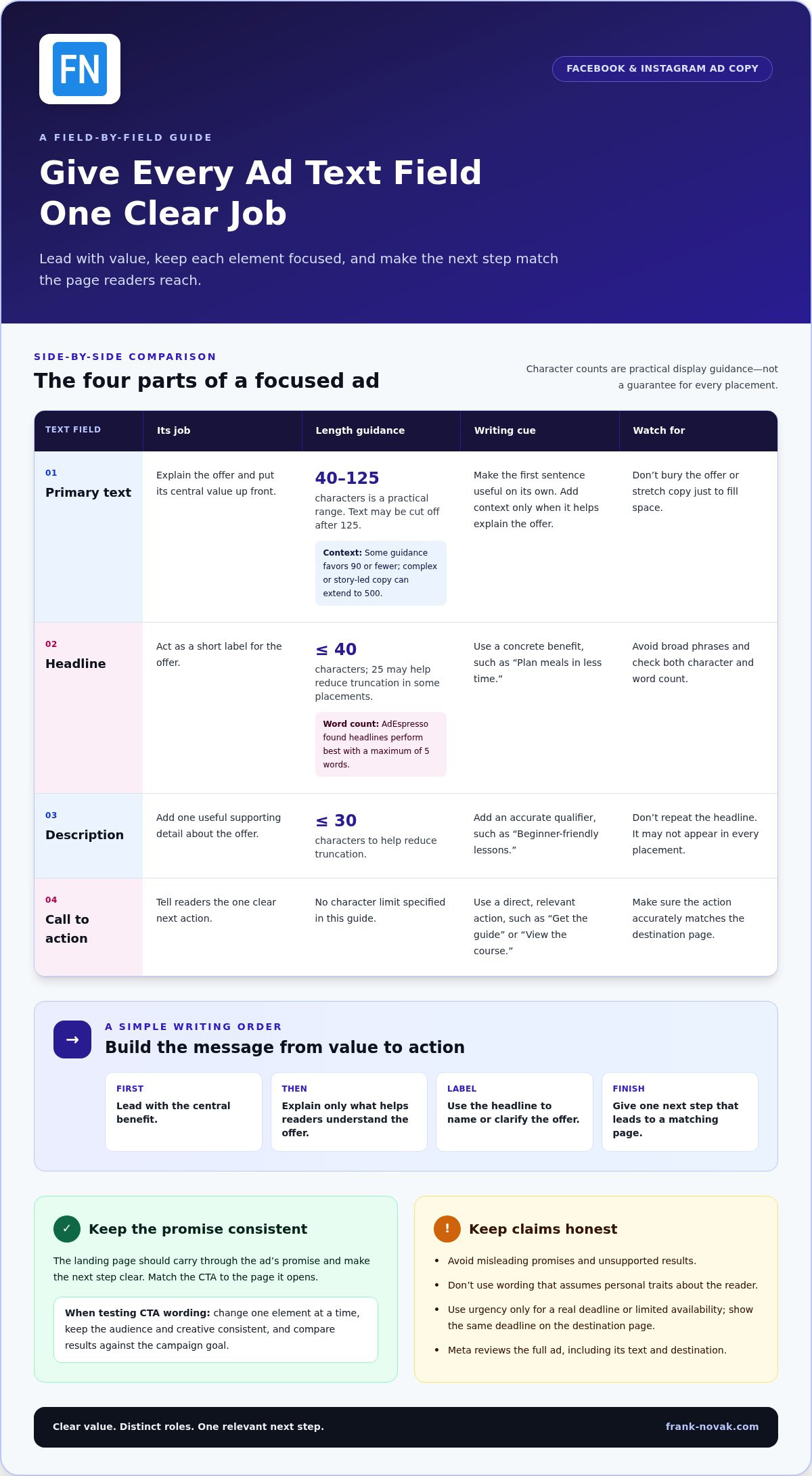
Keep Facebook ad copy focused: the main text can be cut off after 125 characters, so lead with the offer or benefit. Keep headlines to 40 characters or fewer and descriptions to 30 characters to help them fit. The core of how to write compelling ad copy for Facebook is to make the value clear, give readers one direct next step, and match the message to the page they’ll reach.
A strong draft doesn’t have to start from a blank page. AI can help you explore ideas, but your copy still needs to reflect your audience’s language and the details that make the offer relevant and genuine.
This guide explains how to choose a suitable copy length, write a clear call to action, and use AI to generate and refine ideas without losing your voice. You’ll also learn how to align an ad with its landing page, so the promise that earns a click carries through to the next step.
Key Takeaways
- Give each part of the ad a clear job, from the opening message to the headline and call to action.
- Make the next step specific, relevant to the offer, and easy for the reader to understand.
- Use AI to generate options, then refine them with audience details and your campaign goal.
- Carry the ad’s promise through to a landing page that makes the next step clear.
- Try a simple copywriting formula to organize your message and create stronger ad variations.
How long should Facebook and Instagram ad copy be?
Start with a focused primary text, then check how it appears with the headline, description, creative, and call to action. Facebook text can be cut off after 125 characters, so put the value proposition first. A concise draft is easier to scan, but longer copy can work when readers need more context.
For a practical starting point, aim for 40 to 125 characters of primary text. Headlines should be 40 characters or fewer, while descriptions are best kept to 30 characters to reduce truncation. These are writing guidelines, not a guarantee that every placement displays text identically.
Watch this video to see an expert approach to writing Facebook ads:
- Write the primary text first. Give the audience the central benefit in the opening line, before extra explanation. Facebook text can be cut off after 125 characters, so make the first sentence useful on its own. Some guidance favors 90 characters or fewer, while 40 to 125 characters is a practical range for many ads. For a complex offer or a story-led approach, primary text can extend to 500 characters. Keep the added detail relevant rather than stretching the copy just to fill space.
- Build a four-part ad. Treat the primary text as the explanation, the headline as a short label for the offer, the description as supporting detail, and the CTA as the next action. For example, primary text can explain what a budgeting course helps with, the headline can name the course, and the description can clarify its focus. Then choose a CTA that matches the destination, such as learning more or signing up.
- Keep the headline compact. A Facebook headline should stay within 40 characters; 25 characters can help reduce truncation in some placements. AdEspresso found headlines perform best with a maximum of 5 words. Use a concrete benefit, such as “Plan meals in less time,” rather than a broad phrase like “A better lifestyle.” Check the character count and word count before publishing.
- Use the description for one supporting detail. Keep it to 30 characters to help avoid truncation, and don’t repeat the headline. Add a useful qualifier, such as “Beginner-friendly lessons,” if it accurately describes the offer. The description may not appear in every placement, so the headline and primary text should still make sense without it.
- Follow Meta’s rules and avoid risky wording. Character limits offer display guidance, not a complete list of ad restrictions. Meta reviews the full ad, including its text and destination, under its advertising policies. Avoid misleading promises, unsupported results, and wording that assumes personal traits about the reader. Describe the offer and its benefits rather than labeling the audience.
- Adjust the message to the audience and funnel stage. A new audience may need a clear explanation of the offer, while someone comparing options may respond to a specific benefit or next step. Keep the value proposition consistent, but vary how much context you provide. Common mistakes include burying the offer, repeating the headline, and using a vague CTA. Lead with value, give each text field a distinct role, and match the CTA to the landing page.
Calls to action and conversion-focused copy
A strong Facebook CTA connects the ad’s value proposition to one clear action. Decide what readers should do next, then make that action easy to understand.
-
Write Readable Conversion-Focused Calls to Action
Choose one action and state it plainly, such as “Get the meal-planning guide” or “See course details.” Check that the CTA fits both the offer and the page it opens. Keep the surrounding copy focused on one benefit rather than several competing promises. Use line breaks to separate the benefit, supporting detail, and action, making the ad easier to scan.
-
Add Urgency to Calls to Action
Use urgency only when the offer has a real deadline or limited availability. If enrollment closes on a stated date, say “Enroll before registration closes” and make sure the destination page shows the same deadline. Avoid claims such as “Last chance” when there is no actual cutoff. Honest urgency helps readers make an informed choice; invented pressure can undermine trust.
- Match the CTA to reader interest. Consider what the audience needs before asking them to act. Someone encountering a brand for the first time may need an introductory guide, while a reader comparing a specific offer may be ready to review its details. For example, “Explore the guide” suits an educational resource, while “View the course” points to a defined offer. Choose an action that accurately describes the next step.
- Make every line support the action. Open with a clear reason to keep reading, then use the next line to explain the benefit. For example, an ad for a recipe guide could begin, “Plan weekday dinners with less guesswork,” followed by an explanation of what the guide contains. Place the CTA after that. Remove side topics, repeated benefits, and decorative phrases that distract from the action.
- Test different CTA wording. Create variations that change one element at a time, such as “Get the guide” versus “Explore the guide,” while keeping the audience and creative consistent. Compare the results against the campaign goal, rather than choosing the phrase that simply sounds more exciting. Then use what you learn to refine the next version. A useful starting point for improving online marketing decisions is practical online marketing guidance.
Generating and refining ad copy with AI
Use AI to generate starting points, not finished ads. Give it your campaign goal, audience, offer, and platform context, then refine each draft using accurate details and your own judgment.
- Set one campaign goal. Tell the AI whether the ad should build brand awareness, drive website traffic, or encourage sales. A prompt such as “Write Facebook ad copy to drive traffic to a beginner’s guide” gives the tool clearer direction than “Write a great ad.” Keep the goal consistent with the action you want viewers to take.
- Describe the audience and offer. Include the audience’s needs, familiarity with the topic, and the offer’s specific value. For example, explain that the guide helps new gardeners plan a small herb garden rather than simply asking for copy about gardening. This context helps the AI generate language that reflects readers’ interests instead of relying on generic claims.
- Ask for structured options. Request several versions with distinct approaches, such as a direct benefit, a common problem, or a practical tip. Ask the AI to label each approach and separate the primary text, headline, and CTA. For a meal-planning app, one draft might focus on reducing planning effort, while another highlights a simple weekly menu.
- Refine with real details. Check every generated feature, result, and description against the actual offer. Replace broad wording like “transform your routine” with a specific, accurate detail, such as “organize recipes into a weekly plan,” if that describes the product. Add phrases your audience uses and remove claims the offer cannot support. Specific details make the copy feel more genuine.
- Match copy to creative and placement. Read each draft alongside the image or video and check that the message complements what viewers see. If the creative shows a product demonstration, the text can explain the demonstrated benefit instead of describing the image again. Keep the central message clear across Facebook and Instagram, adjusting the wording when the format or audience context changes.
- Compare drafts through focused tests. Change one meaningful element at a time, such as the opening benefit or CTA, while keeping other campaign elements steady. This makes it easier to see which message resonates with the target audience. Review performance data against the campaign goal, then use what you learn to refine the next draft instead of accepting the AI’s first output.
Matching ad copy to a targeted landing page
Make the landing page continue the message the ad begins. If an ad promises a beginner’s guide, make that guide easy to find on the page, explain what it covers, and show the next step clearly.
- Carry the ad’s main promise onto the page. Identify the ad’s central benefit, then use matching language in the landing page headline. If the ad says, “Plan weekday dinners with less guesswork,” the page headline should focus on planning meals, not introduce an unrelated offer. Matching the message helps readers recognize they’ve reached the right place after clicking.
- Keep the offer consistent across every point. Compare the ad, headline, page copy, and button label. Each should describe the same product, service, or resource without changing its name or promised benefit. For example, if an ad promotes a free recipe guide, the landing page shouldn’t lead with a paid meal-planning program. Consistency makes the next step easier to understand.
- Place the promised information where readers expect it. Put the guide, product, or sign-up details near the top of the landing page. If the ad highlights beginner-friendly lessons, explain who they’re for before adding secondary information. Readers shouldn’t have to search through unrelated copy or navigation to confirm the offer they clicked to explore.
- Make the next step specific. Choose a button label that explains what happens after the click. “Download the guide” is clearer than “Submit” when a reader is requesting a digital guide. If the action opens a registration form, use wording such as “Register for the workshop.” The button and nearby text should make the action and its immediate outcome clear.
- Use a page layout that supports the ad’s promise. Build a simple template around the reader’s decision: headline, brief explanation, relevant details, and action button. For an online course, the page might explain the lessons, who they suit, and how to enroll. Remove sections that compete with the offer, such as unrelated promotions or links that lead readers away before they act.
- Review the journey as a reader would. Open the ad’s destination and follow the page from its first headline to the final button. Check that it presents the expected offer, repeats key points accurately, and gives readers a clear action. If the ad says “Explore the guide,” but the page opens on a general homepage, create a more targeted destination that continues the same conversation.
What are the best Facebook ad copywriting formulas and examples?
Use a formula to organize the message, not to make every ad sound alike. Start with the offer’s value, then choose a structure suited to the audience and campaign goal.
- Lead with value, then state the offer. Put the strongest relevant benefit in the first line, followed by what the reader can get. For example: “Plan workouts that fit a busy schedule. Explore a training plan with 10-minute workouts.” The example makes the benefit and offer clear before extra details compete for attention.
- Try the problem, solution, action formula. Name a real challenge, show how the offer helps, then invite a useful next step. A meal-planning guide might say, “Not sure what to cook after work? Get a simple plan for organizing weeknight meals. Explore the guide.” Keep the problem relatable without suggesting every reader experiences it.
- Use question, answer, next step for a curious audience. Open with a question tied to the offer, answer it directly, and guide readers forward. For a gardening resource: “Want to grow herbs in a small space? Learn how to plan a compact herb garden. See the beginner’s guide.” Give useful context rather than leaving the question unanswered.
- Build a feature-to-benefit example. Name a real feature, explain why it matters, and connect it to the reader’s goal. If a recipe app organizes saved recipes into meal plans, the copy could read: “Keep favorite recipes together and use them to plan the week. Explore the meal-planning tools.” Use only features and benefits that accurately describe the offer.
- Use a short story when context helps. A simple before-and-after structure can show how an offer fits a real situation. For example: “The shopping list kept changing. Now, a weekly meal plan helps organize dinner ideas before the grocery trip.” Keep the story specific to the offer, and never present an invented customer result as a testimonial.
- Adapt the formula to the audience’s familiarity. Readers new to an offer may need a plain explanation before being asked to act. People comparing options may value a specific differentiator. For a beginner’s guide, explain its purpose first. For a focused workshop, lead with the skill it teaches and invite readers to view the details.
- Test one copy element at a time. Compare two openings or offers while keeping the audience and creative consistent. For instance, test a benefit-led first line against a question-led one. Review the results against the campaign objective, keep the clearer approach, and develop the next variation based on what you learn.
Frank Novak: Online Success Coaching
Online Success Coaching with Frank Novak can help if you want support applying advertising ideas to your online business. Use this guide to draft and assess your ads; coaching can help you connect those decisions with your broader affiliate marketing and business automation goals. If you’re building around ClickBank, the ClickBank Super Funnel and Clickbank Profit Club are also relevant offerings to explore. Choose what fits the work you’re doing now rather than treating every resource as necessary.
For more information, visit Frank Novak’s website.
Turn Your Next Ad Into a Clear Next Step
Good advertising improves through deliberate practice. As you apply how to write compelling ad copy for Facebook, treat each draft as a focused decision: what should the reader understand, and what action should follow? Note the audience, message, and landing page so you can learn from each campaign and make thoughtful changes.
If you want support developing your online business approach, Online Success Coaching can help you work through your next steps. Frank Novak also offers ClickBank Super Funnel and Never Succeed Online for readers exploring online business and affiliate marketing resources. Consider which direction fits your current goals, then take the next step at your own pace.
Keep learning and refining your ideas. Each new draft can bring you closer to a message that feels clear and true to your offer.
Frequently Asked Questions
How can I write ad copy that works across different campaign objectives?
Keep the offer consistent, but adjust the copy’s emphasis to fit the campaign objective. For awareness, introduce the problem your offer addresses and explain why it matters. For traffic, give readers a reason to visit a specific page. For sales, focus on a relevant benefit and the decision readers can make. For example, a cooking app can introduce meal planning, invite readers to visit a guide, or promote a subscription.
How do I maintain brand consistency across multiple ad variations?
Set a voice guide before drafting variations. Record the audience, preferred terms, tone, approved product descriptions, and claims to avoid. Then vary one message element, such as the opening angle, while keeping the brand’s core promise intact. For example, an educational brand can test a question-led opening against a direct tip without resorting to exaggerated language or unfamiliar jargon.
What makes Facebook ad copy compelling and effective?
Learning how to write compelling ad copy for Facebook starts with making the offer relevant, understandable, and credible. Give readers a specific reason to care, then support it with a truthful detail that helps them assess the offer. For example, a language-learning course could explain that it includes lessons for practicing travel phrases. Avoid broad promises like “change your life” unless the ad explains what the offer provides.
How do you write a strong Facebook ad headline and primary text?
Make the headline communicate one useful idea, then use the primary text to add context that helps readers decide. For a home-organizing service, the headline might say “Make room for what matters,” while the text explains the service’s focus and who it suits. Read both aloud. If they make different promises, revise them to present one connected message.
How do you write effective Facebook ad calls to action?
Choose a CTA that tells readers what happens next, and make sure the destination delivers on that expectation. “View the class schedule” fits a page showing course dates; “Get the checklist” suits a downloadable resource. Avoid pairing a specific promise with a vague button such as “Click here.” Before publishing, follow the action yourself and confirm the page’s first screen supports the CTA.
How long should Facebook ad headlines and primary text be?
Keep headlines at 40 characters or fewer, and plan for primary text to appear within 125 characters before a “read more” link. A useful starting range for primary text is 40 to 125 characters; complex offers can use up to 500 when readers need more explanation. Descriptions are best kept to 30 characters. Preview the ad in its intended placement before publishing.
How do you A/B test Facebook ad copy and measure results?
Test one copy change at a time, such as the opening sentence, while keeping the audience, creative, and destination steady. Choose the success measure before launch: link clicks for traffic, for example, or completed purchases for a sales campaign. Compare each variation against that objective, not just reactions. Record the wording and outcome, then use the clearest learning to shape your next test.

Article by
Frank Novak
Frank Novak is an online marketing professional and coach who focuses on affiliate marketing and business automation. Through his website, frank-novak.com, he shares insights and strategies for leveraging social media platforms like Facebook to generate traffic and commissions.
Affiliate / Sponsored Content Disclaimer
This [website/post] contains affiliate links. If you click through and make a purchase, we may receive a commission at no additional cost to you. We only recommend products or services we believe will add value to our readers.