

Facebook ads can be useful for affiliate marketing, but precise targeting alone won’t make a campaign profitable. Advanced Facebook ad targeting for affiliates works best when you match an audience to the offer, track meaningful actions, and adjust ads based on performance. If the audience is too narrow or tracking misses conversions, even a polished campaign can struggle.
Before investing in paid traffic, weigh the costs and learning curve. Facebook lets you reach people based on interests, behaviors, and demographics, then reconnect with people who’ve engaged with your content or website. Use those options to serve a clear campaign goal rather than simply adding more filters.
This guide walks through the process step by step: define a likely customer, build and refine audiences, set up custom conversions for affiliate actions, and rotate creative to reduce ad fatigue. You’ll also learn what Facebook ads can offer affiliate marketers, where detailed targeting can limit reach, and which campaign considerations to keep in mind before scaling.
Key Takeaways
- Build audience combinations around the offer, using relevant interests, behaviors, and demographics without narrowing reach too far.
- Refresh and test ad creative so you can spot fatigue and learn which messages connect with your audience.
- Set up custom conversions around trackable affiliate actions to make campaign results more useful for optimization.
- Use retargeting and budget controls thoughtfully, while weighing tracking limits and the possibility of wasted spend.
- Decide whether Facebook ads fit your affiliate strategy by balancing their reach and optimization tools against the work of testing and tracking.
What is detailed targeting in Facebook ads?
Detailed targeting lets you select an audience based on interests, behaviors, and demographics. A practical approach to advanced Facebook ad targeting for affiliates starts with the offer, then tests audience signals that fit its likely customer.
-
Identify Audience Interests
Choose interests that relate directly to the offer. For a course about finding freelance work, for example, test freelancing interests. For a Facebook advertising course, Facebook Page admins may be relevant. Match each interest to a clear customer need, and avoid loosely related topics that add detail without improving relevance.
For an introductory offer, test a broad, relevant interest. For a follow-up offer, use engagement signals where available. The best approach depends on the niche and funnel stage: align interests with the offer, then use engagement or site activity to reach people who have already shown interest.
-
Select Behavioral and Demographic Traits
Add a behavior or demographic only when it supports the buying context. An affiliate promoting home goods, for example, could test people showing recent home-related purchase behavior. A course for new freelancers could focus on work-related interests. Demographics can help define an audience, but they don’t show that someone is ready to buy.
For US campaigns, use the audience controls available for the selected category. Options may vary with category restrictions, so review the controls shown in Ads Manager before building your audience.
-
Layer Audience Criteria
Combine criteria to describe one plausible customer, not several unrelated groups. A freelancing course campaign could pair freelancing interests with a relevant work-related behavior, then compare that audience with an interest-only version. Detailed targeting can quickly narrow reach, so review the estimated audience size and remove filters that don’t improve the match.
Other options include Custom Audiences and Lookalike Audiences. A Custom Audience can use eligible customer or engagement data; a Lookalike Audience helps find people resembling a source audience. For a US Lookalike Audience, a 1% audience is estimated to reach approximately 2.4 million people.
-
Apply Psychographic Targeting
Treat interests as clues about values and lifestyle, not proof of someone’s beliefs. For a remote-work course, test interests related to freelancing and flexible work, then tailor the ad to those goals. Advanced Facebook ad targeting for affiliates works best when signals guide relevant messaging, rather than assumptions that everyone with an interest shares the same motivation.
Protect audience trust by using data collected with appropriate permission, explaining its use where required, and avoiding sensitive personal assumptions. Poor data practices can undermine trust or conflict with applicable rules. Limit campaign data to what’s relevant and consider how it was obtained.
Creative rotation and ad fatigue
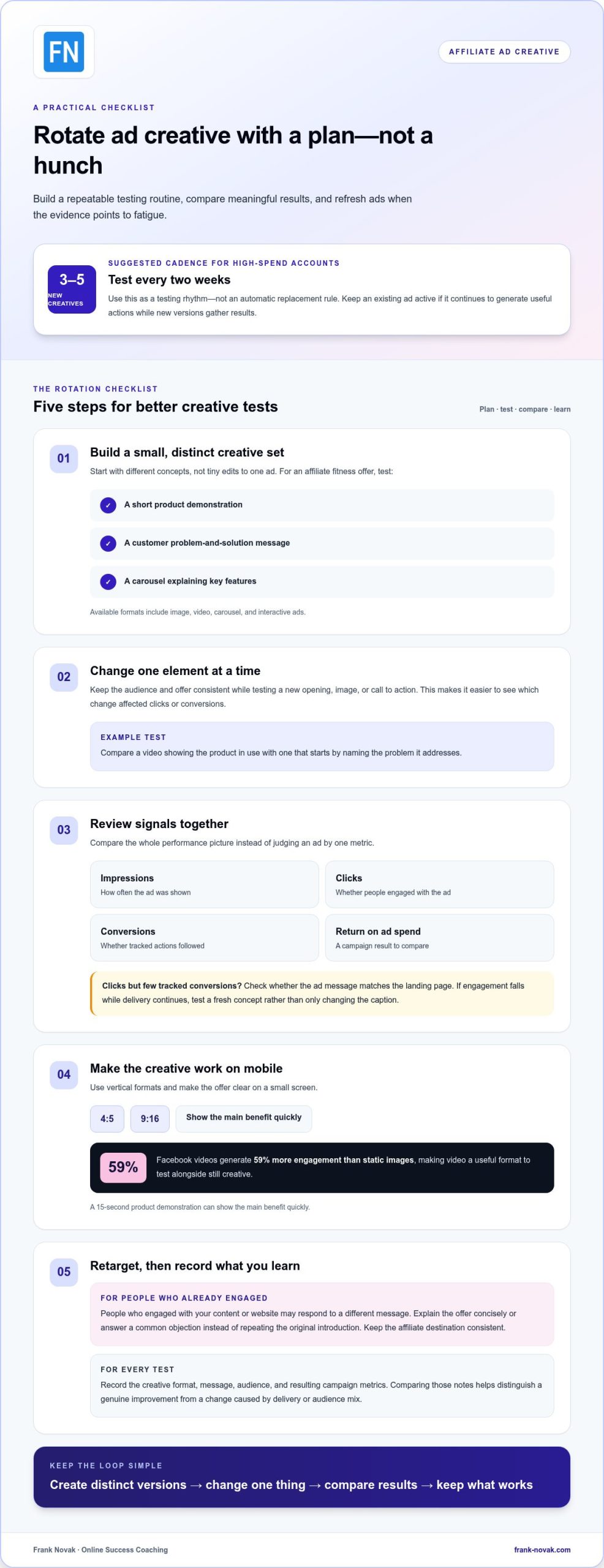
Plan creative rotation as a repeatable testing process, not a reaction to one weak day. For high-spend accounts, test 3-5 new creatives every two weeks, then compare results before replacing ads that still engage.
- Build a small creative set. Start with distinct concepts, not minor edits to one ad. For an affiliate fitness offer, test a short product demonstration, a customer problem-and-solution message, and a carousel explaining key features. Facebook supports image, video, carousel, and interactive formats, offering different ways to present the same offer.
- Change one element at a time. Keep the audience and offer consistent while testing a new opening, image, or call to action. For example, compare a video showing the product in use with one that starts by naming the problem it addresses. This makes it easier to see which change affected clicks or conversions.
- Set a rotation rhythm. For high-spend accounts, introduce 3-5 new creatives every two weeks. Treat that as a testing cadence, not an automatic replacement rule. If an existing ad continues to generate useful actions, keep it active while the new versions gather results.
- Review performance signals together. Compare impressions, clicks, conversions, and return on ad spend instead of judging an ad by a single metric. If an affiliate ad gets clicks but few tracked conversions, check whether its message matches the landing page. If engagement falls while delivery continues, test a fresh concept rather than merely changing the caption.
- Design for mobile viewing. Use vertical formats such as 4:5 or 9:16, and make the offer clear on a small screen. A 15-second product demonstration can show the main benefit quickly. Facebook videos generate 59% more engagement than static images, so video is a useful format to test alongside still creative.
- Retarget with a new message. People who have engaged with your content or website may respond to different creative than a first-time audience. Offer a concise explanation or answer a common objection instead of repeating the original introduction. Keep the affiliate destination consistent so the new message leads naturally to the offer.
- Record each test. Note the creative format, message, audience, and resulting campaign metrics. A simple comparison helps distinguish a genuine improvement from a change caused by delivery or audience mix. If planning and reviewing tests feels difficult, explore affiliate marketing guidance as you build a steadier advertising routine.
Custom conversions based on tracked actions
Custom conversions connect campaign reporting to actions that matter in an affiliate funnel. First, map the actions that happen on pages you control and distinguish them from purchases completed on a merchant’s website.
- Choose an action that represents progress. List the steps between an ad click and the affiliate outcome. For a course promotion, these might include visiting your landing page, clicking the merchant offer, submitting a lead form, or reaching a purchase confirmation page. Decide which action best reflects meaningful progress before setting up reporting.
A landing-page view shows interest, while an outbound affiliate click shows intent to continue. A confirmed purchase is a stronger conversion signal, but it can be measured only if the merchant or tracking setup sends that event to your reporting system.
- Map each event to a page or system. Identify where the action occurs and which tracking you control. If a visitor signs up on your page, you can record an event there. If the customer completes checkout on a merchant’s domain, your site usually can’t observe that confirmation without an approved integration or reporting process.
Keep the distinction clear in campaign names and reports. Label an outbound click as a click, not a sale. This prevents Meta Ads Manager from treating an early funnel action as a completed affiliate conversion.
- Configure the event before the custom conversion. Use the Meta Pixel or Conversions API to send relevant events from pages or systems you control. In Events Manager, confirm that the event arrives and means what you intend. Then create a custom conversion based on that event, using a page rule or event condition to identify the action.
For example, a unique thank-you page after a lead form can distinguish completed sign-ups from ordinary visits. A page shared across several offers may blur results, so make the event or rule specific enough to identify the intended action.
- Check attribution and reporting. Meta’s default attribution window is 7-day click and 1-day view. Compare reported conversions with affiliate network records, while remembering that attribution windows and tracking systems may count actions differently. Review impressions, clicks, conversions, and return on ad spend together.
Apple’s iOS 14.5 reduced advertisers’ visibility into users’ off-app activity. The Conversion API can supplement browser-based signals; advertisers implementing it can see an average 10% improvement in reported conversions.
- Optimize for the closest reliable action. If purchase events aren’t available, optimize for a tracked action that signals genuine intent, such as a qualified lead submission. Don’t treat every page view as a sale. If affiliate purchase data later becomes available through an approved connection, compare that deeper action with earlier funnel signals.
- Audit event quality before changing campaigns. Test the full path from ad click to confirmation, then check whether one action triggers duplicate events. Duplicates can inflate reported conversions and distort optimization. Keep a simple event map showing each action, where it occurs, and whether it represents a click, lead, or completed purchase.
Facebook affiliate ad benefits and campaign considerations
Facebook campaigns can bring targeted traffic and help you compare audience, creative, and placement performance. Before investing, weigh that flexibility against tracking limits, policy fit, and the effort needed to test.
Make sure each ad’s destination matches its message, and clearly disclose the affiliate relationship in the ad or landing-page experience. Claims in the creative should match what visitors find after clicking.
Review Meta’s advertising standards against the specific offer and its claims before launch. Restricted products or claims can affect eligibility, and an allowed audience setting doesn’t make every promotion acceptable.
CPM, CPC, and CPA vary with auction competition, audience, objective, creative, and placement. Estimate campaign costs using your own test results and the commission available for each conversion, not a benchmark detached from your offer.
Create Custom Audiences from eligible site visitors or content engagers, then consider a Lookalike Audience to reach similar people. A recommended starting point is a Custom Audience of at least 1,000 people before creating a Lookalike Audience.
For A/B tests, compare one variable at a time: audience, creative, or placement. Keep the offer and optimization goal consistent, then compare clicks and conversions to identify the effect of the change.
-
Review Affiliate Campaign Considerations
Make sure each campaign has one clear offer, a matching landing page, and an action you can track. Facebook targeting and retargeting can help you reach people at different stages, but detailed filters can also limit delivery. Keep the audience broad enough to serve, and ensure the ad’s claims accurately reflect the offer visitors see.
-
Estimate Campaign Costs
Estimate CPM, CPC, and CPA from your own campaign data rather than assuming a universal rate. CPM reflects impressions, CPC reflects clicks, and CPA reflects the cost of a tracked action. Compare these costs with the commission from a confirmed affiliate conversion, not just a landing-page visit. Use a daily or lifetime budget to control spend while testing.
-
Build Audience Segments
Create a Custom Audience from people who visited your site or engaged with your content, then use it for relevant retargeting. If the source audience has at least 1,000 people, test a Lookalike Audience to find people with similar characteristics. Exclude past purchasers when promoting a one-time offer, so campaign traffic focuses on potential new customers.
-
Test Campaign Variables
Choose one variable for each comparison, such as two audiences, two creatives, or different placements. Keep the offer and campaign goal steady so the result is easier to interpret. Record impressions, clicks, conversions, and return on ad spend, then apply the better-performing choice to the next test. If audience segments overlap by 20% to 30%, consider consolidating ad sets.
Benefits of Facebook Ads for affiliate marketing
Facebook gives affiliate marketers broad reach, audience controls, and campaign feedback in one platform. Advanced Facebook ad targeting for affiliates is valuable when you connect those tools to an offer people want and measure whether the resulting traffic takes a meaningful action.
- Use reach with a clear niche. Facebook has nearly 3 billion monthly active users, and its advertising reach is estimated at 2.19 billion users. These figures describe different measures, but they show the platform’s potential scale. Start with a defined niche, such as beginners exploring freelance work, so your message speaks to a relevant group instead of everyone.
- Use campaign signals to guide decisions. Facebook’s advertising algorithm can learn from campaign interactions and adjust delivery toward people more likely to engage or convert. Give the campaign one clear objective, such as a qualified lead. Then assess whether the traffic matches the offer instead of treating every impression or click as progress.
- Use broad benchmarks as context. Facebook ads had an average conversion rate of 8.95% across industries, as stated for 2026. That figure isn’t a forecast for your affiliate campaign. The offer, audience, landing page, and conversion definition all affect results, so compare your own performance against your campaign’s goal.
- Make the next action obvious. Facebook ads with a clear call to action can drive 2.85 times higher click-through rates than ads without one. A course promotion might invite people to “See how the course works.” Match the wording to the destination so visitors find the information the ad promised.
- Match paid traffic to the offer. Compare the commission from a completed affiliate action with campaign performance, not clicks alone. A focused course landing page may support a direct response. An offer that needs more explanation may benefit from useful introductory content before visitors reach the affiliate link.
- Keep the first test focused. Choose one offer, one audience idea, and one trackable action. Facebook campaign analytics include impressions, clicks, conversions, and return on ad spend. Review them together to decide whether to adjust the message, audience, or landing page.
- Define success before scaling. Advanced Facebook ad targeting for affiliates is useful when audience choices connect to measurable business goals. If you can’t tell whether a campaign generates qualified leads or affiliate actions, more traffic won’t clarify its value. Improve measurement and offer fit before adding complexity.
Frank Novak: Online Success Coaching
Frank Novak’s Online Success Coaching is a natural next step if you understand targeting but want help building a consistent affiliate marketing approach. Use what you’ve learned to clarify your offer, choose a campaign goal, and plan how to review results. Coaching can help aspiring entrepreneurs work through broader decisions involved in developing an online business, beyond selecting audiences or refreshing ads.
If you’re still shaping your business model, ClickBank Super Funnel, Never Succeed Online, and Clickbank Profit Club are also available resources. Choose the next step that fits the work you’re ready to do, whether refining your campaign plan or developing your broader online business.
Visit frank-novak.com to explore the available support.
Turn Your Next Campaign Into a Learning Step
Your next move doesn’t need to be a bigger campaign. Choose one offer, decide which action matters, and use the results to guide your next test. This steady process can make advanced Facebook ad targeting for affiliates part of a wider marketing plan, rather than a collection of disconnected tactics.
If you’d like guidance connecting campaign decisions with your wider online business, Frank Novak offers Online Success Coaching. ClickBank Super Funnel and Never Succeed Online are also available resources for your affiliate marketing journey. Choose the support that fits your next step, and focus on building a process you can learn from.
Each thoughtful test gives you a clearer basis for your next decision. Keep learning, stay consistent, and build your campaign with confidence.
Frequently Asked Questions
Should You Consider Facebook Ads for Your Affiliate Marketing in 2026 & Beyond?
Yes, if you can connect ad spend to relevant affiliate actions and assess whether commissions support your campaign. Start with an offer that has a clear audience and a landing page that explains its value. Before expanding, check whether your tracking captures the actions you can observe. If those basics aren’t in place, improve the funnel first so paid traffic gives you useful information.
How do I avoid ad fatigue when scaling?
Scale with fresh creative concepts, not simply by showing the same ad more often. Record each message, format, and audience, then develop new angles from questions people ask or product features they respond to. If a fitness offer uses a demonstration, for example, the next variation could explain a common use case. Change one major element at a time to learn what helps maintain audience interest.
How do I handle audience overlap?
Give each ad set a distinct audience purpose, such as reaching new prospects or people who have visited your offer page. Where possible, exclude existing customers from acquisition campaigns and separate warm audiences from prospecting groups. Review delivery and results by ad set. If two sets reach essentially the same people with the same message, combine or differentiate them rather than competing against yourself.
How many interests should I include in an interest stack?
There’s no universal number of interests that suits every offer. Build a coherent group around one buyer need instead of collecting loosely related interests. For a course about freelance work, combine signals related to freelancing or job goals, then compare that group with a separate, broader audience. The useful test is whether the interests describe a potential customer while leaving enough room for delivery.
What is the difference between Advantage+ and manual targeting?
Advantage+ gives Meta’s delivery system more room to use optimization signals, while manual targeting puts more emphasis on the audience selections you specify. A manual setup can start with interests related to a niche; an Advantage+ approach can use audience suggestions while its system seeks likely responders. Choose based on how much control your test needs, and judge the setup by tracked outcomes rather than its label.
Where can I learn advanced targeting techniques?
Frank Novak’s Online Success Coaching is an option for people who want guidance developing an affiliate marketing business. You can also build skills by recording each campaign decision, reviewing Ads Manager results, and testing one change at a time. For example, compare two audience approaches while keeping the offer and landing page steady. This practice helps turn campaign data into repeatable decisions rather than isolated tips.
How do Meta Advantage+ audience and detailed targeting controls work?
Detailed targeting lets you select audience signals such as interests, behaviors, and demographics. Advantage+ uses Meta’s automated delivery, where audience suggestions can guide the system without necessarily restricting everyone it reaches. Treat the settings as different ways to guide delivery: use specific controls when a test requires a defined audience, and broader automation when the campaign can learn from conversion signals.
How can affiliates track conversions with Meta Pixel and Conversions API?
Use the Meta Pixel to send relevant browser events from pages you control, and the Conversions API to send event data from a server-side system. Agree on event names and meanings before implementation, such as distinguishing a landing-page visit from an affiliate-link click. Test the path with a sample action, check that events appear as intended, and compare Meta reporting with records from the affiliate program.

Article by
Frank Novak
Frank Novak is an online marketing professional and coach who focuses on affiliate marketing and business automation. Through his website, frank-novak.com, he shares insights and strategies for leveraging social media platforms like Facebook to generate traffic and commissions.
Affiliate / Sponsored Content Disclaimer
This [website/post] contains affiliate links. If you click through and make a purchase, we may receive a commission at no additional cost to you. We only recommend products or services we believe will add value to our readers.