

What if the best next affiliate offer isn’t the one with the biggest commission, but the one that answers your audience’s next question? If you’re creating a value ladder for your affiliate offers, choosing the first offer and deciding what should follow can feel tricky. You want to be helpful without making every recommendation feel like another sales pitch. I earn a commission if you apply through my link, but this doesn’t cost you anything extra.
A useful affiliate offer ladder is built around your audience’s needs and readiness to make a decision. It differs from a seller’s product ladder: you’re arranging offers from different providers, not guiding buyers through products you own. Each recommendation should make sense on its own and offer a relevant next step, rather than simply increasing the potential commission.
In this guide, you’ll learn how to choose an appropriate entry offer, map later offers to changing needs, and assess each recommendation transparently. We’ll also look at how an affiliate ladder differs from a seller’s product sequence, so you can build a practical path that supports trust without promising outcomes.
Key Takeaways
- Build your affiliate offer sequence around what your audience may need next, rather than assuming every reader follows the same path.
- When creating a value ladder for your affiliate offers, distinguish recommendations you promote from products you own.
- Assess audience fit, usefulness, trust, offer terms, and commission as separate factors when deciding which offers belong in your sequence.
- Use a focused, five-step process to map audience needs, choose relevant offers, plan content, and review how the sequence performs.
- Make transparent recommendations and clear affiliate disclosures part of your marketing system from the start.
What Does Creating a Value Ladder for Affiliate Offers Actually Mean?
Creating a value ladder for your affiliate offers means arranging recommendations around the needs a person may have as they learn, compare options, and decide what to do next. The ladder isn’t simply a list of links or a sequence of increasingly expensive products. It’s a planning framework: each offer should address a relevant need, and each step should make sense even if the reader doesn’t take the next one.
Unlike a vendor’s product ladder, an affiliate offer ladder can include products or services owned by different businesses. The affiliate recommends them and may earn a commission when someone makes a qualifying purchase through an affiliate link. The vendor provides the offer; the affiliate provides useful context and guidance, without claiming to own or deliver the vendor’s product.
A customer’s needs can shift across the Customer Journey, from learning about a problem to weighing possible solutions. A ladder helps you plan relevant recommendations across those decision points. A funnel, by contrast, is the route or sequence of actions used to guide people toward an action, such as reading a guide or visiting an offer page. The two can work together, but they describe different things: one maps value to needs, while the other guides actions.
To see how a value ladder is discussed in affiliate marketing, watch this video:
How an affiliate offer ladder differs from a vendor’s product ladder
An affiliate offer ladder is a buyer-led plan for recommending relevant third-party offers as needs change; a vendor product ladder is a seller-led arrangement of products the vendor owns. That distinction matters: an affiliate can discuss an outside course, tool, or service without presenting it as their own. If a reader acts through an affiliate link, the affiliate may earn a commission under that offer’s terms. The ladder is a guide for planning, not a promise that every reader will follow a fixed path or convert.
Why the audience’s next need matters more than the number of offers
Start with one clear problem. For example, someone learning affiliate marketing may first need to understand how affiliate links work, then how to choose a focused niche and create useful content, and later whether a resource or personalized support fits their situation. These are possible needs, not mandatory stages. Some readers may need only an explanation; others may move on to compare solutions.
Keeping recommendations within one or two adjacent niches makes the connection easier to follow. If you combine affiliate marketing guidance with unrelated offers simply because each pays a commission, readers may struggle to see how those recommendations help with the original problem. Relevance supports trust: explain what an offer is for, who it may suit, and what it doesn’t address. The goal isn’t to fill every rung. It’s to make each recommendation understandable and useful on its own.
Mapping Affiliate Offers to the Buyer Journey
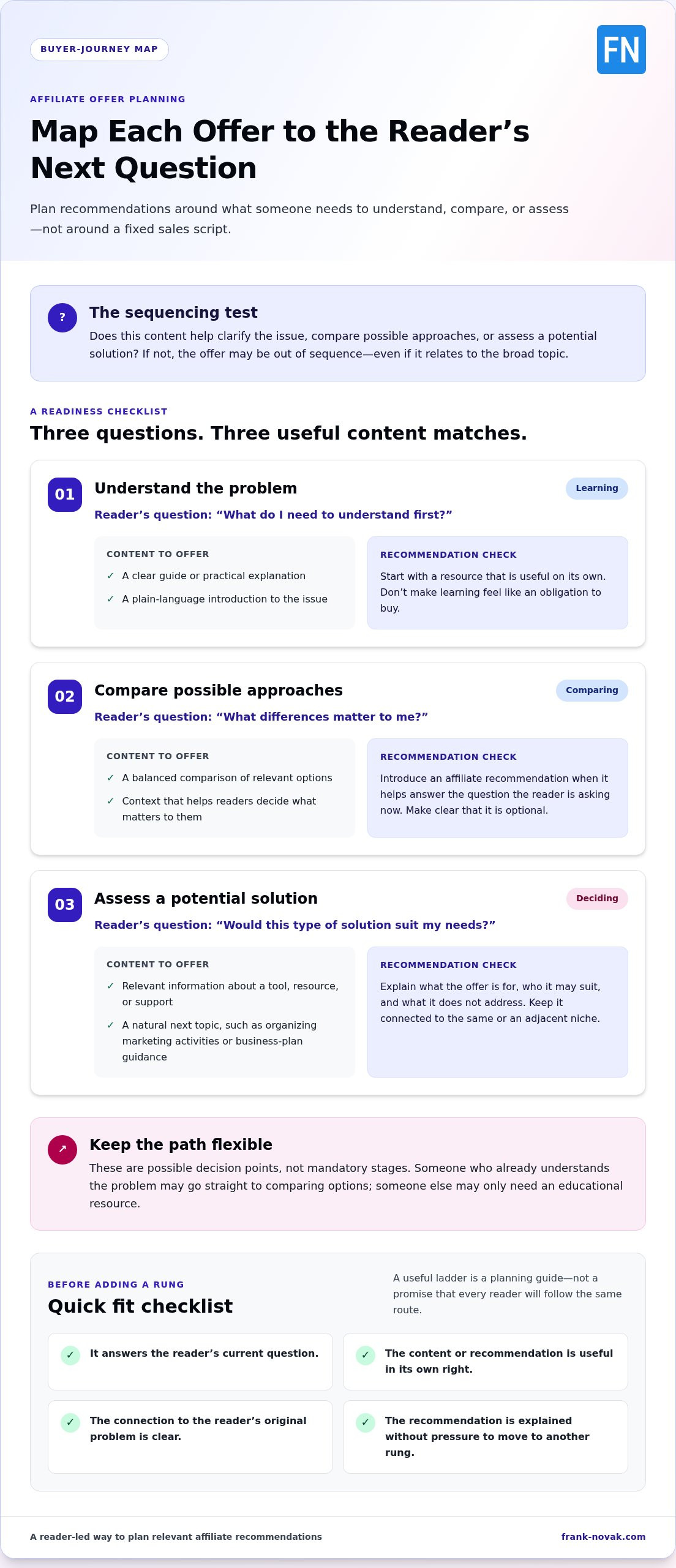
A useful offer sequence follows the reader’s decisions, not a fixed sales script. Someone might first be trying to name a problem, then comparing ways to address it, and finally deciding whether a particular solution fits. Those stages can help you plan, but they aren’t steps every person must complete. A reader who already understands the problem may go straight to comparing options, while another may only need an educational resource.
Each rung should answer the buyer’s next question at their current level of readiness. That gives you a practical test for every piece of content and affiliate recommendation: does it help clarify the issue, make a comparison, or assess a potential solution? If not, the offer may be out of sequence, even if it relates to the broad topic.
Choose a useful first step before presenting affiliate offers
Begin with a resource that helps someone understand the issue, such as a clear guide, comparison framework, or practical explanation. For example, a person exploring financial affiliate marketing may first need a plain-language guide to how affiliate programs work and what to review in their terms. That guide can answer the immediate question without requiring a purchase. A free resource should be useful in its own right, not treated as a disguised obligation to buy.
Only introduce an affiliate recommendation when it helps with the question the reader is asking. If they’re still learning the basics, a detailed explanation may be more appropriate than a product recommendation. If they’re actively comparing options, a balanced comparison can help them identify relevant differences and decide what matters to them. Match the content to the decision stage, and make clear when a recommendation is optional.
Connect later recommendations to a clear next decision
After a reader understands the problem, their next question might be how to compare approaches. Later, they may want to decide whether a particular type of tool or support suits their needs. Keep those recommendations within the same niche or an adjacent need. For instance, content about building an affiliate business can lead naturally to resources about organizing marketing activities or getting guidance on a business plan. A sudden shift to unrelated offers can make the sequence feel driven by commission rather than by the reader’s progress.
Use content as a bridge between decisions, not as pressure to move someone toward the next rung. A comparison article, for instance, can explain what to consider before presenting a relevant offer. A follow-up guide can address common questions for readers who want to explore further. This is where practical affiliate marketing guidance can help you think through how content and offers fit together.
As you’re creating a value ladder for your affiliate offers, sketch the journey in plain language before choosing links:
- Understand: What is the reader trying to learn about the problem?
- Compare: What choices or trade-offs do they need to understand?
- Decide: What kind of solution might address their next need?
Then check whether each recommendation supports one of those decisions. If an offer doesn’t answer a relevant question, leave it out or place it elsewhere. The aim is a flexible map: readers can take the step that suits them, pause, or skip ahead without being treated as though they’ve failed to follow the sequence.
Why the Highest-Commission Affiliate Offer Is Not Always the Best Next Rung
A larger commission can look attractive, but it doesn’t tell you whether an offer belongs in your sequence. It may not fit the reader’s current question, solve the problem your content addresses, or be appropriate for someone who is still comparing options. Treat commission as one evaluation factor, not the reason to place an offer before or after another one.
A more reliable review separates five considerations: audience fit, usefulness, buyer readiness, trust, and program terms. Ask whether the offer relates directly to the content that introduces it, whether its value is clear to the reader, and whether the reader has enough context to consider it. Then review how the program attributes referrals and pays commissions. A strong commission can’t compensate for a poor fit or unclear terms.
Evaluate fit, buyer readiness, and offer terms together
Start with the reader’s problem. If your guide helps someone understand a financial concept, a complex product recommendation may be premature unless the reader has enough information to assess it. If the content compares solutions, an offer could be relevant when it addresses the needs and decision criteria discussed. The sequence should reflect what the reader is prepared to evaluate, not what you hope they’ll buy.
Next, review each program’s current terms. Check attribution rules, cookie duration, and the payment schedule before relying on an offer in your plan. Good financial affiliate programs typically have cookie durations of 30-90 days, with the standard 60-90 days. These terms can affect whether a referral is attributed, so don’t assume programs handle them alike. Monthly payment is standard, and watch for programs that hold payments for 90+ days.
For financial offers, use the stated thresholds as screening guidance: under 30 % for digital products is not worth pursuing, and under $25-$50 per lead for traditional financial products is not worth pursuing. Consider these alongside relevance and the program’s terms, not as a substitute for assessing whether the offer genuinely suits your audience. Verify current offer details before describing them. This article is educational and does not provide personalized financial advice.
Use commission examples without turning them into promises
Some financial affiliate offers may advertise potential commissions of $500, $1,000, or $5,000+ per conversion. Those figures are examples of possible offer terms, not forecasts or guaranteed outcomes. Actual commissions depend on the specific program and its conditions, and a reader’s decision or result can’t be promised. Don’t imply that every niche or offer pays at these levels.
As you’re creating a value ladder for your affiliate offers, compare a high-commission offer with a relevant alternative using the same questions: does it answer the reader’s need, fit their stage, and have terms you can explain accurately? If the answer is no, don’t force it onto the ladder. A lower-paying recommendation that’s genuinely useful may better support a clear, credible sequence. For more practical affiliate marketing guidance, explore Frank Novak’s affiliate marketing resources.
How to Create and Test Your Affiliate Offer Ladder Step by Step
A useful first version doesn’t need a long list of offers. Start with one audience, connect each recommendation to a real need, and review what happens after readers encounter your content. This five-step process gives you a practical way to build and refine the sequence without letting commissions dictate every decision.
- Define your audience. Describe who you’re helping and the problem they’re trying to solve. For example, your audience might be beginner affiliate marketers who need help understanding how to organize and present offers. A specific audience makes it easier to choose relevant content and evaluate whether an offer belongs.
- Map their needs. Write down the questions that may follow the initial problem. A beginner may first ask how affiliate marketing works, then how to compare ways of presenting recommendations, and later whether a particular resource suits their plans. Treat these as possible decisions, not required stages.
- Shortlist relevant offers. Look for offers that connect to the audience’s problem or an adjacent need. Keep the focus to one or two related niches rather than mixing unrelated financial products. Review relevance, usefulness, trust, and program terms before considering commission.
- Sequence your content. Match a useful format to each decision. An educational guide can explain the issue, a product comparison can help readers assess alternatives, and a problem-solution article can address a specific concern. Make sure an offer appears where it answers a question, not simply wherever there’s room for a link.
- Review results. Track clicks, qualified leads, conversions, and reader feedback. Look at how people respond at each transition, then investigate a weak step before adding offers or changing commission priorities.
Build a first version around one audience and connected needs
Picture a reader who wants to understand affiliate marketing. Their first concern may be how the model works; their next might be how to compare ways to organize recommendations. A clear guide can address the first question, followed by a product comparison if readers are actively weighing solutions. Readers may arrive through search, email, or other relevant content, so make each piece useful on its own as well as connected to the next.
As you’re creating a value ladder for your affiliate offers, keep the first map simple: audience problem, follow-up question, helpful content, relevant offer. Search visibility can take patience. SEO traction generally takes 2-4 months of consistent effort, but that isn’t a promise of rankings or a fixed timeline for every site.
Review performance and improve one transition at a time
If an educational guide gets clicks but few readers continue to a relevant comparison, check whether the comparison answers the question raised in the guide. If readers click an offer but don’t become qualified leads or convert, review the match between the content, audience, and offer before assuming the commission is the problem. Reader questions and feedback can reveal missing context or a confusing handoff.
Make one focused adjustment at a time, then observe the available signals. Revisit the sequence when audience questions change, when an offer becomes less relevant, or when program terms are updated. This keeps your ladder responsive without turning every performance fluctuation into a reason to rebuild it.
For more ideas on matching affiliate content to audience needs, explore practical affiliate marketing guidance.
Turn Your Affiliate Offer Ladder into a Trust-First Marketing System
A well-planned ladder is more than a sequence of affiliate links. It connects an audience need to useful content, then to a relevant offer, followed by a responsible review of how well the recommendation serves readers. That structure helps keep your marketing focused: each offer has a clear reason to be there, and each piece of content gives readers information they can use whether or not they click.
Trust depends on how you make recommendations, not only which offers you choose. Describe what an offer is intended to help with, who may find it relevant, and any limitations you know about. Avoid presenting someone else’s product as your own or implying that buying it will guarantee a particular result. If a recommendation no longer fits the questions your audience is asking, revisit it rather than leaving it in place out of habit.
Keep recommendations transparent and audience-first
Make your affiliate relationship clear before readers encounter or act on an affiliate link. Use plain language in a noticeable place, such as near the recommendation, so readers understand the connection without having to search for it. The disclosure can read: I earn a commission if you apply through my link, but this doesn’t cost you anything extra.
Transparency also matters when you cover financial topics. Explain general concepts without turning them into personal recommendations, and state clearly that you are not giving personalized financial advice. Readers should be able to assess an offer based on its relevance and terms, not on exaggerated claims or pressure.
Choose a practical next step for your current stage
Before adding another offer, review the sequence you already have. For each rung, note the audience question it addresses, the content that introduces it, and whether the connection still feels useful. A gap may call for a clearer explanation or comparison, rather than another affiliate link. This simple review keeps the ladder manageable and gives you a specific improvement to work on.
If your next task is organizing how content leads readers toward relevant actions, the ClickBank Super Funnel may be a relevant resource to explore. Consider it in relation to the work you’re doing now; a funnel resource is useful only when its topic fits your needs. Creating a value ladder for your affiliate offers is a process of thoughtful decisions, not a promise of conversions or earnings.
For one-to-one support as you develop your affiliate marketing approach, learn about Online Success Coaching.
Make Your Next Recommendation More Intentional
Your next step doesn’t need to be adding another offer. Choose one transition in your current sequence and ask whether the content prepares readers for the decision that follows. If the connection feels unclear, improve the explanation or resource before expanding the ladder. Small, thoughtful adjustments can help you keep the audience’s needs at the center as your approach develops.
Creating a value ladder for your affiliate offers is ongoing work, shaped by what your audience asks and how they respond. Frank Novak publishes practical affiliate marketing guidance, with Online Success Coaching and the ClickBank Super Funnel as resources for people developing their online business. Consider whether guidance would help as you refine your approach, and take the next step at a pace that feels right for you.
You don’t need a perfect sequence to begin. Keep learning from your readers, make recommendations with care, and let each useful improvement build your confidence.
Frequently Asked Questions
What is a value ladder in affiliate marketing?
It’s a way to plan relevant affiliate recommendations around the questions an audience may have as they learn about a topic. For example, a person exploring financial affiliate marketing might first need an educational guide to the business model, then a comparison of relevant resources, and later decide whether a particular service or support fits. The ladder helps you see whether each recommendation belongs, while leaving readers free to use one resource without moving on to another.
Do I need to create my own products to build an affiliate value ladder?
No. You can build a ladder by recommending third-party offers, provided you’re clear about who provides each product or service and disclose your affiliate relationship. Your own contribution can be the educational content that helps readers understand their options. For instance, a tutorial could explain what to consider before introducing an outside tool. You don’t need to present that tool as your own or make a purchase the only next step.
How many offers should an affiliate value ladder include?
There’s no required number. Start with the offers you can explain clearly and connect to real audience questions, even if that means only one recommendation alongside useful educational content. A short, coherent sequence is easier to maintain than a crowded list. If you can’t explain why an offer belongs or what reader need it addresses, leave it out until it has a clear role.
Should I put the highest-commission offer at the top of my affiliate ladder?
No. Place an offer according to its relevance to the reader’s question and readiness, not its commission alone. A high-commission service may require careful comparison and more context, so it might not suit someone who is just learning the basics. Before featuring it, consider whether your content explains its purpose and limitations. Commission matters, but it doesn’t establish that the offer is a good fit.
How long should affiliate cookies last?
Cookie duration varies by program, so review the current terms before recommending an offer. Good financial affiliate programs typically have cookie durations of 30-90 days, with the standard 60-90 days. A longer window may allow more time for a reader to decide, but it doesn’t guarantee that a referral will be attributed. Check the program’s attribution rules as well, since cookie length is only one part of how tracking works.
Can beginners promote financial affiliate offers without a finance degree?
Yes. You don’t need a finance degree or 10 years of industry experience to promote financial products. Beginners should still take care to explain offers accurately and avoid claims they can’t support. I am not a licensed financial advisor, and this content is not personalized financial advice. Keep educational material separate from personal recommendations, and don’t suggest that general affiliate content can replace individualized advice.
How long does it take for affiliate content to gain SEO traction?
Affiliate content may take 2-4 months of consistent effort to gain SEO traction, but that timeframe isn’t a promise of rankings or traffic. Results can vary with the topic, competition, and how well the content answers searchers’ questions. For example, a focused guide addressing a specific query may serve readers better than a broad article covering many unrelated terms. Review performance over time and improve the content when you learn what readers need.

Article by
Frank Novak
Frank Novak is an online marketing professional and coach who focuses on affiliate marketing and business automation. Through his website, frank-novak.com, he shares insights and strategies for leveraging social media platforms like Facebook to generate traffic and commissions.
Affiliate / Sponsored Content Disclaimer
This [website/post] contains affiliate links. If you click through and make a purchase, we may receive a commission at no additional cost to you. We only recommend products or services we believe will add value to our readers.