

What if the best next move for your affiliate business isn’t spending more, but waiting until you know what needs fixing? When to reinvest profits into your affiliate business can be a difficult question when commissions fluctuate and the same cash may need to cover personal expenses, taxes, and business costs. Spending without a clear purpose can add overhead without improving results.
This guide will help you distinguish sustainable reinvestment from premature spending. Use the readiness checklist to work out what cash is actually available, compare possible investments against your business’s main bottleneck, and test a change before committing more. The aim is not to reinvest for its own sake, but to fund a specific improvement while keeping business and personal finances in view.
Start with your financial foundation, then identify what’s limiting growth. From there, you’ll learn how to test an investment at a manageable scale and assess whether it’s helping. A useful decision comes down to three questions: Can the business afford this commitment? What problem should it solve? What evidence will tell you whether it worked?
Key Takeaways
- Decide when to reinvest profits into your affiliate business by checking your financial readiness and giving each investment a clear purpose.
- Map upcoming obligations and operating expenses before deciding how much profit is available to reinvest.
- Compare potential investments by the specific bottleneck they address, how you’ll measure progress, and what remains uncertain.
- Test one major change at a time where practical, then use the results to decide whether to adjust, stop, or increase spending.
- Make reinvestment a regular review process by recording your reasons, results, and what evidence would change your plan.
When to reinvest profits into your affiliate business: start with readiness
Reinvestment isn’t an automatic rule for every commission that arrives. It means directing available business profit toward a specific growth or operating goal. The right timing depends on both your cash needs and the opportunity you’re considering. One strong month can be encouraging, but it doesn’t necessarily show that the same spending will be manageable next month.
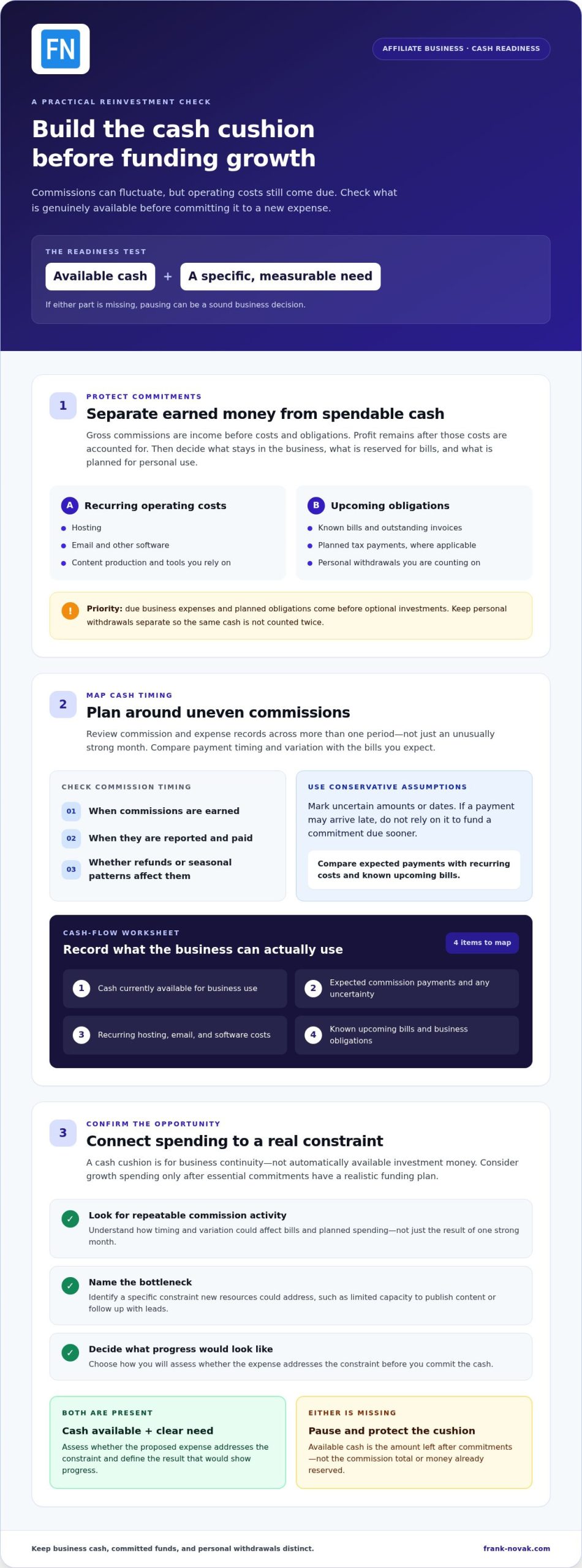
Begin by separating money earned from money available to use. Gross commissions are income before business costs and obligations. Profit is what remains after those costs are accounted for. You then need to decide what stays in the business, what’s set aside for upcoming bills, and what you plan to withdraw for personal use.
This video offers another perspective on deciding whether business profits are ready to be put back to work:
What counts as profit available for reinvestment?
Before choosing an investment, list recurring costs such as hosting, email or other software, content production, and any tools you rely on to run your affiliate business. Add near-term obligations, including planned tax payments where applicable, outstanding invoices, and personal withdrawals you’re counting on. The cash left after these commitments is a more realistic starting point than the commission total. Profits kept in the business are often described as retained earnings, though your own records should distinguish retained cash from funds already committed.
Signs your affiliate business may be ready
Look for repeatable commission activity over time, not just an unusually strong result. Income doesn’t have to be perfectly predictable, but you should understand how its timing and variation could affect bills and planned spending. Check that essential expenses and upcoming obligations have a realistic funding plan. Then identify a specific constraint that new resources could address, such as limited capacity to publish content or follow up with leads.
Reinvestment readiness means available cash plus a specific, measurable business need. If either is missing, pausing can be a sound business decision. If both are present, assess whether the proposed expense addresses the constraint and decide what result would indicate progress. That’s the practical answer to when to reinvest profits into your affiliate business: when the business can afford the commitment and you have a clear way to evaluate its purpose.
Build a cash cushion before reinvesting affiliate profits
Affiliate commissions can arrive unevenly. A campaign may perform well one month, while reporting delays, seasonal changes, or refunds affect what you receive or when you receive it. Routine expenses still come due. A cash cushion helps you manage that mismatch without interrupting essential operations or relying on your next commission arriving on schedule.
There’s no single reserve amount that fits every affiliate business. Your planning depends on recurring costs, how predictable your commissions are, and which obligations are coming due. Estimate how much cash the business may need to keep operating through a quieter period. Treat that cushion as money reserved for continuity, not as cash automatically available for a new investment.
Assess cash flow when commissions vary
Review commission and expense records across more than one period so you’re not basing a decision on an unusually strong month. Note when commissions are earned, reported, and paid, and whether refunds or seasonal patterns affect the amounts. Compare that history with expected expenses. Use conservative assumptions: if a payment is uncertain or may arrive late, don’t rely on it to fund a commitment due sooner.
A simple cash-flow worksheet makes the timing easier to see. Record:
- Cash currently available for business use.
- Expected commission payments, with uncertain amounts or dates marked.
- Recurring costs such as hosting, email tools, and other operating software.
- Known upcoming bills and other business obligations.
Once you’ve listed these figures, estimate what can remain in the business after essential commitments. That’s a more grounded starting point for deciding whether growth spending is affordable.
Protect obligations before funding growth
Set priorities in writing. Due business expenses and planned obligations come before optional investments. Separate planned personal withdrawals from the cash you intend to retain for business use, too. This makes it less likely that the same dollars will be counted both for household needs and business growth.
Tax and accounting obligations depend on your individual circumstances, so consider discussing your records and plans with a qualified tax or accounting professional. Once essentials are accounted for, judge whether any remaining cash is genuinely available for reinvestment. If you want help shaping a growth plan around your business constraints, Frank Novak’s online success coaching focuses on digital business growth and automation.
The question of when to reinvest profits into your affiliate business is easier to answer after mapping cash timing and protecting essential commitments. A cushion won’t remove uncertainty, but it can help you make growth decisions without treating every commission as spendable.
Compare affiliate reinvestments by the bottleneck they solve
Once you know what’s holding your business back, compare possible investments by the problem they address, how soon you might see a useful signal, and how you’ll measure it. More traffic won’t necessarily help if visitors aren’t a good fit. A new tool won’t fix a process you haven’t clearly defined. Choose an option tied to a real constraint, not simply the newest or most popular one.
| Investment | Purpose and likely time horizon | How to assess it | Main uncertainty |
|---|---|---|---|
| Traffic activity | Reach a relevant audience; results may take time to assess. | Track qualified visits and meaningful actions, such as clicks or sign-ups. | Whether the channel reaches people likely to engage. |
| Landing page or follow-up system | Organize the visitor journey; assess after enough visitors move through it. | Review completion, click-through, and follow-up engagement. | Whether the page or messages address audience needs. |
| Tools or skills | Reduce a documented task or close a knowledge gap; timing depends on use. | Compare task completion, consistency, or execution before and after. | Whether the tool or learning is applied effectively. |
Traffic, funnels, and audience-building investments
If your constraint is inconsistent or poorly matched traffic, a focused channel test may be more useful than spreading effort across several platforms. For practical ideas on assessing traffic sources, see How to Drive Traffic to Affiliate Links: The Strategic Guide for 2026. If visitors arrive but the next steps are unclear, landing pages and follow-up systems can make the journey more organized. Automated Marketing Funnel: The 2026 Guide to Sustainable Business Growth explores that broader funnel context.
The ClickBank Super Funnel is one of Frank Novak’s digital resources for affiliate marketers considering funnel structure. Compare its approach with the specific gap you’re trying to solve, and decide how you’ll assess whether it supports your process.
Tools, skills, and support: what should come first?
Before adding a subscription, name the task it should improve and how you’ll know it’s helping. If you’re unsure how to complete that task, learning or coaching may address the execution gap more directly. Systems work best when you understand the process they’re meant to support. Otherwise, they can add steps, cost, and confusion instead of removing a bottleneck.
That’s the practical test for when to reinvest profits into your affiliate business: connect each possible expense to a constraint, a way to measure progress, and an uncertainty you’re willing to test.
Use a small test-and-review process before increasing spending
A measured test can show whether an investment addresses the problem you identified before you commit more cash. Keep the process focused: name the bottleneck, record a baseline, run a test, measure a relevant result, then decide whether to continue, adjust, or pause.
For example, if your goal is to improve lead generation, track qualified leads rather than relying only on website visits. If you’re testing a follow-up sequence, monitor whether subscribers engage and take the next intended action. Choose measures that connect directly to the investment. Where practical, avoid changing several major things at once. If you alter the traffic source, landing page, and follow-up messages together, it becomes harder to tell which change influenced the result.
Set a baseline and define what success means
Before spending, write down the current measure you want to improve, such as qualified leads per period or the share of visitors who complete a funnel step. Choose a review window that fits the activity and gives you enough relevant data to make a useful comparison. A short test may reveal early signals, but it may not be enough to judge eventual commissions.
Separate leading indicators from later outcomes. Leads, clicks, and sign-ups can show whether people are responding, while commissions may take longer to appear. Define what would count as a promising signal, what would suggest a change is needed, and when you’ll review the test. A useful reinvestment test starts with a defined goal and a scheduled review point.
Review results and decide what to do next
At the review point, compare the result with your baseline and consider whether the test stayed within its planned scope. If the evidence points in the right direction and cash capacity remains sound, continue or expand cautiously. If the signal is weak, adjust one part of the approach or pause spending while you investigate.
Keep a brief record of what you changed, what you measured, and what the results can and can’t tell you. A short-term lift could reflect normal variation, while a disappointing result might mean the test needs more time or a clearer measure. Don’t treat one outcome as proof that an approach will always work, or never work. This disciplined review helps clarify when to reinvest profits into your affiliate business without turning a promising idea into an open-ended expense.
Turn reinvestment into a sustainable affiliate-business growth plan
A reinvestment decision works best as part of an ongoing plan, not a one-time reaction to a good month or a disappointing result. Bring together the factors you’ve assessed: whether cash is available, which obligations need protection, what business constraint matters most, and what your latest test revealed. Use that picture to decide whether to hold, adjust, or fund the next step.
Create a repeatable reinvestment review
Choose a consistent time to review your business finances and priorities. Set a schedule that suits how often your commissions, expenses, and marketing activity change. At each review, ask whether cash readiness has shifted, whether the main bottleneck is still the same, and whether recent tests produced evidence worth acting on.
Keep a concise decision record. Note the investment, why you made it, the measure you planned to watch, and what happened. Include what the result can’t establish, too. For example, a change in leads may be a useful signal, but it doesn’t automatically prove that the same approach will keep working or lead to more commissions over time.
Revisit your assumptions when commission patterns, business expenses, or goals change. A spending plan that made sense before a new recurring cost or a shift in audience priorities may need updating. Your record helps you understand why you made earlier choices and whether new evidence supports continuing them.
When outside guidance may help
If several constraints compete for attention, it can be difficult to tell which one deserves your next investment. Coaching can help you sort priorities, connect spending to a practical growth plan, and think through the systems and automation that support your affiliate business. It won’t remove uncertainty, but it can give you a clearer structure for deciding what to test and how to review it.
For a closer look at how coaching can support planning, explore Why Online Success Coaching is Your Shortcut to Growth in 2026. Consider how guidance fits the challenge you’re facing now, such as deciding between improving your funnel, building your mailing list, or strengthening your day-to-day process.
Ultimately, when to reinvest profits into your affiliate business depends on the evidence and circumstances in front of you. Keep your approach flexible: protect what the business needs, invest with a defined purpose, and let results inform your next decision.
Frank Novak offers online success coaching for entrepreneurs working to grow and automate their digital businesses. Explore online success coaching to get support shaping a plan around your priorities.
Make your next reinvestment a deliberate step forward
Knowing when to reinvest profits into your affiliate business isn’t about spending every time commissions rise. Check that essential cash needs are covered, choose an investment that addresses a real business constraint, and decide in advance how you’ll assess its value. A measured test gives you evidence before you commit more.
Keep a simple record of what you funded, why you chose it, and what results would lead you to continue, adjust, or pause. As your income, expenses, or goals shift, revisit those decisions and update your plan. Frank Novak focuses on affiliate marketing and business automation. The ClickBank Super Funnel is one of his digital resources for marketers considering funnel systems, and online success coaching can help you turn business priorities into a practical growth plan.
You don’t need to rush. Build steadily, learn from each decision, and let your business’s needs guide what comes next.
Frequently Asked Questions
When should I reinvest profits into my affiliate business?
Reinvest when essential business expenses and upcoming obligations are accounted for, you have cash available to commit, and a specific business need gives the spending a clear purpose. The best time to reinvest profits into your affiliate business isn’t necessarily after a strong commission month. Identify a need you can address and a result you can track, then test the investment at a manageable level before increasing spending.
How much of my affiliate profits should I reinvest?
There’s no single percentage that suits every affiliate business. First subtract operating expenses and money reserved for known obligations from available business cash. Decide separately how much you need to withdraw for personal use and what should remain in the business. Then set a test amount you can afford without relying on uncertain future commissions. Your records and cash-flow needs can guide the amount as they change.
Should I reinvest affiliate income before I have consistent sales?
You can invest before sales become consistent, but keep the commitment limited and tie it to a clear learning goal. For example, a small test may help you understand whether a particular audience responds to your content. Avoid taking on ongoing expenses that depend on commissions you haven’t established yet. Track what the test reveals, and protect funds needed for essential business costs and personal obligations.
What should I reinvest affiliate profits in first?
Start with the constraint that most directly limits your next step. If relevant visitors are scarce, investigate traffic quality or consistency. If visitors arrive but don’t take the next action, review the page or follow-up process. If execution is slow or unclear, a tool, training, or coaching may be more relevant. Choose based on a problem you can describe and a measure you’ll use to assess progress.
How do I know if an affiliate business investment is working?
Record a baseline before you spend, then track a measure connected to the investment. For traffic activity, that might be qualified visits or leads; for a funnel change, it could be completion of a key step. Set a review point suited to the activity, and distinguish early signals from eventual commissions. Use the evidence to continue, adjust, or pause, without treating a short-term change as a lasting guarantee.
Should I reinvest profits in paid traffic or an affiliate funnel?
Choose based on the bottleneck, not on which option sounds more appealing. If you lack relevant visitors, a carefully limited traffic test may help you learn about audience response. If people already arrive but have no clear next step, improving the funnel may be the better focus. Before either investment, define what you’ll measure and ensure you can track the journey from visitor to lead or action.
Do I need to reinvest every affiliate commission?
No. A commission isn’t automatically available for reinvestment. Account for business expenses, upcoming obligations, and any planned owner withdrawal before deciding what to do with the remaining cash. You can retain funds for future business needs, use some as income, or allocate a portion to a purposeful test. Making that choice deliberately helps you avoid spending simply because money arrived.

Article by
Frank Novak
Frank Novak is an online marketing professional and coach who focuses on affiliate marketing and business automation. Through his website, frank-novak.com, he shares insights and strategies for leveraging social media platforms like Facebook to generate traffic and commissions.
Affiliate / Sponsored Content Disclaimer
This [website/post] contains affiliate links. If you click through and make a purchase, we may receive a commission at no additional cost to you. We only recommend products or services we believe will add value to our readers.