

What if the secret to your first $1,000 month isn’t a lucky viral post, but a simple spreadsheet? Most creators spend their first year chasing “hacks” while completely ignoring the underlying mechanics that actually drive revenue. If you’ve found yourself feeling frustrated by slow progress or contradictory advice from online gurus, you aren’t alone. The reality is that setting realistic income goals for affiliate marketing requires moving away from guesswork and toward a data-driven approach that treats your content like a business.
You likely understand that this journey takes patience, yet it’s difficult to stay motivated when you don’t have a clear roadmap to follow. In this guide, we’ll bridge that gap by providing the exact mathematical framework and mindset shifts you need to reach achievable, scalable milestones in 2026. We’ll explore a 12-month income projection model that accounts for current commission trends and conversion rates. By the end, you’ll have a clear understanding of the math behind affiliate success and the confidence to scale your business from zero to your first four-figure month and beyond.
Key Takeaways
- Identify which of the three stages of affiliate growth you are currently in to ensure your milestones align with your available resources and experience level.
- Master the mathematical framework of traffic, conversion rates, and average order value to move from guesswork to predictable revenue planning.
- Learn the specific strategies for setting realistic income goals for affiliate marketing in a landscape increasingly defined by AI search and personal brand authority.
- Shift your daily focus toward lead indicators, such as content consistency and email list growth, rather than only tracking the lag indicator of total dollars earned.
- Understand how to bypass the manual income ceiling by integrating automated systems like the ClickBank Super Funnel to maintain growth without increasing your workload.
What is a Realistic Affiliate Marketing Income for Beginners?
Most beginners enter this space with a skewed perspective of what success looks like, often fueled by “get rich quick” stories that lack context. If you want to build a sustainable business, setting realistic income goals for affiliate marketing is the single most important factor in whether you’ll still be here in twelve months. Before we dive into the numbers, let’s establish a foundation. What is Affiliate Marketing at its core? It’s a performance-based model where you earn commissions for referring customers. Because it’s performance-based, your income is directly tied to your skill level and the systems you have in place.
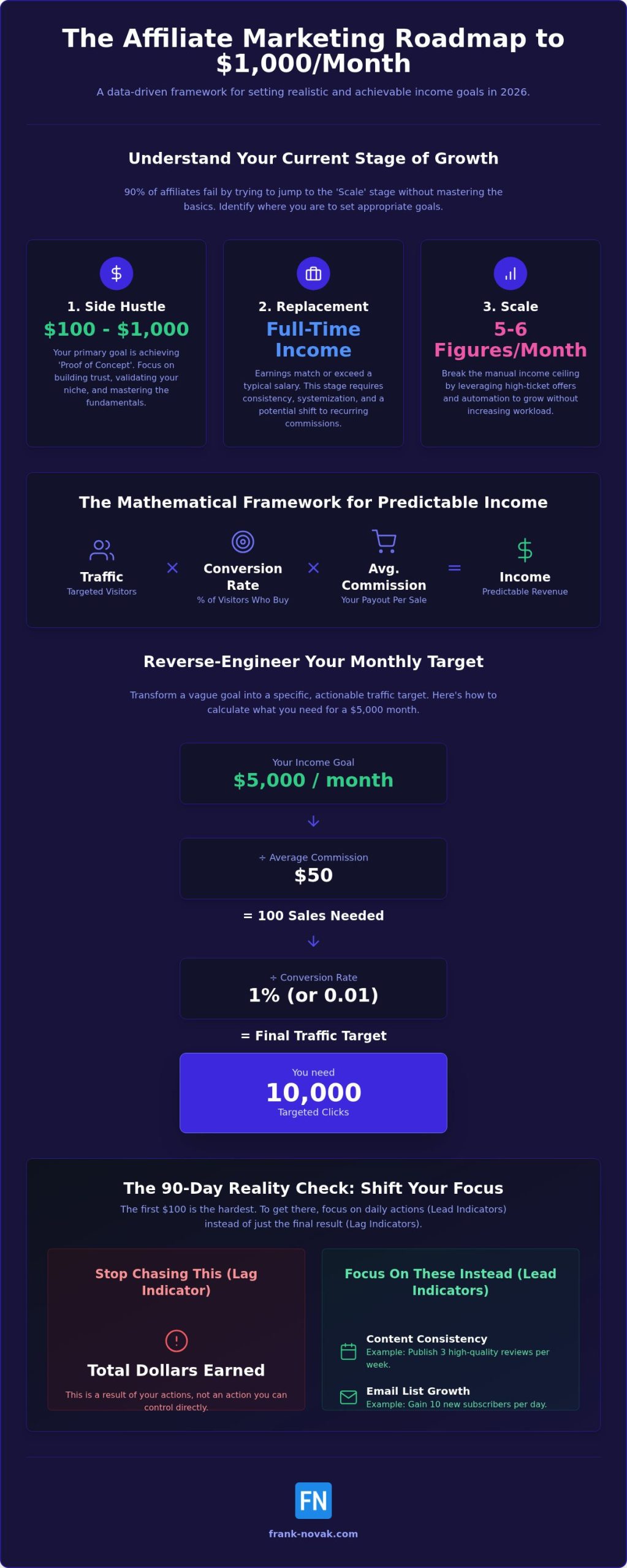
Success generally happens in three distinct stages. First is the Side Hustle stage, where you’re aiming for your first $100 to $1,000. Next is the Replacement stage, where your earnings match a full-time salary. Finally, the Scale stage is where you leverage automation to reach five or six figures monthly. About 90% of affiliates fail because they try to jump to the Scale stage without mastering the basics of the Side Hustle. They set “unrealistic” goals that don’t account for the time it takes to build trust with an audience.
Year one is about foundation. Data from mature affiliate programs suggests that most successful marketers don’t see significant profit until months six through nine. It’s also vital to distinguish between gross revenue and net profit. If you earn $2,000 in commissions but spend $1,800 on ads, your business isn’t as healthy as someone earning $500 with zero overhead.
The 90-Day Reality Check
The first $100 is often the hardest hurdle because you’re building the engine while trying to drive it. During these first 90 days, your focus should be on “Process Goals” rather than “Dollar Goals.” If you commit to publishing three high-quality reviews per week or growing your email list by ten people a day, the money will follow. Building an email list is far more valuable than a quick sale; it’s an asset you own that pays dividends for years.
Income Tiers: From $500 to $10,000 per Month
When you reach the $500 monthly threshold, you’ve achieved “Proof of Concept.” You’ve validated your niche and your traffic source works. Moving to the $3,000 level requires more consistency and perhaps a shift toward recurring commission programs. To break the $10,000 per month ceiling, manual effort isn’t enough. This is where high-ticket offers and automated systems like the ClickBank Super Funnel become essential. By automating the follow-up process, you ensure that the math behind setting realistic income goals for affiliate marketing actually works in your favor as you scale.
The Mathematical Framework: Calculating Your Income Potential
Predictable income is not a matter of luck; it is a matter of multiplication. If you want to move beyond the experimental phase described in the previous section, you must view your business through the lens of a simple formula: Traffic x Conversion Rate x Average Order Value (AOV). By setting realistic income goals for affiliate marketing based on these three variables, you transform a vague desire for wealth into a specific set of daily tasks. If you know your conversion rate is 1% and your payout is $50, you can see exactly how much traffic you need to generate to hit your targets.
Earnings Per Click (EPC) serves as the primary metric for measuring the health of your funnel. While total revenue is often a vanity metric, EPC tells you exactly how much every click is worth to your business. This clarity is especially important when you factor in recurring commissions, which provide a stable floor for your monthly earnings. If you promote software with a 30% monthly recurring commission, your income potential compounds over time, making your long-term goals much easier to hit than if you were starting from zero every month. Research into realistic affiliate marketing income suggests that even modest conversion rates can lead to significant results when paired with the right traffic volume.
Reverse-Engineering Your Monthly Target
If your goal is a $5,000 month, you need to work backward from the final payout. If your average commission is $50 and your conversion rate is 1%, you will need 10,000 targeted clicks to reach that target. You must also account for niche-specific variations; the health niche often sees higher volume but lower conversion rates compared to high-intent wealth offers. Always include a 10% refund buffer in your projections to keep your expectations grounded and your financial planning secure.
High-Ticket vs. Low-Ticket Goal Setting
The path to your income goal changes drastically depending on your product price point. Selling a $27 ebook requires massive traffic volume to reach a living wage, whereas a $997 coaching offer can hit the same goal with just a handful of sales. EPC (Earnings Per Click) is a metric calculated by dividing your total commission earned by the number of clicks sent to an offer, representing the average value of every visitor you generate. Many successful creators find that a hybrid approach is best, using low-ticket offers to cover ad costs while high-ticket commissions provide the actual profit. If you find the manual calculation of these variables overwhelming, working with online success coaching can help you streamline the process and focus on the activities that actually move the needle.
2026 Benchmarks: How Market Shifts Impact Your Goals
The digital environment in 2026 looks significantly different than it did even a few years ago. AI-driven search engines and evolving social algorithms have fundamentally shifted how users discover products, often increasing the cost of acquisition. Because of this, setting realistic income goals for affiliate marketing requires you to account for these higher barriers to entry from day one. Success now leans heavily on personal brand authority. If your audience doesn’t recognize your voice or trust your recommendations, your conversion rates will remain low, regardless of how much traffic you generate through paid or organic channels.
When you look at your traffic sources, Facebook Ads remain a cornerstone for many, but your expectations must be grounded in current data. Aiming for a Return on Ad Spend (ROAS) of 2:1 or 3:1 is a healthy, sustainable target for most niches. Short-form video has emerged as the most effective tool for driving top-of-funnel interest without a massive upfront budget. It allows you to test hooks and offers quickly. However, email marketing remains your highest ROI activity because it’s the only channel where you truly own the data. Without a robust email follow-up system, hitting your monthly income milestones becomes an uphill battle.
Building for longevity is now more important than chasing a quick win. The FTC has significantly increased its oversight of affiliate disclosures, with potential fines now ranging between $51,744 and $53,088 per violation. This regulatory environment means that “burn and turn” strategies are no longer viable for anyone serious about a long-term career. A compliant, transparent approach is the only way to ensure your business survives the next algorithm update and continues to provide a steady income.
The 2026 Affiliate Income Maturity Model
| Timeline | Business Focus | Realistic Income Benchmark |
|---|---|---|
| Months 1-3 | Learning & Setup | $0 to $200 (Focus on skill acquisition) |
| Months 4-9 | Optimization | $500 to $2,000 (Focus on conversion) |
| Months 10-18 | Scaling | $5,000+ (Focus on automation) |
If your actual revenue is significantly lower than these benchmarks after six months of consistent effort, it’s often a red flag that your traffic source and offer are mismatched. Developing the right Affiliate Marketing Success Mindset is essential during the middle phase when progress often feels plateaued. By staying patient and following a clear roadmap, you can transition from the learning phase into a profitable, automated asset. Success is rarely a straight line, but having these benchmarks allows you to adjust your strategy before you lose momentum.
The Strategic Roadmap: Setting SMART Affiliate Goals
Moving from mathematical theory to daily execution requires a framework that protects your mental resilience. While the numbers provide a target, the SMART methodology ensures that setting realistic income goals for affiliate marketing doesn’t become a source of burnout. You must first define your “Freedom Number,” which is the exact monthly amount required to cover your essential expenses. Once you have this specific figure, you can balance your ambition with the actual hours you have available each week. If you only have ten hours to spare, aiming for a $10,000 month in your first quarter is a recipe for frustration. Instead, align your goals with relevant systems like the ClickBank Super Funnel, which allows you to leverage automation rather than manual labor.
Lead Measures vs. Lag Measures
The biggest psychological trap in this industry is focusing exclusively on “lag measures,” such as your total commissions earned. These are results that happen after the work is done. To maintain your momentum, you must track “lead measures,” which are the activities you can control. This includes the number of emails sent, the volume of traffic generated, or the pieces of content published. Achieving your “First Sale” milestone is the most significant goal you’ll set because it provides the emotional proof that your system works. When you shift your focus to the process, you build the consistency needed for setting realistic income goals for affiliate marketing that actually stick.
Building Your 12-Month Affiliate Business Plan
A successful year is usually divided into four logical phases. During Quarter 1, your priority is skill acquisition and setting up your technical foundation. You aren’t looking for profit yet; you’re looking for a working funnel. In Quarter 2, you move into traffic testing and data collection, where you learn which hooks resonate with your audience. By the time you reach Quarters 3 and 4, you should have enough data to identify your winners. This is the stage where you scale your ad spend and automate your back-end systems to turn your traffic into a 24/7 asset. This 90-day sprint methodology keeps you focused on the immediate task without losing sight of the long-term vision.
Scaling to 6 Figures: The Role of Automation and Coaching
As you move through the maturity model we discussed earlier, you’ll eventually hit a ceiling where your personal time becomes the limiting factor. Manual affiliate marketing, while effective for reaching your first few milestones, often leads to an “Income Ceiling” because there are only so many hours in a day to create content and manage campaigns. To break into the six-figure bracket, you must transition from being a solo affiliate to a digital business owner. This shift requires setting realistic income goals for affiliate marketing that prioritize system-driven growth over individual effort.
Leveraging Systems for Exponential Growth
Using a system like the ClickBank Super Funnel removes the technical barriers that often stall progress for growing affiliates. Instead of manually sending every lead to an offer, an automated funnel captures data and manages the follow-up process 24/7. This automation is crucial for increasing the Lifetime Value (LTV) of your leads, as it allows for consistent email marketing without constant manual intervention. If you want to scale, you need a mechanism that works while you’re offline. Automation serves as the vital bridge that transforms a time-consuming hobby into a scalable, professional digital business.
The Shortcut: Why Mentorship Matters
Even with the best tools, the digital landscape moves fast, and small errors can have significant consequences. For example, many affiliates find their accounts suspended because they didn’t understand the nuances of Facebook ad compliance or updated disclosure rules. Expert Online Success Coaching provides a shortcut to avoiding these “blind spots” that can derail your progress for months. A coach helps you interpret your data objectively, showing you exactly where to pivot if your current metrics aren’t aligning with your original projections. This high-level guidance ensures that setting realistic income goals for affiliate marketing leads to actual results rather than just theoretical plans.
Building Your Path to Affiliate Success in 2026
Success in the affiliate space is rarely about finding a secret hack; it’s about the steady application of proven systems. You now have the mathematical framework to move from guesswork to predictable revenue by focusing on traffic volume and conversion metrics. By setting realistic income goals for affiliate marketing, you’ve already separated yourself from the majority of beginners who rely on luck. You understand that while the first sale is a vital milestone, the real growth happens when you transition into a digital business owner who leverages automation.
Focusing on sustainable growth and compliant traffic strategies ensures your business remains resilient against algorithm shifts. If you implement the ClickBank Super Funnel system, you can begin turning your daily efforts into a 24/7 automated asset. This approach prioritizes long-term stability over short-term shortcuts, giving you the foundation needed for a professional career.
Take the first step today with the confidence that you have a clear roadmap. Your progress might start small, but with the right mentorship and systems, your potential for growth is limited only by your consistency.
Frequently Asked Questions
How long does it take to make $1,000 a month in affiliate marketing?
It typically takes six to twelve months of consistent work to reach the $1,000 monthly milestone. During the first three months, your focus is entirely on skill acquisition and setting up your technical foundation. By month six, you should be optimizing your traffic sources based on the data you’ve collected. If you follow a structured roadmap, you’ll see your commissions grow as your email list and authority expand. Patience is key when setting realistic income goals for affiliate marketing.
Is $10,000 a month a realistic goal for a beginner?
Achieving $10,000 a month is an achievable long-term target, but it is rarely realistic for a beginner in their first few months. Most creators reach this level by moving from low-ticket products to high-ticket offers and implementing automated systems. If you try to hit this number immediately without the proper foundations, you’ll likely face burnout. Focus on reaching your first $1,000 month before scaling toward five-figure territory with advanced coaching and more complex funnels.
How much money do I need to start affiliate marketing in 2026?
You can start an affiliate business in 2026 with a budget of approximately $100 to $500 for essential tools. Basic costs include a domain name, email marketing software, and tracking tools to monitor your progress. For instance, affiliate software like Rewardful or FirstPromoter often starts at around $49 per month. While you can use free organic traffic, having a small budget for testing allows you to gather data faster and see which offers actually convert.
What is the highest-paying affiliate niche for 2026?
Software as a Service (SaaS) and Financial Services remain the highest-paying niches in 2026 due to their high margins. SaaS programs often provide recurring commissions between 20% and 40%, which builds long-term stability. Financial services can pay between $100 and $200 for a single qualified lead. High-ticket coaching programs are also lucrative, often offering payouts of $500 or more per sale. Choosing the right niche is a vital part of setting realistic income goals for affiliate marketing.
Can I do affiliate marketing without a website?
You can certainly perform affiliate marketing without a traditional website by leveraging social media platforms and simple landing pages. Many successful affiliates use short-form video to drive traffic directly to a bridge page or an email opt-in form. This approach allows you to build a list and promote offers without the technical overhead of a full site. However, you must still ensure your disclosures are clear and conspicuous to remain compliant with the latest FTC guidelines.
What happens if I don’t hit my income goals in the first 6 months?
If you don’t hit your goals within six months, you should analyze your lead indicators to identify where your funnel is leaking. Check if your traffic volume is sufficient and if your conversion rate matches the industry average of 1% to 5%. Often, a lack of progress stems from a mismatch between the audience and the offer. Instead of quitting, use this data to pivot your strategy or seek mentorship to find your specific blind spots.
How much traffic do I need to make a full-time income?
To earn a full-time income, you generally need between 5,000 and 10,000 targeted clicks per month, depending on your average commission. If you’re promoting a product with a $50 payout and a 1% conversion rate, you’ll need 10,000 clicks to reach $5,000. You can reach your goals with less traffic if you focus on high-ticket items or products with a high Average Order Value. Tracking your Earnings Per Click will help you stay on target.
Is affiliate marketing still profitable in 2026 with AI?
Affiliate marketing remains highly profitable in 2026, though AI has changed the way successful marketers operate. While AI can assist with content production and data analysis, consumers now crave personal brand authority and human trust more than ever. The marketers who succeed are those who use AI for efficiency while providing genuine, unique value to their audience. Profitability now depends on building a loyal community rather than just chasing generic, automated search traffic.

Article by
Frank Novak
Frank Novak is an online marketing professional and coach who focuses on affiliate marketing and business automation. Through his website, frank-novak.com, he shares insights and strategies for leveraging social media platforms like Facebook to generate traffic and commissions.
Affiliate / Sponsored Content Disclaimer
This [website/post] contains affiliate links. If you click through and make a purchase, we may receive a commission at no additional cost to you. We only recommend products or services we believe will add value to our readers.