
In 2026, the era of dropping affiliate links into Facebook groups and hoping for a quick sale isn’t just dying; it’s officially over. If you’ve ever felt the frustration of a post that gets zero engagement or the sudden sting of an account ban, you’re not alone. Most marketers find the manual outreach process exhausting and hate being labeled as a link spammer by the very communities they want to serve. It’s a common struggle to balance the need for commissions with the platform’s increasingly strict rules.
This guide will show you how to master using Facebook groups for affiliate marketing by building a sustainable personal brand that attracts a steady stream of organic leads. You’ll learn how to generate consistent commissions without appearing spammy or risking your reputation. We’ll walk through the shift from manual posting to professional scaling, covering everything from Meta’s 2026 Partnership Ad requirements to the technical systems that keep your links safe. By the end, you’ll have a clear roadmap to move beyond the simple link drop and start building a high-converting incubator for your affiliate offers.
Key Takeaways
- Discover why the 2026 Facebook algorithm favors private communities and how you can tap into “dark social” for high-quality organic traffic.
- Learn a foolproof method for using Facebook groups for affiliate marketing by identifying active, high-conversion communities while avoiding low-quality bot groups.
- Adopt a “Value-First” content strategy that uses the 80/20 rule to build your personal brand and establish genuine authority within your niche.
- Safeguard your account from bans by utilizing bridge pages and technical tools like the ClickBank Super Funnel to capture leads safely and professionally.
- Identify the right moment to scale your business by launching your own community, giving you complete control over your marketing environment and affiliate offers.
Why Facebook Groups Are the Ultimate Free Traffic Source in 2026
Digital interaction has undergone a massive transformation. While the public newsfeed used to be the primary place for discovery, 2026 has seen a definitive shift toward “dark social” and private communities. Users are increasingly seeking out smaller, more focused environments where they can connect with like-minded individuals. For those interested in affiliate marketing, this shift represents a goldmine of opportunity. Facebook groups have become the heartbeat of the platform because they offer something a generic ad never can: a sense of belonging and immediate relevance.
The 2026 Facebook algorithm is designed to reward “meaningful social interactions,” a metric that heavily favors active group discussions over passive scrolling. If a post generates helpful comments and genuine engagement within a community, the platform pushes it to the top of members’ feeds. This organic visibility is becoming vital as the cost of traditional Facebook Ads continues to climb. By using Facebook groups for affiliate marketing, you’re essentially bypassing the “pay-to-play” barrier and reaching a warm audience that’s already primed to listen to your recommendations. This “Trust Factor” is the secret sauce. Group members aren’t just looking at a banner; they’re reading a suggestion from someone they perceive as a peer or a mentor.
The Psychology of Group-Based Marketing
Success in this space requires a fundamental shift in your mindset. You aren’t just a seller; you’re a valued contributor to a niche ecosystem. Groups provide pre-vetted audiences who’ve already raised their hands and expressed interest in a specific topic. When you consistently offer solutions to their problems, you benefit from the “Expert Authority” effect. This psychological trigger builds trust, making members far more likely to click your links compared to a cold ad they see in their feed. It’s about being the person people go to for advice, not the person they try to avoid in the comments.
Affiliate Marketing vs. Spamming: The Fine Line
Ethical group marketing is the practice of providing genuine value and building relationships before ever introducing a product or service. If you enter a group and immediately drop a raw link, you’ll likely be flagged as a “link spammer” and banned. Common red flags include posting the same content across multiple groups or ignoring the specific rules set by moderators. Respecting these boundaries is non-negotiable. Using Facebook groups for affiliate marketing effectively means taking the time to read the group’s “About” section and engaging with others’ posts before sharing your own insights. If you follow the rules and lead with help, the commissions will follow naturally.
Finding and Vetting High-Conversion Affiliate Groups
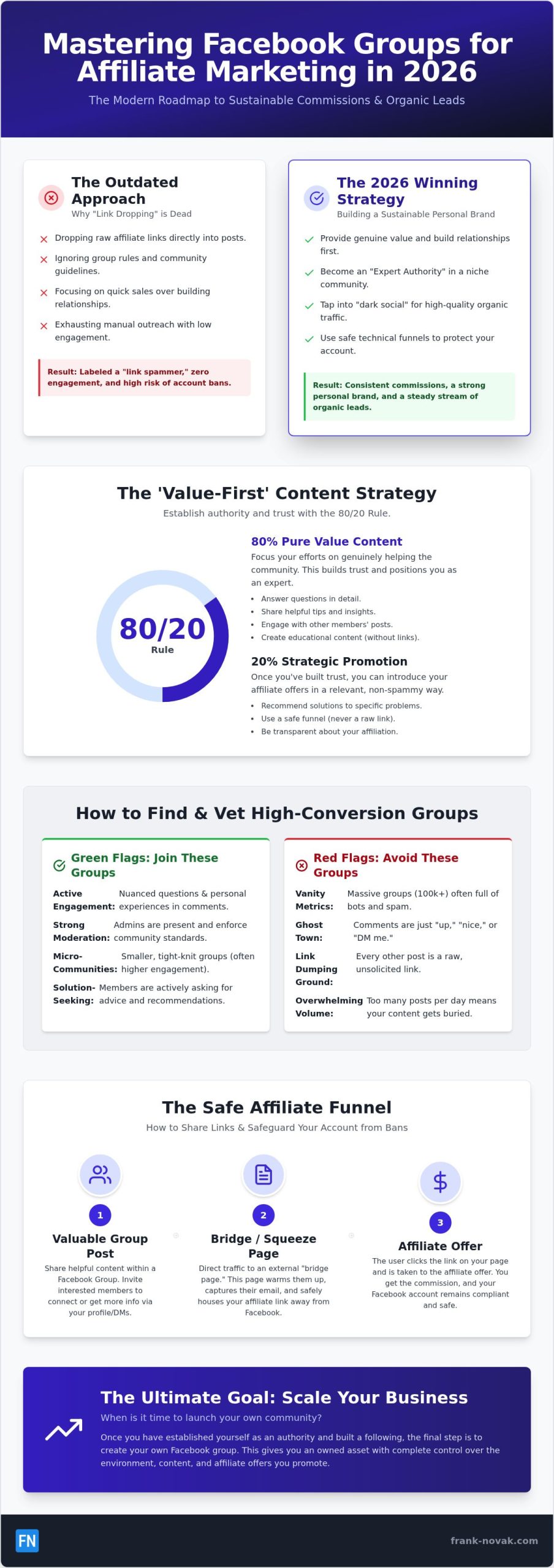
Finding the right community is like prospecting for gold; you have to sift through a lot of silt to find the nuggets. When you’re using Facebook groups for affiliate marketing, start with the advanced search filters. Look for “Groups” and filter by “Recent Posts” or “Public/Private” status. However, the size of the group is often a vanity metric. Massive groups with 100,000 members are frequently overrun by bots and automated link-droppers. Instead, focus on smaller “micro-groups” where the members actually know one another. These tight-knit communities often see engagement rates five to ten times higher than public “free-for-all” groups.
Before joining, perform a quick “Engagement Check.” Look at the last ten posts. If the comments are just “up,” “nice,” or “DM me,” you’re looking at a ghost town. Real conversion happens where people ask nuanced questions and share personal experiences. Also, check the admin list. If the admins aren’t active or don’t enforce community standards, the group will eventually devolve into a spam pit. You want a group where the moderators are present but open to genuine recommendations. This balance ensures your efforts aren’t buried by low-quality noise.
Criteria for the Perfect Affiliate Group
A healthy group shows a steady member growth rate without a sudden, suspicious spike. Post volume should be consistent but not overwhelming. If a group has 500 posts a day, your voice will get lost in the noise. Ideally, you want a space where members are actively seeking solutions. High-quality discussions are the hallmark of a profitable environment. If you notice a high ratio of educational content, it’s a sign that the Value-First Content Strategy is already working there, making it a perfect place for you to contribute.
Strategic Group Selection
Don’t just stick to your primary niche. While joining groups directly related to your product is essential, secondary groups with tangential interests often have less competition. For example, if you’re promoting fitness gear, look for “busy parent” or “remote work” groups where health is a secondary pain point. Organize these into a “Group Portfolio” to manage your daily interactions efficiently. For a deeper look at moving these users toward your offers, check out our guide on Strategic Traffic Generation for Affiliate Links. If you find the manual vetting process overwhelming, Online Success Coaching can help you streamline your strategy and identify the most profitable pockets of the platform.
The ‘Value-First’ Content Strategy to Build Authority
Building a sustainable presence requires a strategic shift from promotion to education. If you want to succeed while using Facebook groups for affiliate marketing, you should adopt the 80/20 rule. This means 80% of your contributions should focus on pure education and support, while only 20% involves strategic promotion. This ratio ensures that when you finally suggest a solution, the community is actually ready to listen. It’s about planting seeds of trust long before you ever try to harvest a commission.
One of the most effective ways to bridge this gap is through story-based posts. Instead of listing features, share a personal experience or a case study that mirrors the group’s pain points. When you describe a struggle they’re currently facing and explain how you overcame it, you create an emotional connection. Once that trust is established, you can use the ‘Hand-Raiser’ technique. This involves ending a value-packed post by asking if anyone wants the specific resource or tool you used. This shifts the dynamic; instead of you pushing a link, they’re asking you for it, which significantly increases your conversion rates.
Adding video into the mix can accelerate this process. A quick Facebook Live session or a short tutorial video allows members to see your face and hear your voice, which builds trust much faster than text alone. In a digital landscape where authenticity is rare, showing up as a real person makes a massive difference.
The Three Pillars of Group Engagement
To maintain a consistent presence, you can rotate through three distinct roles to keep your content fresh and engaging:
- The Commenter: Spend time daily answering questions in the comments. Don’t pitch; just be helpful and supportive.
- The Educator: Share tutorials or ‘AHA’ moments that relate to your niche. This positions you as a knowledgeable guide rather than a salesperson.
- The Connector: Introduce members to helpful resources. Eventually, these resources can lead them toward your automated funnel.
Using AI to Enhance Human Connection
While nearly 80% of affiliate marketers are now using AI tools for content, the goal is to enhance connection, not automate it away. You can use AI to draft personalized responses that reflect the Frank Novak brand voice. This voice is supportive, professional, and patient, ensuring you sound like a mentor rather than a chatbot. AI is also incredibly useful for analyzing group sentiment. By identifying the times when members are most active and what topics are causing the most frustration, you can time your posts for maximum impact. This data-driven approach allows you to stay helpful and relevant without spending every hour of the day manually monitoring the feed.
From Group Member to Commission: Integrating Your Affiliate Funnel
Moving from conversation to conversion requires a technical bridge that protects your account while maximizing your profit potential. When you’re using Facebook groups for affiliate marketing, the biggest risk is posting raw affiliate links directly into comments or posts. Facebook’s automated systems are trained to flag these URLs as spam; this can lead to your account being restricted or even banned without warning. Instead, you should always direct interested members to a bridge page that serves as a professional buffer between the social group and the final offer.
A bridge page is essential because it allows you to capture a lead’s email address before they ever see the affiliate product. This ensures that you’re building an asset you own, rather than just sending traffic to someone else’s website. To make this process feel natural, optimize your personal profile with a link in bio or a pinned featured post. When group members click on your name to learn more about you, they’ll find a clear path to your solution without you ever needing to post a public link in the group feed.
The Technical Setup for Group Success
Setting up this system doesn’t have to be complicated. Start by creating a lead magnet, such as a simple checklist or a short video, that addresses a specific pain point the group members are facing. When people respond to your value-based posts, send them a private message directing them to a compliant landing page. Once they’ve opted in, your email automation can take over to deliver the lead magnet and introduce the affiliate offer. This approach builds trust and ensures you’re following up with every single prospect who shows interest.
Maximizing Conversions with Automation
Success in using Facebook groups for affiliate marketing depends on your ability to scale beyond manual effort. If the technical side of things feels like a barrier, the ClickBank Super Funnel can handle the heavy lifting for you. This system is designed to automate lead capture and follow-up, which is crucial for maintaining a sustainable business. You should also track your traffic sources to identify which groups are providing the highest ROI. Understanding where your best leads come from allows you to focus your energy where it matters most. For more on building these systems, read our Automated Marketing Funnels Guide.
Automate your affiliate business with the ClickBank Super Funnel
Scaling Your Facebook Presence with Online Success Coaching
While using Facebook groups for affiliate marketing is an incredible way to generate initial momentum, you’ll eventually hit a productivity ceiling. There’s only so much manual outreach one person can do before the hours in the day simply run out. This is the plateau where many affiliates get stuck, feeling like they’re trading all their time for inconsistent results. To move beyond this stage, you must transition from being a guest in someone else’s community to becoming the owner of your own house. Starting your own group allows you to set the rules, control the narrative, and ensure your offers are always front and center.
The “Group Owner” advantage is significant because it grants you total control over the links and content within the community. You no longer have to worry about a moderator deleting your helpful post or a competitor stealing your leads in the comments. This level of authority changes how members perceive you; you’re no longer just another person sharing advice, but the leader of the conversation. This shift is the first step toward building a sustainable personal brand that can support high-ticket affiliate offers and long-term business growth.
Building Your Own Affiliate Empire
Setting up your own group requires a clear strategy for naming, rule-setting, and member growth. Your group’s name should focus on a specific transformation or solution that your target audience is searching for. Once the group is established, your goal is to convert members into long-term clients by consistently delivering the value we discussed in earlier sections. If you’re worried about making the wrong move, the Never Succeed Online resource is an excellent guide for identifying and avoiding the common pitfalls that cause new communities to fail.
The Role of Mentorship in Scaling
Scaling a business from a side hustle to a six-figure operation is rarely a solo journey. This is where Online Success Coaching becomes a vital asset. Personalized mentorship cuts your learning curve by months, if not years, by providing you with a proven roadmap. Instead of guessing which strategies work in 2026, you can leverage Frank Novak’s systems to move from constant “hustle” to true business ownership. This transition involves implementing automation that handles lead capture and follow-up, allowing you to focus on high-level strategy rather than manual posting. If you’re ready to stop the grind and start growing with a steady, reliable guide, apply for Online Success Coaching today.
Building Your Sustainable Affiliate Future
Success in 2026 isn’t about how many links you can post; it’s about how much trust you can build within a community. By focusing on a value-first approach and protecting your account with professional bridge pages, you’ve already separated yourself from the sea of spammers. Mastering the art of using Facebook groups for affiliate marketing requires patience and a commitment to serving your audience before you ever ask for a sale.
If you’re feeling overwhelmed by the manual work of vetting groups and engaging members, it’s time to look toward automation. Moving from a manual hustle to a scalable business owner mindset is much easier when you have the right systems in place. Whether you need the technical edge of the ClickBank Super Funnel or the personalized guidance of Online Success Coaching, there’s a clear roadmap available to help you reach your goals.
Ready to automate your commissions? Discover the ClickBank Super Funnel here.
You have the tools and the strategy to build something lasting. Stay focused on the value you provide, and the growth will follow naturally.
Frequently Asked Questions
Is using Facebook groups for affiliate marketing still effective in 2026?
Yes, using Facebook groups for affiliate marketing is highly effective because the platform’s algorithm now prioritizes private, high-engagement communities over public newsfeed posts. As traditional ad costs rise, these groups provide a sanctuary for organic reach. Success depends on shifting from a link-dropper mindset to a community-contributor role. By building genuine trust within these niches, you can bypass the noise and connect with a pre-vetted audience ready for your specific solutions.
How do I promote affiliate links without getting banned by Facebook group admins?
You avoid bans by leading with value and respecting the specific rules of each community. Instead of posting raw affiliate links, which often trigger automated spam filters, you should share helpful insights or personal stories. If someone shows interest, you can direct them to a bridge page or offer a resource via private message. This approach keeps you in the admins’ good graces while positioning you as a helpful expert rather than a salesperson.
Should I create my own Facebook group or join existing ones for affiliate marketing?
You should ideally do both as your business matures. Joining existing groups allows you to tap into established audiences and learn the specific pain points of your niche without the overhead of moderation. However, creating your own group is the ultimate scaling strategy. As a group owner, you have total control over the narrative and the links shared, which protects your business from the whims of other moderators and builds a stronger personal brand.
What are the best types of affiliate products to promote in Facebook groups?
The best products are those that solve the specific problems discussed within the group. In 2026, high-demand categories include SaaS with recurring commissions, health and wellness products, and finance tools. SaaS products are particularly effective because they often offer 20 to 30 percent recurring rates. The key is to ensure the product aligns perfectly with the group’s interests. If you’re in a group for digital growth, software that automates manual tasks will always resonate.
How much time should I spend engaging in groups before posting a link?
You should follow the 80/20 rule: 80 percent of your time should be spent answering questions and providing support, while only 20 percent involves strategic promotion. It’s best to engage for several days or weeks to build rapport before you ever introduce a link. This warming up period establishes your authority and trust. When you eventually share a recommendation, it feels like helpful advice from a peer rather than a cold sales pitch from a stranger.
Do I need a website to do affiliate marketing in Facebook groups?
You don’t need a traditional multi-page website, but you definitely need a bridge page or a lead capture funnel. Directing traffic straight to an affiliate link is risky and often leads to account bans. A simple landing page allows you to capture emails and build a list you own. Systems like the ClickBank Super Funnel provide the necessary technical structure to handle this professionally without requiring you to build a complex website from scratch.
Can I use AI to automate my Facebook group posts and comments?
You can use AI to assist with drafting content, but you shouldn’t fully automate your interactions. In 2026, nearly 80 percent of marketers use AI tools, but Facebook’s algorithm and group members value authentic human connection. If you’re using AI for Partnership Ads, Meta requires manual disclosure. Use AI to analyze sentiment or brainstorm ideas, but ensure your final responses sound like a supportive coach rather than a repetitive, automated chatbot.
What is a ‘bridge page’ and why is it necessary for Facebook marketing?
A bridge page is a simple landing page that sits between your Facebook post and the affiliate offer. It’s necessary because it protects your Facebook account from being flagged for link scraping or spam. It also gives you the opportunity to introduce yourself and the product, which builds trust. Most importantly, it allows you to capture a visitor’s email address. This ensures you can follow up with them even if they don’t buy the product immediately.

Article by
Frank Novak
Frank Novak is an online marketing professional and coach who focuses on affiliate marketing and business automation. Through his website, frank-novak.com, he shares insights and strategies for leveraging social media platforms like Facebook to generate traffic and commissions.
Affiliate / Sponsored Content Disclaimer
This [website/post] contains affiliate links. If you click through and make a purchase, we may receive a commission at no additional cost to you. We only recommend products or services we believe will add value to our readers.